- Not all debt collector mistakes are accidental. Threats of arrest, disclosing your debt to an employer, and ignoring a cease and desist letter are deliberate tactics designed to leverage fear and social pressure.
- Failing to provide a written validation notice or demanding an inflated balance often stems from how debt is bought and sold in bulk, leaving collectors with incomplete records.
- Documenting an FDCPA violation flips the power dynamic. Under federal law, collectors can be held liable for statutory damages, actual damages, and your attorney fees.
The Reality of FDCPA Violations in Modern Debt Collection
In 2024, consumers filed 207,800 debt collection complaints with the Consumer Financial Protection Bureau. That number nearly doubled from the previous year. If you are dealing with a debt collector and something feels wrong, deceptive, or abusive, the statistics suggest your instincts are probably right.
During my twelve years working inside third-party collection agencies and a national debt buyer, I saw exactly how the Fair Debt Collection Practices Act (FDCPA) is applied on the floor. I also saw how it is bent, tested, and outright broken.
Most consumers who experience a violation have no idea the collector just broke federal law. They assume the aggressive tactics are just part of the process. Collectors rely heavily on this assumption. The FDCPA exists to protect you from abusive, deceptive, and unfair practices, but the law only works if you know when a line has been crossed.
Understanding how debt collection laws apply to your situation requires looking at violations through an operational lens. Some violations are deliberate pressure tactics. Others are systemic errors caused by the way debt is bought and sold. Knowing the difference changes how you respond.
The Deliberate Pressure Tactics
Certain FDCPA violations rarely happen by accident. They are calculated moves used by aggressive agencies to force immediate payment. These tactics exploit a consumer’s lack of legal knowledge and their fear of severe consequences.
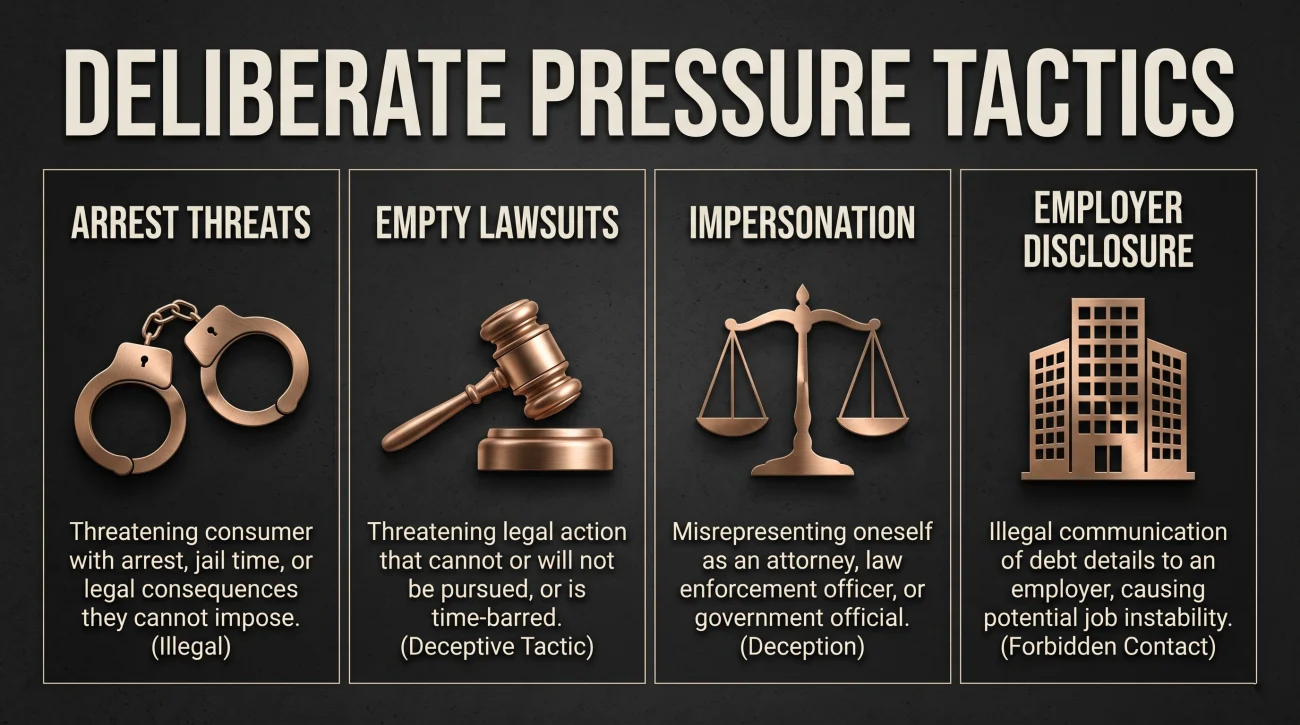
Threatening Arrest or Criminal Charges
You cannot be arrested for unpaid consumer debt in the United States. Civil debt like credit cards, medical bills, and personal loans exists in a completely different legal system than criminal law. Yet, threats of police involvement or jail time remain a remarkably common collection tactic.
This is a blatant FDCPA violation under Section 1692e(4). A legitimate collector knows they cannot have you arrested. When a collector makes this threat, they are deliberately weaponizing your fear. If you have been told you face jail time over an unpaid bill, you need to know exactly why this arrest threat is illegal and what it means for your case.
“In the lower-tier agencies I observed, managers knew arrest threats were illegal but sometimes looked the other way if an agent was closing accounts. The threat costs the agency nothing to make over the phone, and it triggers a panic response that often results in a credit card payment on the spot.”
Empty Lawsuit Threats
Collectors frequently threaten to file a lawsuit or take you to court. Threatening legal action is perfectly legal if the collector actually intends to sue you and has the legal standing to do so. However, threatening to sue when they have no intention of filing, or when the debt is past the statute of limitations, is a strict violation.
Agencies often use the word “court” to create artificial urgency on small balances they would never actually litigate. Understanding when a lawsuit threat is a bluff and when it is real requires looking at the balance size, the age of the account, and the type of agency contacting you. When the threat of a lawsuit is not enough, some agencies take the deception a step further by pretending the legal process has already started.
Impersonating Attorneys or Government Officials
A call claiming to be from the “pre-litigation department” or a letter printed on law firm letterhead creates instant intimidation. While there are legitimate debt collection law firms, the FDCPA strictly prohibits a collection agency from falsely representing that a communication is from an attorney when no lawyer has actually reviewed your file.
This “meaningless attorney letter” tactic was designed to scare consumers into thinking a lawsuit had already been initiated. If you are unsure who is actually contacting you, review what is and is not legal when a collector claims to be a lawyer. While fake attorneys leverage legal fear, other tactics rely purely on social shame.
Disclosing Debt to Your Employer or Family
A debt collector is generally only allowed to discuss your debt with you, your spouse, or your attorney. They are permitted to contact third parties once strictly to obtain your location information. They are absolutely forbidden from telling your boss, your coworkers, or your extended family that you owe money.
This violation is almost never an accident. Disclosing a debt to an employer creates immense social shame and professional panic. Collectors know that a consumer who is embarrassed at work will prioritize that payment above all else. If this has happened to you, it is one of the most actionable violations under the law. See what steps to take if a collector disclosed your debt to your employer.
Systemic Failures and Documentation Errors
Not all FDCPA violations are born from aggressive floor tactics. When I reviewed purchased portfolios at a national debt buyer, we rarely received original contracts. We received massive spreadsheets. That information gap creates the next major category of violations.
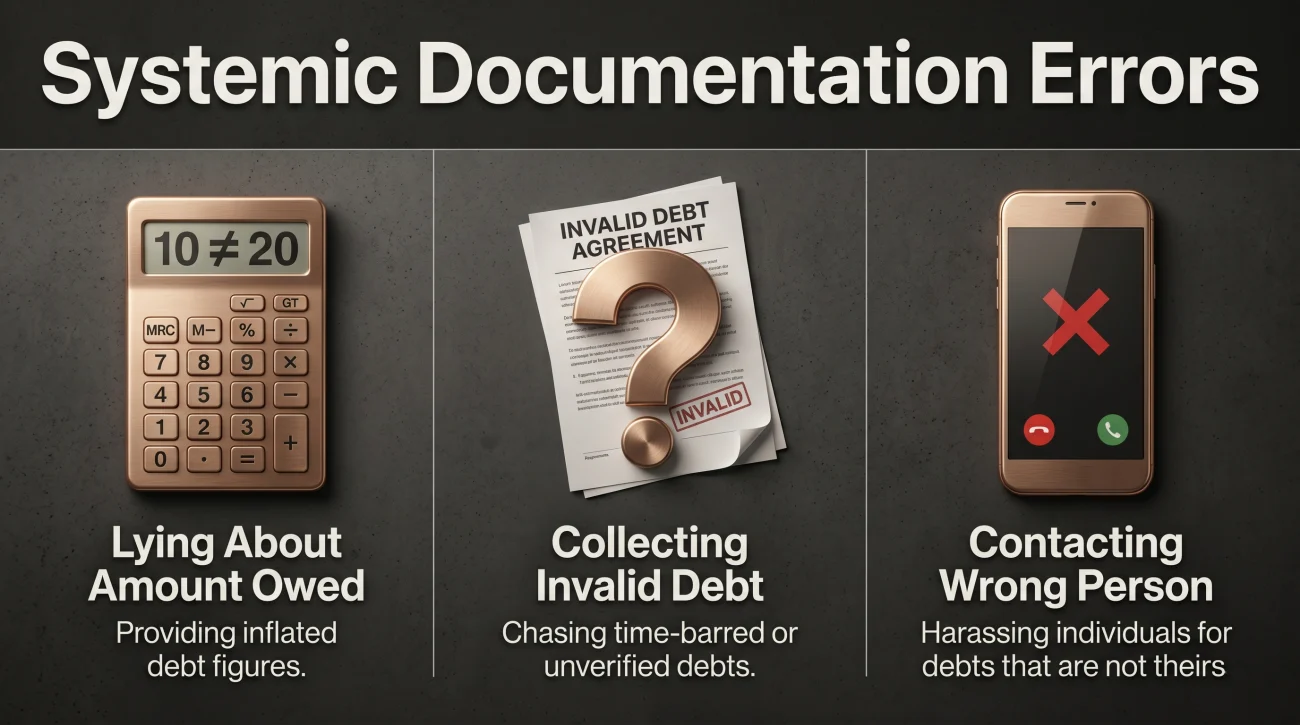
Lying About the Amount Owed
The FDCPA prohibits collectors from misrepresenting the character, amount, or legal status of any debt. Yet, consumers routinely receive collection notices demanding amounts that do not match their records.
I have seen countless accounts where a debt buyer receives nothing more than a final balance figure. They have no clear accounting of how interest and late fees were calculated by previous owners. If the collector is claiming you owe a different amount than your records show, they may be strictly liable for the misrepresentation.
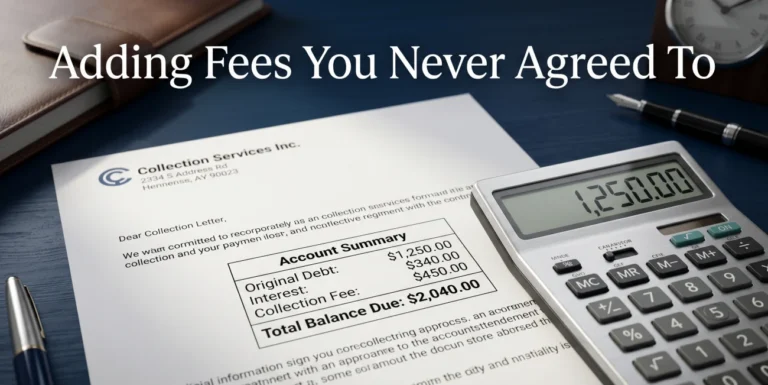
This issue frequently overlaps with unauthorized charges. If a collector tacks on collection fees or interest rates that were not permitted in your original creditor agreement, they cross the line. You have the right to challenge a collector adding fees you do not actually owe.
Collecting a Debt You Do Not Owe
Nearly half of all CFPB debt collection complaints involve consumers being pursued for debt they do not owe. This includes debts that were already paid, debts discharged in bankruptcy, or debts stemming from identity theft.
Attempting to collect an invalid debt is a severe violation. Because debt portfolios are rarely updated properly after they are sold, collectors frequently call on resolved accounts. The agent on the phone genuinely believes you owe the money because their screen says so. If you are caught in this loop, you need to understand the mechanics of how to stop collectors from pursuing debt that isn’t yours.
Contacting the Wrong Person
If you have repeatedly told an agency they have the wrong phone number but the calls continue, the agency is violating the law. In modern agencies, agents do not dial the phone manually. Auto-dialer software cycles through numbers endlessly. When you say “wrong number” and hang up, if the agent does not properly code that disposition in the system, the software simply dumps your number back into the queue for tomorrow.
This intersection of automated dialing and poor record-keeping creates massive FDCPA liability, and it often triggers violations of the Telephone Consumer Protection Act (TCPA) as well. You have specific tools available to force them to update their systems when a debt collector keeps calling the wrong person.
Compliance Avoidance Violations
The rules give consumers leverage, which is exactly why some collectors try to bypass them. When they intentionally ignore protective protocols, they hand you a clear procedural advantage.
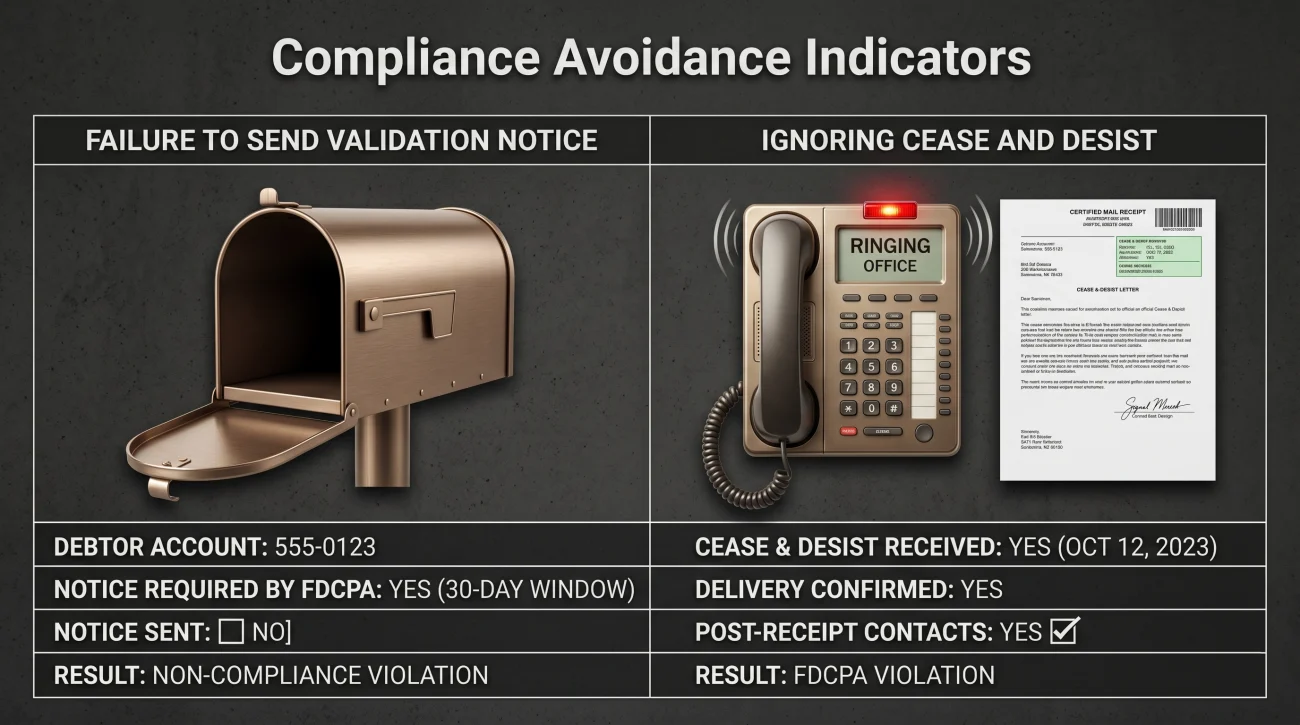
Failing to Send a Validation Notice
Within five days of their initial communication with you, a debt collector must send you a written validation notice detailing the debt and your dispute rights. Many collectors skip this step entirely.
I watched collectors actively avoid sending these notices because starting the 30-day dispute clock slowed down their commission cycle. Collectors with weak documentation prefer to secure a payment before you realize you have the right to ask for proof. If you never received a written validation notice, the collector has committed a documentable violation.
Ignoring a Cease and Desist Letter
When you send a written request for a collector to stop contacting you, they must comply. They are permitted one final communication to confirm they are stopping or to inform you of specific legal action. Any call, text, or letter demanding payment after that is an illegal contact.
Sometimes continued contact is a clerical error. The letter goes to a compliance desk and the floor manager never updates the active calling file. But often, it is a deliberate test to see if you actually know your rights and are willing to enforce them. The mechanics of how you send this letter determine your leverage. If you send it by email or fax, a collector facing a lawsuit will simply claim they never received it, or that it went to an unmonitored inbox. This is why the safest method by far is to send it via USPS Certified Mail with a Return Receipt. That green card with a signature proves exactly when the compliance clock started. Once they sign for it, the “clerical error” excuse loses its legal protection in court.
Key Point: Most consumers feel powerless when a cease and desist letter fails. The correct framing is the exact opposite. Once they receive your certified letter, every subsequent call they make is a documented federal offense.
If you are dealing with an agency that refuses to honor your written request, you need to understand exactly what each call after a cease and desist letter is now worth legally.
Signs You Are Actively Experiencing FDCPA Violations
It is easy to second-guess yourself when dealing with a professional debt collector. They sound authoritative and they act like their behavior is perfectly legal. However, the signs of an FDCPA violation are usually hidden in plain sight.
You might notice the collector pressing for an immediate payment over the phone before sending any written validation notice. They might refuse to break down a balance that seems inexplicably high compared to your last statement. If a caller implies law enforcement is involved, or if you find out they spoke to your manager at work, the legal line has been crossed completely. Even subtle patterns are actionable. Calls continuing days after your certified cease and desist letter was delivered, or automated systems repeatedly hitting your phone for someone else’s debt, are clear indicators that the agency is operating outside the law.
Recognizing these patterns is the critical first step. Deciding whether the contact you have been receiving crosses the line requires looking at your specific documentation and understanding your options for handling severe debt collector harassment.
What These Violations Are Actually Worth
An FDCPA violation is not just a customer service complaint. It is a federal offense that creates immediate financial liability for the collection agency and significant leverage for you.
Under the law, a successful FDCPA claim allows a consumer to recover up to $1,000 in statutory damages. More importantly, you can sue for actual damages. For instance, if a collector illegally discloses your debt to your employer and you are subsequently passed over for a promotion or terminated, your actual damages could encompass those lost wages. That transforms a standard statutory claim into a high-stakes liability for the agency.
This fee-shifting provision means you do not need to be wealthy to hold a collector accountable. Many consumer protection attorneys take strong FDCPA cases on contingency. They get paid by the collector when you win. If you have kept good call logs and saved your letters, exploring whether you can sue a debt collector at no out-of-pocket cost is a highly practical next step.
How to Document the Violations
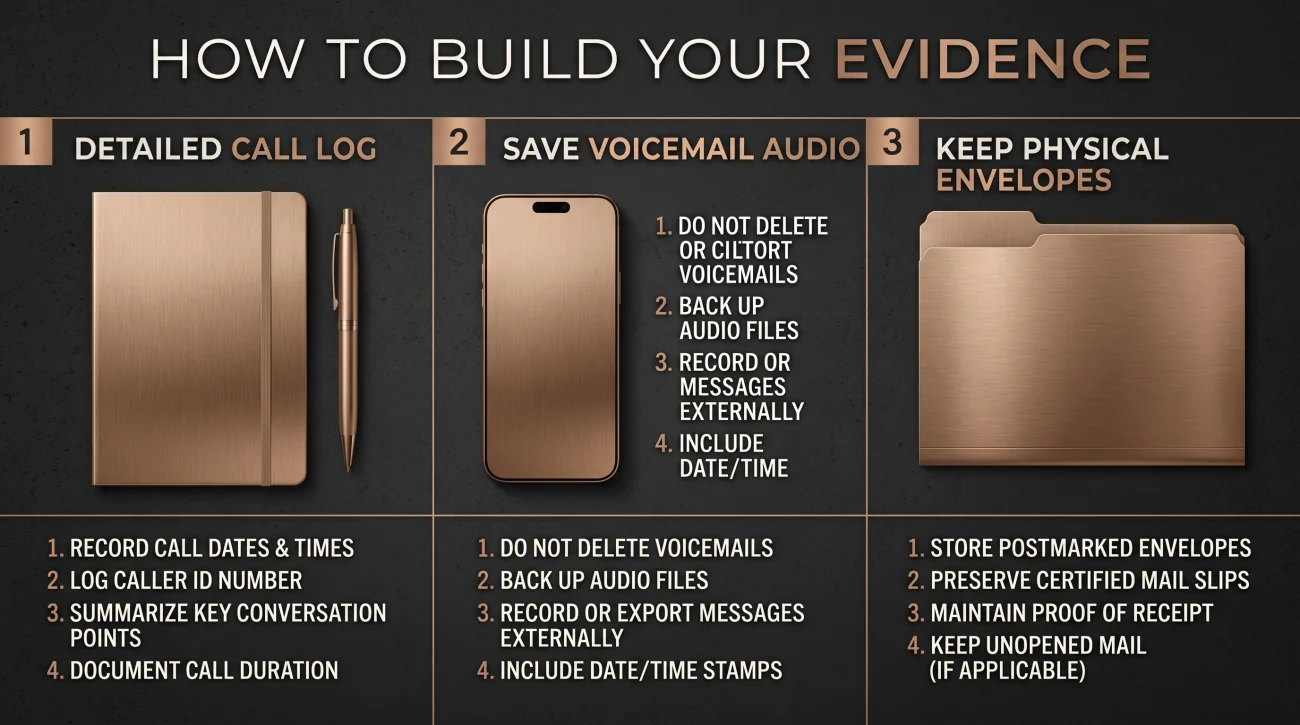
A violation only creates leverage if you can prove it happened. The biggest mistake consumers make is relying on their memory instead of building a paper trail.
Start a dedicated call log immediately. Write down the exact date, time, and duration of every incoming call. Note the phone number displayed on your caller ID and the name of the agent if they provide it. If they leave a voicemail, do not just leave it in your mailbox where it might be auto-deleted. Export the audio file to your computer or take a screen recording of it playing on your phone. If a collector mails you a letter, keep the physical envelope. The postmark date on the envelope is often the only way to prove a collector missed a critical legal deadline.
Reporting the Abuse
If you do not want to file a lawsuit right now, filing official complaints is the correct path. Regulatory bodies use consumer complaints to track systemic abuse and build enforcement actions against rogue agencies.
Log the violation + Submit agency complaint + Retain the record
Filing a complaint with the CFPB forces the collection agency to respond formally on the public record. While the CFPB will not act as your private attorney, generating this official documentation is highly valuable for building your case file. You can also file reports with the FTC and your state’s Attorney General. Understanding exactly how to report a debt collector and what each agency actually does ensures your effort produces a usable result.
Final Thoughts on Protecting Your Rights
Debt collectors break the law because the math usually works in their favor. The revenue generated by aggressive, non-compliant tactics often outweighs the occasional penalty paid to the few consumers who fight back.
You change that math the moment you document a violation. Recognizing illegal behavior removes the collector’s primary weapon which is your uncertainty. Documenting their missteps shifts the balance of power. Whether you use that leverage to negotiate a settlement, file an official claim, or defend yourself if they ultimately decide to file suit, knowing the rules is your best defense. If their tactics have already escalated into a formal summons, do not ignore it. You should consider having a professional evaluate your lawsuit defense strategy before the court deadline expires.
Deep Dive: Specific FDCPA Violations
To understand exactly how the law applies to the specific tactic being used against you, explore the detailed guides below. Each situation requires a different response strategy.
| Violation & Resource Guide | What You Need to Know |
|---|---|
| Debt Collector Threatened Arrest | Why collectors intentionally exploit the gap between civil and criminal law, and how to document this severe violation. |
| Debt Collector Threatening to Sue You | The insider calculus: how to tell the difference between a high-pressure bluff and a legitimate legal threat. |
| Debt Collector Claiming to Be an Attorney | Unpacking the meaningless attorney letter tactic and learning how to spot fake legal authority. |
| Debt Collector Claiming You Owe More Than You Do | Why balances are frequently wrong when debt is sold in bulk portfolios, and how to force an itemization. |
| Debt Collector Told Your Employer About Your Debt | The social pressure tactic of workplace disclosure, and the actual damages you can claim when it happens. |
| Debt Collector Has the Wrong Person | Why simply telling them wrong number rarely works, and the exact written steps to force them to update their files. |
| Debt Collector Never Sent Validation Notice | The strategic reason collectors deliberately skip your 5-day notice, and how this compliance failure gives you leverage. |
| Debt Collector Claiming You Owe Money You Don’t | The mechanics behind 45% of all CFPB complaints, and how to permanently stop collection on invalid accounts. |
| Debt Collector Still Calling After Your Cease and Desist Letter | Why you should stop feeling powerless: every call after your certified letter arrives is a documented federal offense. |
| Can You Sue a Debt Collector? | How the FDCPA fee-shifting provision allows you to hire a consumer protection attorney on contingency. |
| How to Report a Debt Collector | Which regulatory agency does what, and how filing a CFPB complaint builds your documentary paper trail. |
| Debt Collector Adding Fees You Don’t Owe | Identifying unauthorized collection fees and using the collector’s documentation gap against them. |
❓ FAQ
📊 Does filing a CFPB complaint actually do anything?
Yes. While the CFPB will not represent you in court, the complaint forces the agency to answer on the record within 15 days. This provides excellent documentation if you later decide to hire an attorney.
🏛️ Can a collector still sue me if they violated my rights?
Yes, violating your rights does not automatically erase the underlying debt. However, you can use their FDCPA violations as a counterclaim in court, which often forces them to negotiate or drop the suit.
🎙️ How do I prove what they said on the phone if it wasn’t recorded?
Your contemporaneous notes are legal evidence. A detailed call log showing the exact date, time, duration, and a summary of the threat made during the call holds significant weight in an FDCPA claim.
🌍 What if the collector is calling from an overseas call center?
If they are collecting debt from a consumer residing in the United States, they must still comply with the FDCPA regardless of where their call center is physically located.
The full FDCPA framework and the four areas where it matters most.
- Your legal rights when collectors call, write, or threaten to sue
- When they can call, what they cannot say, and how to make it stop
- How to identify FDCPA violations and what you can do with them
- Why the age of a debt determines what a collector can legally do
- Your right to demand proof before paying or acknowledging anything
Harassment is one thing. Lawsuits, garnishments, and frozen accounts are another.
- When collector behavior crosses the line the FDCPA was written to prevent
- What to do if a collector files suit after their calls have not worked
- What collectors can do to your wages once a judgment is entered
- How a bank levy works and which funds the law protects from seizure
- How to resolve the debt that collectors have been calling about
Disclosure: The content on this site reflects direct experience inside the debt collection industry and is grounded in federal law and regulation. It is informational in nature. Reading it does not constitute legal advice and does not create any professional relationship. If you are dealing with a lawsuit, a judgment, or a legal deadline, consult a licensed attorney in your state before acting.