- Telling an agent they have the wrong number usually fails because automated dialing systems do not update across the entire collection floor based on one conversation.
- Consumer protection rules prohibit agencies from repeatedly calling your number once you have clearly stated you are not the debtor.
- To stop the calls, you need to transition from verbal requests to a formal written notice that bypasses the calling agents and goes directly to compliance.
- Never provide your Social Security number or detailed financial information just to prove you are not the person they are looking for.
- If contact continues after your notice is received, you have documented proof of harassment that can be used to pursue financial penalties against the agency.
Why “Wrong Number” Is Not Enough to Stop the Calls
You told them they have the wrong person. You explained that you just got this phone number, or that you have never heard of the individual they are asking for. The agent apologized and hung up. Then, two days later, a different agent from the exact same company called asking for the exact same person. You told them again. And they called again.
If you are stuck in this loop, you are experiencing one of the most frustrating failures in the debt collection industry. Having a debt collector calling the wrong person repeatedly is not just annoying. When it crosses a certain line, it becomes actionable harassment.
During my 12 years working inside third-party collection agencies and a national debt buyer, I watched this exact scenario play out thousands of times. Most consumers assume that when they tell a collector “wrong number,” the company simply deletes the number from their system. That is not how bulk debt collection operates. To make the calls stop, you have to understand why the agents keep dialing and the specific step that forces their system to drop your phone number for good.
Recognizing When Mistaken Identity Becomes Harassment
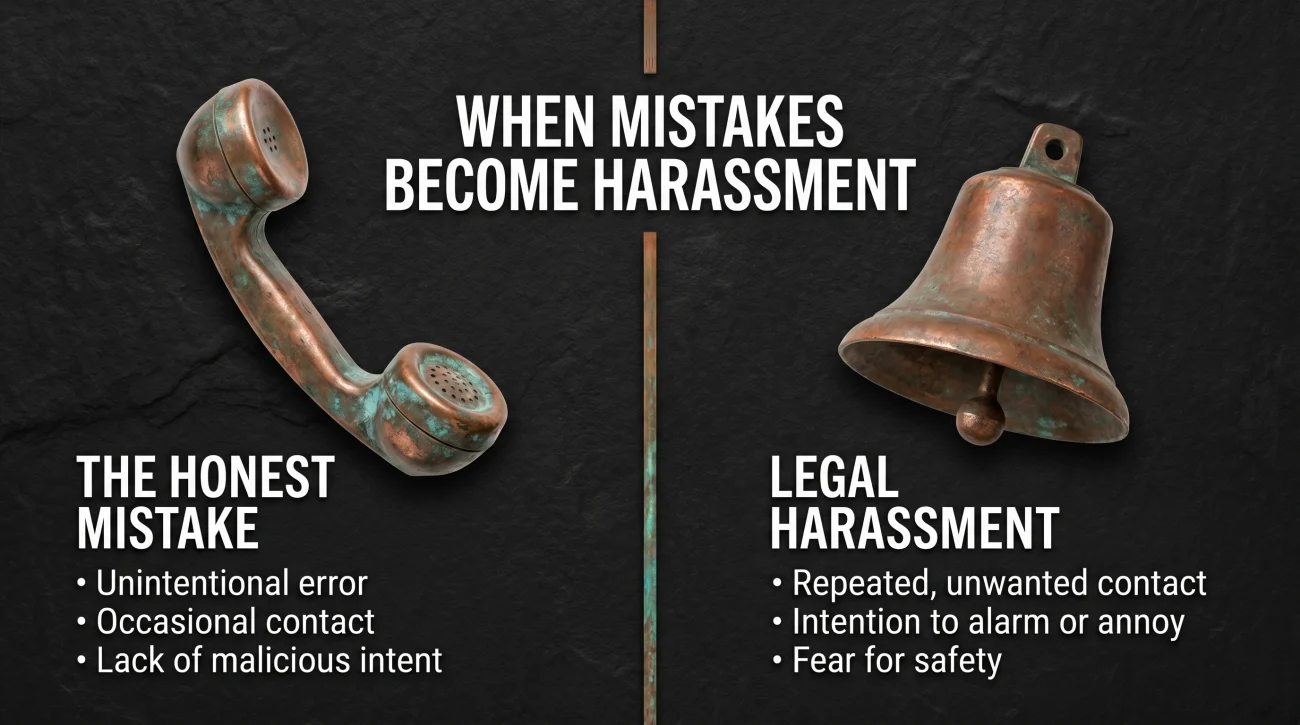
There is a difference between a collector making an honest dialing mistake and an agency running a sloppy operation that ignores consumer notifications. You need to identify exactly which situation you are dealing with before taking action.
When an agency buys a massive portfolio of old accounts, the data is often degraded. The first call you receive is usually just a symptom of bad data. The fifth call is a choice. Here are the clear signs that the wrong-person contact you are experiencing has moved past a simple administrative error:
- You inherited a recycled phone number: You recently got a new mobile number, but the debt belongs to the previous owner. The agency’s automated dialer does not know the number changed hands, and agents often assume you are the debtor lying to avoid them.
- The debt involves an unfamiliar account type: They are demanding payment for a specific store credit card or an auto loan from a state you have never lived in, proving their skip-tracing database has merged your profile with someone else’s.
- They are calling at extreme hours: You are receiving automated robocalls early in the morning or late at night looking for the wrong person, combining mistaken identity with timing violations.
- The calls resumed after a formal notification: You already sent them written notification that you are not the person they are looking for, but the calls started up again. This indicates systemic non-compliance.
When you hit these markers, the frustration is entirely justified. If the contact is disrupting your life, you need to assess your options. You can learn more about how to evaluate these boundaries by reviewing your options regarding what to do if a collector is harassing you.
The Insider Reality: Why They Keep Calling After You Say Stop
The most common question people ask in this situation is simple. Why won’t they just listen? The answer comes down to how collection floor technology works and the default assumptions collectors are trained to make.
When a debt is purchased in bulk, it arrives as a row on a massive spreadsheet. A software system called a predictive dialer loads these phone numbers and dials them automatically. When you answer, the call is instantly routed to the headset of whichever agent happens to be available. That agent has about two seconds to read the screen before speaking to you.
When I was auditing collection calls, I saw the exact breakdown constantly. A consumer would tell Agent A they had the wrong number. Agent A, trying to keep their call times low, would click a generic “No Contact” disposition code instead of the specific “Wrong Party” code. Three days later, the dialer would automatically route that same number to Agent B, who had no idea the previous conversation ever happened.
This technological disconnect is the primary reason the calls persist. But there is a secondary, more cynical reason. Collectors are trained to assume that people lie to avoid paying debts. From the collector’s perspective, claiming “you have the wrong person” is one of the oldest evasion tactics in the book. If they have a skip-tracing report that links your phone number to the debtor’s name, agents are often instructed to push past the first denial until they can verify the data is wrong. Your verbal word is rarely considered enough proof to override their database.
What the Rules Require When They Have the Wrong Person
While the collector’s technology and training explain the behavior, consumer protection rules govern whether that behavior is acceptable. The framework that protects you dictates exactly how collectors must behave, and you can read the full overview of how it works in our guide to debt collection law explained.
Under these rules, a debt collector is allowed to contact third parties (people who do not owe the debt) for one specific purpose. They can call to acquire location information about the actual debtor. This means they can ask if you know the person or have their current address.
However, the moment you clearly inform them that you are not the person they are looking for and have no information regarding their whereabouts, their reason for calling your number disappears. They are not granted an unlimited grace period to fix their database. Unfortunately, because verbal notifications are difficult to prove, consumers often struggle to enforce this right over the phone.
When the rules are not enough to stop an agent on the phone, you have to force their system to recognize your request. This requires changing the way you communicate with them entirely.
The Definitive Fix: How to Stop the Calls Properly
If answering the phone and explaining the mistake is not working, you must move the communication from verbal to written. Agencies prioritize written documentation because it creates a hard paper trail. When the mailroom receives your formal letter, it typically bypasses the floor agents and goes straight to a compliance officer or account manager who will manually delete your number from the dialer.
Here is the exact process you need to follow to make this effective.
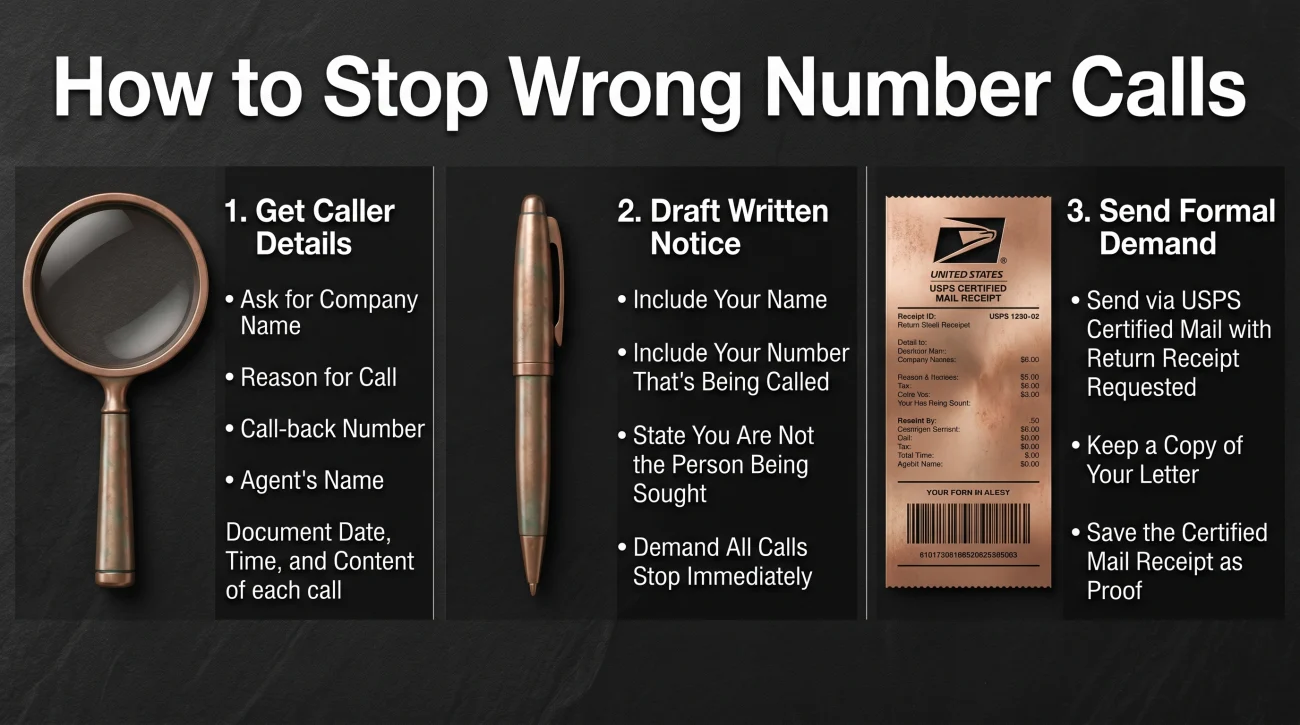
Step 1: Gather the Minimum Required Information
To send a letter, you need to know exactly who is calling you. The next time they call, stay calm and collect the necessary details.
Ask for the company name + Ask for their mailing address + Ask for the account reference number
If they refuse to provide a mailing address or a company name, note that refusal. Legitimate debt collectors must identify themselves. If they will not, you may be dealing with a scam rather than a standard collection agency.
Step 2: Draft the Notice of Mistaken Identity
Your letter does not need to be written in dense legal jargon. It needs to be clear, factual, and absolute. You are stating that you are not the debtor, that they have the wrong contact information, and that all communication must cease.
Sample Wrong Person Notice
[Your Name]
[Your Phone Number]
[Date]
[Collection Agency Name]
[Agency Address]
Re: Account or Reference Number: [Insert Number if known]
To Whom It May Concern,
I am writing in response to phone calls I am receiving from your company at [Your Phone Number]. Your representatives are asking for a person named [Name of Person They Ask For].
I am not this person. I have no relation to this person. I do not owe the debt you are attempting to collect, and I have no information regarding the location of the person you are looking for.
Because you are contacting the wrong individual, I am formally requesting that you immediately remove my phone number from your dialing system and cease all further communication with me. Any further contact after your receipt of this letter will be considered harassment.
Sincerely,
[Your Signature]
[Your Printed Name]
Step 3: Send via Certified Mail
This is the step where most consumers fail. You must send this letter via USPS Certified Mail with a Return Receipt requested. This provides you with a tracking number and a physical signature card proving exactly what day the agency received your notice. Keep a photocopy of the signed letter and attach your tracking receipt to it. This folder becomes your insurance policy. If they call you again, this piece of paper is exactly what turns their phone call into actionable harassment.
Common Mistakes That Keep You on the Call List
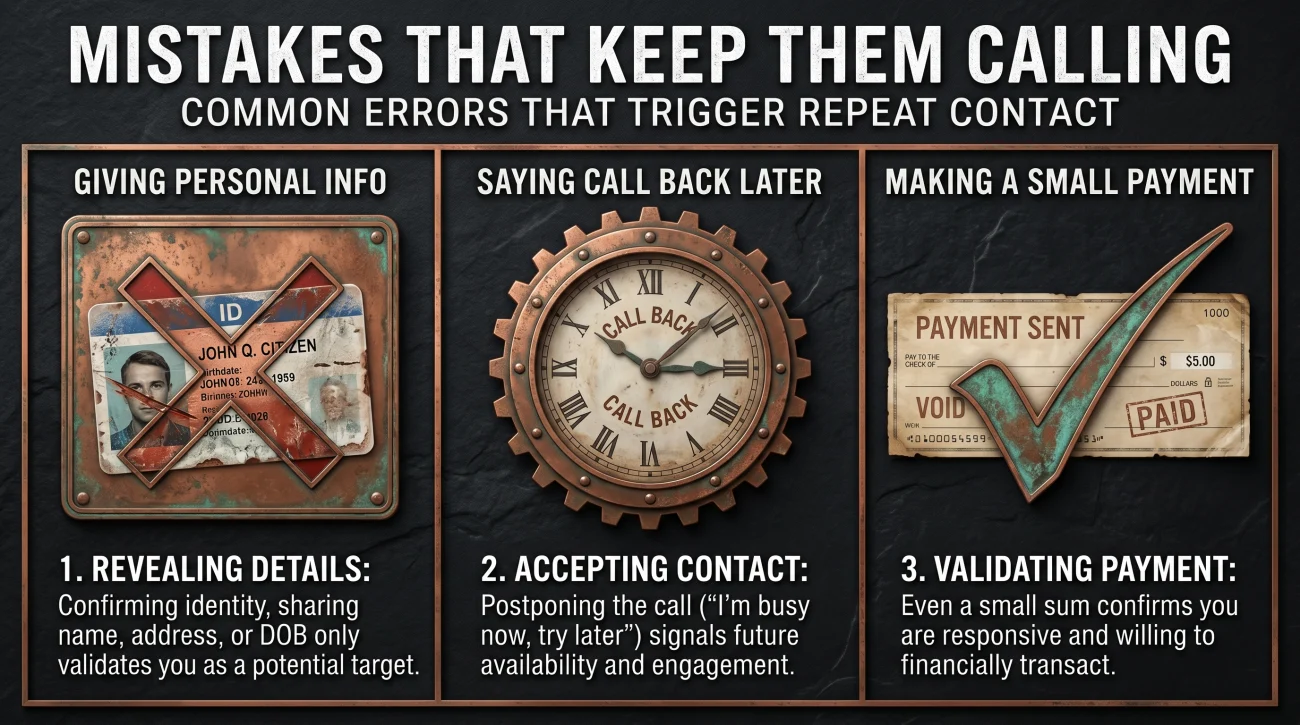
When consumers are frustrated by mistaken identity calls, they often say or do things that accidentally make the situation worse. Collectors are trained to listen for specific phrases that justify keeping a number active.
The collector asks for the last four digits of your Social Security number or your date of birth to “verify you are not the debtor.” You provide it, thinking this will clear up the mistake. Now a strange company you do not owe money to has your sensitive personal data.
You state clearly: “I am not the person you are looking for, and I will not provide my personal information to a company I do not do business with. Remove this number.”
Another major mistake is being vague in your language. If a collector asks for “John,” and you say “John isn’t here right now,” the agent logs that John lives there but is unavailable. The dialer will call back tomorrow. If you say “I’ll think about it and call you back,” the agent logs that they have the right person and you are stalling. You must use absolute terms. “There is no John here. You have the wrong number.”
⚠️ Warning: Never make a “make it go away” payment. Sometimes collectors will claim a debt is very small and consumers will pay it just to stop the harassment. Paying a debt that is not yours can be interpreted as acknowledging the debt, completely ruining your leverage to dispute it later.
When Continued Calls Become Legal Leverage
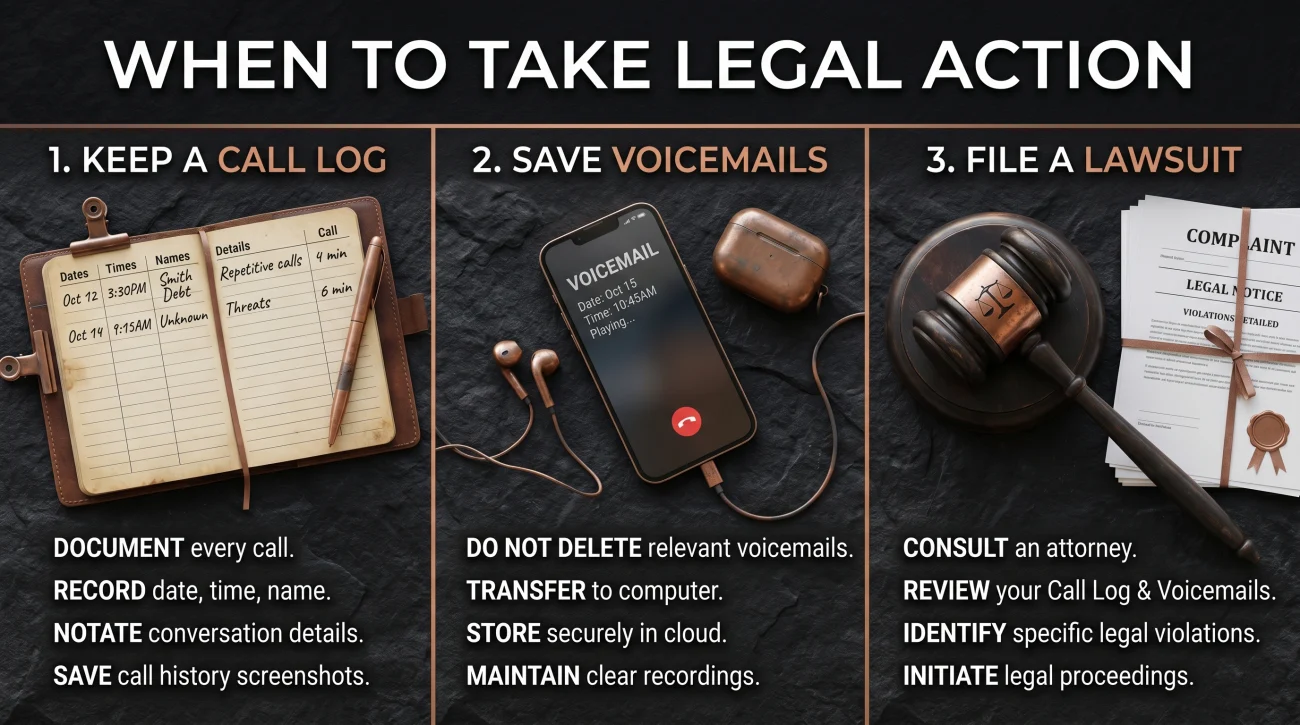
If you have sent the notice, received the return receipt, and the calls are still coming, the dynamic has completely changed. You are no longer just a frustrated consumer. You are now a consumer with documented violations.
Every single call they make to you after receiving your formal notice that they have the wrong person is a separate violation. A pattern of these calls demonstrates willful non-compliance. This is where the rules give you real teeth.
You need to start a call log immediately. Every time the phone rings, write down the date, the exact time, the phone number they used, and the name of the caller if they provide it. If they leave voicemails, save the audio files. Having this proof on record is what forces agencies to take your complaint seriously.
Consumer protection rules provide for financial penalties for these kinds of actions. Many attorneys handle these cases at no upfront cost to you. You can explore exactly how this process works in our guide on how to sue collection agency operators who break the rules. For a broader look at the various ways agencies cross the line, review our breakdown of common illegal debt collection practices.
Mistaken Identity vs. Disputing Your Own Debt
It is very important to draw a clear line between the situation described in this article and a completely different scenario that requires a different response.
This article is specifically for people who are entirely disconnected from the debt. The collector has the wrong phone number, the wrong name, or is looking for a previous tenant. You are not the debtor.
If the collector is actually looking for you, using your correct name, but you believe the debt is invalid, already paid, or fraudulent, that is a different process. You are the correct person, but you are dealing with a wrong debt. In that situation, simply telling them to stop calling is not enough. You must use the formal validation process to challenge the account. You can find the exact steps for that scenario in our guide on dealing with a collection agency wrong debt situation.
Additionally, if a collector reached out to you but failed to provide the required written details about the account in their initial communications, they have committed an entirely different compliance failure. You can learn how to handle that specific gap by reading about the debt collector no validation notice sent scenario.
Final Thoughts: Taking Control of the Situation
The most important takeaway when a collector repeatedly asks for the wrong person is that your phone line is not their administrative testing ground. You do not have to tolerate ongoing interruptions just because their skip-tracing database is outdated.
Stop relying on phone conversations to fix their internal data errors. By formalizing your boundary with a mailed notice, you shift the burden entirely onto them. They must correct their system, and if they fail to do so, they hand you the exact documentation you need to hold them accountable.
❓ FAQ
📞 Can a debt collector call me for someone else’s debt?
They can call you once to ask if you know how to locate the actual debtor. They cannot discuss the debt with you, and they cannot continue calling you if you tell them you do not know the person or ask them to stop.
📝 What if the debt collector has the wrong name but my right number?
This usually means your phone number previously belonged to the debtor. Tell the collector verbally that they have the wrong person. If they call back, send a written notice by certified mail demanding they remove your number.
🚫 Can a collection agency call my family looking for the wrong person?
If their database incorrectly links your family members to the debtor, they might. Your family members should firmly state that the person does not live there and demand the calls stop. Continued third-party calls are not permitted.
🏦 What do I do if someone else’s debt is on my credit report?
This is a serious data error. You must file a formal dispute directly with the three major credit bureaus (Equifax, Experian, TransUnion) stating the account does not belong to you. Do not just argue with the collection agency.
⚖️ Can I pursue legal action against a debt collector who thinks I’m someone else?
Yes, if you have documented proof that you informed them they had the wrong person (ideally in writing) and they continued to contact you anyway. This gives you documented grounds to escalate your complaint.
The full FDCPA framework and the four areas where it matters most.
- Your legal rights when collectors call, write, or threaten to sue
- When they can call, what they cannot say, and how to make it stop
- How to identify FDCPA violations and what you can do with them
- Why the age of a debt determines what a collector can legally do
- Your right to demand proof before paying or acknowledging anything
Harassment is one thing. Lawsuits, garnishments, and frozen accounts are another.
- When collector behavior crosses the line the FDCPA was written to prevent
- What to do if a collector files suit after their calls have not worked
- What collectors can do to your wages once a judgment is entered
- How a bank levy works and which funds the law protects from seizure
- How to resolve the debt that collectors have been calling about
Disclosure: The content on this site reflects direct experience inside the debt collection industry and is grounded in federal law and regulation. It is informational in nature. Reading it does not constitute legal advice and does not create any professional relationship. If you are dealing with a lawsuit, a judgment, or a legal deadline, consult a licensed attorney in your state before acting.