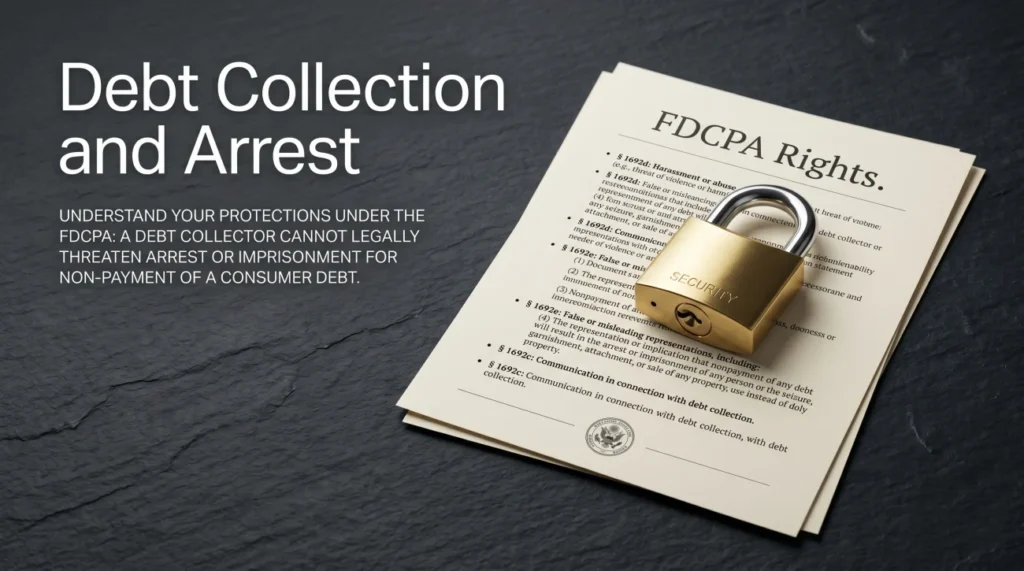
- You cannot be sent to jail for failing to pay a civil consumer debt like a credit card or medical bill.
- Threatening criminal charges is an explicit violation of the Fair Debt Collection Practices Act (FDCPA).
- Legitimate agencies rarely make this threat. If you hear it, you are likely dealing with a scam or a rogue debt buyer.
- This specific threat is a documentable federal violation that consumer protection attorneys can use to hold the agency financially accountable.
The Calculated Strategy Behind the Fear
A voice on the phone just told you that if you do not make a payment by the end of the day, law enforcement will be dispatched to your home or workplace to arrest you. Your heart rate spiked. Your stomach dropped. You immediately started calculating how you could scrape the money together to make them stop.
That physical reaction of absolute panic is exactly what the caller wanted. It is the entire point of the script.
From my years working inside the debt collection industry, I can tell you that the fear of losing your freedom is one of the most powerful psychological triggers a human being has. Collectors know this. They also know that the average person has no idea where the line between the civil court system and the criminal justice system is drawn. They exploit that gap intentionally.
If you are reading this because you just got off a terrifying phone call, take a deep breath. You are not going to jail over an unpaid credit card. What you actually experienced was a severe, documentable violation of federal law. Here is exactly why they said it, how the law protects you, and what you need to do next to hold them accountable.
The Reality: Civil Debt vs. Criminal Law
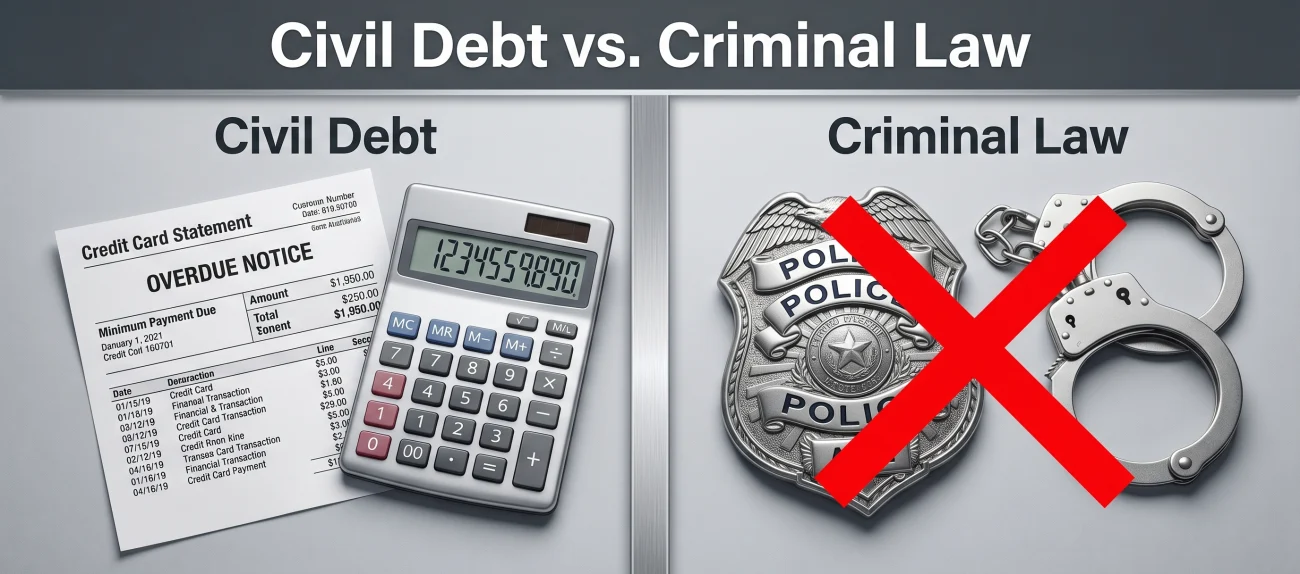
To dismantle the threat, you have to understand why it is fundamentally false. The United States abolished debtors’ prisons in the 1830s. Unpaid consumer debts (including credit cards, medical bills, payday loans, and personal loans) are strictly civil matters.
In the civil legal system, the worst thing a creditor can do is file a lawsuit against you to obtain a financial judgment. A civil judge cannot sentence you to prison for lacking the funds to pay a bank. The police do not enforce civil debt collection. A county sheriff will not show up at your door with handcuffs because your account was charged off.
There is only one extremely narrow scenario where unpaid debt and the threat of jail intersect, and it happens long after a lawsuit. If a collector successfully sues you, wins a judgment, and the judge issues a formal court order demanding you appear in court for a review of your assets, ignoring that direct order from the judge can lead to contempt of court. A warrant in that scenario is issued for ignoring the judge, not for the debt itself.
But a debt collector on the phone has zero authority to issue warrants, dispatch police, or press criminal charges. Even though their threat is entirely fabricated, you cannot simply ignore it. You need to use their lie against them.
The FDCPA: Why This Threat is Never Legal
Because the threat of jail is so highly coercive, federal regulators drew a hard line against it decades ago. This is not a grey area subject to interpretation.
Under Section 1692e(4) of the Fair Debt Collection Practices Act, a debt collector is explicitly prohibited from representing or implying that nonpayment of any debt will result in your arrest or imprisonment. Furthermore, Section 1692e(5) prohibits threatening to take any action that cannot legally be taken or that is not intended to be taken.
This means that when you are evaluating the foundational rules of debt collection laws, the arrest threat is universally recognized as illegal. There is no innocent context for it. A collector cannot claim they misspoke or were just trying to express urgency. It is a deliberate violation.
Scam vs. Rogue Agent: Who is Actually Calling You?
If threatening arrest is blatantly illegal, why did it just happen to you? To understand who is actually on the other end of the line, you have to know how real agencies operate.
“During my time managing a collections floor, the rule was absolute: if an agent even hinted at police or jail on a call, they were fired and walked out of the building that same day. Legitimate collection agencies carry massive compliance insurance. They know an arrest threat is a guaranteed FDCPA lawsuit they will lose.”
Because licensed agencies avoid this tactic entirely, receiving an arrest threat almost always points to one of two scenarios:
- 📌 Scenario A: The Phantom Debt Scam. This accounts for the vast majority of arrest threats. You are receiving a call from an offshore boiler room or an unregulated domestic operation. They have purchased stolen data or breached loan applications. They threaten to send the local authorities if you do not wire money or buy gift cards immediately. They do not care about the FDCPA because they are already committing extortion.
- 📌 Scenario B: The Rogue Debt Buyer. Occasionally, you will deal with a bottom-tier debt buyer operating in the shadows of the domestic industry. They buy uncollectible zombie debt for less than a penny on the dollar. They employ aggressive agents on high commissions who go off-script, hoping you will panic and pay via debit card before anyone audits their call logs.
If the caller claims to be an attorney or a law enforcement officer preparing to serve a warrant, they are stacking violations. You can read more about how to identify the line where a debt collector impersonates legal authority to see exactly how these specific scripts operate.
How to Handle the Call While It Is Happening
I have listened to hundreds of these recorded calls, and the pattern is always the same: they want you reacting, not thinking. If you are on the phone when the threat is made, your only goal is to gather information without giving any in return. Do not argue about whether they can actually arrest you. Do not try to educate them on the law.
Use this exact approach:
The Information Gathering Script:
“I need the legal name of your company, your company’s physical mailing address, and your direct extension. Send all claims and debt validation notices to me in writing. Do not call this number again.”
What happens next will tell you everything. A legitimate debt collector is required by law to provide their company name. If they refuse, hang up. If they become aggressive, start yelling, or double down on the police threat, do not match their energy. Simply end the call. You have already triggered their script to fail.
Turning Fear Into Leverage: After You Hang Up
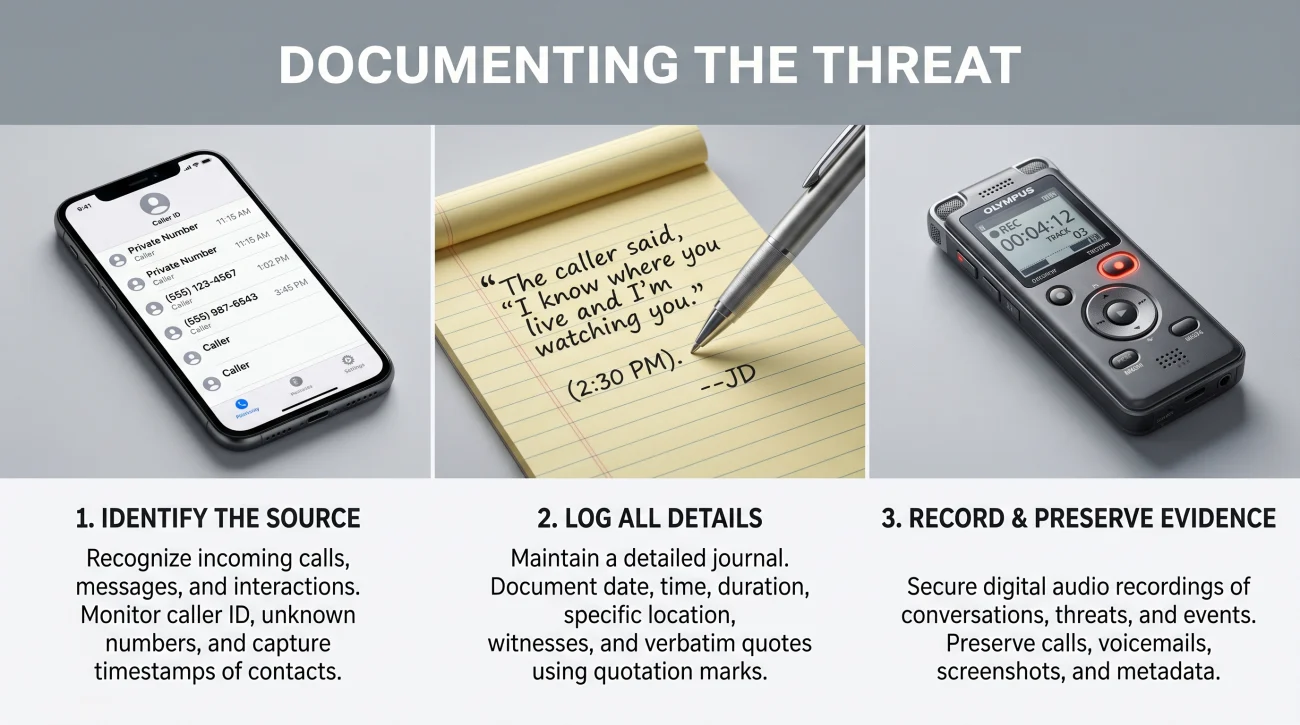
The moment you hang up the phone, the dynamic shifts. They have handed you a federal case, but a case requires evidence. You must document the interaction immediately while the details are fresh.
The Documentation Formula: Identify the Caller + Log the Threat + Preserve the Evidence
Create a log immediately. Write down the exact date and time of the call. Record the phone number that appeared on your caller ID. Write down the name the caller used and the company they claimed to represent.
Most importantly, write down the exact phrasing of the threat. Did they say “the police are coming”? Did they say “we are filing charges for theft by deception”? Quote them as accurately as possible.
💡 Pro Tip: If they left the arrest threat on your voicemail, save the audio file. Email it to yourself to create a timestamped backup. A recorded voicemail of a collector threatening jail is the holy grail of FDCPA evidence because it eliminates the “he-said, she-said” defense the agency might try to use.
What Happens With a Documented FDCPA Violation?
When reviewing case files with legal teams, an arrest threat is the exact type of violation that changes the entire trajectory of an account. When you have a documented threat from a verifiable collection agency, you are no longer just a debtor. You are a plaintiff.
Under the law, a successful FDCPA claim can result in statutory damages of up to $1,000 per lawsuit, plus compensation for any actual damages or emotional distress you suffered.
More importantly, the FDCPA includes a fee-shifting provision. This means that if you win your case against the collection agency, the agency is required to pay your attorney’s fees. Because of this rule, many consumer protection attorneys will take strong FDCPA cases on contingency, meaning you pay nothing out of pocket. To understand how accessible this process is, review our breakdown on how FDCPA lawsuits work in practice.
If you actually owe the underlying debt, the threat of an FDCPA countersuit is often used by attorneys to negotiate the complete cancellation of that debt in a settlement. The illegal tactic they used to scare you becomes the exact tool used to erase the balance.
Recognizing the Line Between Aggressive and Illegal
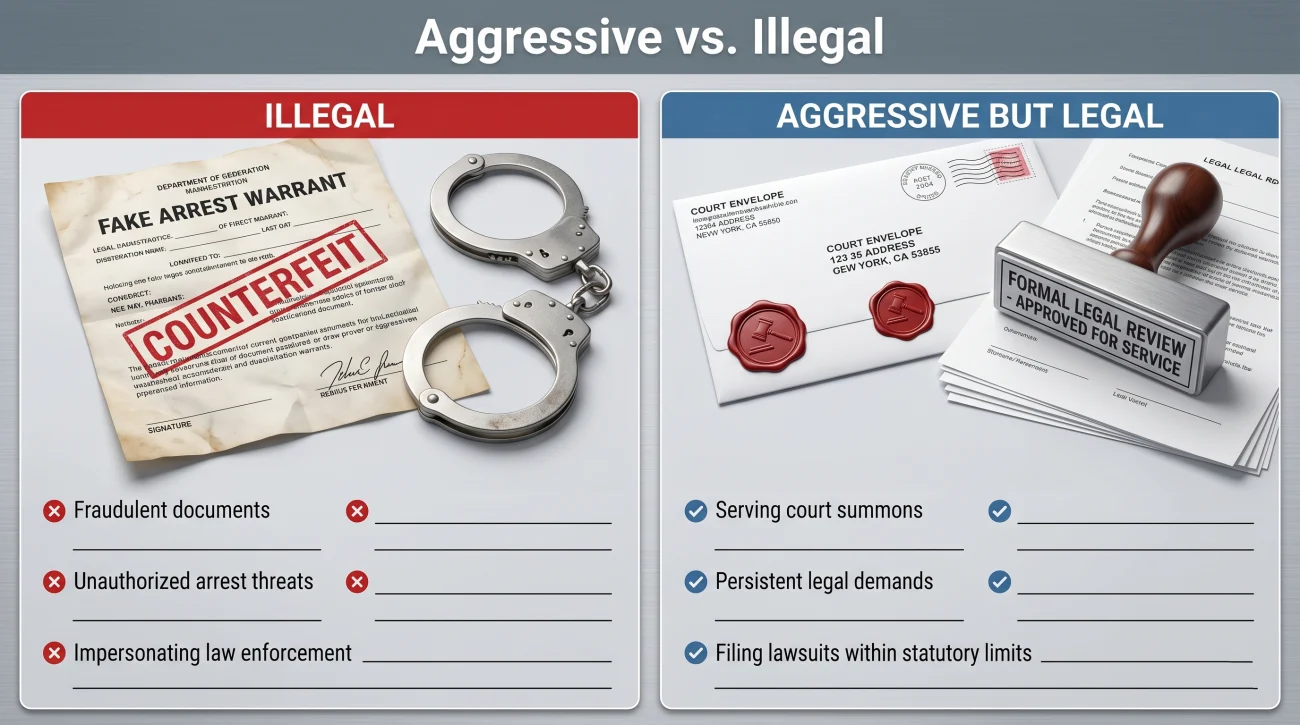
Collectors often try to walk up to the edge of the line without crossing it by using vague language. However, the courts look at how a typical consumer would interpret the call. If any of the following happened to you, the line was clearly crossed:
The Illegal Tactics:
- The caller explicitly stated that local police or the sheriff would be dispatched to your home or work.
- The caller used criminal terminology, claiming you are facing charges for fraud or theft by deception regarding a standard consumer loan.
- The caller claimed they were calling from a pre-trial intervention unit or a county processing division.
- The caller stated that your driver’s license would be suspended if you did not pay.
The Legal (But Aggressive) Tactics:
- The collector states they will review your account for further action.
- The collector states they will forward your file to their legal department.
- The collector states they may file a civil lawsuit in county court (if they actually intend to do so).
If you recognize the illegal tactics from a recent phone call, you are dealing with behavior that requires intervention. Your next step is evaluating your options against illegal collector harassment with a professional who understands the leverage you now hold.
Final Thoughts: The Mindset Shift You Need
The most important shift you can make right now is how you view that phone call. Ten minutes ago, an arrest threat felt like a massive financial emergency. Now, you should recognize it for what it actually is: a catastrophic strategic error by the debt collector.
They played their ultimate scare card, assuming you would not know the law. By documenting that threat instead of paying out of panic, you stop being their target and become their legal liability. You hold the leverage now. Keep your records meticulous, refuse to engage with their intimidation, and use their own compliance failure to resolve your account on your terms. When you are ready to use that leverage, have an attorney who litigates FDCPA claims evaluate the evidence you just gathered.
❓ FAQ
👮♂️ Can a debt collector actually send the police to my house?
No. Debt collectors are private citizens working for private companies. They have no authority over law enforcement, and the police do not arrest people for unpaid civil consumer debts.
⚖️ Can I go to jail if the debt collector sues me and wins?
No. If a collector sues you and wins, they get a civil judgment, which allows them to pursue wage garnishment or bank levies. You do not go to jail for losing a civil lawsuit about a debt.
🏛️ What if the collector says I committed fraud by taking out a loan I couldn’t pay?
This is a common scare tactic. Inability to repay a loan due to financial hardship is not criminal fraud. The collector is using threatening legal buzzwords to scare you into making a payment.
🎙️ What should I do if they leave a voicemail threatening arrest?
Save the voicemail immediately. Back it up by emailing it to yourself or recording it on another device. A recorded threat of arrest is incredibly strong evidence of an FDCPA violation.
🛑 How do I make these threatening calls stop right now?
Do not engage with the threat. Tell them you refuse to pay, demand their physical mailing address, and state clearly that they are to cease all phone communications immediately. Then, hang up.
🕵️♀️ How do I know if the caller is a scammer or a real collection agency?
Scammers typically demand immediate payment via wire transfer, prepaid debit cards, or cryptocurrency, and refuse to send written validation through the mail. Legitimate agencies have standard payment portals and mailing addresses.
📝 What if the debt involves a bounced check?
While knowingly passing a bad check can involve different legal frameworks, third-party debt collectors are still strictly bound by the FDCPA. They cannot independently threaten you with jail time or criminal prosecution as a tactic to force payment on a collection account.
💸 Can I sue the collection agency for threatening me with jail?
Yes. If the caller represents a legitimate, verifiable collection agency operating within the US, you can sue them under the FDCPA for statutory damages, actual damages, and your attorney’s fees.
The full FDCPA framework and the four areas where it matters most.
- Your legal rights when collectors call, write, or threaten to sue
- When they can call, what they cannot say, and how to make it stop
- How to identify FDCPA violations and what you can do with them
- Why the age of a debt determines what a collector can legally do
- Your right to demand proof before paying or acknowledging anything
Harassment is one thing. Lawsuits, garnishments, and frozen accounts are another.
- When collector behavior crosses the line the FDCPA was written to prevent
- What to do if a collector files suit after their calls have not worked
- What collectors can do to your wages once a judgment is entered
- How a bank levy works and which funds the law protects from seizure
- How to resolve the debt that collectors have been calling about
Disclosure: The content on this site reflects direct experience inside the debt collection industry and is grounded in federal law and regulation. It is informational in nature. Reading it does not constitute legal advice and does not create any professional relationship. If you are dealing with a lawsuit, a judgment, or a legal deadline, consult a licensed attorney in your state before acting.