
- Ignoring a court summons from a debt collector is the worst possible move. Over 70 percent of these cases end in a default judgment, giving the collector the power to garnish your wages or freeze your bank account without further warning.
- Filing an answer to the lawsuit changes the entire dynamic. It forces the debt buyer to actually prove they own the debt and have the legal right to sue you, which they often cannot do.
- You do not always have to pay out of pocket for a debt collection lawsuit attorney. Many consumer protection lawyers offer free consultations and work on contingency if the collector violated your rights under the FDCPA.
The Envelope on the Counter
The envelope sat on your kitchen counter for two days before you finally opened it. You saw the return address, you felt the weight of the paper, and you knew it was not a standard collection letter. Inside is a formal summons. A debt collector has filed a lawsuit against you, and there is a strict deadline stamped across the top of the page.
If you are reading this, you are likely feeling a mix of panic, frustration, and confusion. Most people do exactly the wrong thing at this point. They either let the panic take over and agree to pay whatever the collector demands just to make the court threat go away, or they ignore the envelope entirely, hoping the problem will resolve itself.
Neither of those approaches works. When a debt collector files a lawsuit, the rules of engagement change entirely. The phone calls and letters were attempts to get you to pay voluntarily. A lawsuit is an attempt to force you to pay through the power of the court system.
I spent over a decade working inside third-party collection agencies and a national debt buyer. I have seen thousands of these files pushed across the desk to the legal department. Understanding how a debt collector decides who to sue, and what they expect you to do next, is the key to protecting yourself. You need to know what is actually at stake, what your options are, and when you absolutely need a debt lawsuit attorney to step in.
The Reality of the Default Judgment Trap
The single biggest mistake consumers make when they are sued by a debt collector is assuming that going to court is the only outcome. They picture a judge, a jury, and a dramatic legal battle. Because they cannot afford a long court fight, they do nothing. They fail to respond to the summons before the deadline.
This is exactly what the debt collection agency is counting on.
“From where I sat in the agency, we knew the statistics. We fully expected the vast majority of consumers to ignore the summons. When they did, our attorneys would simply ask the judge for a default judgment. We won automatically, not because our documentation was perfect, but because the consumer never showed up to challenge it.”
Over 70 percent of debt collection lawsuits end in a default judgment. A default judgment is a court order stating that you owe the money simply because you failed to file a formal legal response. Once a collector has a default judgment, they stop asking nicely.
With that piece of paper, a debt collector can typically take aggressive actions that were previously illegal. They can instruct your employer to garnish your wages, taking a percentage of your paycheck before you ever see it. They can place a levy on your bank account, freezing your available funds. They can even place a lien on your property.
⚠️ Warning: The clock starts ticking the moment you are legally served with the summons. Depending on your jurisdiction, you usually have between 14 and 30 days to file a formal written response with the court. A phone call to the collection agency does not count as a legal response.
What a Summons Actually Means (From the Collector’s Side)
It helps to understand the mechanics behind the lawsuit. A debt collector suing you is not a random event. Lawsuits cost money. The agency has to pay court filing fees, process servers, and attorneys. They do not spend that money unless they believe they will get a return on their investment.
When a file gets moved to the legal department, it usually fits a specific pattern. The balance is high enough to justify the court costs. The statute of limitations has not yet expired. And most importantly, the agency believes you have the ability to pay, either through steady employment that can be garnished or assets that can be levied.
But here is the secret most people do not realize: filing a lawsuit does not mean the debt buyer actually has all the proof required to win in a contested trial.
Debt buyers purchase portfolios containing thousands of defaulted accounts for pennies on the dollar. They receive a massive spreadsheet with names, addresses, and balances. They rarely receive the original signed contracts, the complete account statements, or the proper chain of custody documents proving they have the legal right to collect that specific debt from you.
They file the lawsuit anyway, assuming you will not challenge them. While you are panicking, their legal team is simply watching the calendar, waiting to see if you become a default statistic or a contested file. Filing a formal answer is how you call their bluff.
What Filing an Answer Actually Does
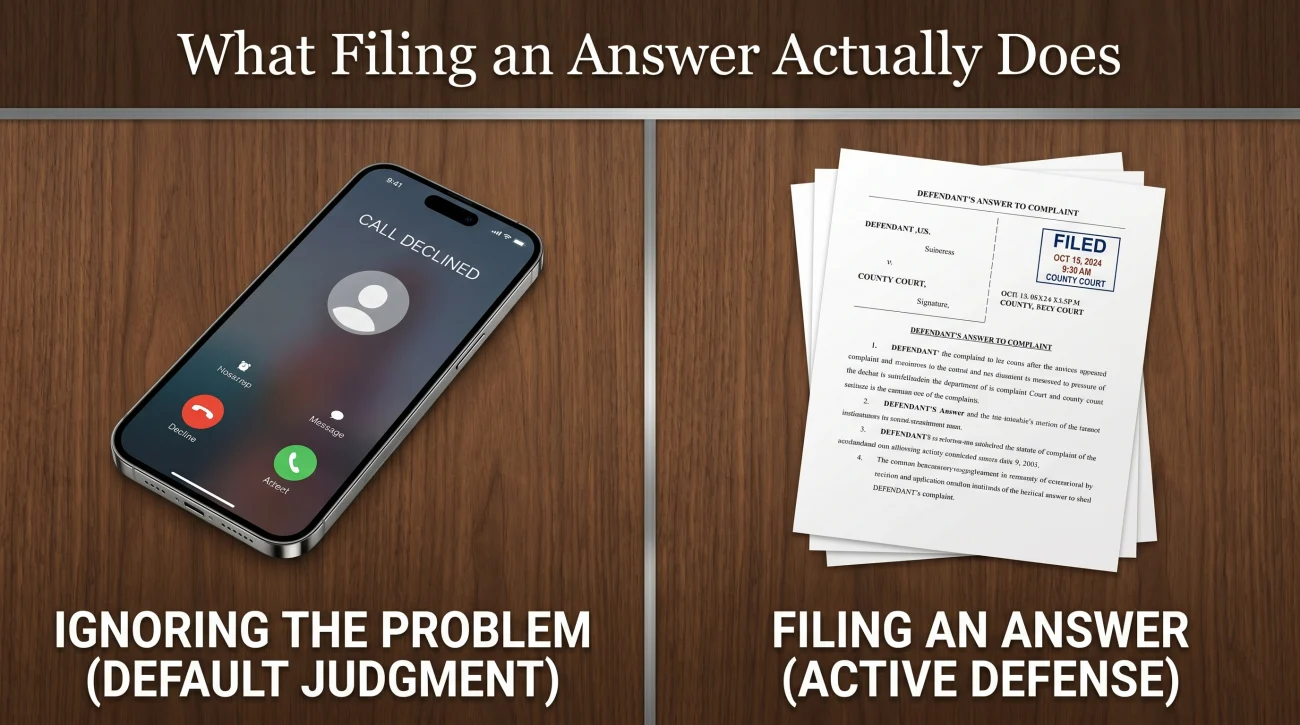
To prevent a default judgment, you must file a document with the court typically called an “Answer.” This is not a letter explaining why you fell behind on payments or asking for sympathy. It is a structured legal document that responds to every single claim the collector made in their complaint.
Filing an answer does not mean you are admitting you owe the debt. In fact, if you admit to the debt in your answer, you have just handed the collector a victory.
Instead, filing an answer forces the burden of proof back onto the collector. It signals to their legal team that you are not going to be an easy target. When an answer is filed, the collector’s attorneys suddenly have to review the file. They have to see if they actually have the original credit card agreement. They have to see if they can prove how the balance was calculated.
Calling the collection agency’s lawyer to argue about the balance over the phone after receiving a summons. This changes nothing in the court record and does not pause your deadline.
Ensuring a legally formatted Answer is filed directly with the court clerk before the deadline, forcing the plaintiff to prove their legal standing.
However, crafting that response correctly is a minefield. Asserting the right affirmative defenses, such as the statute of limitations or a lack of legal standing, requires a precise understanding of the law. If you use the wrong terminology or fail to raise a defense in your initial answer, you may lose the right to use it later.
When Self-Representation Fails (And When It Doesn’t)
You may be wondering if you can just handle this yourself. The internet is full of templates and automated services like SoloSuit offering to help you generate your own court response. While these DIY tools exist, using them without understanding your specific legal leverage is a massive gamble.
An automated PDF might prevent an immediate default judgment, but it cannot negotiate a settlement, it cannot demand discovery documents from the plaintiff, and it cannot counter-sue for consumer rights violations.
Self-representation is generally only viable in highly specific, low-risk situations. If you are dealing with a very small balance where the cost of an attorney exceeds the debt itself, and there are absolutely no complexities regarding the age of the debt, you might consider handling it alone.
But the vast majority of collection lawsuits involve junk debt buyers and missing documentation. In these scenarios, trying to act as your own debt collection defense lawyer usually ends poorly.
| Situation | DIY Risk Level | Why Professional Help is Critical |
|---|---|---|
| The debt has been sold multiple times | Extremely High | Requires aggressively challenging the “chain of title” and objecting to hearsay evidence during the formal discovery process. |
| The collector harassed you before filing suit | High | You may have a valid counterclaim under the FDCPA that could offset the debt or turn the case against the collector entirely. |
| The debt is several years old | High | Determining the exact statute of limitations requires analyzing your state’s laws, the choice-of-law provision in the original contract, and the exact date of last activity. |
| A default judgment has already been entered | Critical | You must file a complex motion to vacate the judgment based on lack of proper service or excusable neglect, which automated tools cannot handle. |
What a Debt Collection Lawsuit Attorney Actually Does
When self-representation fails to provide real protection, a professional defense changes the math completely. A credit card debt lawsuit lawyer does far more than just fill out paperwork.
From an insider’s perspective, collection agencies do not want to litigate against experienced consumer protection attorneys. It ruins the economics of the file. An attorney will demand a formal discovery process, forcing the agency to dig up original documents they likely do not have. Suddenly, a file they expected to win by default becomes incredibly expensive to pursue.
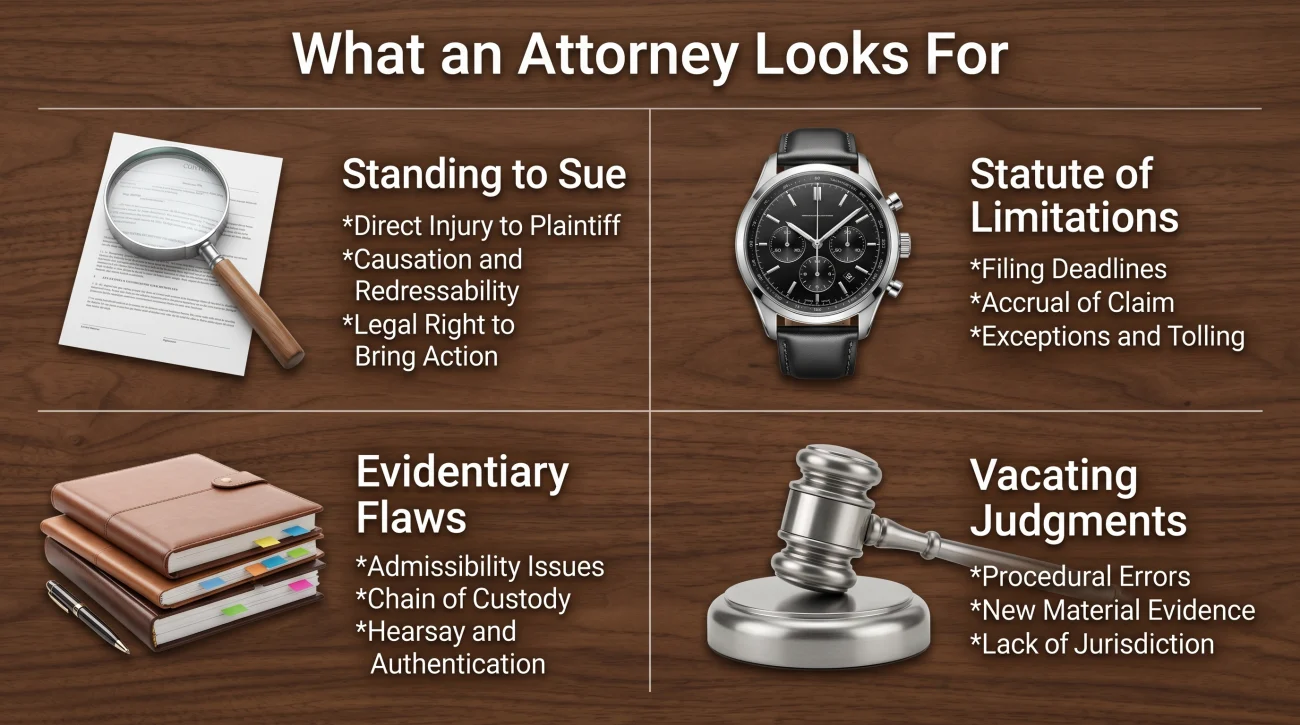
Here is what an attorney actually looks for when they review your summons:
- Standing to Sue: They will scrutinize the chain of title. If a major debt buyer is suing you, can they produce the exact bill of sale connecting your specific account from the original bank to them? Often, they cannot.
- Statute of Limitations: They will audit the timeline. Collectors frequently try to sue on time-barred debt, hoping you won’t realize the legal window to sue has already closed.
- Evidentiary Flaws: They will demand the original contract and proper account statements. A single spreadsheet line is not sufficient legal evidence, and an attorney knows exactly how to file motions to strike insufficient proof.
- Vacating Judgments: If you were never properly served and already have a default judgment against you, an attorney knows how to file motions to vacate that judgment and stop active wage garnishments.
I remember reviewing a file where the consumer responded through a local defense attorney. The attorney demanded the complete chain of custody for a five-year-old credit card debt. We only had a spreadsheet line, not the specific bill of sale. Our legal department dropped the lawsuit the next day because the cost to procure those documents far exceeded the value of the debt.
The FDCPA Counterclaim: When the Tables Turn
This is the angle most debt collectors do not want to face. A skilled attorney will review how you were treated before the lawsuit was filed. Did the collector call your employer? Did they threaten you with arrest? Did they fail to send a mandatory validation notice?
If the collector violated the Fair Debt Collection Practices Act, your attorney can file a counterclaim against them. Instead of you defending yourself against a debt, the collector is suddenly defending themselves against federal law violations. In many cases, asserting valid FDCPA counterclaims forces the debt buyer to drop the lawsuit entirely or settle for a tiny fraction of the original balance.
If you are planning to speak with an attorney, gather your evidence to bring to the consultation. Do not use this to argue with the collector yourself. Create a simple folder containing:
1. The summons and complaint, including the envelope it arrived in (the postmark date is vital).
2. Any previous letters received from this specific collector.
3. Your own notes or call logs regarding any telephone conversations you had with them.
The Cost Question: How Do I Pay for a Lawyer?
The number one reason people do not seek out a debt lawsuit attorney near me is the fear of legal fees. It is a logical concern. If you are being sued because you cannot afford a debt, how can you afford a lawyer?
This is a misconception that debt collectors rely on. In the world of consumer defense, the fee structures are designed differently than traditional corporate law.
Many attorneys who specialize in defending debt collection lawsuits offer a free initial consultation. During this consultation, they will review your summons, look at the plaintiff, and tell you if there are obvious flaws in the collector’s case.
If you choose to hire them, they often work on flat fees rather than unpredictable hourly billing. More importantly, if they identify that the collection agency violated your rights under the FDCPA, they may take your case on contingency. Under federal law, if a debt collector is found guilty of an FDCPA violation, the collector is required to pay your attorney’s fees.
From the agency side, we knew this rule perfectly well. If a defense attorney found a valid FDCPA violation in our call logs, our cost of collection just skyrocketed because we would be on the hook for the consumer’s legal bills. This is exactly why those cases often ended in rapid settlements.
💡 Pro Tip: Never assume you cannot afford legal help until you actually have a case evaluation. The cost of ignoring the lawsuit and suffering a default judgment, resulting in garnished wages and frozen bank accounts, is always vastly higher than the cost of exploring your legal options.
Final Thoughts: The Clock Is Ticking
When a debt collector filed a lawsuit against you, they made a calculated bet. They bet that the confusing legal language, the tight deadlines, and the intimidation factor of the court system would force you into submission. They pushed the file forward hoping you would not fight back.
You have the power to prove them wrong, but you do not have unlimited time. The deadline printed on your summons is hard and fast. If you miss it, your options evaporate.
The specific vulnerabilities in the collector’s file against you, and the true cost required to settle it, are not things you can discover by reading articles online. Every debt buyer operates differently, and every lawsuit has unique blind spots.
You need a professional to look at your specific summons and tell you exactly where you stand before your window to respond closes entirely.
[Click Here to Get a Free Consultation with a Debt Defense Attorney and Find Out if Your Case Can Be Dismissed]
❓ FAQ
⏳ How long do I have to respond after a debt collector sues me?
The timeline varies strictly by state and the type of court where the lawsuit was filed. It typically ranges from 14 to 30 days from the exact date you were officially served with the paperwork. Missing this deadline almost guarantees a default judgment.
📞 Can I just call the collection agency to get the lawsuit dismissed?
No. Once a summons is filed, a phone call does not stop the legal process or extend your deadline to answer. If you negotiate a settlement over the phone but fail to file a formal legal response, the collector can still ask the court for a default judgment behind your back.
🗑️ How do you get a debt lawsuit dismissed?
Dismissals usually occur when an attorney proves the collector lacks the legal standing to sue, the statute of limitations has expired, or the collector failed to follow proper legal procedures. You must formally raise these issues in your filed Answer.
🛑 What happens if I just ignore the court summons?
If you do nothing, the collector will request a default judgment from the judge. Once granted, they can legally garnish your wages, place a levy on your bank accounts, or put a lien on your property without asking for your permission.
⚖️ Do I definitely need a lawyer for a debt lawsuit?
While you have the right to represent yourself, it is highly risky unless the debt is extremely small and straightforward. If the debt was bought by a third-party agency, is old, or is for a significant amount, professional legal evaluation is crucial to finding hidden defenses.
Four areas of the collection process. Start wherever your situation applies.
Some situations have deadlines attached. These pages are written for those situations.
- When collector behavior crosses the line the FDCPA was written to prevent
- What to do if a collector files suit after their calls have not worked
- What collectors can do to your wages once a judgment is entered
- How a bank levy works and which funds the law protects from seizure
- How to resolve the debt that collectors have been calling about
Disclosure: The content on this site reflects direct experience inside the debt collection industry and is grounded in federal law and regulation. It is informational in nature. Reading it does not constitute legal advice and does not create any professional relationship. If you are dealing with a lawsuit, a judgment, or a legal deadline, consult a licensed attorney in your state before acting.