
- There is no single “debt relief” program. There are seven distinct paths, and choosing the wrong one can cost you thousands of dollars or force you into bankruptcy unnecessarily.
- Your options are dictated by a four-question math test: your current payment status, your budget surplus, your credit score, and your total debt amount.
- If you are still current on payments with a score above 680, a balance transfer or consolidation loan is usually the mathematical best move.
- If you are behind on payments and cannot afford minimums, debt settlement or nonprofit credit counseling are your primary structured options.
- Never enroll secured debts, like auto loans or mortgages, into standard unsecured debt relief programs. The creditor can simply repossess the collateral.
The Illusion of a Single Solution
When you are drowning in minimum payments, the internet wants to sell you a single, magical off-ramp. You see ads promising to cut your balances in half, consolidate your bills into one tiny payment, or wipe the slate clean completely. After spending twelve years inside the debt collection industry, working for third-party agencies and a national debt buyer, I can tell you exactly how those promises look from the inside.
There is no one-size-fits-all debt relief. There are at least seven meaningfully different paths to get out of debt. Each path requires a different financial starting line, produces a wildly different outcome, and leaves a completely different mark on your credit report.
Most people fail at debt relief because they choose a strategy that does not match their actual financial reality. They attempt a DIY snowball method when they have zero budget surplus. They apply for a consolidation loan after their credit score has already crashed. They enroll in an aggressive debt settlement program when a simple nonprofit management plan would have saved their credit. Choosing the right path is a matter of ruthless, objective math. Let us look at how you actually evaluate your options before you make a move.
What Collectors Know About You Before They Call
Before we dive into the solutions, you need to understand how the other side views your situation. When my agency bought a portfolio of defaulted credit card accounts, our analysts already knew which path a consumer was likely to take based purely on their credit profile. We did not call blindly.
“When we reviewed files at the collection agency, the first thing we looked at was recent payment history on other accounts. If a consumer was defaulting on us but paying their auto loan and a small credit card perfectly on time, we knew they had cash flow. We just needed to pressure them enough to redirect that cash flow to us. Your cash flow dictates your leverage.”
Creditors regularly run soft inquiries on your credit report. They can see if you are opening new lines of credit, maxing out existing cards, or paying other lenders while ignoring them. Because they have this visibility, your negotiation strategy or relief program choice must match your actual financial footprint. You cannot convincingly claim you have absolutely no money to settle a debt if your credit report shows you just originated a new auto loan.
The Four-Question Baseline Test
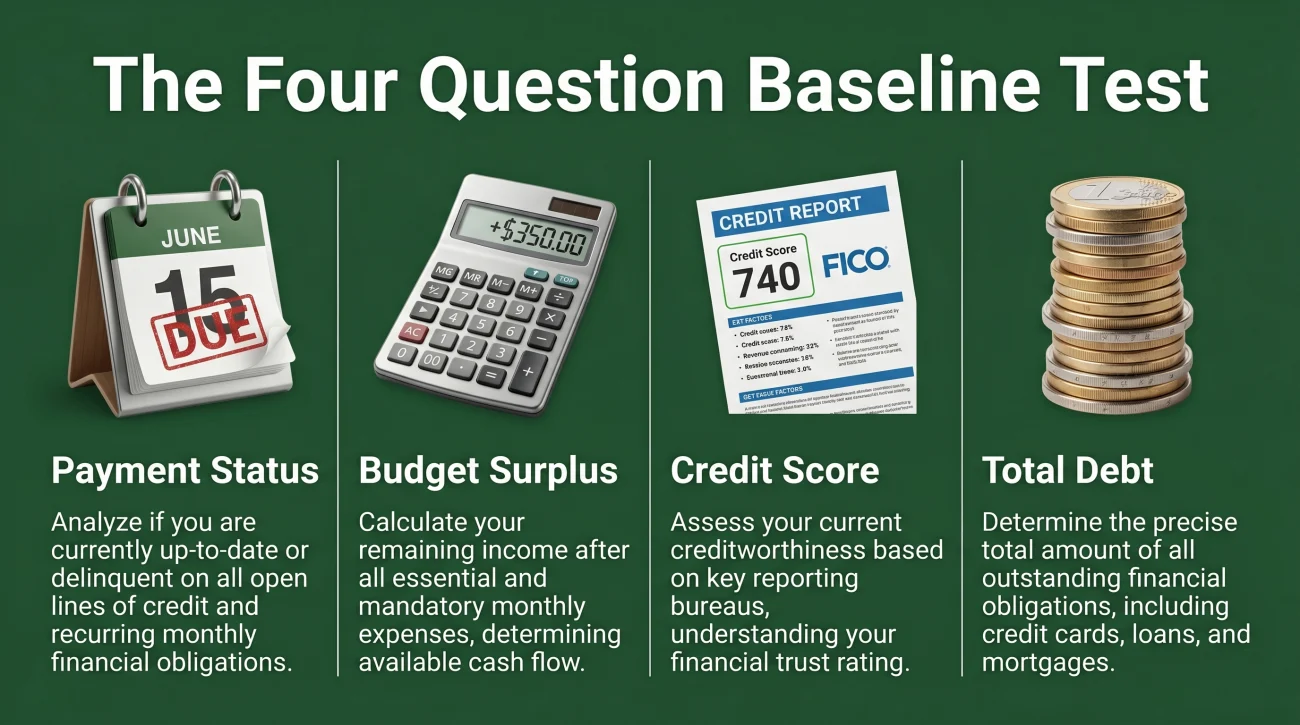
Before you look at any specific program or loan, you need to establish your baseline. Collectors and lenders use a rigid set of data points to determine what you qualify for. You need to look at your own finances the exact same way. Grab your recent statements and answer these four honest questions.
- 📌 Are you still current on your payments, or are you already behind? If you have not missed a payment, you have access to credit-based options. Once you are 60 to 90 days past due, the doors to new loans slam shut.
- 📌 Can you afford any monthly payment at all? Calculate your take-home pay minus your absolute survival expenses like rent, utilities, and groceries. If the remaining number is zero or negative, you cannot afford a loan or a repayment plan.
- 📌 Is your credit score still above 650? This is the practical cutoff line in the modern lending environment. Above 650, you might qualify for consolidation. Below 650, the interest rates you will be offered are often worse than your current credit cards.
- 📌 Is your total unsecured debt below or above $10,000? Most professional relief programs will not take clients with less than $7,500 to $10,000 in debt because the economics of the program do not work for small balances.
The Scenario-Based Decision Tree: Where Do You Fit?
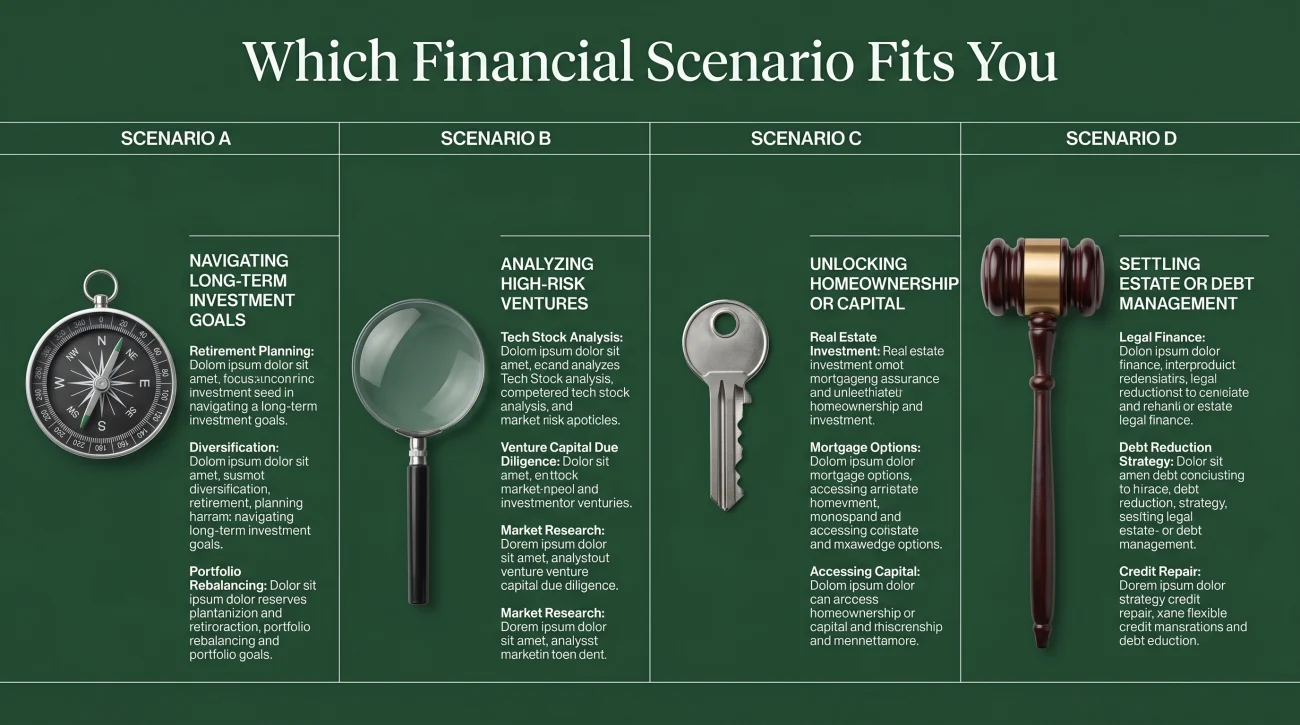
At the agency, we did not waste time guessing. We dropped every consumer into one of four buckets based on the exact variables you just answered above. Your financial footprint dictates your leverage. Instead of reading about paths you do not qualify for, find your exact scenario below and jump straight to the solution that actually applies to you.
- Scenario A: The High-Credit Bleed. You are current on payments, have a monthly budget surplus, and your credit score is still above 680. You are paying too much interest but you have leverage. Start with Path 2 (Balance Transfer) or Path 3 (Consolidation). You are a prime candidate to lower your interest rate without damaging your credit.
- Scenario B: The Breaking Point. You are current but struggling, you have almost zero surplus, and your credit score is dropping but still intact. You are one unexpected bill away from default. Evaluate Path 4 (Credit Counseling/DMP) or Path 1 (DIY Snowball). You need a structured intervention before you miss a payment.
- Scenario C: The Default Zone. You are already behind on payments, have no surplus, your score is below 650, and you owe over $10,000. Lenders will not give you new money. Look immediately at Path 5 (Direct Negotiation) or Path 6 (Debt Settlement). You are in settlement territory and need to start cutting principal.
- Scenario D: The Legal Threat. You are facing active lawsuits, frozen bank accounts, or wage garnishment. You simply cannot survive the current collection demands. Read Path 7 (Bankruptcy) immediately. You need the hard stop of federal legal protection.
Path 1: DIY Payoff Strategies (Snowball and Avalanche)

The most heavily promoted personal finance advice usually centers around doing it yourself. You list out your debts, pay the minimums on all of them, and attack one specific account with every extra dollar you can find. The two main variations are the debt snowball and the debt avalanche.
To succeed here, you must be current on your payments and your total debt is usually under $15,000. Most importantly, you must have a consistent monthly budget surplus. If you are scraping by with zero dollars left before the next paycheck, DIY payoff strategies are mathematically impossible to execute.
How the Math and the Psychology Work
The avalanche method tells you to attack the debt with the highest interest rate first. This saves you the maximum amount of money over the life of your repayment. The snowball method tells you to attack the smallest balance first, regardless of the interest rate. Once that small debt is gone, you roll that payment into the next smallest debt.
You target a $12,000 credit card at 24% APR while ignoring three smaller $500 medical bills. Eight months later, the $12,000 balance has barely moved, you feel defeated, and you quit the strategy entirely.
You knock out the three $500 medical bills in four months. You get the psychological win of seeing accounts close. You take that freed-up cash and attack the large credit card with renewed energy.
In practice, human behavior matters more than spreadsheet optimization. If you have the discipline and the surplus cash, this path has zero negative impact on your credit score. If you want a deeper dive into the numbers behind these two methods, you can review our full breakdown on evaluating the snowball versus avalanche strategies.
Path 2: The Balance Transfer Strategy
If your credit score is strong but your interest rates are suffocating you, a balance transfer card can act as a temporary freeze on the bleeding. You open a new credit card that offers a 0% introductory annual percentage rate for a set period, usually 12 to 21 months. You move your high-interest debt onto this new card, allowing 100% of your payments to attack the principal balance.
Inside the industry, we call 0% intro offers “rope”. Credit card companies hand you enough rope hoping you trip over it. They offer these deals because they know the statistics. A massive percentage of consumers fail to clear the balance before the promotional period ends. When day one of month twenty-two hits, the interest rate snaps back to the standard rate, which is often 24% or higher.
The Three Rules for Success
This path requires three strict conditions to work. First, your credit score must generally be above 680 to qualify for the promotional rate. Second, your total debt should be small enough that the new card’s credit limit can absorb it. Finally, you must have a concrete plan to pay off the transferred amount before the introductory clock runs out.
You also need to calculate the transfer fee. Most issuers charge between 3% and 5% of the total amount transferred. If you move $10,000, you are instantly hit with a $300 to $500 fee added to your new balance. It is almost always worth paying that fee to escape a 25% APR, but it must be factored into your timeline. For a full breakdown on navigating these promotional windows safely, read about executing a balance transfer without falling into the post-intro trap.
Path 3: Debt Consolidation Loans
When a balance transfer limit is not large enough, consumers often turn to a debt consolidation loan. This replaces multiple unsecured debts with a single personal loan. Instead of juggling five credit cards with varying due dates and fluctuating minimum payments, you make one fixed payment every month to one lender.
At the collection agency, my favorite portfolios to buy were the “double-dippers”. These were consumers who took out a consolidation loan, paid off their five credit cards, and then kept those cards open in their wallet. Six months later, they had maxed out the credit cards again. Now they owed the full consolidation loan plus brand new credit card debt. They were highly profitable to collect on because they had proven they could secure financing.
The Critical Math Test for Consolidation
A consolidation loan only works if it passes a very specific math test. The new interest rate must be meaningfully lower than the weighted average of your current interest rates. You would be shocked at how many people take out a 20% personal loan to pay off credit cards that were averaging 18%, simply because they wanted the convenience of a single payment.
This path is designed for people who have consistent income and a credit score above 650. If your credit is already severely damaged from missed payments, you will likely be denied or offered an interest rate that defeats the purpose of the loan. To determine if your current rates justify this move, review the math in our breakdown of debt consolidation loan mechanics.
Path 4: Credit Counseling and Debt Management Plans (DMP)
When consolidation fails the math test because your credit score has dropped below 650, you need a different kind of intervention. If you are struggling to keep up with minimum payments but still have a steady income, a Debt Management Plan is often the most sound choice. This is administered by nonprofit credit counseling agencies.
In a DMP, you do not take out a new loan, and you do not settle the debt for less than you owe. You agree to pay back 100% of your principal balance. The magic of the program lies in the interest rate concessions. The nonprofit agency works with your creditors to drastically reduce your interest rates, often dropping them from 25% down to somewhere between 0% and 8%.
How the DMP Structure Protects You
You make one monthly payment to the credit counseling agency, and they disburse the funds to your creditors. Because the interest rates have been slashed, the vast majority of your payment actually goes toward the principal. A debt load that would take thirty years to clear by making minimum payments can often be wiped out in three to five years under a DMP.
“From a collector’s standpoint, a DMP proposal from a recognized nonprofit was usually an easy yes for us. We knew that a consumer entering a DMP was serious about paying the principal. We would much rather suspend the interest and get a guaranteed monthly check than force that account into default where we might end up settling for 40 cents on the dollar.”
The fees are highly regulated and usually very low, often a $50 setup fee and a $25 to $75 monthly administration fee. While enrolled, your credit card accounts will be closed, which will impact your credit utilization ratio. However, because you are making consistent, agreed-upon payments, your credit score often stabilizes and improves over the life of the program. If you are deciding between this route and a for-profit settlement, understanding the differences is crucial. We strongly recommend comparing the two models directly by reading about why credit counseling and settlement are built for completely different hardship levels.
To qualify, you must be able to afford the negotiated monthly payment. For a deeper look at the enrollment process, see our walkthrough on what happens behind the scenes of a debt management plan.
Path 5: Direct Negotiation with Creditors
If the structured math of a DMP does not work because your income is inconsistent, or if you have access to a lump sum, direct negotiation gives you more flexibility. You do not always need a third party to broker a deal. This path is highly dependent on where your account sits in the delinquency timeline and who actually owns the paper.
The Debt Sale Chain: Why Settlement Works
To negotiate effectively, you have to understand the economics of the industry. When an original creditor (like a major bank) gives up on collecting a debt, usually around 180 days past due, they charge it off. They then sell a portfolio of these defaulted accounts to third-party debt buyers for pennies on the dollar, often between 5 and 15 cents.
This massive discount is the entire foundation of debt settlement. If a debt buyer purchased your $10,000 credit card balance for $1,000, they can accept a $4,000 settlement from you and still generate a 300% profit. That spread is your negotiating power. Original creditors have much less room to negotiate; debt buyers have plenty of it.
The Negotiation Framework
If you are still current on your payments but foresee a crisis, you can call your original creditor and ask for their hardship department. Explain your situation objectively. They may offer a temporary interest rate reduction, waive late fees, or defer a payment. If you are already 120 days behind, the conversation shifts toward a lump-sum settlement.
“The biggest mistake consumers make when calling us directly is talking too much. They want to explain their hardship, but they end up telling us about a recent tax refund, a new job, or money they just borrowed from family. The moment a collector knows you have access to cash, your leverage drops to zero. Stick to the numbers, not the narrative.”
Never reveal your maximum ability to pay. If you have $3,000 to settle a $10,000 debt, open your negotiation at $1,500. State clearly that you are facing severe financial hardship and this lump sum is a one-time offer. Let them counter.
The absolute rule of DIY negotiation: never give a collector access to your checking account, and never make a payment until you have the settlement agreement in writing. Verbal promises over the phone are entirely worthless if the agency decides to sell the remaining balance to another collector next month. If you are attempting this yourself, learn how to handle these conversations safely before you pick up the phone.
Path 6: Debt Settlement Programs
When you are significantly behind on payments, cannot afford the minimums, and have over $10,000 in unsecured debt, formal debt settlement programs often come into play. These are for-profit companies. The mechanism here is aggressive: you intentionally stop paying your creditors and instead make monthly deposits into an FDIC-insured escrow account that you control.
Once your accounts become deeply delinquent and enough money has accumulated in your escrow account, the company negotiates with your creditors to accept a lump sum that is less than what you owe. The timeline is long, typically taking 24 to 48 months to resolve all enrolled accounts.
The Risks and The Reality
This is not a gentle process. Your credit score will sustain severe damage as the missed payments pile up. You will face intense collection calls. Most importantly, there is a legitimate risk that an original creditor may decide to file a lawsuit against you before a settlement can be reached. Legitimate companies disclose this risk upfront.
When evaluating these companies, follow one unbreakable rule. Legitimate settlement companies are prohibited from collecting any fees before they have successfully negotiated a settlement and you have approved it. If a company demands an upfront payment to “enroll” you or process your file before settling a debt, that is a massive red flag, not a standard fee structure.
If you are exploring this route, you must know how to spot the bad actors. I strongly recommend reading about the red flags and fee structures of the major settlement companies before signing any contracts. If you have already decided this is your best option and want to see how the top-rated providers compare, you can review options for professional debt settlement representation.
Path 7: Bankruptcy
Bankruptcy is the legal mechanism of last resort. It is designed for situations where the math is completely broken and no amount of budgeting, consolidation, or settlement will ever bridge the gap. It is a federal court process that provides immediate protection from collection efforts.
Bankruptcy is the ultimate trump card. From the collector’s desk, the moment an automatic stay notice hits our system, the account is dead. We are legally barred from making another phone call, sending another letter, or pursuing any active lawsuit. It is an immediate, hard stop that stops the bleeding entirely.
Timelines and Reality Checks
Chapter 7 bankruptcy, often called liquidation bankruptcy, can discharge most of your unsecured debt entirely. The timeline is surprisingly fast, often taking only three to six months from filing to discharge. Many people fear they will lose everything they own, but state asset exemptions often protect your primary vehicle, your personal belongings, and a certain amount of home equity. You must pass a strict means test based on your state’s median income to qualify.
Chapter 13 bankruptcy involves a court-mandated repayment plan lasting three to five years. It is often used to halt a foreclosure and allow you to keep valuable assets while catching up on arrears.
The damage to your credit is absolute and lasts for seven to ten years. However, if a collector has already secured a judgment and is actively seizing your paycheck, standard relief options are usually off the table. At that stage, you need to understand how a legal defense or bankruptcy filing can halt an active garnishment.
The Timeline Reality: Duration and Credit Recovery
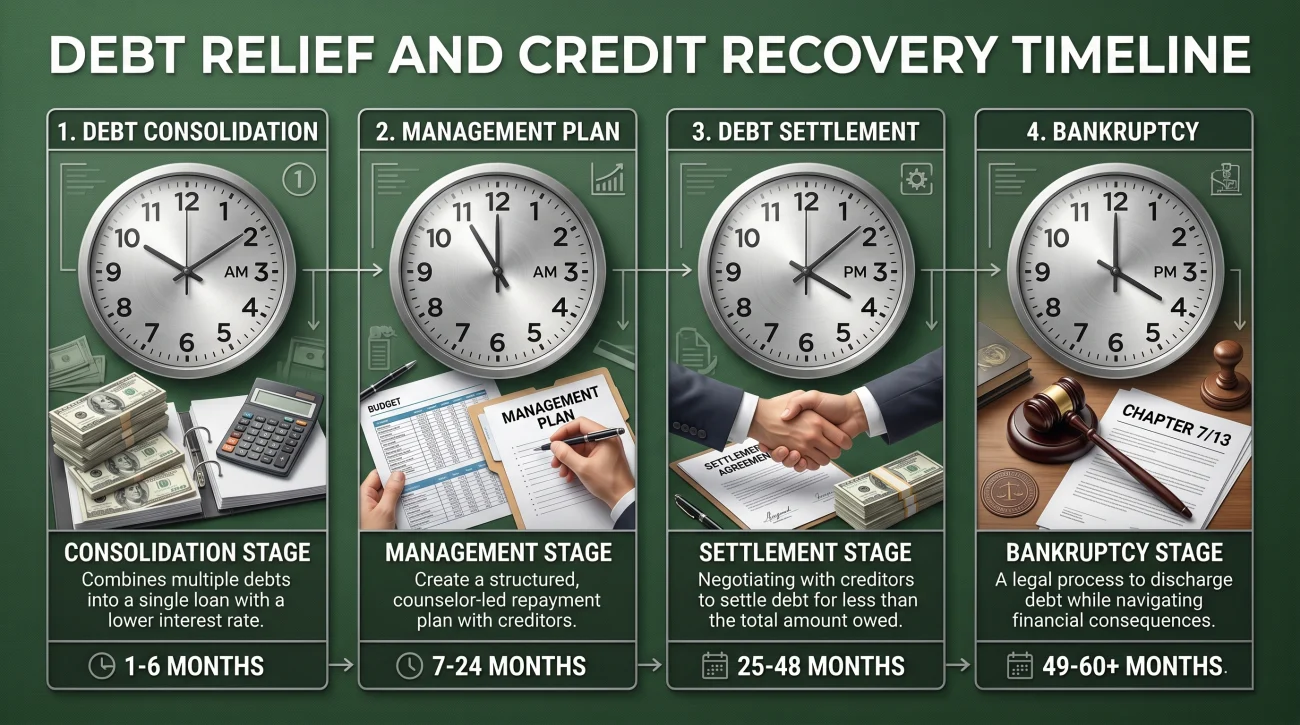
Every option has a cost in either time or credit score points. Understanding how long these paths take to complete, and how long your credit takes to recover, is crucial to setting realistic expectations.
- Consolidation and Balance Transfers: Immediate relief on interest rates. Time to debt-free depends entirely on your payment size. Credit Recovery: Usually immediate. Your score often jumps within 30 to 60 days as your individual credit card utilization ratios drop to zero.
- Debt Management Plan (DMP): Typically takes 3 to 5 years to complete. Credit Recovery: While your accounts are closed initially (causing a slight dip), making consistent on-time payments through the DMP helps stabilize your profile. Most consumers see their credit scores recover and improve significantly within the first 12 to 24 months of the program.
- Debt Settlement: Takes 2 to 4 years to complete all settlements. The first 6 months of a settlement program feel like nothing is happening. That silence is intentional; accounts need to age before collectors have real incentive to negotiate. Credit Recovery: Your score will crash during the first year as you intentionally miss payments. Meaningful credit recovery typically begins 12 to 24 months after your final account is settled and reported as a zero balance.
- Chapter 7 Bankruptcy: Takes 3 to 6 months to discharge debts. Credit Recovery: The bankruptcy stays on your credit report for up to 10 years, making it an absolute last resort. However, with active rebuilding strategies like secured credit cards, many consumers can push their scores back into the high 600s within 2 to 3 years after discharge.
What Debts Can Actually Be Included?
When I reviewed a new file, I did not care how much you owed on your house or your car, because I could not touch them. The type of debt you have dictates the leverage the creditor holds over you, and it dictates which programs you can use.
Unsecured debts are backed by nothing but your promise to pay. This includes credit cards, personal loans, and medical bills. Because the creditor has no property to seize directly, they have a strong incentive to negotiate. They know that if they push you into bankruptcy, they might get nothing at all. Almost all of the paths outlined above focus on unsecured debt.
⚠️ Warning: You generally cannot settle secured debt through standard programs. Auto loans and mortgages are backed by collateral. If you stop paying your car loan while waiting for a settlement company to negotiate, the bank will not negotiate. They will simply send a tow truck to repossess the car. Federal student loans are also exempt from standard private settlement programs and require federal income-driven repayment plans. For a detailed breakdown of eligibility, read about exactly which debts qualify for relief programs and which do not.
What Happens If You Do Nothing
Ignoring the problem is not a strategy, but it is the most common path consumers take. If you stop paying and refuse to engage with any relief option, the debt collection pipeline moves forward mechanically.
At 30 to 90 days late, your original creditor will call you aggressively and your credit score will drop. At 180 days, the original creditor typically charges off the debt, marks it as a loss, and sells it to a third-party debt buyer. Now you are dealing with professional collection agencies. If they cannot pressure you into paying, they escalate the file to a law firm. Once a lawsuit is filed, if you do not respond, the court will issue a default judgment. A judgment allows the collector to freeze your bank account or garnish your wages directly from your employer.
Doing nothing removes all your leverage. By the time a wage garnishment hits, you are out of options and must rely on aggressive legal intervention.
Signs You Need Structured Help Rather Than a DIY Strategy
Pride often keeps people in the DIY phase long after the math has failed. If you are experiencing any of the following realities, trying to snowball your way out of debt is likely mathematically impossible. You need to look objectively at the formal programs.
- Your minimum payments consume more than 25% of your take-home pay. At this ratio, any unexpected expense like a car repair will force you to use the credit cards you are trying to pay off, creating a permanent cycle.
- You have carried the same balances for over three years. If you are making payments every month but the balance never shrinks, interest charges are eating your entire payment. You need an interest rate intervention like a DMP.
- You are rationing necessities to pay credit cards. If you are skipping meals or delaying medical care to keep a Chase card current, your financial priorities are inverted.
- You are receiving aggressive calls from third-party collectors. This means your accounts have already charged off. A consolidation loan is no longer an option, and you are in settlement territory.
- You have received a formal lawsuit summons. The timeline for voluntary debt relief has collapsed. You have a strict window of time to respond to the court before facing a default judgment. See what your options are when a debt collector files a lawsuit against you immediately.
Final Thoughts: Math Over Emotion
Debt is not a moral failure. It is a math problem. The collection industry relies on your fear and your pride to keep you paying minimums for decades or to pressure you into settlements you cannot afford.
Take emotion out of the equation. Assess your cash flow objectively, understand exactly what leverage your creditors actually have, and choose the path that fits your numbers. Do not let debt collectors dictate your timeline, and do not let generic financial advice shame you away from using the legal tools designed to protect you.
| Topic | What You Will Learn |
|---|---|
| Debt Relief Options Overview | The complete breakdown of all seven paths out of debt and how to choose the right one. |
| Choosing a Settlement Company | How to spot scams, verify accreditation, and understand fee structures. |
| Settlement vs. Credit Counseling | The critical difference between lowering interest and cutting principal. |
| How Debt Management Plans Work | The mechanics of nonprofit credit counseling and interest rate concessions. |
| Debt Consolidation Loans | The math test you must pass before taking a loan to pay off credit cards. |
| Balance Transfer Strategy | How 0% APR transfers work and the hidden traps that cause them to fail. |
| DIY Debt Negotiation | The delinquency timeline and strategies for dealing directly with creditors. |
| Taxes on Settled Debt (1099-C) | Understanding the insolvency exclusion and IRS rules on forgiven debt. |
| Snowball vs. Avalanche | The math versus the psychology of paying off multiple debt accounts. |
| Paying Off Credit Card Debt | A step-by-step strategy based on your actual monthly budget surplus. |
| Medical Debt Relief | Hospital charity care requirements and how medical debt differs from credit cards. |
| Avoiding Debt Relief Scams | The FTC rules on upfront fees and red flags of predatory companies. |
| What Debts Qualify for Relief | Why secured debts like car loans cannot be enrolled in standard programs. |
| The Settlement Timeline | Why the process takes 2 to 4 years and what happens in the first year. |
| The Debt Settlement Process | How escrow accounts work and why you approve every settlement. |
| Typical Settlement Percentages | Why debt buyers settle for less than original creditors and how the math works. |
❓ FAQ
📊 Does debt relief ruin my credit score?
It depends on the path. Debt Management Plans and consolidation loans have minimal negative impact and can actually improve your score as you pay down balances. Debt settlement programs severely damage your credit because you must stop making payments for accounts to go delinquent enough to negotiate.
📞 Will debt collectors stop calling if I enroll in a program?
In a Debt Management Plan, calls usually stop once the creditor accepts the proposal. In a debt settlement program, calls will actually increase initially because you are intentionally missing payments. Legitimate programs will instruct you on how to handle or redirect these calls to their legal teams.
⚖️ Can I be sued while in a debt settlement program?
Yes. Enrollment in a settlement program does not strip a creditor of their legal right to collect. Because you stop making payments during the program, original creditors may file a lawsuit before a settlement is reached. Legitimate companies disclose this risk and usually prioritize settling accounts that pose an immediate legal threat.
💰 What happens if a creditor refuses to settle?
Creditors are not legally obligated to accept a settlement offer. If an original creditor refuses to negotiate, they may eventually charge off the debt and sell it to a debt buyer, who is almost always willing to settle later. If they refuse and threaten a lawsuit, your settlement company will typically advise you on alternative steps.
🏥 Can medical bills be included in debt relief?
Yes, medical debt is unsecured and can usually be included in settlement programs and some management plans. However, you should always check if you qualify for the hospital’s charity care or financial assistance programs first, as nonprofit hospitals are legally required to offer them based on income.
🎓 Does debt relief work for student loans?
Private debt relief companies cannot settle federal student loans. Federal loans have their own specific government programs, such as Income-Driven Repayment plans. Some private student loans can be negotiated or settled if they have gone into default, but it is much harder than credit card debt.
⏱️ How long does it take to become debt-free?
Debt Management Plans typically run for 3 to 5 years, as you are paying off the full principal at a lower interest rate. Debt settlement programs generally take 24 to 48 months to accumulate enough funds in your escrow account to settle all enrolled accounts.
🏦 Can I keep one credit card open for emergencies?
In a Debt Management Plan, creditors generally require all your active credit cards to be closed as a condition of lowering your interest rates. In a debt settlement program, you can choose which accounts to enroll, but creditors often close your accounts anyway once they see you defaulting on other major lines of credit.
📝 Do I owe taxes on forgiven debt?
The IRS considers forgiven debt over $600 as taxable income, and you will receive a 1099-C form. However, if your total debts were greater than your total assets at the time the debt was settled, you likely qualify for the IRS insolvency exclusion, which can eliminate that tax liability entirely.
🛑 How do I know if a debt relief company is a scam?
The biggest warning sign is an upfront fee. As detailed in Path 6, legitimate companies are prohibited from charging you before they successfully settle a debt. If they demand money to “enroll” you, it is a scam.
Relief options exist alongside the collection process. These explain both sides.
- The options for resolving debt outside of continued collection
- What Debts Can Be Settled or Included in a Debt Relief Program - and What Can't
- What Percentage Do Debt Collectors Actually Settle For - and Why the Answer Depends on Who Owns the Debt
- How Does a Debt Management Plan Work: How Nonprofit Credit Counseling Actually Helps You Pay Off Debt
- How to Pay Off Credit Card Debt: A Working Plan Based on What You Can Actually Afford
Some of these have deadlines attached. Start here if something is already happening.
- What collectors can legally do to you while a settlement program is running
- How to handle a lawsuit on a debt you are actively trying to settle
- What happens to a garnishment order when debt relief is in progress
- How bank levies interact with the debt you are trying to resolve
- How professional settlement programs work and what they actually cost
Disclosure: The content on this site reflects direct experience inside the debt collection industry and is grounded in federal law and regulation. It is informational in nature. Reading it does not constitute legal advice and does not create any professional relationship. If you are dealing with a lawsuit, a judgment, or a legal deadline, consult a licensed attorney in your state before acting.