
- It is a clear violation of federal law for a debt collector to tell your employer, manager, or coworkers that you owe a debt.
- While collectors can call your workplace to verify your employment status or ask for your contact information, the moment they disclose the nature of the call, they cross a legal line.
- This violation is rarely accidental. It is a calculated pressure tactic designed to use professional humiliation to force an immediate payment.
- Because workplace disclosure can threaten your job security or professional reputation, you may be entitled to “actual damages” that go far beyond the standard statutory limits.
- To hold the collector accountable, you must document exactly who heard the disclosure, what was said, and when it happened, often by securing a brief written statement from your coworker or HR representative.
The Humiliation of Workplace Debt Disclosure
Your manager pulls you into a meeting room, closes the door, and awkwardly asks if everything is okay financially. Or worse, a coworker from the front desk messages you to say a collection agency just called the main line looking for you. For many people, having a debt collector told my employer about my debt is the absolute nightmare scenario. It merges personal financial stress with professional humiliation, creating a level of panic that few other collection tactics can match.
During my twelve years inside third-party collection agencies and a national debt buyer, I saw exactly how this tactic is deployed. When a debt collector reveals your financial struggles to your workplace, it is almost never a slip of the tongue. It is a deliberate, calculated move designed to leverage your fear of losing your job into an immediate payment.
The good news is that this tactic represents one of the most clear-cut, easily provable violations of the Fair Debt Collection Practices Act (FDCPA). Federal law heavily restricts who a collector can talk to about your accounts. When they decide to involve your boss, human resources department, or colleagues, they hand you a powerful piece of leverage.
In this guide, I will break down exactly what the law says about third-party disclosure, why collectors take the risk of breaking this rule, how to gather the evidence you need from your workplace, and how to use this violation to turn the tables on the agency pursuing you.
What the FDCPA Actually Says About Third-Party Disclosure
To understand how badly a collector stepped out of bounds by talking to your employer, you need to understand the strict communication barriers established by the foundational debt collection laws that govern the industry. The FDCPA was designed specifically to prevent the kind of social and professional ruin that rogue collectors used to inflict on consumers decades ago.
Under the FDCPA, a debt collector may only discuss your debt with a very specific, limited group of people. Without your direct, prior consent given directly to the debt collector, they are legally permitted to communicate about the debt with exactly three parties:
- You (the consumer).
- Your spouse.
- Your retained attorney.
That is the entire list. Anyone else – your parents, your adult children, your neighbors, your coworkers, your manager, or your company’s HR department – is considered a “third party.” Contacting an employer and disclosing that you owe a debt is explicitly prohibited. The law recognizes that your financial obligations are private, and weaponizing them against your career is abusive.
The Three Narrow Exceptions
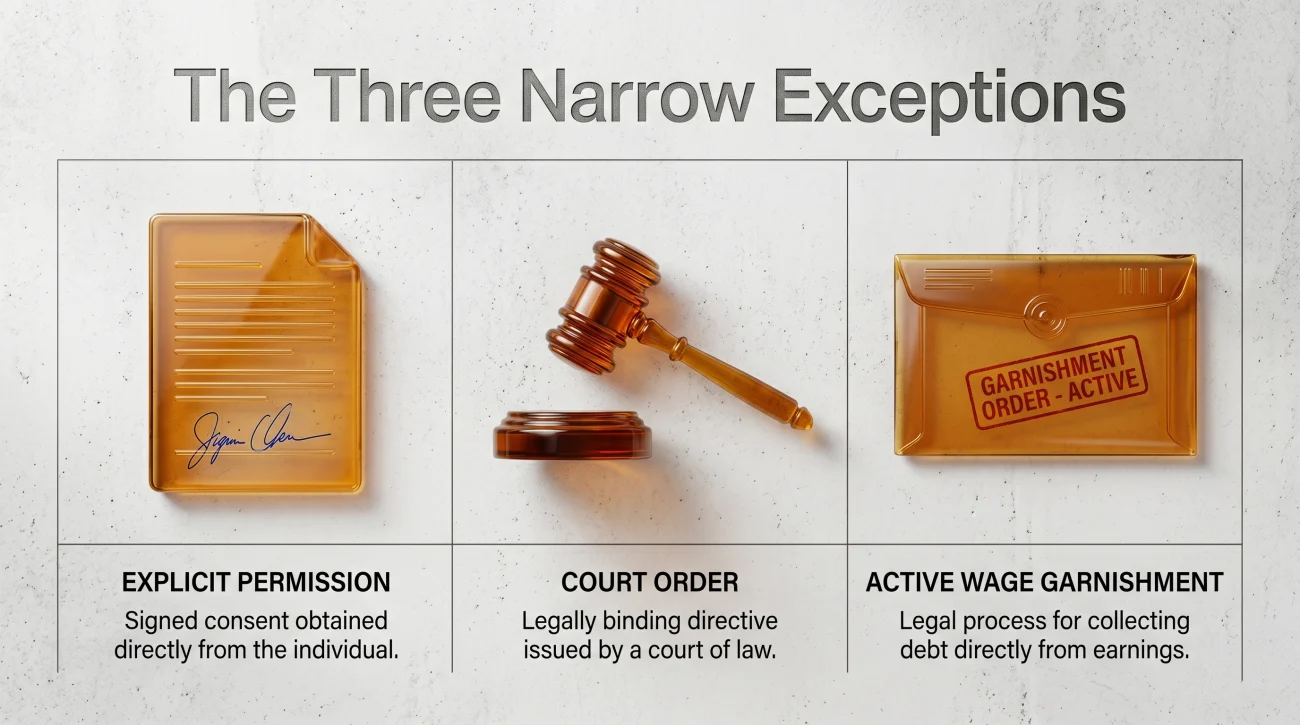
There are only three highly specific scenarios where a collector communicating with your employer about a debt is legally permissible. If your situation does not fit into one of these boxes, the collector broke the law:
- You gave them explicit permission: If you told the collector, “You can call my HR manager to verify my situation,” they are allowed to do so. (You should never do this).
- They have a court order: A judge explicitly granted them permission to make the disclosure, which is exceptionally rare outside of active litigation.
- They are enforcing a wage garnishment after a judgment: If the collector already sued you, won by default or at trial, and obtained a court judgment, they are legally required to serve a wage garnishment order on your employer. The disclosure of the debt at that stage is a formal legal process, not a collection call.
If you have not been sued and there is no active judgment against you, a phone call to your workplace dropping hints about your unpaid bills is a flagrant violation.
Why This Tactic Is a Calculated Move
It is easy to assume that a collector simply made a mistake – that they were chatting with a receptionist, got confused, and accidentally let the word “debt” slip out. While administrative errors do happen, you need to look at this from the perspective of the collection floor.
When a collector is working an account, their primary goal is to establish urgency. If you have been ignoring their calls on your cell phone, or if you have told them you simply cannot pay right now, they know that their standard toolkit is failing. They need to change the environment to make the debt your top priority. Disclosing the debt to an employer creates the exact kind of social pressure and shame that collectors want.
“When I was training new agents at a third-party agency, we strictly forbade third-party disclosures because of the liability. However, veteran collectors knew exactly how to walk right up to the line. They knew that if an employee’s professional reputation felt threatened, that person would suddenly find a way to borrow money from family or drain a savings account just to make the workplace calls stop. The recovery rate on humiliated consumers was incredibly high.”
The professional consequences of this tactic are severe. When a manager finds out an employee is in collections, it can lead to uncomfortable questions about financial stability, security clearances, or focus at work. This creates an intense, artificial urgency to pay. Collectors who engage in this behavior are making a calculated bet: they are betting that you will be too embarrassed by the situation to realize that they just broke federal law.
Calling Your Job vs. Telling Your Boss: The Crucial Difference
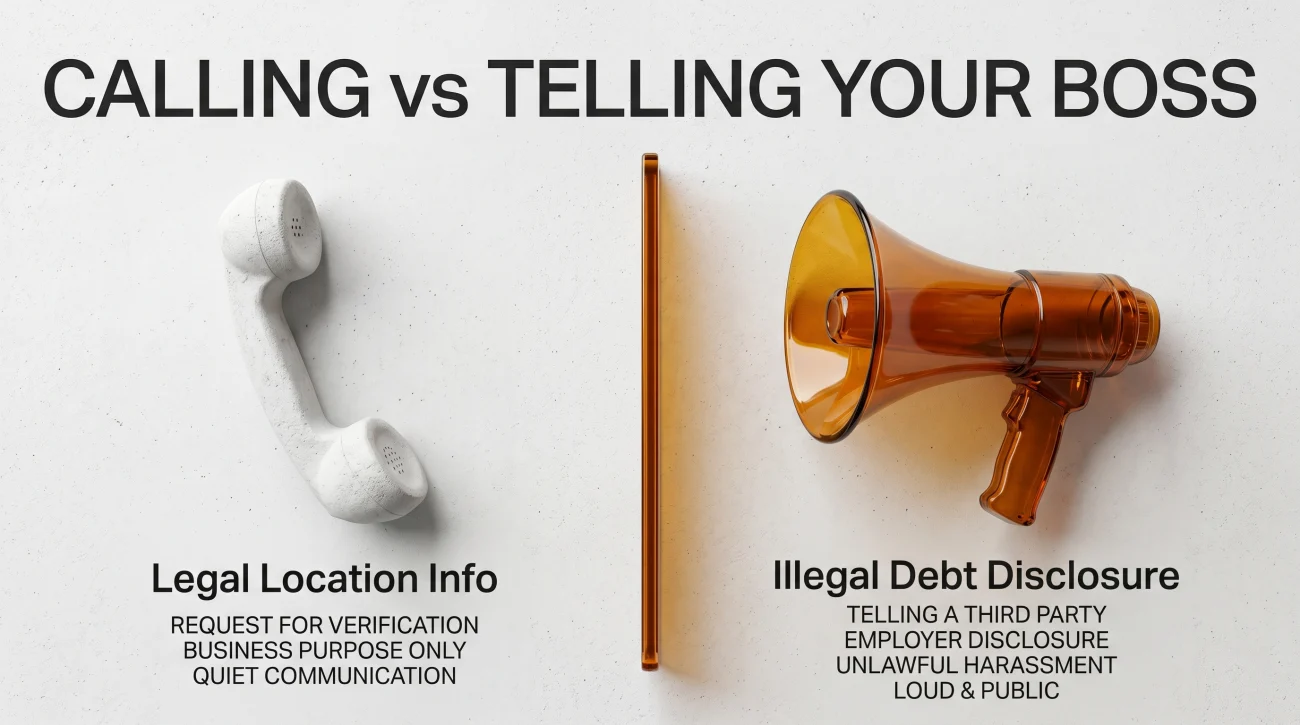
One of the most common areas of confusion for consumers is understanding the difference between a collector calling a workplace and a collector disclosing a debt. It is critical to grasp this distinction before you accuse an agency of a violation.
Debt collectors are generally allowed to call your workplace. This is covered extensively in the framework of what collectors are allowed to say when calling your job. They are permitted to call a business number to ask if you are available, or to verify your employment status (often called “location information”).
However, the FDCPA dictates exactly how that location information call must be handled. The collector must identify themselves by their personal name, state that they are confirming location information, and – this is the absolute rule – they must not state that you owe any debt.
The line is crossed the exact moment they reveal the nature of their business to a third party.
Collectors often fall into the “transfer trap.” A gatekeeper at your company presses them for information before transferring the call. A well-trained collector will simply refuse to give details and end the call. A rogue or aggressive collector will drop the words “debt,” “collections,” or “past due account” to force the gatekeeper to pass the message along. That failure of discipline is a violation of the law.
The Financial Value: Why This Violation Carries Actual Damages
When you look at the broad spectrum of illegal debt collection practices and FDCPA violations, most of them carry a standard penalty. The law allows a consumer to pursue up to $1,000 in “statutory damages” per lawsuit for violations like calling too early in the morning or failing to send a proper letter.
Workplace disclosure is treated differently because it routinely causes actual damages. Actual damages represent real, measurable financial harm caused directly by the collector’s illegal actions. This is where a workplace disclosure violation becomes significantly more impactful than a simple harassing phone call to your house.
If a debt collector calls your employer and discloses your financial status, the fallout can be severe. I have seen cases where consumers were passed over for promotions because management deemed them financially irresponsible. In extreme cases, particularly in industries requiring security clearances, strict financial probity, or bonding, employees have been terminated or placed on administrative leave due to collection harassment at work. You might lose hours of wages dealing with HR, or suffer severe, medically documented emotional distress.
If you suffer professional blowback or lost income directly resulting from the collector talking to your employer, those specific financial losses can be claimed as actual damages on top of the statutory penalty. Employer disclosure is one of the stronger FDCPA violation scenarios precisely because the courts recognize the profound damage it does to a person’s livelihood. To understand how this translates into a legal case and why consumer attorneys are motivated to pursue these specific infractions, review how pursuing a debt collector for FDCPA violations works in practice.
How to Document the Violation at Work
Whether you intend to file a lawsuit for those actual damages or simply want to force the agency to back off, you cannot rely on your own outrage to make your case. A claim cannot be built simply on your statement that “my boss said a collector called.” You need to document the event while memories and records are fresh.
Because the violation happened at your workplace, the evidence sits with your employer. You must gather it quietly and professionally through a few key steps.
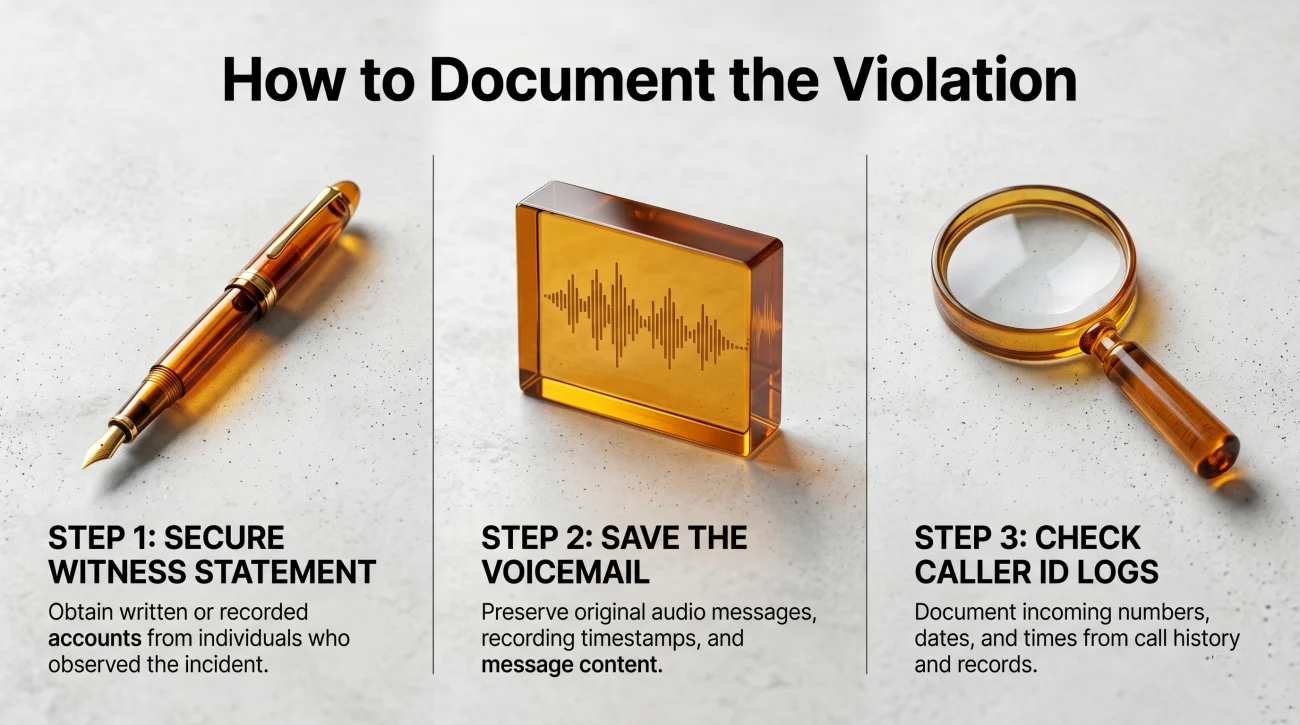
1. Secure a witness statement
Approach the coworker, receptionist, or manager who took the call. Ask them to write a brief, factual email to you summarizing exactly what the caller said. Keep it simple. You can say: “I am dealing with an abusive telemarketer who shouldn’t be calling this office. Could you shoot me a quick email writing down exactly what they said to you, including any company name they used?”
2. Save the voicemail
If the collector was reckless enough to leave a voicemail on a general company line or on a manager’s extension detailing the debt, that recording is gold. Ask the recipient to forward the audio file to your personal email address immediately before the corporate system auto-deletes it.
3. Check the caller ID logs
If your company uses a modern VoIP phone system, your IT department or office manager may be able to pull a call log showing the exact inbound phone number, date, and time of the call. Match this number against the collection agency’s known numbers.
Once you have this documentation, you must also consider filing formal complaints with regulatory bodies. While legal action addresses your personal damages, a federal complaint puts the agency on the regulatory radar. You should immediately begin the process of reporting the debt collector to the proper agencies to create an official paper trail of their misconduct.
What if the Debt Doesn’t Even Belong to You?
The humiliation of a workplace disclosure is compounded exponentially when the collector has targeted the wrong person entirely. Because debt is bought and sold in massive, messy portfolios, agencies frequently run “skip traces” to find contact information based on matching names or old addresses.
If a collector tracked down your workplace and disclosed a debt to your employer that actually belongs to someone else with a similar name, they have committed multiple violations simultaneously. They have failed to verify the identity of the debtor, and they have committed an illegal third-party disclosure. If you are dealing with this specific nightmare, the documentation you gather at work is vital, but you must also force them to stop targeting you. Review the exact steps for handling a situation where a debt collector is calling the wrong person to shut down the harassment permanently.
Signs This Was Clearly an Illegal Workplace Disclosure
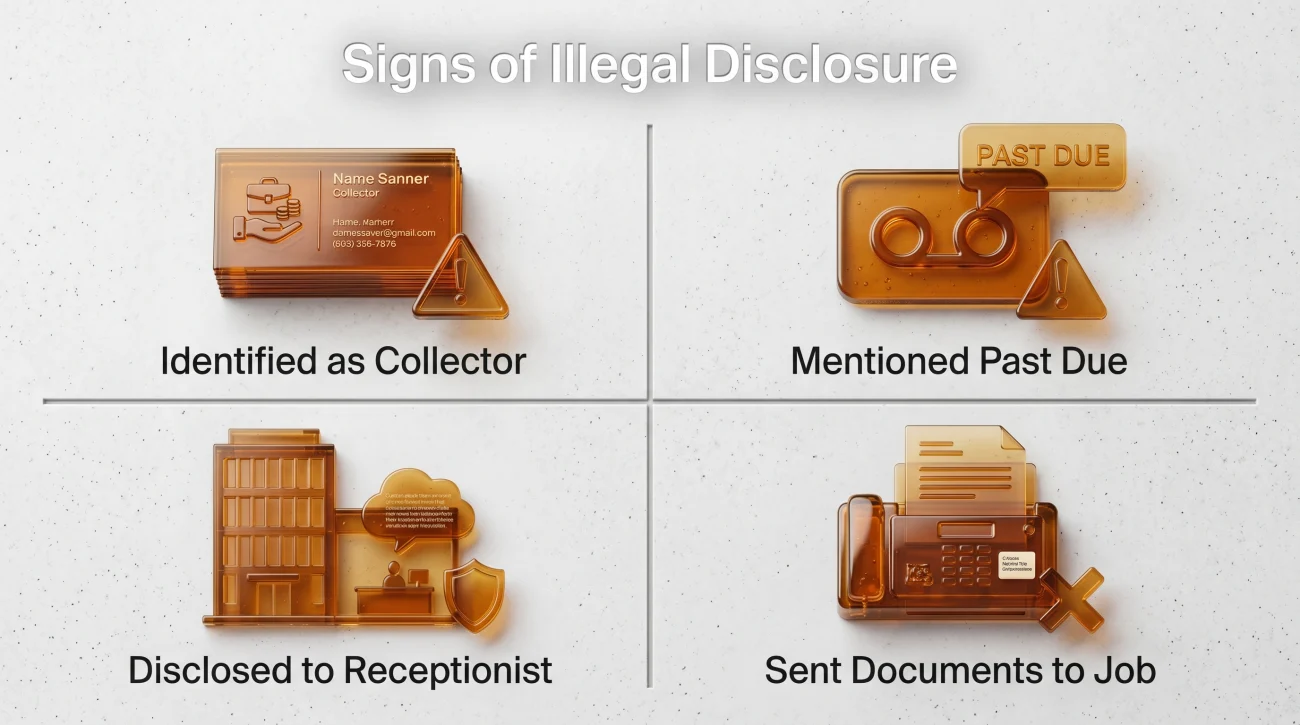
When you are called into an HR office or confronted by a coworker about a collection call, the embarrassment can make it difficult to think clearly about your legal rights. Before you make a panicked payment, you need to recognize the specific markers of illegal behavior. If you notice any of these signs, the collector has crossed the line and handed you significant leverage:
- The caller explicitly identified themselves as a debt collector to your manager, an HR representative, or a coworker who answered the phone.
- The caller left a voicemail on a shared company extension or a colleague’s phone that mentioned a “past due balance,” “collections,” or “unpaid account.”
- The collector called the company’s main line and freely disclosed the details of your debt to a receptionist simply because they were asked what the call was regarding.
- The collector faxed or emailed documents regarding your debt to a shared company machine or a general departmental email address.
If you have documented any of these scenarios, do not confront the collector yourself and do not agree to a settlement out of fear. You are currently holding evidence of a serious federal violation. Your best immediate move is to have the situation evaluated by a professional who understands fee-shifting statutes. I highly recommend discussing the violation with a consumer protection attorney to understand the full value of your actual damages, or looking into formal avenues for holding the agency accountable for targeted harassment.
Final Thoughts on Workplace Collection Tactics
Having your financial struggles aired out in your workplace is deeply upsetting, but it is critical that you reframe how you view the event. The debt collector wanted you to feel small, panicked, and willing to do anything to make the embarrassment stop. They banked on your shame overriding your knowledge of the law.
By illegally disclosing your debt to your employer, the collection agency did not assert dominance – they made a critical mistake. They handed you a documented FDCPA violation that carries the potential for actual damages. Do not let the embarrassment dictate your response. Gather your witness statements, save the voicemails, and use their illegal tactics to protect your rights and your career.
❓ FAQ
🏢 Can a collection agency call my boss about my debt?
No. While a collector can call your workplace to verify your employment or ask for your contact information, they are strictly prohibited under federal law from telling your boss, manager, or anyone else that you owe a debt.
🗣️ What if a coworker overheard the collector on the phone?
If the collector voluntarily disclosed the debt to the coworker who answered the phone, that is an illegal third-party disclosure. If they were speaking to you and a coworker simply overheard your side of the conversation, the collector is generally not liable for that.
📠 Is it legal for a collector to fax debt info to my job?
No. Sending collection notices to a shared company fax machine or a general workplace email address where third parties can reasonably view it constitutes an illegal disclosure of your debt to your employer or coworkers.
⚖️ Can I pursue action if they told my HR department I owe money?
Yes, this may be grounds for a lawsuit. Disclosing a debt to an HR department (unless they are enforcing an active, court-ordered wage garnishment) is a clear FDCPA violation. You may be able to pursue statutory damages, plus actual damages if the disclosure harmed your job standing.
📞 How do I prove the debt collector told my employer?
You need documentation. Get a brief, factual email or written statement from the coworker or manager who took the call, detailing exactly what the collector said and the company name they used. Save any voicemails left on corporate systems.
🛑 How do I make them stop calling my work immediately?
Tell the collector clearly: “My employer prohibits me from receiving personal calls at work.” Under the FDCPA, once you state that your employer does not allow these calls, the collector is legally required to stop calling your workplace entirely.
The full FDCPA framework and the four areas where it matters most.
- Your legal rights when collectors call, write, or threaten to sue
- When they can call, what they cannot say, and how to make it stop
- How to identify FDCPA violations and what you can do with them
- Why the age of a debt determines what a collector can legally do
- Your right to demand proof before paying or acknowledging anything
Harassment is one thing. Lawsuits, garnishments, and frozen accounts are another.
- When collector behavior crosses the line the FDCPA was written to prevent
- What to do if a collector files suit after their calls have not worked
- What collectors can do to your wages once a judgment is entered
- How a bank levy works and which funds the law protects from seizure
- How to resolve the debt that collectors have been calling about
Disclosure: The content on this site reflects direct experience inside the debt collection industry and is grounded in federal law and regulation. It is informational in nature. Reading it does not constitute legal advice and does not create any professional relationship. If you are dealing with a lawsuit, a judgment, or a legal deadline, consult a licensed attorney in your state before acting.