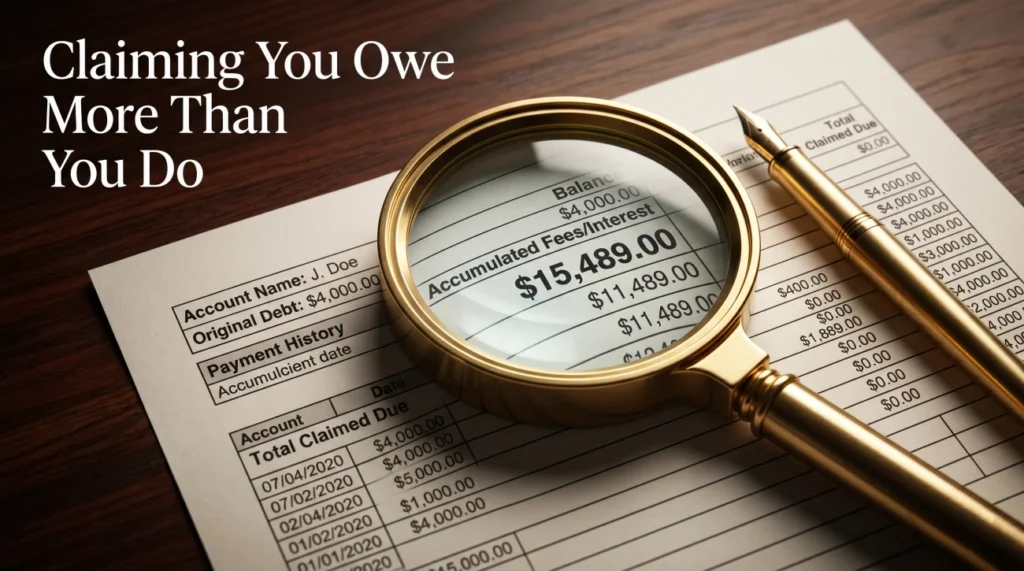
- Discrepancies are usually a data problem: If a debt collector says you owe more than your records indicate, do not assume your memory is wrong. Debts are sold in bulk spreadsheets, and missing data frequently leads to inflated balances.
- Federal rules require accuracy: The legal framework governing debt collection does not give agencies a free pass for bad math. They are required to pursue the correct, verifiable amount.
- Force them to show their work: Do not make a partial payment on an inflated balance just to resolve it. Use the written validation process to force the collector to produce the original documentation supporting their numbers.
The Balance Discrepancy That Makes You Doubt Your Memory
The phone rings, and the debt collector on the other end states that you owe $4,200. You immediately freeze. You know you had an old credit card that went into default, but your records from three years ago clearly show a balance of $3,100. Before you assume you are misremembering the facts, or that late fees magically added a thousand dollars overnight, you need to understand how the collection industry operates behind closed doors.
During my 12 years working inside third-party collection agencies and a national debt buyer, I saw exactly how these balance discrepancies happen. When a collection agency claims a wrong amount, it is rarely a sophisticated accounting maneuver. It is usually the predictable result of how old debt is bought, sold, and transferred. The documentation trail is often incredibly thin, leaving collectors to pursue inflated numbers based on nothing more than a flawed spreadsheet.
When a debt collector lying about amount owed becomes an issue, consumers often panic and consider paying the inflated amount just to close the account. This is exactly what the agency hopes you will do. In this guide, I will explain how data decay inflates these balances over time, how the federal framework approaches accuracy in collections, and the exact steps you can take to force the agency to prove their math.
Why Debt Portfolios Produce Incorrect Balances
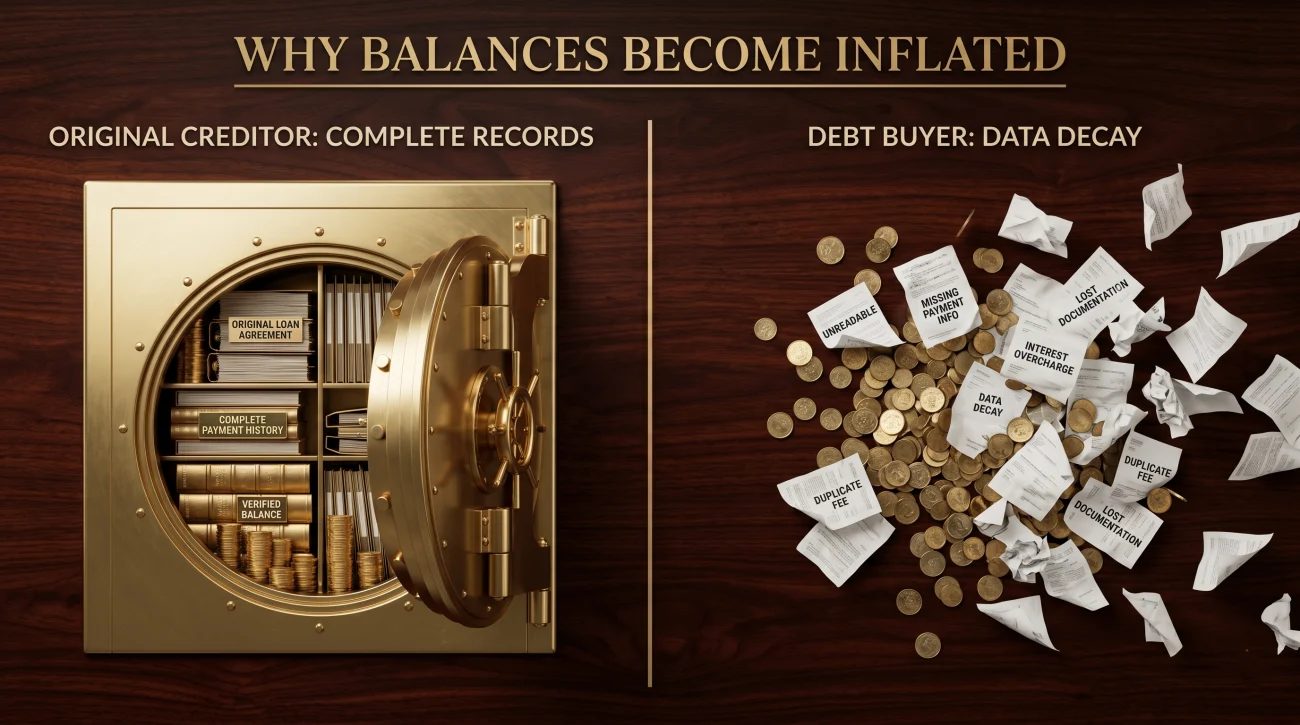
To understand why a debt collector amount does not match your records, you have to look at how debts change hands. When you stop paying a credit card or a medical bill, the original creditor eventually charges off the account as a loss. They bundle your account with tens of thousands of others and sell them to a debt buyer for pennies on the dollar.
The debt buyer does not receive a neat, organized folder containing your original signed contract, your complete payment history, and a detailed ledger of interest calculations. They receive a massive data file containing names, addresses, Social Security numbers, and a single column labeled “Current Balance.”
This is where the data decay begins. If your account is sold two or three times over a period of five years, that single balance number gets passed from buyer to buyer. The documentation explaining how that number was calculated is often left behind. The collector calling you is looking at a screen that tells them to collect $4,200. They usually do not know if that includes post-charge-off interest, unauthorized agency fees, or simple data entry errors made by a previous buyer.
“When I was reviewing portfolio acquisitions on the collection floor, we frequently found accounts where the balance had jumped 20 to 30 percent between the second and third debt buyer. There was no itemization. Someone at a previous agency had likely applied a blanket ‘collection fee’ macro to the entire spreadsheet column before selling the portfolio. Our agents were instructed to collect the inflated number anyway, because that is the number we bought.”
The Three Reasons a Collection Agency Claims the Wrong Amount
When a debt collector says I owe more than I do, the discrepancy usually falls into one of three specific scenarios. Identifying which one applies to your account will help you understand how to challenge it.
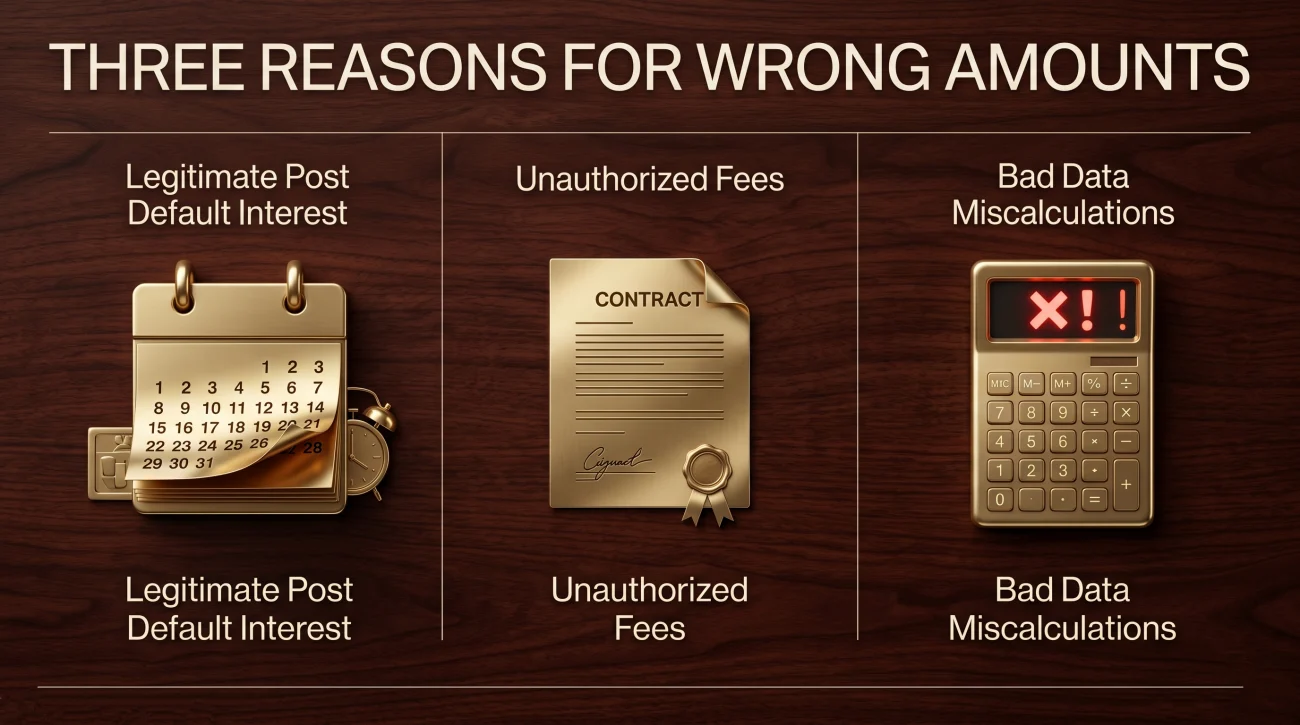
Scenario 1: Legitimate Post-Default Interest
Sometimes, the increased balance has a contractual basis. Depending on the terms of your original credit agreement and your state’s laws, interest may continue to accrue even after the account is charged off and sent to collections. If your original contract permitted ongoing interest at a specific rate, the collector might be applying that exact rate to your principal balance over time.
However, the collector must be able to document this. They cannot simply guess at an interest rate or apply a generic state maximum if the contract says otherwise. They need the original agreement to show the authorized rate. If they cannot produce it, their right to charge that ongoing interest is highly questionable.
Scenario 2: Unauthorized Fees and Charges
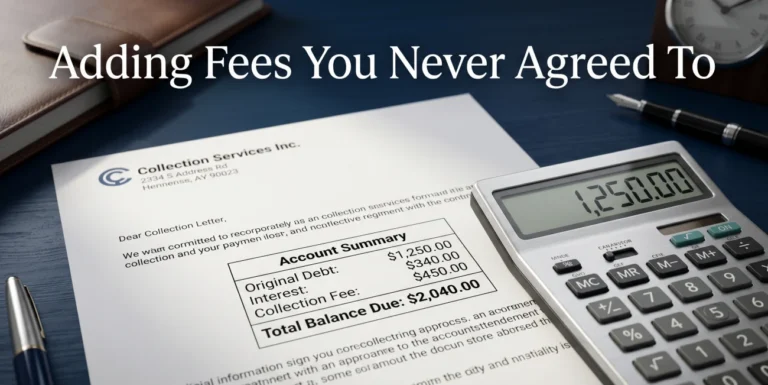
This is where debt buyers frequently cross the line. A debt collector inflating balance figures often does so by layering their own internal fees on top of the principal. They might label these as “service fees,” “administrative costs,” or “skip tracing charges.”
Federal guidelines generally prohibit a collector from adding any fee that was not explicitly authorized by the original agreement creating the debt or permitted by state law. Because debt buyers rarely hold the original contract, they often apply these fees blindly, hoping the consumer will not ask questions.
“I once oversaw a portfolio of old gym memberships. The previous agency had automatically added a $50 ‘skip tracing and processing’ fee to every single account because the original gym contract vaguely mentioned ‘collection costs.’ When consumers pushed back and asked for the actual receipt for the skip tracing service, we never had it. We were instructed to just remove the $50 for anyone who complained in writing.”
Scenario 3: Bad Data and Miscalculations
Sometimes, a collection agency incorrect balance is just a pure administrative error. Payments you made to a previous collector might not have been credited to the file before it was sold to the current agency. Data migrations between different software systems can cause formatting errors that shift decimal points. Two completely separate accounts belonging to people with similar names might get merged under one profile.
| How an $800 Debt Becomes $1,350 (The Data Decay Lifecycle) | Documentation Reality |
|---|---|
| Original Charge-off: Bank closes account at $800 balance. | Bank has full records. |
| Sale to Buyer 1: Buyer 1 adds 15% interest over two years ($120). New balance: $920. | Buyer 1 lacks the contract to prove the 15% rate is allowed. |
| Sale to Buyer 2: Buyer 2 adds a flat 20% “collection fee” ($184) because it is their agency policy. New balance: $1,104. | Fee is unauthorized by original contract. |
| Sale to Buyer 3 (Current): Buyer 3 adds court filing preparation fees ($246) before even filing a lawsuit. Final demanded balance: $1,350. | Buyer 3 only sees “$1,350” on their spreadsheet and demands payment. |
What the Federal Framework Says About Accuracy
You do not have to accept the collector’s number as an absolute truth. The federal government has established a framework designed to promote honesty in debt collection, and these rules form the foundation of your defense when dealing with a collection agency claiming wrong amount issues.
The Fair Debt Collection Practices Act (FDCPA) is the primary federal law governing third-party collectors. You can review how this framework operates in our broader overview of debt collection laws. Under the FDCPA, a debt collector is generally prohibited from falsely representing the character, amount, or legal status of any debt.
This means that if a collector pursues an inflated amount, even if they are simply relying on bad data passed down from a previous debt buyer, they are still running afoul of the framework. Claiming ignorance of the bad data does not automatically shield the collection agency from responsibility. The system is designed to require accuracy, and consumers have the right to demand that accuracy before turning over any money.
How to Formally Dispute the Wrong Amount
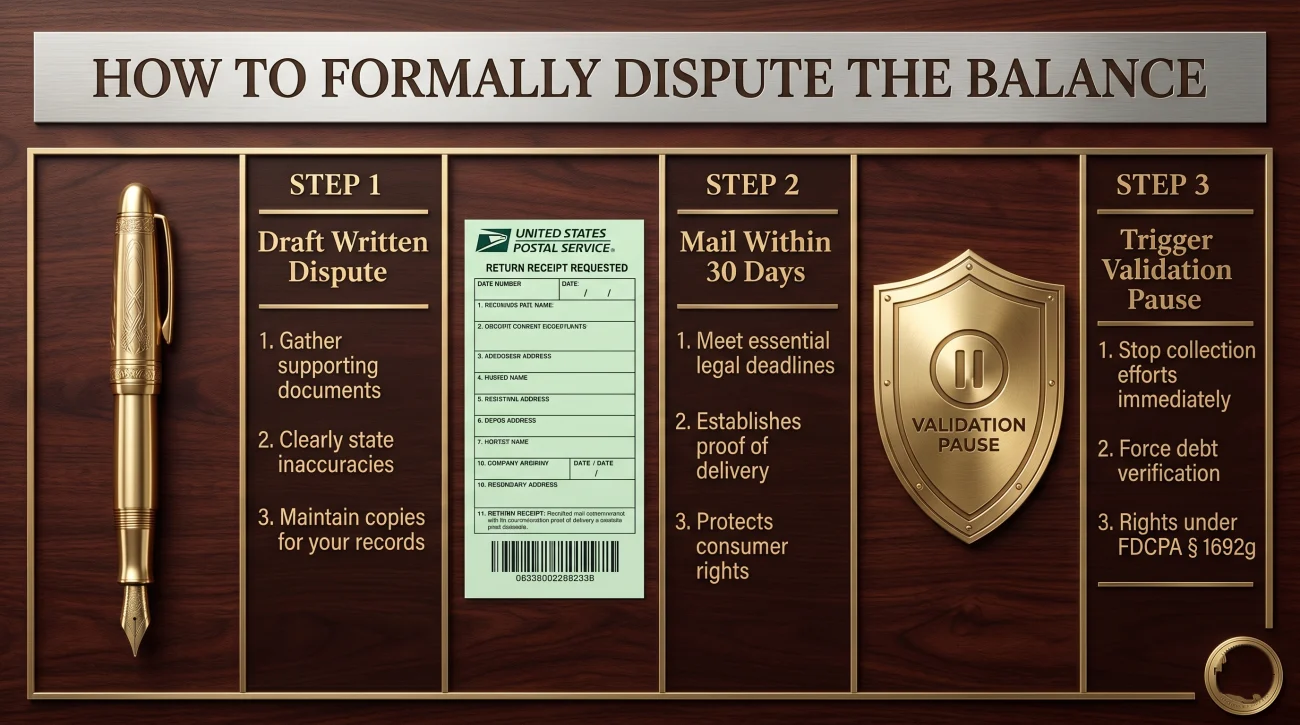
When you realize the number is wrong, trying to resolve it verbally on a phone call rarely works. The agent in the call center has no authority to reduce the principal balance just because you say it is incorrect. They are looking at their screen, and their screen says you owe the inflated number. You must move the dispute out of the call center and into the formal documentation process.
To learn how to dispute wrong debt amount effectively, you must trigger the validation process. After a collector first contacts you, they are required to send a written notice. Once you receive it, you have a 30-day window to dispute the debt in writing and request verification. This action generally forces the agency to pause collection efforts until they can produce documentation supporting their math.
Here is the specific structure you should use when demanding a breakdown of the balance in your written dispute letter:
Sample Dispute Language for an Incorrect Amount:
“I am writing in response to your communication regarding account number [Insert Account Number]. I do not agree with the amount you are claiming, and I dispute the balance of [Insert Claimed Balance].
Please provide a complete itemized accounting of this alleged debt from the original date of charge-off to the present. This itemization must include the original principal balance, a specific breakdown of any interest applied, a specific breakdown of all added fees or collection charges, and a record of all payments or credits applied to the account.
If you cannot provide original documentation authorizing these specific additions, please correct the balance immediately or cease collection efforts.”
If you are unsure how to put this together into a complete document, you can review our full debt validation letter templates for additional guidance.
The consumer calls the agency, argues that the balance is too high, and accepts the agent’s verbal explanation that “interest and fees were added by the bank before we got it.” The consumer then agrees to a payment plan on the inflated number.
The consumer sends a certified letter disputing the amount and demanding an itemized accounting. The collector realizes they do not have the original contract to justify the added fees, and they either drop the fees or abandon the account entirely.
What Happens After You Send the Dispute
Once your certified letter lands on the collector’s desk, they have to make a business decision. Because retrieving archived documents from original creditors costs time and money, their response usually takes one of three paths.
First, they might simply close the account and stop contacting you. If the debt is old, the balance is relatively small, and they know they lack the paperwork, many debt buyers will voluntarily walk away. Second, they might send you a generic summary, like a single statement showing the inflated final balance. This is often legally insufficient if it does not explain how the fees were calculated, and you can push back again.
Third, they might actually provide the full itemization and the original contract. If they do, and the contract clearly authorizes the interest and fees they applied, you now know the balance is legally grounded and you can plan your next steps accordingly. For a deeper understanding of this phase, read our full breakdown on the debt validation process.
The Credit Report Double-Hit
Even if the collection agency pauses their efforts or voluntarily walks away after receiving your dispute letter, your work is not entirely finished. An inflated balance does not just affect what the collector tries to extract from your bank account; it also impacts your credit profile. Collection accounts are highly damaging on their own, but an artificially inflated balance causes a secondary problem: it skews your overall debt utilization ratio.
If a debt collector reports a $4,000 balance to the credit bureaus for a debt that should only be $1,500, your total outstanding debt appears much higher to potential lenders. While you are disputing the amount with the collection agency, you should simultaneously file a dispute directly with Equifax, Experian, and TransUnion. Under the Fair Credit Reporting Act, the bureaus must investigate the discrepancy. If the collector cannot verify the inflated amount to the bureaus, the tradeline must be corrected or removed.
The Partial Payment Trap You Must Avoid
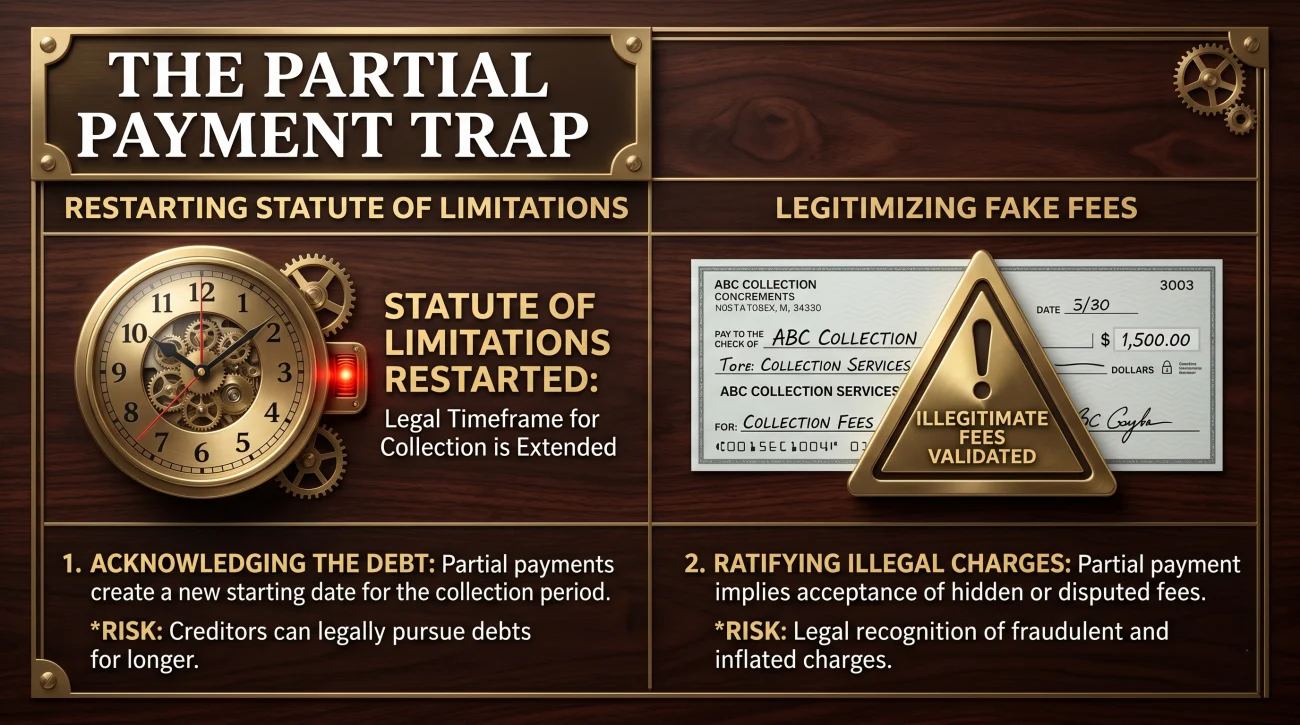
When faced with a debt collector added interest I don’t owe scenario, many consumers make a critical strategic error. They look at the inflated balance of $4,200, look at their own records showing $3,100, and decide to act reasonably. They call the collector and say, “I know I owe the $3,100, and I will pay that part, but I am not paying your fake fees.” Then, they make a payment toward the $3,100.
In the debt collection world, making a voluntary partial payment on an account while the total balance is actively disputed is incredibly dangerous. In many jurisdictions, making a payment can be legally construed as acknowledging the validity of the debt. By paying a portion of it without a formal agreement, you might accidentally legitimize the very fees you were trying to fight.
Furthermore, if the debt is old, making any payment can restart the statute of limitations clock. This gives the collector a brand new window of several years to file a lawsuit against you for the remaining inflated balance. Never make a partial payment on a disputed amount without a signed, written settlement agreement that clearly states your payment satisfies the account in full.
How to Spot a Flawed Balance on Paper
Debt buyers rely on the fact that most consumers will not push back on the math. They hope you are too intimidated by the collection process to ask for receipts. If you want to know whether you have a strong hand to challenge the balance, look for these specific red flags in the real world:
- The balance is a suspiciously round number: Credit card debts and medical bills almost always end in odd dollars and cents. If the collector is demanding exactly $3,500.00, it is highly likely the number has been estimated or manipulated.
- Massive discounts on the first call: If a collector claims you owe $6,000 but immediately offers to settle it right now for $1,000, it is a strong signal they know their $6,000 figure is largely made of unenforceable fees and they lack the documentation to prove it in court.
- Refusal to put the breakdown in writing: When you ask how they calculated the interest and the agent aggressively pivots to asking for your debit card number instead of answering the question, they likely do not have the itemization.
- The math changes randomly: The balance on a letter you received in March is significantly different from the balance quoted on a phone call in April, with no clear explanation for the jump.
If you spot these signs, you are likely dealing with an unverified amount. If the collector is aggressively harassing you for this inflated balance, calling you repeatedly, or threatening legal action over a number they refuse to explain, consulting a professional can help you evaluate your options. This is the exact moment to get a review of the collector’s communications to see if their tactics cross the line.
If the situation has already escalated and you have received a court summons for an amount that is clearly incorrect, ignoring it guarantees the collector wins the inflated amount by default. In a litigation scenario, having an attorney review the lawsuit is often the most effective way to expose their lack of proof.
Final Thoughts on the Industry’s Open Secret
Data decay is the debt collection industry’s open secret. Every time a massive file of distressed accounts is sold from one buyer to the next, a little more context is lost, and a few more undocumented fees are quietly baked into the final number. The system relies entirely on the assumption that you will be too overwhelmed to ask them to show their work.
When a collector states a balance that contradicts your records, trust your records first. Use the written validation process to force them to put their math on paper. By refusing to pay unverified fees and demanding a breakdown, you shift the burden of proof back exactly where it belongs: squarely on the collection agency’s shoulders. More importantly, every time a consumer demands this level of verifiable proof, it disrupts their high-volume business model. When enough people push back on these flawed spreadsheets, the economics of buying and enforcing bad data simply stop working. You are not just protecting your own wallet; you are holding the collection process to the standard of actual proof.
❓ FAQ
⚖️ Is a debt collector allowed to ask for an incorrect amount?
The federal framework is built around accuracy. Under guidelines like the Fair Debt Collection Practices Act (FDCPA), debt collectors are instructed not to falsely represent the character, amount, or legal status of any debt they are attempting to collect.
📝 How do I prove the debt collector is inflating the balance?
You do not have to prove it is inflated initially. You send a written debt validation request demanding an itemized accounting. The burden is on the collector to provide documentation justifying the principal, interest, and fees.
📈 Can a collection agency add their own fees to my debt?
A collection agency generally can only add fees or interest if those specific additions were expressly authorized by the original contract you signed, or if they are explicitly permitted by your state’s laws.
🛑 What should I do if the validation notice shows a wrong amount?
You should send a written dispute letter via certified mail within 30 days of receiving the notice. State clearly that you dispute the amount claimed and require a full itemized breakdown.
🤔 Does a wrong amount mean I do not have to pay the debt at all?
Not automatically. An incorrect balance means the collector has a compliance issue and must correct their claim, but it does not erase the underlying principal debt that you actually incurred.
🏦 Why do debt buyers so often have the wrong balance?
Debt buyers purchase accounts in massive bulk portfolios. They often receive only a spreadsheet with a final balance figure, missing the historical itemization of how previous owners calculated interest or added fees.
📞 What do I say on the phone when they quote the wrong amount?
Avoid arguing the math over the phone. Simply state, “I dispute this amount. Please send me a complete validation notice in writing.” Then end the call and handle the dispute through the mail.
⏱️ Can interest keep growing while the debt is in collections?
Yes, if the original credit agreement you signed allowed for post-default interest. However, the collector must calculate this correctly and be able to provide the contractual basis for the interest rate if challenged.
The full FDCPA framework and the four areas where it matters most.
- Your legal rights when collectors call, write, or threaten to sue
- When they can call, what they cannot say, and how to make it stop
- How to identify FDCPA violations and what you can do with them
- Why the age of a debt determines what a collector can legally do
- Your right to demand proof before paying or acknowledging anything
Harassment is one thing. Lawsuits, garnishments, and frozen accounts are another.
- When collector behavior crosses the line the FDCPA was written to prevent
- What to do if a collector files suit after their calls have not worked
- What collectors can do to your wages once a judgment is entered
- How a bank levy works and which funds the law protects from seizure
- How to resolve the debt that collectors have been calling about
Disclosure: The content on this site reflects direct experience inside the debt collection industry and is grounded in federal law and regulation. It is informational in nature. Reading it does not constitute legal advice and does not create any professional relationship. If you are dealing with a lawsuit, a judgment, or a legal deadline, consult a licensed attorney in your state before acting.