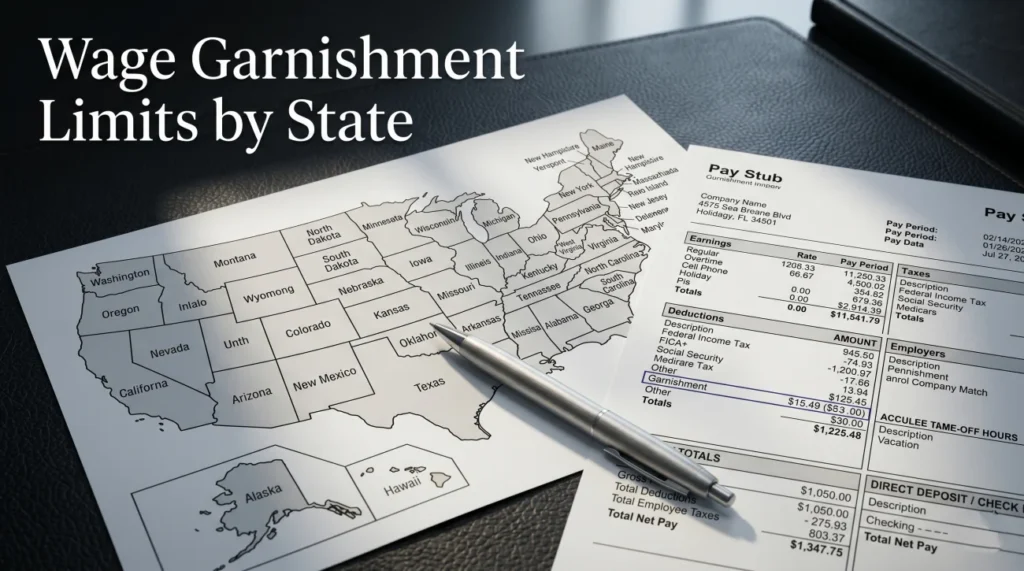
- Federal law caps consumer wage garnishment at 25 percent of your disposable earnings, but many states have passed laws to lower that limit and protect more of your paycheck.
- When state laws conflict with federal laws regarding garnishment limits, your employer is legally required to use whichever calculation leaves you with more take-home pay.
- Four states completely prohibit wage garnishment for consumer debts, while others like Florida offer massive exemptions for heads of household.
- National employers often make calculation errors, applying the federal maximum instead of your specific state’s stricter protections, which means you must audit your own paystub.
The Hidden Rule That Protects Your Paycheck
When a court judgment is finalized and a debt collector targets your income, the first number you usually hear is 25 percent. Most people assume this federal cap is the final word on how much money can legally be siphoned out of their paycheck. From my experience inside the collections industry, I can tell you that assuming the federal limit is your only protection is a costly mistake.
I spent years working inside collection agencies and buying debt portfolios. We knew exactly which states made it easy to extract funds and which states threw up massive legal roadblocks. The reality is that wage garnishment limits by state vary wildly. Some states offer zero additional help, leaving you exposed to the maximum federal extraction. Other states cap the damage at 15 percent, 10 percent, or prohibit consumer debt garnishment entirely.
If your state offers more protection than the federal government, the debt collector and your employer must follow the state rule. They do not get to choose the option that pays the creditor faster.
However, getting an out-of-state collection attorney and a corporate payroll department to apply the correct, highly specific state math is not automatic. In many cases, no one is double-checking the math but you. This guide will walk you through how state and federal laws interact, which states offer the strongest shields, and how to verify that your employer is not illegally over-garnishing your wages.
The Golden Rule: Whichever Leaves You With More Money
To understand state limits, you first have to understand the baseline. Title III of the federal Consumer Credit Protection Act creates the absolute floor for wage protection across the entire United States. It dictates that a creditor collecting on a standard consumer debt can take the lesser of two amounts.
They can take 25 percent of your disposable earnings, or they can take the amount by which your weekly disposable earnings exceed 30 times the federal minimum wage. If you want to see exactly how those two tests are calculated against your gross income, I highly recommend reviewing our complete breakdown of the exact mechanics of calculating disposable earnings.
The federal law is a protective floor, meaning states are not allowed to drop below it. A state cannot pass a law saying debt collectors are allowed to take 40 percent of a consumer’s paycheck. However, states are completely free to build the floor higher. They can pass laws saying collectors can only take 10 percent, or that low-income earners are completely exempt.
Key Point: When a state law and a federal law clash over wage garnishment limits, the law that results in the smallest deduction from your paycheck always wins.
This sounds straightforward, but in practice, it creates administrative chaos. If you live in a state with strict protections, but you work for a massive national corporation headquartered in a state with no protections, the payroll software often defaults to the federal 25 percent standard. The employer receives the court order, plugs it into their system, and starts taking a quarter of your disposable income without realizing your specific state law caps it at a much lower rate.
Inside the agency, we relied heavily on automated payroll systems making errors in our favor. When we served a garnishment order to a massive national retailer, we knew their HR software would frequently default to the federal 25 percent limit, even if the consumer lived in a state that capped it at 10 percent. We never corrected them. The burden was entirely on the consumer to catch the error.
Human resources departments are not consumer protection experts. They view garnishments as a compliance burden, not an opportunity to advocate for you. If you want your state’s protections applied, you have to know what they are.
States Stricter Than the Federal Baseline
Many states have recognized that losing 25 percent of your take-home pay can instantly push a family into poverty. To counter this, they have passed their own specific formulas. Because these formulas are more protective than the federal guidelines, employers in these states must use them.
State laws change frequently, often triggered automatically when a state raises its minimum wage, but here is a conceptual look at how some of the most protective states operate differently than the federal government.
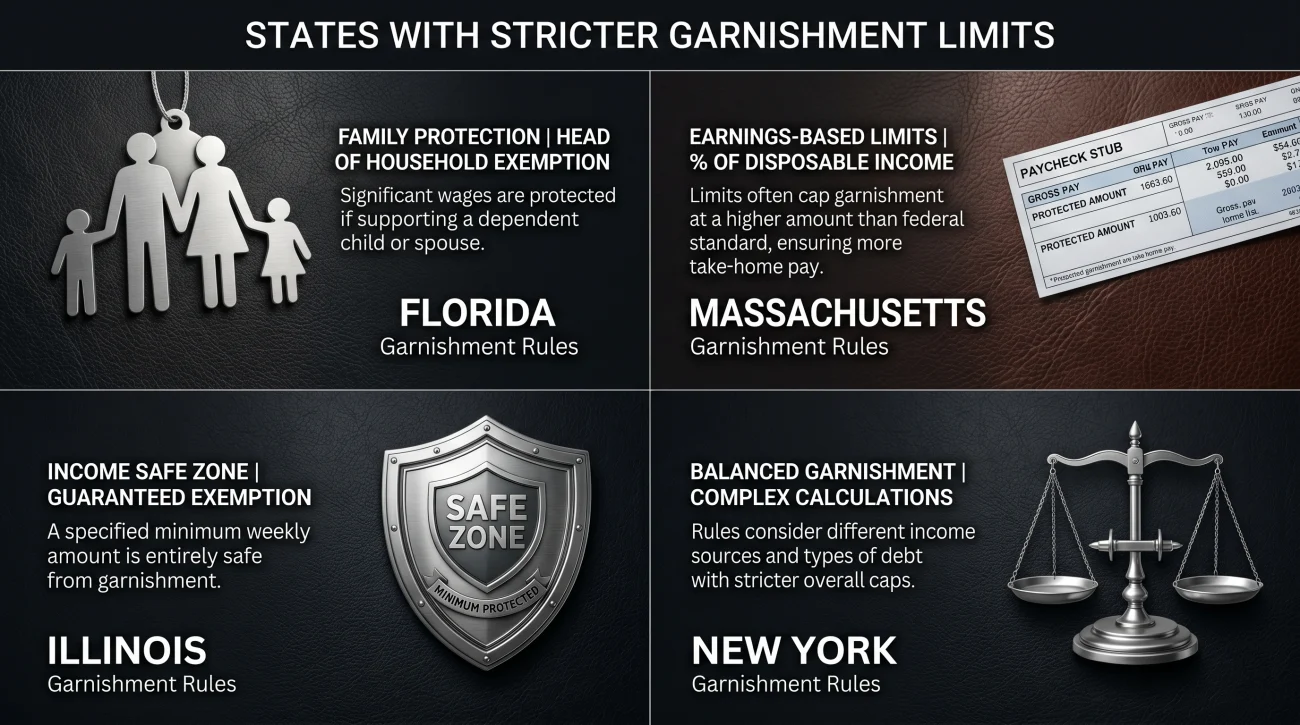
Florida and the Provider Shield
Florida offers a unique and highly powerful protection for individuals who support a family. If you qualify as the head of your family, meaning you provide more than half the financial support for at least one dependent, your wages are incredibly difficult to touch. Florida law generally exempts 100 percent of disposable earnings for a qualifying head of family earning less than a specific statutory weekly amount. Even above that amount, garnishment requires specific conditions to be met. If you are supporting dependents in this state, you need to fully understand Florida’s powerful protections for family providers because this exemption must be claimed actively in court.
Massachusetts Limits Gross Extraction
Massachusetts takes a completely different mathematical approach. Instead of calculating from the federal 25 percent mark, Massachusetts limits consumer debt garnishment to 15 percent of your gross wages, or your disposable earnings minus a significant multiple of the state minimum wage. By tying their exemption to their higher state minimum wage rather than the stagnant federal minimum wage, Massachusetts protects a massive chunk of income for middle and lower-tier earners.
Illinois Focuses on the Safe Zone
Illinois shifts the focus entirely. Instead of relying on the federal baseline, lawmakers there created a safe zone tied directly to their own state minimum wage. They cap the standard deduction at a strict 15 percent of gross wages. Furthermore, as long as your income falls below their specific state-calculated threshold, creditors cannot touch it. Because the state minimum wage is significantly higher than the federal rate, the protective net for an Illinois worker is much larger.
New York and the Dual Test
New York approaches the math from two different angles. They look at both a percentage of your gross income and a percentage of your disposable income, forcing the creditor to accept whichever number is smaller. In addition, they set a hard income floor based on the current New York state minimum wage. If your weekly earnings do not clear that floor, you are effectively immune to paycheck seizure.
Whenever a state legislature raises its minimum wage, the protective shield around your paycheck often expands automatically. This is why you must always check current state guidelines rather than relying on outdated online calculators.
States That Follow the Federal Maximums
On the opposite end of the spectrum are the states that have chosen not to write additional protections into their local statutes. If you live in one of these states, you are subject entirely to the federal rules.
In these jurisdictions, a judgment creditor can absolutely demand the full 25 percent of your disposable earnings. The states that generally follow only the federal guidelines without adding supplementary percentage caps for standard consumer debt include:
- 📌 Alabama
- 📌 Georgia
- 📌 Idaho
- 📌 Indiana
- 📌 Kentucky
- 📌 Louisiana
- 📌 Mississippi
- 📌 Missouri
- 📌 Montana
- 📌 Nebraska
- 📌 Ohio
- 📌 Tennessee
- 📌 Utah
- 📌 Wyoming
If you reside in one of these states, the federal formula is the only formula that applies. However, this does not mean you have to simply absorb the financial hit. If losing a quarter of your disposable income means you cannot buy groceries, pay rent, or cover basic medical needs, you can often fight back.
You will need to file a formal claim of exemption with the court demonstrating severe financial hardship. You must present your income and living expenses to show the judge that the standard garnishment amount leaves you unable to survive. While this relief is left to the judge’s discretion rather than guaranteed by a mathematical formula, a well-documented hardship claim is often your best defense in a federal-only state.
The Four States With Total Prohibition
There are four states where analyzing percentage limits is completely unnecessary for standard consumer debts. These states have decided that credit card companies, medical billers, and personal loan originators have no right to access a resident’s paycheck directly.
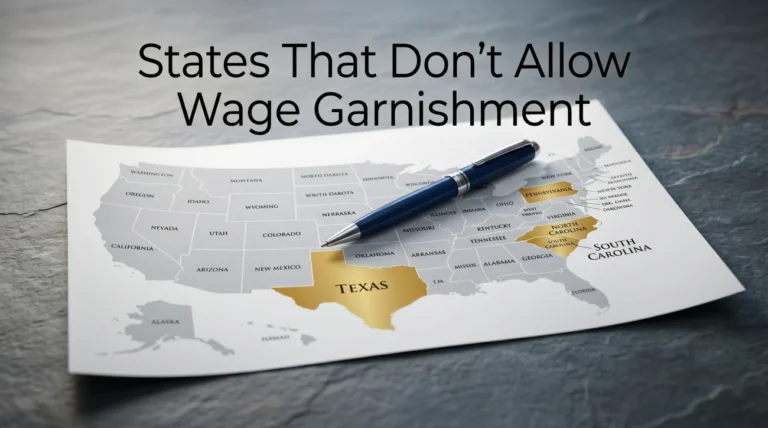
Texas, Pennsylvania, North Carolina, and South Carolina prohibit wage garnishment for standard civil judgments. If a credit card company sues you in Texas and wins, they get a judgment, but they cannot send an order to your employer to deduct money from your wages.
However, this prohibition is not a magical shield against all debt. It only applies to consumer debts. Even in these four states, your wages can still be heavily garnished for child support, alimony, federal student loans, and IRS tax levies.
The Bank Levy Shift
Collectors in these four states know they cannot touch your paycheck, so they often shift their strategy to a bank levy instead. Once your wages are deposited into your checking account, they lose their status as protected wages in many scenarios. A creditor with a judgment can freeze your bank account to extract those funds. If you live in a prohibition state, protecting your money does not stop at payroll. You must also understand how to shield your bank accounts and review the exact mechanics of states offering complete protection from paycheck seizure.
Signs You Are Currently Being Over-Garnished
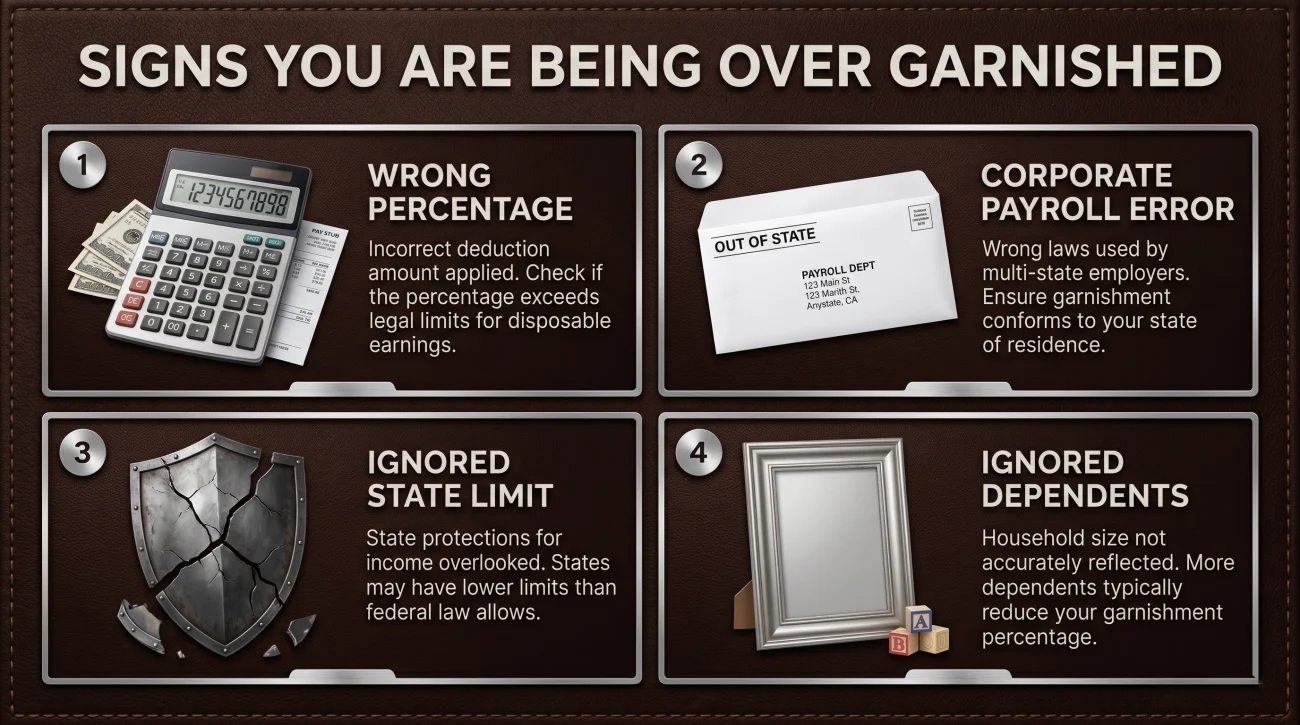
Because the interaction between state and federal law is complex, mistakes happen every single day. Employers blindly process orders, and collection law firms rarely go out of their way to notify you if they are taking too much. If you are currently dealing with an active paycheck deduction, you must look for the warning signs that your rights are being violated.
You need to take a hard look at your situation if any of the following apply to you right now:
- Your state is not on the “federal-only” list, yet exactly 25 percent of your disposable income is disappearing every week.
- You work for a large corporation that processed the order centrally, defaulting to the 25 percent standard without checking your local laws.
- The amount being taken leaves you below your state’s specific minimum wage protection floor.
- You support dependents, but your employer never asked you if you wanted to claim a family exemption before they started withholding.
When payroll algorithms get it wrong, they drain money that legally belongs in your bank account. If your calculations show that your state limits are being ignored, or if your employer is refusing to adjust the deduction based on your state’s laws, you cannot just accept it. The financial damage compounds with every single pay cycle. You need to take immediate action, which often requires having a professional review the legality of your paycheck deductions to force the collector and the employer to comply with the correct statutes.
How to Audit Your Employer’s Calculation
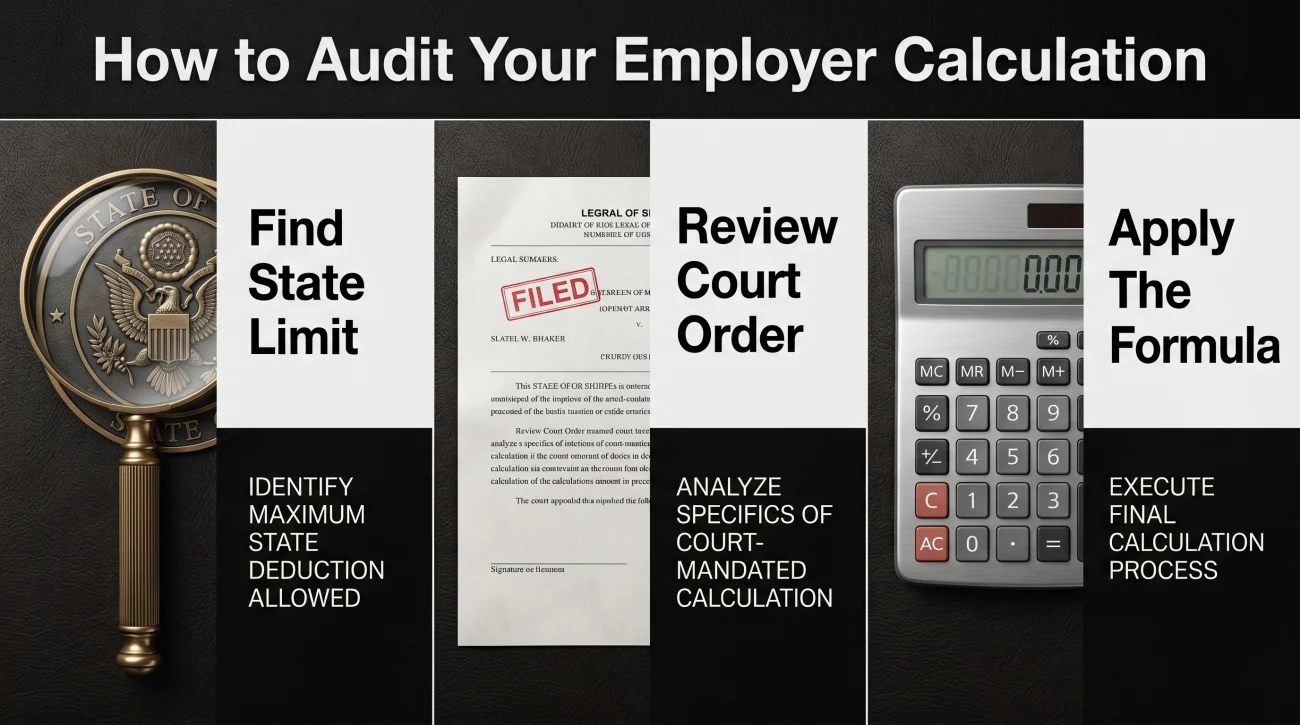
Debt collectors are not going to audit their own math to save you money. You have to audit your own paystub to ensure your specific state limits are being honored. Here is exactly how you take control of the calculation.
Calling the debt collector’s law firm to ask if they are sure they are taking the correct amount allowed by your state. They represent the creditor, not you.
Pulling your state’s current exemption limits from your Department of Labor website, running the math against your gross pay, and presenting your employer with the discrepancy in writing.
First, locate your state’s official Department of Labor or state court self-help website. Search for “wage garnishment limits” to find the current year’s exact percentages and minimum wage multipliers. Do not rely on third-party blogs for the final number, as state minimum wages update frequently, altering the math.
Second, request a copy of the garnishment order from your human resources department. Look at which state court issued the order. If the order was issued in a state different from where you live and work, this is a massive red flag. The laws of the state where you are employed and reside generally govern how much can be taken from your check.
Third, apply the formula. Calculate your disposable earnings by taking your gross pay and subtracting only legally required taxes. Do not subtract your health insurance or retirement contributions. Then, apply your state’s formula and compare it to the federal formula. Take whichever number is smaller.
If your employer is taking more than the smallest legal number, you must notify them immediately.
Identify the error + Cite the state statute + Demand immediate correction
Here is a basic template to open the conversation with your payroll department when you spot a discrepancy.
Subject: Urgent: Incorrect Wage Garnishment Calculation on Employee ID [Your ID]
Hello Payroll Department,
I am writing to formally request a review of the garnishment deduction currently being applied to my paychecks. I am a resident of and employed in [Your State].
Under [Your State] law, wage garnishment is limited to [State Limit, e.g., 15 percent of gross wages]. It appears my current deductions are being processed at the federal 25 percent maximum. State law requires that the calculation resulting in the smaller deduction be used.
Please review my account immediately, adjust the withholding to comply with [Your State] statutes, and advise on how the over-garnished funds from previous pay periods will be reimbursed.
Thank you,
[Your Name]
📌 Note: Your employer may be hesitant to change the deduction without a court order telling them to do so. If HR refuses to adjust the math to match state law, you will need to file a formal motion or claim of exemption with the court that issued the judgment to force the correction.
Final Thoughts on State Protections
Wage garnishment is designed to be painful, but it is not designed to be lawless. The interaction between federal minimums and state maximums is where consumers lose the most leverage simply because they do not know the rules. Debt collectors rely on your confusion. They rely on your employer’s administrative fatigue.
By understanding that your state likely offers a stronger shield than the federal baseline, and by taking the time to audit the math on your own paystub, you take the power back. If you catch an error, do not wait. Every pay period that passes is money wrongfully taken from your family.
You worked hard for that money, and you have every right to protect it using every legal tool available. If you need broader strategies to stop the extraction process, you should explore the broad options to halt wage garnishment entirely before your next payday.
❓ FAQ
💸 Does my state limit how much a debt collector can take from my paycheck?
It depends on where you live. While federal law caps it at 25 percent of disposable earnings, many states have passed laws lowering that cap to 15 percent or 10 percent, and four states prohibit it entirely for consumer debts.
🏢 What happens if my employer is in a different state than I live in?
Generally, the laws of the state where you live and perform your work dictate your garnishment protections. However, out-of-state judgments processed by national payroll centers frequently result in errors that you must catch and correct.
⚖️ Does federal law overrule my state’s wage garnishment laws?
Federal law acts as a floor, not a ceiling. If your state law offers more protection and results in a smaller deduction from your paycheck, your employer is legally required to follow the state law, not the federal law.
📉 Can a state take more than 25 percent of my wages?
For standard consumer debts like credit cards, no. Federal law forbids taking more than 25 percent. However, for child support, alimony, or IRS tax levies, both state and federal rules allow significantly more than 25 percent to be taken.
🚫 Are there states where creditors cannot garnish wages at all?
Yes. Texas, Pennsylvania, North Carolina, and South Carolina do not allow wage garnishment for standard consumer debt judgments. You are still vulnerable to government debts and child support in these states.
👨👩👧 Does having dependents change my state garnishment limits?
In many states, yes. Florida, for example, offers a massive “head of household” exemption that can protect 100 percent of your wages if you provide the majority of financial support for a dependent.
📝 How do I find out my exact state wage garnishment limits?
The most accurate and current information is found on your state’s Department of Labor website or your state court’s official self-help portal. Look for “wage exemptions” or “post-judgment collection rules.”
🔄 Do state garnishment rules change every year?
They often do. Many state exemptions are calculated as a multiple of the state minimum wage. Whenever a state raises its minimum wage, the amount of your paycheck protected from garnishment automatically increases.
☎️ Who do I call if my employer is taking too much from my check?
Start with your payroll or human resources department in writing. If they refuse to adjust the math to comply with state law, you will need to file a claim of exemption with the court or contact a consumer rights attorney.
🛑 Can I be fired if my state has weak garnishment protections?
Federal law protects you from being fired for a single debt garnishment, regardless of which state you live in. However, if you have multiple garnishments for different debts, that federal protection disappears, though some states offer extra protection.
Garnishment sits at the end of a process that starts earlier. These cover the full picture.
- How courts allow collectors to reach your paycheck and your bank
- Types of Wage Garnishment: Why the Debt Type Changes Everything About Your Options
- IRS Wage Levy: Why It's Different and How the IRS Can Take Almost Everything
- Can Your Employer Fire You for Wage Garnishment? The One-Debt Rule
- How to Claim a Wage Garnishment Exemption: The Forms, Deadlines, and What Happens Next
Garnishment is a symptom. These cover the options that address what caused it.
- The collector behavior that typically comes before the garnishment order
- How the lawsuit you may have missed is what created the garnishment
- How wage garnishment works and the options available to stop or limit it
- When a collector goes after your bank account instead of your wages
- How settling the underlying debt stops the garnishment permanently
Disclosure: The content on this site reflects direct experience inside the debt collection industry and is grounded in federal law and regulation. It is informational in nature. Reading it does not constitute legal advice and does not create any professional relationship. If you are dealing with a lawsuit, a judgment, or a legal deadline, consult a licensed attorney in your state before acting.