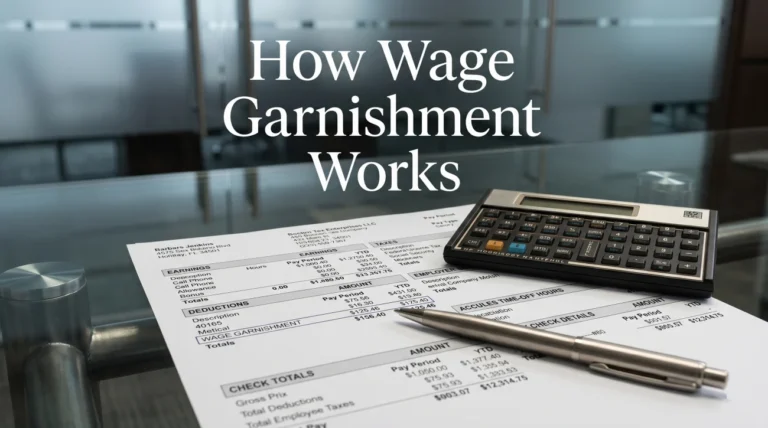
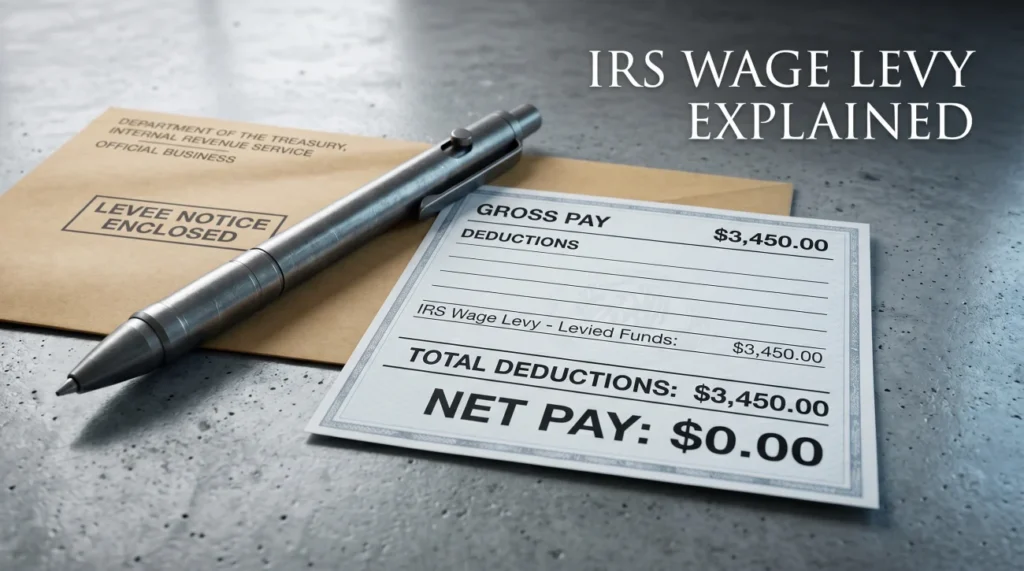
- An IRS wage levy does not require a court order or a lawsuit. The agency can order your employer to withhold wages administratively without ever taking you to a judge.
- Unlike consumer debt collection, the IRS is not bound by the 25 percent garnishment cap. They use a fixed exemption table that can legally take 70 percent or more of your paycheck.
- You have a strict 30 day window after receiving a Final Notice of Intent to Levy to request a hearing and pause the collection action before it reaches your employer.
- Filing an exemption statement with your employer immediately is critical once a levy arrives, or the IRS will automatically default to the maximum possible deduction.
The Reality of an IRS Wage Levy
A common call I used to field started with a panicked consumer reading their pay stub, completely bewildered as to why their take-home pay had dropped to almost zero. They would call our agency thinking we had somehow bypassed the 25 percent limit we were legally bound by. I had to tell them to look closer at the garnishment code on their pay stub. It was not us. It was the federal government.
Most consumers assume there is a universal safety net for wage garnishment. If a credit card company sues you and wins, federal law strictly caps what they can take at 25 percent of your disposable earnings. That is the safety net for private creditors, designed to ensure you can still pay for basic survival needs.
But when the federal government is the creditor, that safety net vanishes entirely. An IRS wage levy is a fundamentally different collection mechanism. It operates under its own statutory authority, it skips the civil court system entirely, and it has the absolute power to take a shocking percentage of your income.
During my years working inside the third-party collection industry, I spoke with thousands of consumers who were terrified that a standard debt collector was going to empty their bank account or take their entire paycheck on a Friday afternoon. I regularly had to explain that private collectors simply do not have that power. We had to file a lawsuit, win a judgment, and even then, we were strictly bound by the 25 percent cap. However, when those same consumers found themselves facing a tax debt, they mistakenly assumed the IRS was bound by the exact same limitations.
They are not. Understanding the different categories of wage garnishment is the critical first step to realizing what you are up against. If you have received a notice of intent to levy from the IRS, or if your employer just notified you that your paycheck is being seized, you are dealing with the most aggressive collection tool in the country. Here is exactly how it works and what mechanisms exist to stop it.
Why the IRS Bypasses the 25 Percent Cap
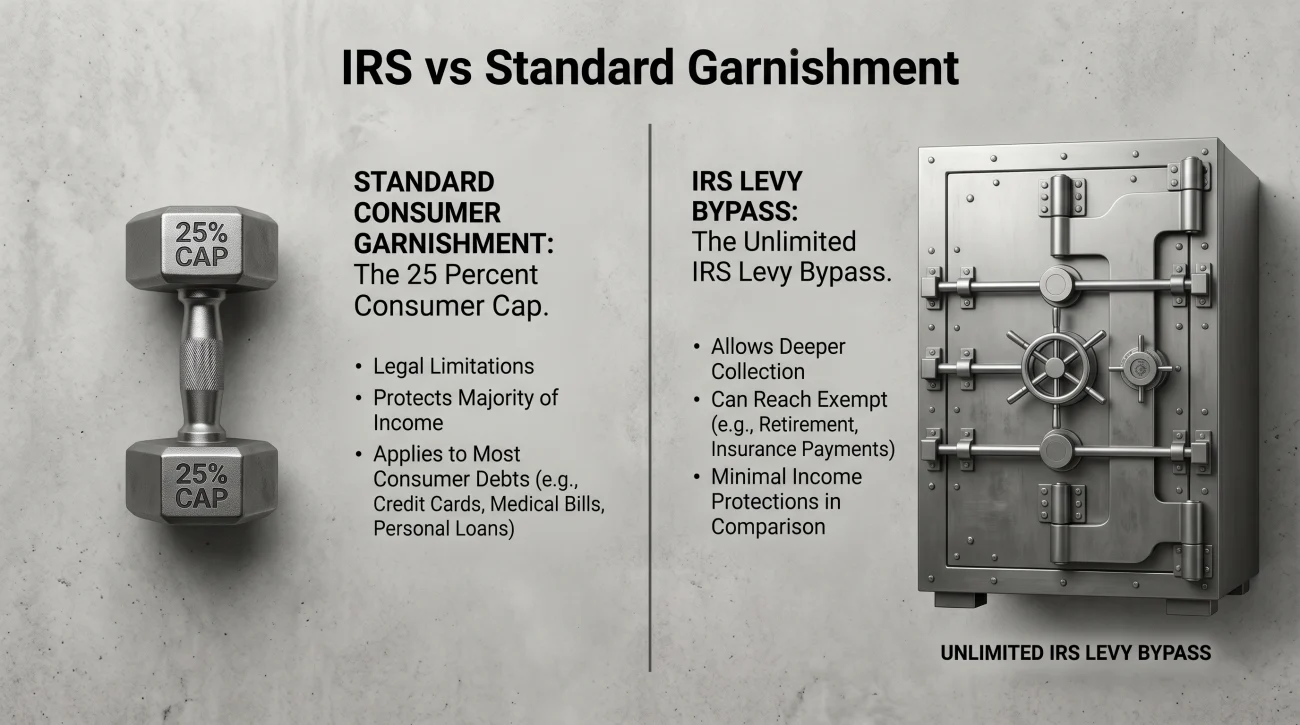
To understand why an IRS levy hits your household finances so hard, you have to look at the law that protects wages from private debt collectors. Title III of the Consumer Credit Protection Act (CCPA) is the federal law that limits standard wage garnishment to 25 percent of your disposable earnings.
However, the CCPA contains explicit, intentional exceptions. It specifically states that its limits do not apply to debts due for state or federal taxes. Because the IRS is exempt from the CCPA caps, they do not calculate your garnishment based on a maximum allowable percentage of your income. They calculate it based on a minimum allowable survival amount.
The mental shift consumers have to make is brutal. A private collector calculates what they are allowed to take. The IRS calculates what you are allowed to keep, and they take everything else. It is a completely inverted equation.
This exemption is built directly into federal law to give the government priority over every other type of unsecured debt. When I was reviewing portfolios for a national debt buyer, spotting an active IRS tax levy on a consumer’s credit profile meant an immediate file closure for us. We knew the IRS had absolute priority. If you currently have a credit card garnishment taking 25 percent of your check, an incoming IRS levy supersedes it, often leaving the private creditor with nothing until the tax debt is fully satisfied.
Furthermore, the IRS does not need to sue you to access these funds. They do not have to file a complaint in your local courthouse, serve you with a summons, or wait for a judge to sign a default judgment. They have administrative collection authority. Once they have assessed a tax debt and sent the statutorily required notices to your last known address, they can issue a levy directly to your employer’s payroll department.
The Math: How Publication 1494 Drains a Paycheck
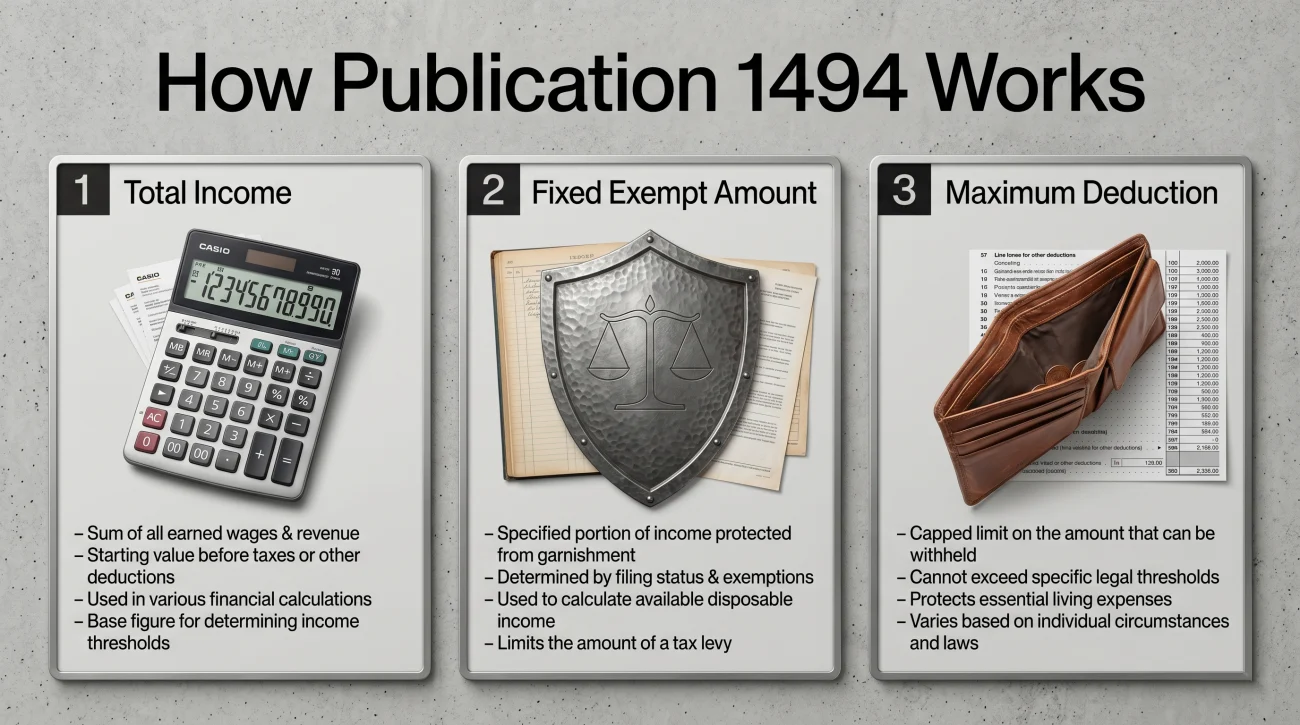
Instead of taking a percentage of your wages, the IRS uses a document called Publication 1494. This is a fixed exempt amount table updated annually. It determines exactly how much of your paycheck is protected from the levy based strictly on your filing status and how many dependents you claim.
Everything you earn above that fixed exempt amount is legally required to be sent to the IRS. There is no percentage cap. The more you earn, the higher the percentage the IRS takes, creating a ceiling on your take-home pay regardless of how many overtime hours you work.
⚠️ Warning: If your employer receives an IRS levy, they will give you a Statement of Exemptions and Filing Status. You typically have only three days to complete and return this form to your employer. Three days is rarely enough time to consult a tax attorney or build a strategy, which is exactly how the system is designed to work. If you fail to return it, the IRS forces your employer to calculate your exemption as “married filing separately with zero dependents,” which results in the absolute minimum protection and the maximum possible paycheck deduction.
A Practical Calculation Example
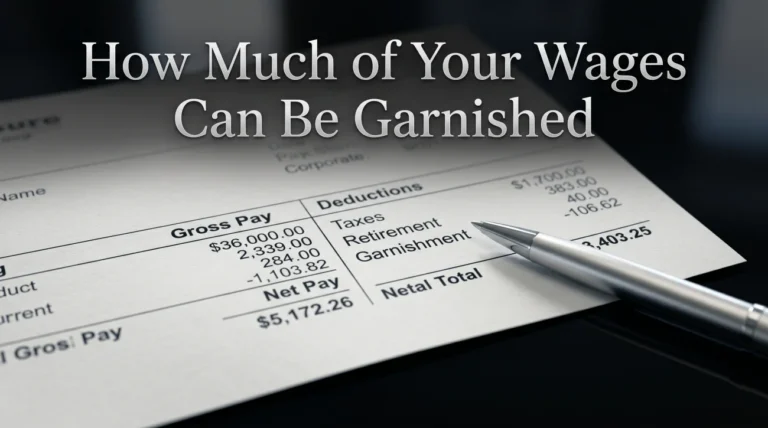
To see how aggressive this gets, look at a hypothetical worker in a recent tax year. Assume a single filer with no dependents who earns $1,000 a week in gross pay.
- Under a consumer debt judgment, the maximum a private collector could take is 25 percent of their disposable earnings (roughly $200, depending on taxes).
- Under an IRS levy, the Publication 1494 table might dictate that this single filer’s exempt amount is only $290 a week.
- The IRS legally takes everything above $290. Out of a $1,000 paycheck, the IRS could levy $710.
In this scenario, the IRS is taking roughly 70 percent of the worker’s gross income. To make matters worse, the Publication 1494 table is a national standard. It does not care if your rent is $2,500 a month in a major metropolitan city or $800 a month in a rural town. The exempt amount is identical everywhere. This rigid mathematical formula is why an active IRS levy almost immediately triggers a severe financial crisis for a household. You simply cannot budget your way out of a 70 percent pay cut.
The Notice Process and Your Action Window
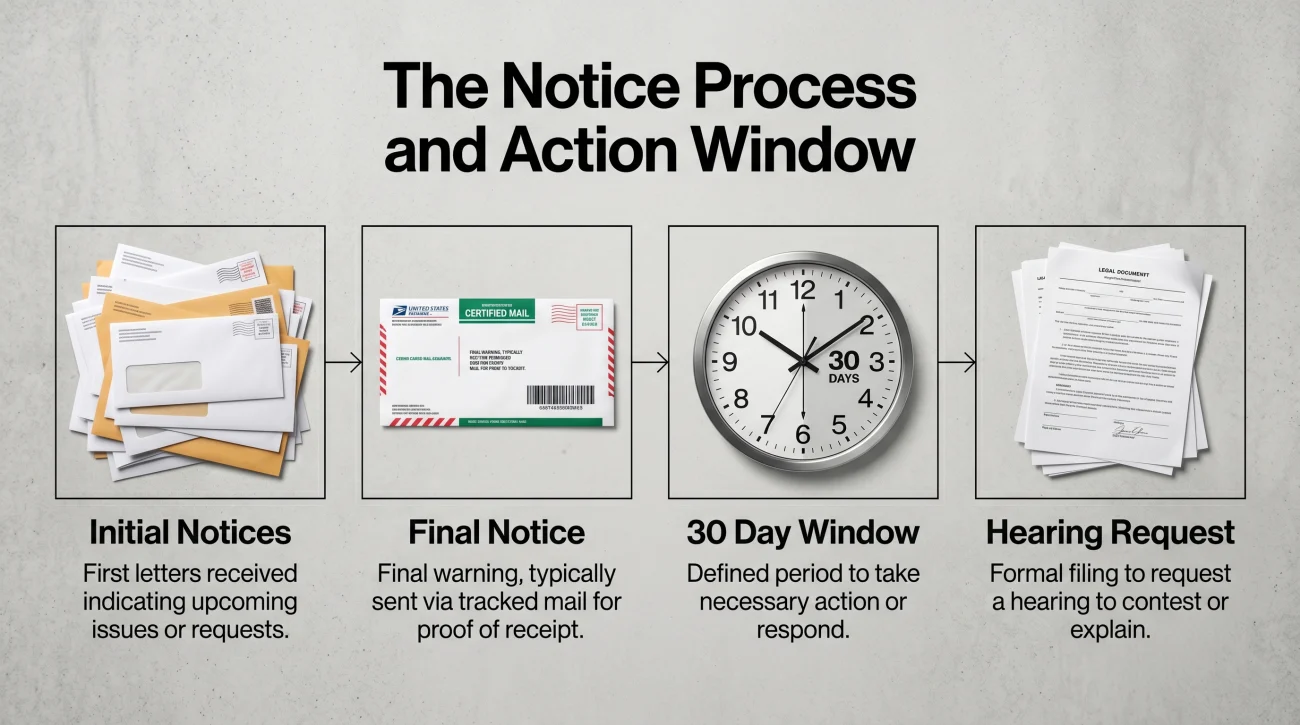
The IRS is powerful, but they are required to follow a strict notification sequence before they can touch your wages. They do not levy accounts by surprise. The problem is that many taxpayers are so intimidated by IRS correspondence that they throw the envelopes in a drawer unopened, assuming they will deal with it later.
The standard sequence involves multiple written requests for payment. Many taxpayers assume these are just generic bills and file them away. The escalation is subtle at first, but it accelerates. The CP14 is a basic notice of balance due. The CP501, CP502, and CP503 notices become increasingly urgent reminders. If those are ignored, the process jumps from standard mail to certified mail, escalating to the most important document in the sequence: The Final Notice of Intent to Levy and Notice of Your Right to a Hearing (often an L1058 or LT11 letter).
If you request a Collection Due Process (CDP) hearing within that 30-day timeframe, the IRS is legally required to pause the levy action while your hearing request is processed. A CDP hearing acts as a procedural roadblock. It gives you the chance to discuss resolution options with an independent IRS appeals officer before your paycheck is slashed.
If you let the notice period expire without responding, the IRS will fax or mail Form 668-W (Notice of Levy on Wages, Salary, and Other Income) directly to your employer. Once your employer has that form, they are legally bound to comply. They cannot advocate for you, they cannot delay the deduction, and they cannot refuse the IRS order without facing severe penalties themselves.
How to Stop or Release an IRS Wage Levy
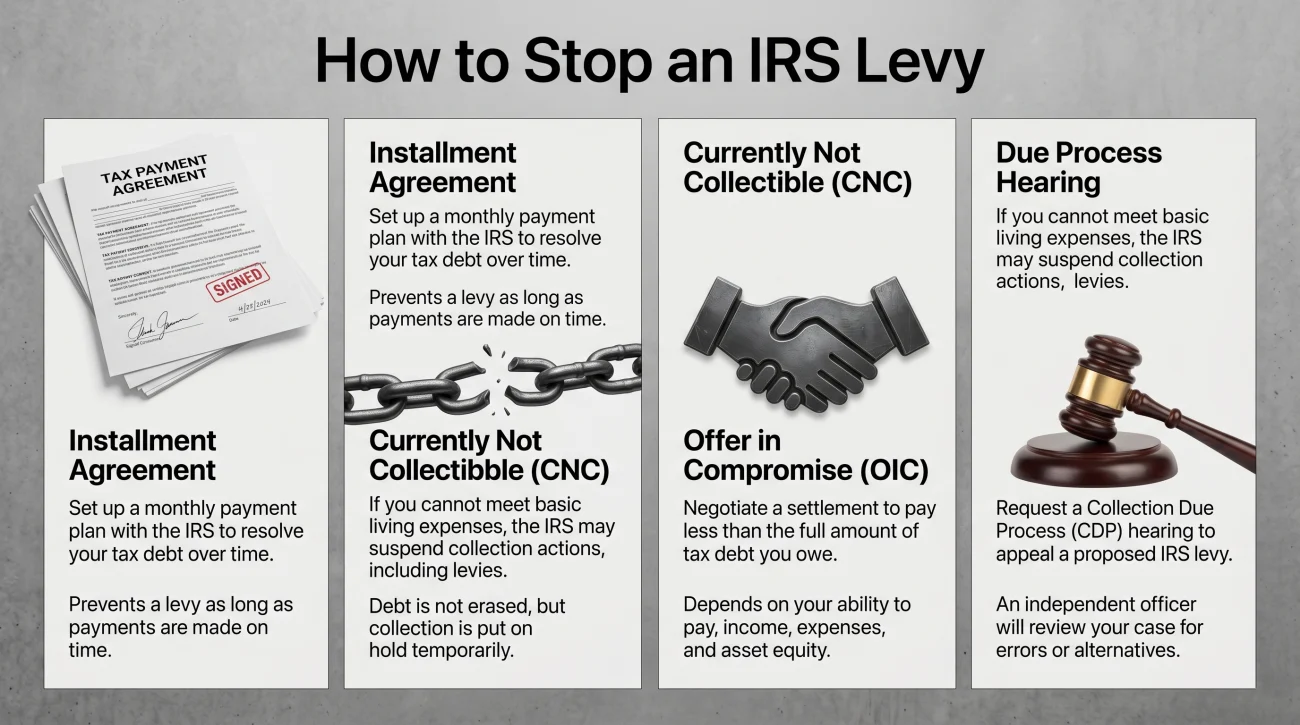
If you are actively being levied, panic is not a strategy. The IRS does not stop a levy just because it causes hardship; they stop it when you force them into one of their official resolution pathways. The options below range from the fastest fix to the most complex legal challenge.
1. Setting Up an Installment Agreement
The most common and straightforward way to release a wage levy is to establish a formal payment plan, known as an Installment Agreement. If you agree to pay the tax debt in monthly installments that the IRS finds acceptable, they will generally issue a release of levy to your employer. In my experience, as soon as the IRS accepts the agreement and processes the first payment, the release fax goes out to your payroll department. It is the most reliable “off switch” available.
2. Currently Not Collectible (CNC) Status
If an installment plan is impossible because you genuinely have no money left at the end of the month, the next step is applying for Currently Not Collectible status. You must provide a detailed financial statement (usually Form 433-F or 433-A) documenting your income, assets, and monthly expenses. The IRS compares your expenses to their national allowable standards. I have seen consumers living paycheck to paycheck successfully freeze levies this way, but you must be prepared to prove your poverty with exact numbers. The debt still accrues interest, but active collection stops temporarily.
3. Offer in Compromise (OIC)
For those who owe a massive balance they can never repay, an Offer in Compromise is the ultimate, albeit difficult, solution. It is an application to settle your tax debt for less than the full amount owed based on your “Reasonable Collection Potential.” Submitting an OIC in good faith generally suspends active collection activities while the IRS evaluates the offer. Do not fall for late night commercials promising to settle your tax debt for pennies; the IRS accepts these only when their math proves they cannot collect more before the statute of limitations expires.
4. Collection Due Process Hearing
Finally, if you are still inside the pre-levy warning period, requesting a CDP hearing using Form 12153 is your emergency brake. This is the tactical move I always recommend if the clock is still ticking: it stops the levy from starting and forces a human appeals officer to look at your file. This buys you the critical time needed to prepare a financial statement or propose a payment plan without the pressure of an active garnishment draining your bank account.
What Does Not Work Against the IRS
When consumers panic about a massive reduction in their take home pay, they often attempt strategies that might temporarily confuse a private debt collector but will fail completely against the federal government.
- ❌ Quitting and changing jobs. A standard consumer garnishment requires the collector to locate your new employer and serve new paperwork. The IRS, however, receives quarterly wage reports tied to your Social Security Number. The levy will simply follow you to your next job, often within a few months. This administrative tracking is a power they share with agencies executing federal student loan wage garnishment.
- ❌ Filing for bankruptcy as a quick fix. Filing for Chapter 7 or Chapter 13 bankruptcy does trigger an automatic stay, which pauses most collection actions immediately. However, how bankruptcy can stop wage garnishment works differently for taxes. While the stay halts the levy temporarily, recent tax debts generally survive Chapter 7 bankruptcy completely intact. In Chapter 13, priority tax debts must be repaid in full through your court structured plan.
- ❌ Asking your employer to ignore the notice. Your employer is legally liable for the funds if they fail to comply with an IRS levy. They will not risk their own business to protect your paycheck.
While quitting your W-2 job or filing a quick bankruptcy will not solve an IRS levy, there are specific situations where standard resolution tactics fall short and you need to escalate the matter.
Signs You Need Advanced Intervention
Most levies can be resolved through an Installment Agreement or CNC status. However, some scenarios break the standard mold. If you fall into any of the following categories, you are facing a highly complex collection environment that requires immediate, advanced strategy.
- You transitioned to self-employed or 1099 work. If you leave a traditional W-2 job to avoid a wage levy, the IRS will simply shift their tactics. They will issue a bank levy or an Accounts Receivable levy directly to your clients, which can freeze your independent income entirely and damage your business relationships.
- The levy is causing an immediate economic threat. If the deduction means you will be evicted, face foreclosure, or cannot afford life sustaining medical care, and the standard IRS phone lines are not processing your hardship claim fast enough, you need to escalate to the Taxpayer Advocate Service (TAS). TAS is an independent organization within the IRS that can issue a Taxpayer Assistance Order to intervene in extreme hardship cases.
- You have competing levies from both the IRS and the state. If both a state tax agency and the IRS have issued levies against your paycheck simultaneously, priority rules apply. Navigating which agency gets paid first and protecting enough income to survive becomes a jurisdictional battle.
Attempting to navigate IRS resolution programs while your income is actively being drained is incredibly difficult. If you are dealing with independent contractor levies, severe economic hardship, or competing agency orders, you need to review the overarching strategies to stop wage garnishment. More importantly, you should strongly consider evaluating your options with a wage garnishment defense professional who understands the specific financial disclosures required to negotiate a levy release.
Final Thoughts on Facing an IRS Levy
An IRS wage levy is the ultimate blunt force collection tool. It is designed to be devastating enough to force you to the table. The lack of a percentage cap is what makes it so dangerous, and the administrative bypass of the court system is what makes it so fast.
But remember, the IRS is fundamentally a massive bureaucracy that processes paperwork. They want compliance, not your complete financial ruin. Once you understand the specific forms and exemptions they require, you can beat them at their own administrative game. Pick your resolution path, file the necessary paperwork, and force them to release your paycheck.
❓ FAQ
📉 How much of my paycheck can the IRS take?
There is no percentage limit. The IRS uses a fixed exemption table (Publication 1494) based on your filing status and dependents. They leave you that exact exempt amount to live on, and they take 100 percent of everything you earn above that number.
⚖️ Does the IRS have to take me to court to garnish my wages?
No. The IRS has administrative collection authority. They do not need to file a civil lawsuit, serve you with court papers, or wait for a judge’s order. They can issue the levy directly to your employer after sending the required statutory notices.
🛑 How do I stop an IRS wage levy once it starts?
You must negotiate a resolution directly with the IRS. This typically involves setting up an Installment Agreement, proving financial hardship to get Currently Not Collectible (CNC) status, or submitting an Offer in Compromise. Once an agreement is reached, the IRS sends a release order to your employer.
⏱️ How much warning do I get before the IRS levies my pay?
The IRS must send a “Final Notice of Intent to Levy and Notice of Your Right to a Hearing” at least 30 days before issuing the levy. This is your critical window to request a hearing and pause the action.
🏢 Can my employer refuse to process the IRS levy?
No. Employers are legally obligated to comply with an IRS Notice of Levy on Wages. If an employer refuses to withhold the funds, they can become personally liable for the amount they failed to collect, plus penalties.
📄 What happens if I do not fill out the exemption form my employer gives me?
If you fail to return the Statement of Exemptions and Filing Status within the required time, the IRS requires your employer to calculate your exemption as “married filing separately with zero dependents.” This results in the smallest possible protected amount and the largest possible deduction from your check.
🏃 What if I quit my job to avoid the IRS levy?
The current levy stops because you no longer receive a paycheck from that employer. However, the IRS tracks your employment through your Social Security Number and quarterly tax filings. They will quickly locate your new employer and issue a new levy.
🏛️ Will filing for bankruptcy clear my IRS tax levy?
Filing for bankruptcy triggers an automatic stay that temporarily pauses the levy. However, most recent income tax debts are not dischargeable in a Chapter 7 bankruptcy, meaning you will still owe them. In a Chapter 13 bankruptcy, priority tax debts must be repaid in full through your court structured plan.
Garnishment sits at the end of a process that starts earlier. These cover the full picture.
- How courts allow collectors to reach your paycheck and your bank
- Received a Wage Garnishment Notice: What It Means and What You Must Do Before the Window Closes
- Wage Garnishment Limits by State: Which States Protect More Than Federal Law Requires
- Types of Wage Garnishment: Why the Debt Type Changes Everything About Your Options
- Child Support Wage Garnishment: Why the Rules Are Different - and What You Can Actually Do
Garnishment is a symptom. These cover the options that address what caused it.
- The collector behavior that typically comes before the garnishment order
- How the lawsuit you may have missed is what created the garnishment
- How wage garnishment works and the options available to stop or limit it
- When a collector goes after your bank account instead of your wages
- How settling the underlying debt stops the garnishment permanently
Disclosure: The content on this site reflects direct experience inside the debt collection industry and is grounded in federal law and regulation. It is informational in nature. Reading it does not constitute legal advice and does not create any professional relationship. If you are dealing with a lawsuit, a judgment, or a legal deadline, consult a licensed attorney in your state before acting.