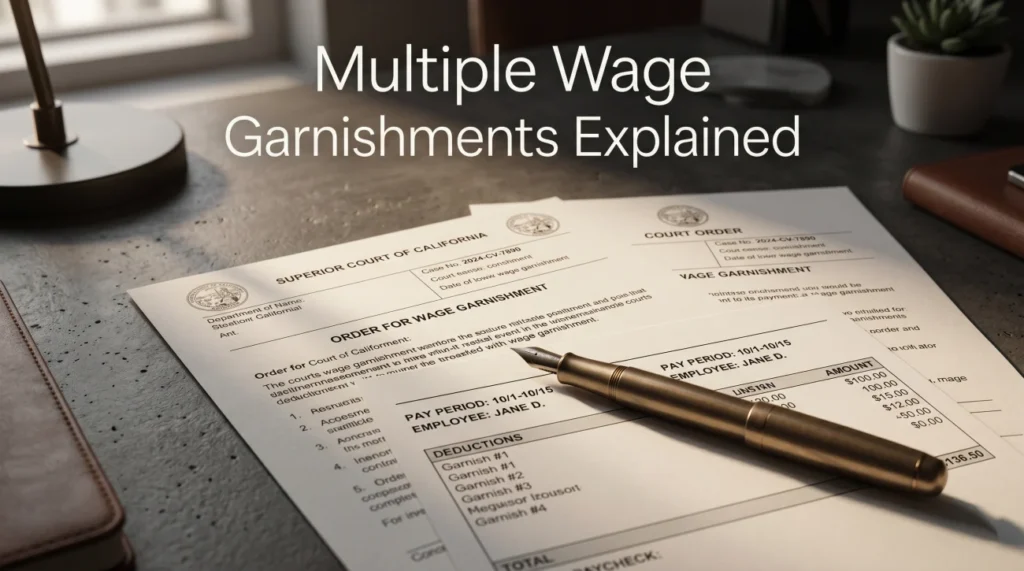
- Priority rules dictate who gets paid first when multiple garnishments hit your paycheck. The type of debt always overrides the date the order was received.
- Child support and tax levies sit at the top of the priority ladder. Consumer debt judgments for things like credit cards or medical bills fall to the very bottom.
- Federal limits still protect your baseline income. Higher priority debts can exhaust your legally garnishable wages, leaving lower priority creditors with nothing but a spot in the waiting line.
- Garnishment queues do not transfer automatically if you change jobs. Creditors must locate your new employer and file fresh paperwork, which resets their position in line.
- Federal job protection applies to one single indebtedness. Having garnishments for two or more separate debts removes your federal protection against termination.
The Reality of Facing Two Wage Garnishments at Once
Finding out your wages are going to be garnished is incredibly stressful. Finding out a second creditor has filed an order against your paycheck while the first one is still active can feel like complete financial suffocation. Most people assume that if two different creditors have court orders, they will both take a piece of your paycheck until you have absolutely nothing left to live on.
That is not how the collection system works. Federal law strictly governs what happens when multiple wage garnishments collide at your payroll department. There is a rigid priority ladder that dictates exactly who gets paid first. More importantly, there is a hard mathematical ceiling on how much can be taken from you in total, regardless of how many creditors are standing in line.
During my twelve years managing accounts inside third party collection agencies, dealing with multiple garnishments was a daily occurrence. I reviewed thousands of files. The most frustrating update my collectors could ever receive from an employer was a notice stating there was a prior garnishment already active on the consumer. We knew exactly what that meant. It meant our hard won court judgment was going into an HR filing cabinet to wait. Sometimes we waited for months, and sometimes we waited for years, while a higher priority debt took the legally allowed maximum.
If you have more than one garnishment order heading for your employer, you need to understand these priority rules. You must learn how the math actually limits your financial exposure and how a queued garnishment creates unique negotiation leverage. Understanding these mechanics gives you back a measure of control.
The Priority Ladder: Type Overrides Arrival Time
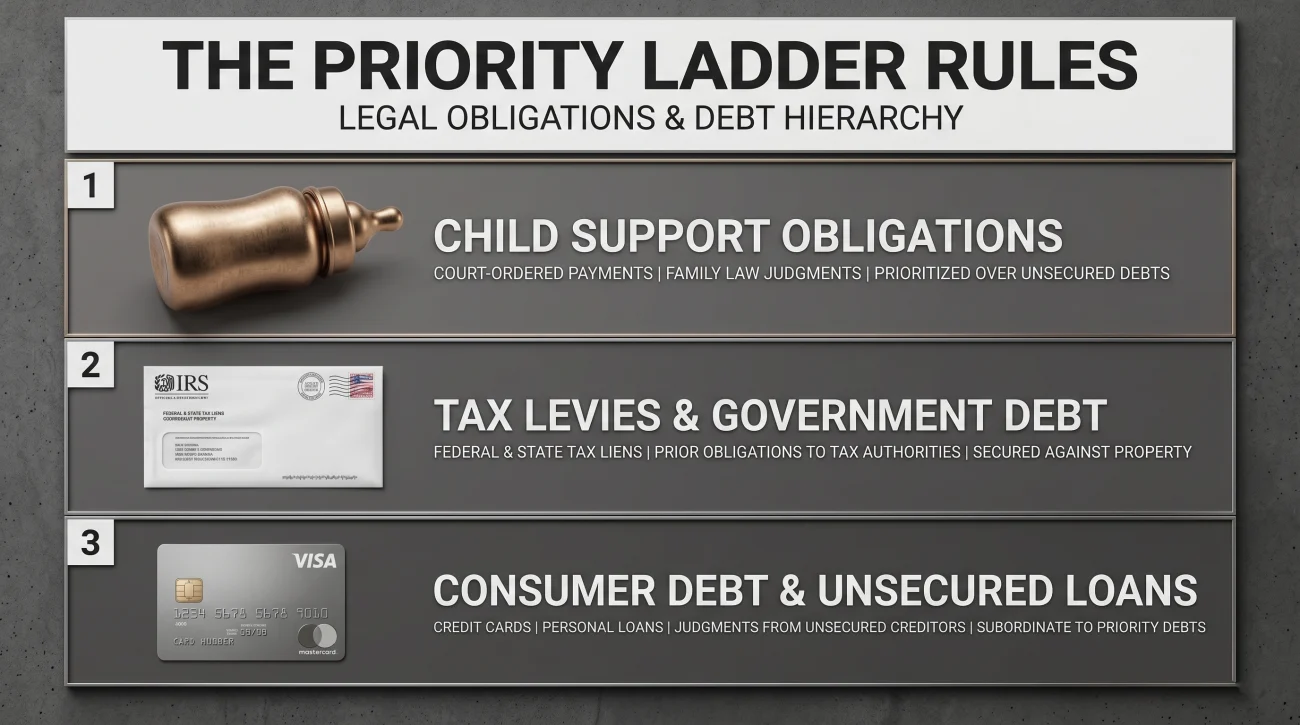
When two or more garnishment orders arrive at your employer, the payroll department cannot simply split the money evenly between them. They also cannot just pay the one that arrived first. They must follow a strict legal hierarchy based entirely on the type of debt.
The fundamental rule of multiple garnishments is that the type of debt always overrides the arrival time. A high priority debt that arrives today will instantly jump ahead of a low priority debt that has been garnishing your wages for six months.
| Priority Level | Type of Debt | How It Works in the Queue |
|---|---|---|
| First Priority | Child Support and Alimony | Always takes precedence over all other debts, regardless of when the order was received by the employer. |
| Second Priority | Federal Taxes (IRS Levies) | Jumps ahead of consumer debt and student loans. Only takes a back seat if a child support order was established before the tax levy arrived. |
| Third Priority | Federal Student Loans and Admin Debts | Takes priority over regular consumer judgments but sits below family support and tax obligations. |
| Lowest Priority | Consumer Debt (Credit Cards, Medical, Personal Loans) | Paid last. If multiple consumer debts arrive, they are paid in the exact order the employer received them. |
This ladder explains why a private debt collector might suddenly stop receiving payments from your paycheck out of nowhere. If an income withholding order for child support suddenly arrives at your HR department, the employer must immediately prioritize the family support obligation. The consumer debt gets pushed to the side, completely legally.
If you are trying to map out your financial survival, identifying where your specific debts sit on this ladder is your first necessary step. A thorough evaluation of a comprehensive overview of how to stop wage garnishments requires knowing exactly who is holding the leverage at any given moment.
The Total Cap Limitation and Disposable Earnings
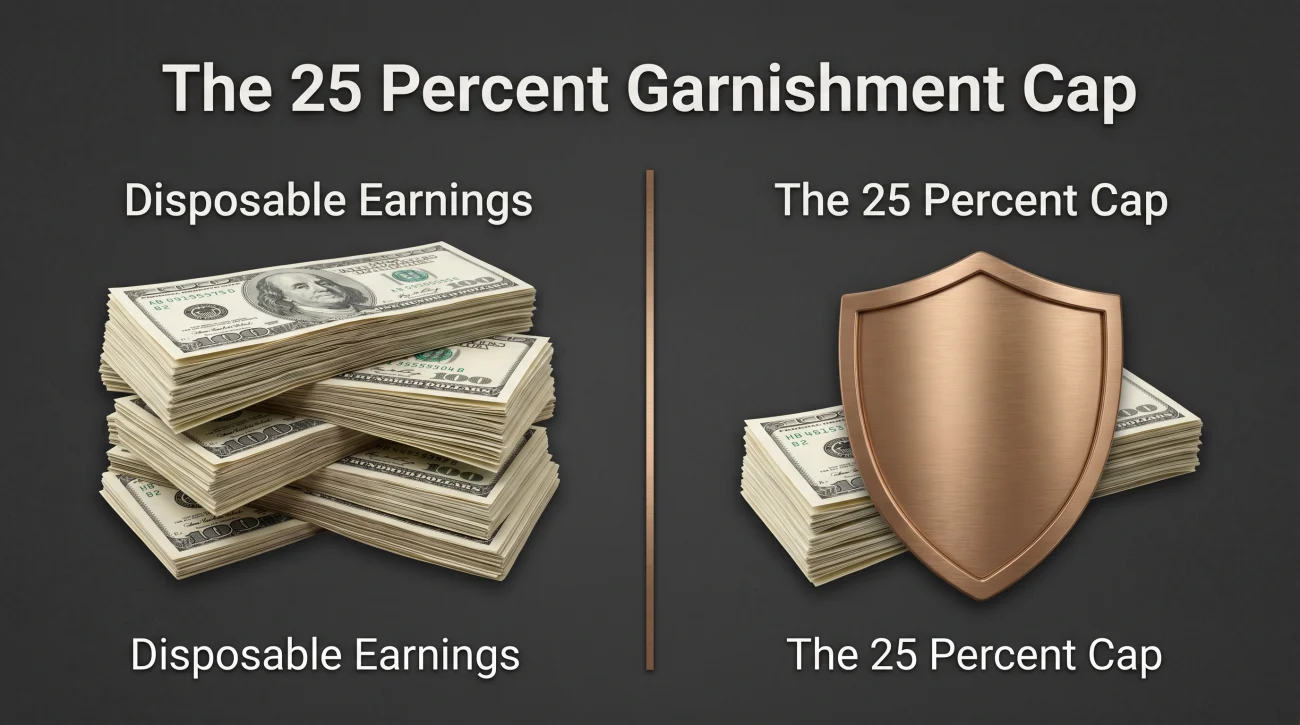
The biggest fear I hear from consumers is that two creditors will simply combine their allowed percentages, taking half of their paycheck. Fortunately, federal law provides an absolute shield against multiple consumer judgments draining your entire livelihood. Title III of the Consumer Credit Protection Act creates a firm ceiling. No matter how many consumer creditors sue you, the total combined amount withheld for standard consumer debt cannot exceed 25 percent of your disposable earnings.
Disposable earnings are calculated as your gross pay minus legally required deductions like federal taxes, state taxes, Social Security, and Medicare. Voluntary deductions like your health insurance premiums, union dues, or retirement contributions do not reduce your disposable earnings. If you are unsure of the exact math, you should review how the federal limit on disposable earnings is actually calculated to ensure your baseline is correct.
If Creditor A is already taking the maximum allowed 25 percent limit, Creditor B cannot take a single penny. They must wait until Creditor A is paid off entirely. The law does not care that Creditor B went through the trouble of filing a lawsuit. If the cap is hit, the payroll door is closed.
Real World Math: When Different Debt Types Collide
The interaction between high priority debts and standard consumer debts is where the math gets complicated. Child support and alimony have entirely different limits. Under federal law, child support can take up to 50 or even 65 percent of your disposable earnings depending on your family situation. The IRS has no percentage cap at all. Consumer debt, however, is strictly trapped at 25 percent.
So what happens when a low priority consumer debt tries to garnish a paycheck that is already paying a high priority debt? The mathematics here dictate that the consumer debt gets frozen out. I have seen these scenarios play out in the collections industry constantly.
Scenario 1: Child Support Collides with Consumer Debt
Assume your weekly disposable earnings are exactly $1,000.
The Orders on File:
1. Child Support Order: Requires $400 per week (which is 40 percent of disposable earnings).
2. Credit Card Judgment: Demands the standard maximum of 25 percent.
The Result:
Child support takes top priority. The employer deducts the full $400. The federal cap for consumer debt is 25 percent, which means a maximum of $250 can be taken overall for standard creditors. However, because the child support deduction (40 percent) already exceeds the maximum consumer cap (25 percent), there is absolutely no room left for the credit card company.
The credit card garnishment gets $0. It is placed in a queue and will not receive any money until the child support obligation drops below the 25 percent threshold.
This is a critical point that collectors rarely explain voluntarily. If you are currently paying heavy family support obligations, you are essentially immune to standard consumer wage garnishment. Your available garnishment capacity is exhausted by the priority debt. If you need to understand how those specific limits are applied by state agencies, reviewing how family support deductions are administered will clarify the specialized math.
Scenario 2: IRS Levy Collides with Consumer Debt
Assume your weekly take home pay is $1,200. You are a single filer with one dependent, claiming head of household.
The Orders on File:
1. Active Credit Card Garnishment: Taking 25 percent ($300).
2. IRS Notice of Levy: Arrives on Tuesday.
The Result:
The IRS does not use a percentage cap. They use a fixed table of exempt income known as Publication 1494. According to the IRS table for your specific filing status, your legally protected weekly amount might be exactly $480.77. The IRS is entitled to take everything above that number.
Because the IRS is a higher priority than the credit card debt, they jump the line. Your employer leaves you with your $480.77 exempt amount. The IRS takes the remaining $719.23. The credit card company stops getting their $300 immediately because the IRS levy consumed all the available funds.
The First In Time Rule and The Waiting Queue
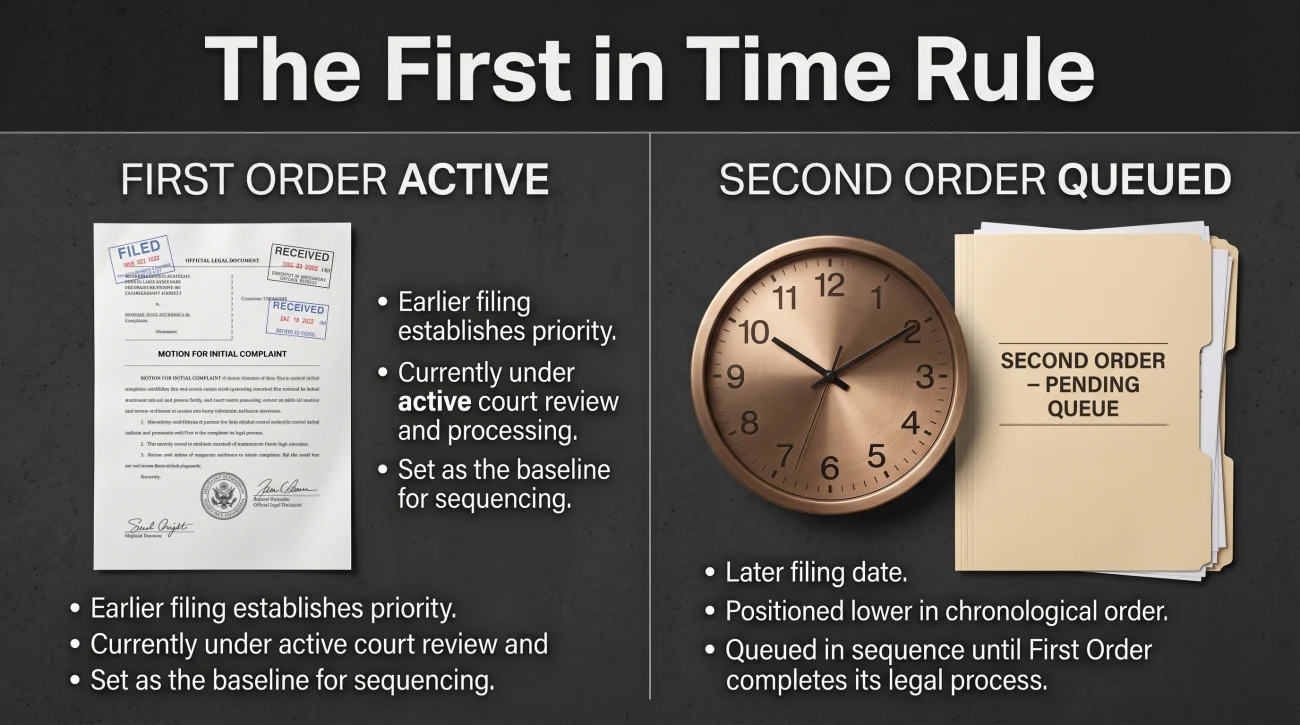
If you have multiple garnishments of the exact same priority level, the rule becomes incredibly simple. It is a strict system of first come, first served. In the collections industry, we referred to this as the race to the payroll department.
If a medical debt collector and a credit card debt buyer both win lawsuits against you, they are both holding lowest priority consumer judgments. The tie breaker is the exact timestamp on when your employer was legally served with the paperwork.
If the medical collector serves your HR department on Tuesday, and the credit card company serves them on Thursday, the medical collector wins the race. Your employer will deduct the maximum 25 percent and send it to the medical collector. The credit card company is placed in a holding pattern.
The employer holds the second order in a queue. Once the medical debt is paid down to a zero balance, the employer automatically activates the credit card garnishment on the very next pay cycle. You do not get a break between them.
Do queued garnishments ever expire?
This is a question many consumers fail to ask. Judgments do not last forever. Every state puts a strict expiration date on court judgments. If a credit card judgment is stuck in your employer’s queue behind a massive child support order for years, the clock is actively ticking against the collector.
If the judgment expires while the collector is waiting in line, the garnishment order dies with it. The burden is entirely on the debt collector to track this deadline and actively file legal paperwork to renew the judgment before it expires. If they forget, or if the debt buyer goes out of business while waiting, that queued order becomes completely unenforceable.
Negotiating from the queue
Being stuck in a garnishment queue is a collector’s worst nightmare. They spent money on court fees to get the judgment, and now they are seeing zero return on investment.
“When a collector on my floor found out their active garnishment was suspended because a child support order just hit the employer, their strategy changed instantly. They knew they would not see paycheck money for a long time. I would usually instruct them to pivot immediately and start searching for the consumer’s bank accounts to levy instead. The paycheck was a dead end.”
This “dead end” creates a massive tactical advantage for you. If you know a collector is sitting in second place behind a medical debt that will take three years to pay off, you hold the leverage. You can contact the queued collector and offer a highly reduced lump sum settlement to satisfy the account today. Remind them that they are stuck in line and will not see a dime from your paycheck for years. I have authorized deep settlement discounts specifically because I knew my agency was locked out of a paycheck by a prior garnishment.
Why Employer Payroll Mistakes Happen Frequently
HR representatives at small to midsize companies are rarely legal experts. When multiple court orders arrive commanding them to withhold money under threat of liability, they often panic and make expensive payroll errors.
The most dangerous mistake an employer makes is illegal stacking. This happens when an employer sees two consumer garnishment orders demanding 25 percent each, and they mistakenly deduct 50 percent of your paycheck to appease both courts simultaneously.
Another common error is illegal splitting. Some payroll managers try to play fair by taking your total 25 percent capacity and splitting it down the middle, sending 12.5 percent to Creditor A and 12.5 percent to Creditor B. This is entirely illegal under the first in time rule. The first creditor is legally entitled to the full 25 percent until satisfied.
Assuming your payroll software automatically handles complex federal priority limits and accepting a paycheck where deductions seem abnormally high.
Sending a polite email to HR the moment you know a second order has arrived, specifically asking them to confirm how they plan to queue the new order.
If you suspect a second garnishment is on the way, you need to establish a paper trail with your payroll department immediately.
Subject: Verification of garnishment limits on upcoming payroll
Hello Payroll Team,
I understand the company recently received a second wage garnishment order regarding my account. I want to proactively ensure my payroll is processed correctly under federal guidelines.
As I currently have an active garnishment taking the maximum 25% of my disposable earnings, can you please confirm that the new order will be queued, and that my total deduction will not exceed the 25% federal cap set by the Consumer Credit Protection Act?
Thank you for your help in verifying this calculation.
This simple email puts the employer on notice. Most payroll managers will forward a message like this straight to their legal department or their external payroll vendor, ensuring the correct caps and queues are applied before the checks are cut.
Does the Queue Follow You If You Change Jobs?
A common misconception is that a garnishment queue is attached to your Social Security number and automatically transfers to a new employer. It does not.
A writ of garnishment is a legal order directed at a specific employer. If you quit, get fired, or change jobs, the garnishment orders currently filed with your HR department die. Your old employer simply returns the paperwork to the court or the collector with a notice stating you are no longer employed there.
The creditors must then conduct a new employment search, locate your new job, and file brand new garnishment orders with your new HR department. The critical detail here is that changing jobs resets the race. The creditor who was stuck in second place at your old job might find your new employer first. If they serve their paperwork before the other creditor does, they take the first priority spot. However, while changing jobs might temporarily shuffle the line, having multiple creditors actively hunting your payroll department introduces a much more severe problem.
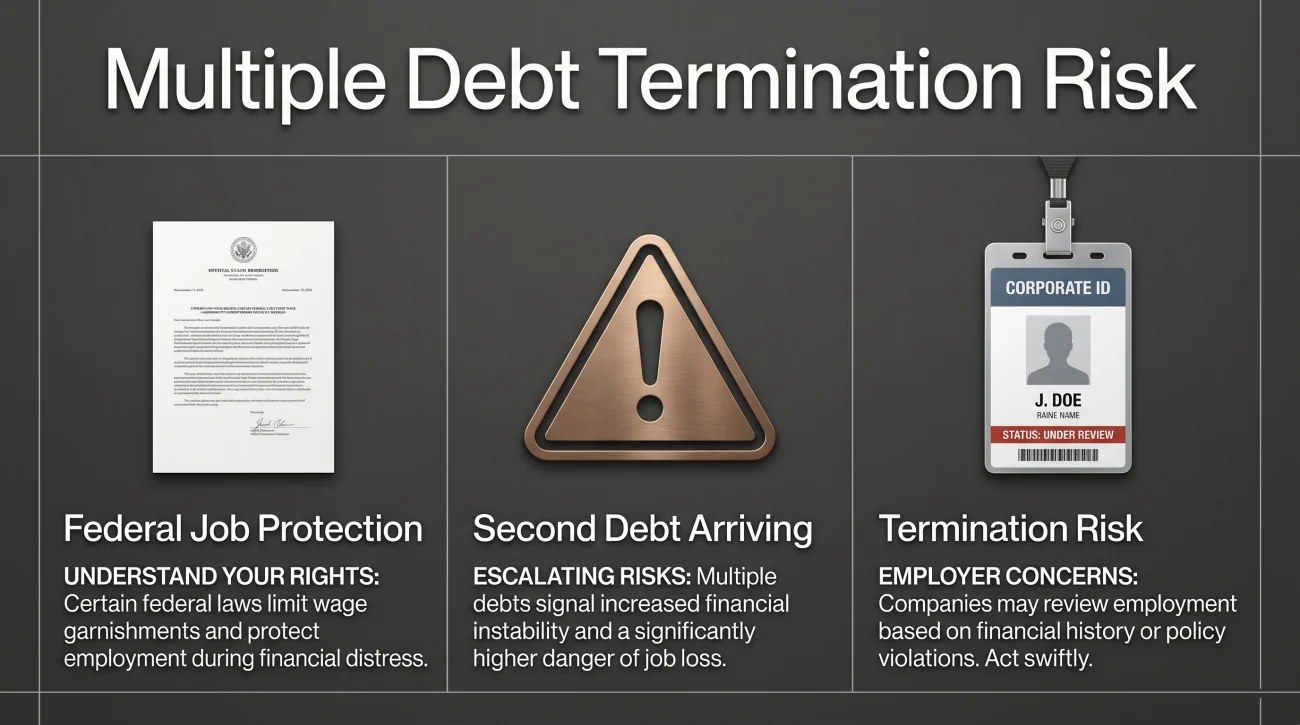
The Multiple Debt Termination Risk
That severe, often overlooked consequence involves your actual job security.
Federal law provides a shield against being fired because of a wage garnishment. However, that shield is incredibly narrow. The law explicitly states that an employer cannot fire you because your wages have been garnished for any one debt. It does not matter how many times a single creditor sends a levy attempt for that single debt. You are protected.
The moment a garnishment arrives for a second, distinctly separate debt, that federal protection vanishes entirely.
⚠️ Warning: If you have an active garnishment for a credit card, and an order for a medical bill arrives months later, your employer is legally permitted under federal law to terminate your employment based on the administrative burden of multiple garnishments.
Employers truly hate processing garnishments. It creates corporate liability, requires specific accounting workflows, and costs them administrative time. While highly automated corporate companies rarely fire employees over this, smaller employers absolutely will. They view multiple garnishments as a sign of personal financial instability that might bleed into your work performance.
Some states have stepped in to offer stronger protections than the federal baseline. If you are concerned about your job security, you need to review the federal job protection rules regarding paycheck levies to see if your specific state bans termination for multiple debts entirely.
Signs Your Multiple Garnishments Are Being Handled Illegally
When multiple creditors are fighting over your paycheck, the burden of ensuring the math is legal falls entirely on you. The courts do not double check your pay stubs. You must audit your own deductions every single pay period.
You need to take immediate action if you spot any of the following red flags on your payroll record:
- ❌ Your employer is deducting more than 25 percent of your disposable earnings to pay consumer debts.
- ❌ A consumer debt is actively taking money from your check while a child support order is simultaneously taking 25 percent or more.
- ❌ You received two consumer debt garnishment notices, and your employer is splitting the 25 percent deduction between the two collectors instead of paying the first one in full.
- ❌ A private debt collector is being paid ahead of an IRS tax levy that arrived on the same day.
If your paycheck math is wrong, or if multiple aggressive creditors have placed your job at risk, you are beyond the point of simple phone calls. The fastest way to force a collector to back down or correct an illegal garnishment is to have a professional review the collection orders. A consumer law attorney can instantly spot priority violations and demand immediate correction from your employer.
What to Do When the Second Order Arrives
If you have just been notified that a second garnishment order is hitting your employer, you must execute a specific process to protect your income and your job.
Step 1: Identify the debt type and verify the queue. Find out exactly who filed the new order. Pull your pay stubs and calculate your disposable earnings yourself to establish your exact 25 percent cap. Then, send the verification email to your HR department to ensure they understand that standard consumer debts must be queued, not stacked.
Step 2: Leverage the lockout. If a consumer debt collector is the one being pushed into the queue, inform them immediately. While you do not legally have to tell them about your child support or IRS levy, doing so forces them to realize their garnishment is practically useless right now. This is your window to offer a deeply discounted lump sum settlement to wipe out the judgment entirely while they are starved for leverage.
Step 3: Evaluate bankruptcy viability. If you have multiple consumer judgments queued up waiting to drain your paychecks for the next decade, negotiating one by one may not be feasible. Multiple active garnishments are the primary trigger for consumer bankruptcy.
Filing for Chapter 7 or Chapter 13 bankruptcy creates an immediate court injunction called the automatic stay. This order instantly halts all consumer wage garnishments, regardless of how many you have or where they sit in the queue. It forces the HR department to clear the board entirely. While bankruptcy is a major decision that requires professional guidance, it is often the most definitive tool for breaking a cycle of endless garnishment queues.
Final Thoughts on Navigating the Garnishment Queue
Having multiple garnishments filed against you is incredibly intimidating. However, the rules are designed to ensure you still have a baseline income to survive. Debt collectors rely heavily on the fact that most consumers do not understand priority rules or the hard cap on deductions.
Collection tactics are often designed to create panic, pushing you to believe your entire paycheck is gone so you will drain your savings or borrow from family to satisfy the debt. Do not let that pressure dictate your response. Trust the math. Verify your employer’s calculations, understand where your debts sit on the priority ladder, and strictly enforce the 25 percent cap. If the numbers do not add up, escalate the issue immediately to protect your livelihood.
❓ FAQ
💳 Can two credit card companies garnish my wages at the same time?
No. They can both have valid court orders on file with your employer, but they cannot actively take money simultaneously. The order received first will take up to the 25 percent maximum. The second order must wait in line until the first debt is entirely paid off.
⚖️ Do family support orders cancel out other garnishments?
They do not cancel them, but they do override them. Because family support is a priority debt, it gets paid first. If that deduction takes up 25 percent or more of your disposable earnings, standard consumer creditors are mathematically blocked from taking any money and are placed on hold.
📉 How much can they take if I have multiple garnishments?
For standard consumer debts, the absolute maximum your employer can withhold is 25 percent of your disposable earnings, no matter how many orders exist. However, if priority debts like child support or IRS levies are involved, the total percentage taken can be legally higher, up to 65 percent or more depending on the debt type.
⚠️ Can my employer just split the 25 percent between two debt collectors?
No, this is an illegal payroll practice. Under the first-in-time rule, the creditor whose order arrived first is legally entitled to the full allowable percentage until their judgment is completely satisfied.
🏢 Will changing jobs get rid of my queued garnishments?
Changing jobs forces the active and queued garnishments at your old employer to close. However, the underlying court judgments remain valid. The creditors will eventually locate your new employer and serve fresh paperwork, resetting the race for priority.
🛑 Does filing for bankruptcy stop a queued garnishment?
Yes. The automatic stay triggered by a bankruptcy filing immediately halts both active and queued consumer wage garnishments. Your employer must stop all related deductions, though family support obligations will continue.
Garnishment sits at the end of a process that starts earlier. These cover the full picture.
- How courts allow collectors to reach your paycheck and your bank
- Types of Wage Garnishment: Why the Debt Type Changes Everything About Your Options
- Can Social Security Be Garnished? What's Protected, and the Bank Account Trap That Isn't
- How Wage Garnishment Works: From Judgment to Paycheck Deduction
- Received a Wage Garnishment Notice: What It Means and What You Must Do Before the Window Closes
Garnishment is a symptom. These cover the options that address what caused it.
- The collector behavior that typically comes before the garnishment order
- How the lawsuit you may have missed is what created the garnishment
- How wage garnishment works and the options available to stop or limit it
- When a collector goes after your bank account instead of your wages
- How settling the underlying debt stops the garnishment permanently
Disclosure: The content on this site reflects direct experience inside the debt collection industry and is grounded in federal law and regulation. It is informational in nature. Reading it does not constitute legal advice and does not create any professional relationship. If you are dealing with a lawsuit, a judgment, or a legal deadline, consult a licensed attorney in your state before acting.