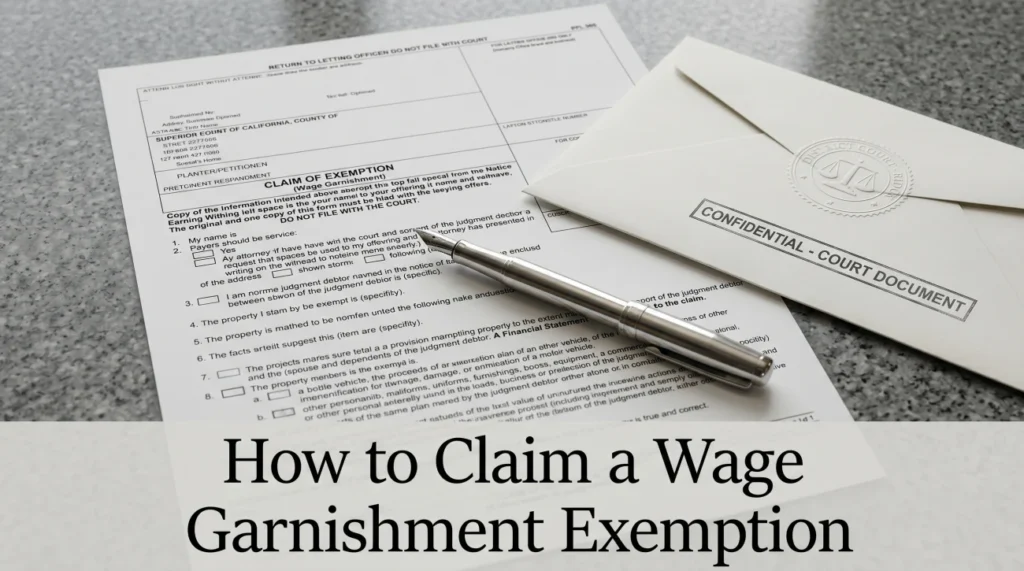
- Filing a claim of exemption is a legal process requiring specific court paperwork submitted before a strict, non-negotiable deadline.
- The form alone is not a pause button. Your employer must continue payroll deductions until a judge officially rules in your favor.
- You can protect your paycheck by proving your income falls into a protected categorical status or by demonstrating severe financial hardship.
The Reality of Claiming a Wage Garnishment Exemption
When you find out your wages are about to be garnished, the panic usually sets in immediately. But the legal system does build in safety valves to ensure people are not left completely destitute. These safety valves are called exemptions. The problem is that the courts do not apply these protections automatically. If you qualify for a wage garnishment exemption, you have to raise your hand, file the paperwork, and prove it.
In my twelve years working inside third-party collection agencies and a national debt buyer, I saw the garnishment process play out from the creditor’s side thousands of times. The biggest advantage a creditor has is consumer inaction. Most people who qualify for an exemption simply never file the paperwork. They assume that if they cannot afford the deduction, the court will somehow know and stop it. That is not how the system works.
You have a very narrow window of time to act. In most states, the clock starts ticking the moment you receive official notice. This guide walks you through exactly how to file your claim, what happens after you submit the forms, and why you need to prepare for your paycheck to be reduced while you wait for a judge’s decision.
Signs You Need to File an Exemption Immediately
Before diving into the procedural steps, you need to evaluate your immediate risk. The moment that notice hits your hands, the legal clock is already ticking, and the system is designed to take your money by default if you do not fight back. If any of the following scenarios apply to you, you cannot wait until next week to start your paperwork.
- ⚠️ You provide more than half the financial support for a child, spouse, or elderly parent, but your full wages are being targeted.
- ⚠️ The amount your employer plans to deduct will make it impossible for you to pay your rent, buy groceries, or keep your utilities turned on.
- ⚠️ Your only source of income is Social Security, disability, or VA benefits, and those funds are being threatened by a civil judgment.
- ⚠️ You received official paperwork from the court, but you have less than a week left before the stated deadline expires.
If you are looking at your financial reality and realizing the math simply does not work, you cannot afford to wait. In these high-stakes situations, getting professional legal advice to evaluate your defense options is often the safest move before you submit anything to the court.
The Two Main Routes to an Exemption
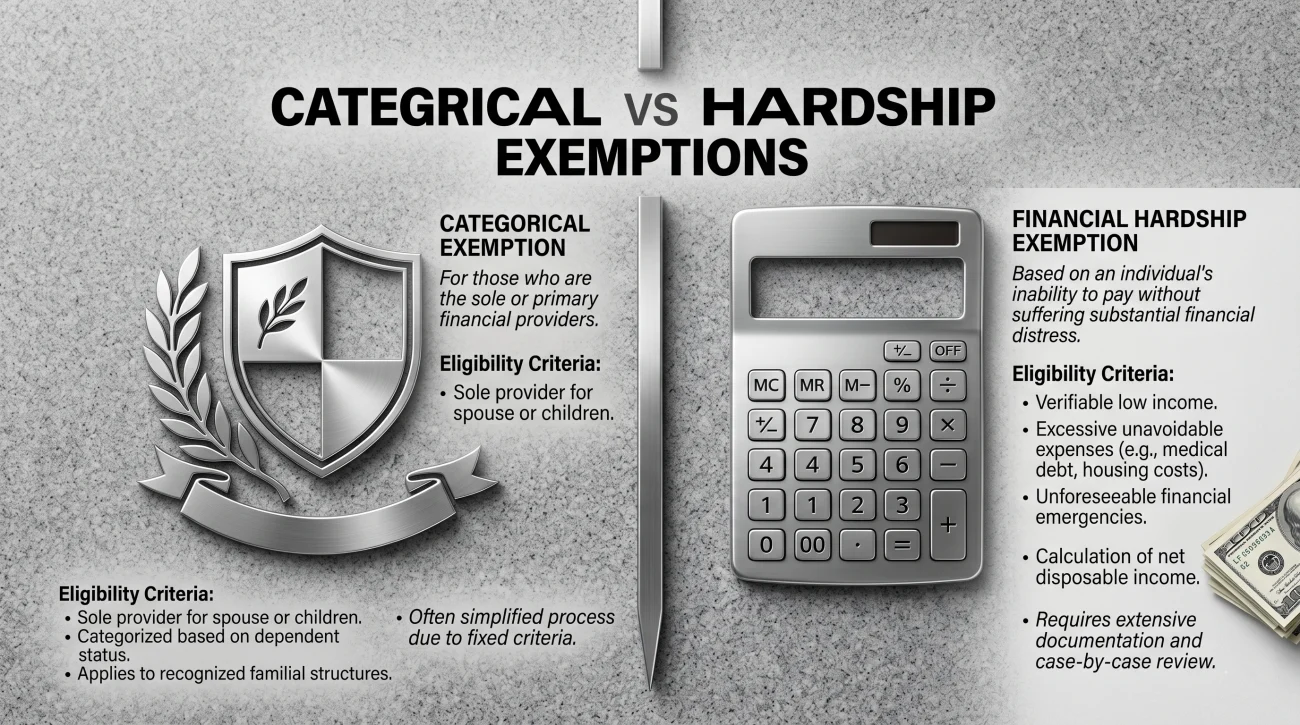
When you file a claim, you cannot just tell the judge that losing the money is unfair. You have to base your claim on a specific legal justification. Generally, courts recognize two primary categories of wage exemptions. You must clearly identify which path applies to your situation when filling out your paperwork.
Categorical Exemptions
A categorical exemption means that the law automatically protects your income based on your family status or the specific source of the money. If you meet the definition, the creditor cannot touch those funds for a consumer debt.
The most common categorical exemption is the head of household protection. In several states, if you provide more than half of the financial support for a dependent, your wages receive massive protection. Florida is famous for this, but other states have similar, albeit weaker, versions. If you are relying on this defense, you must understand how specific state protections for family breadwinners apply, as many people unknowingly sign waivers in their original loan contracts that forfeit this exact right.
Another major categorical exemption involves federal benefits. If your income comes from Social Security, Supplemental Security Income (SSI), or Veterans Affairs, a private creditor cannot garnish it. However, the rules get complicated once that money hits your checking account. It is crucial to review the guidelines for protecting federal benefits from aggressive collection so you do not accidentally mix protected funds with unprotected wages.
Financial Hardship Exemptions
If you do not qualify for a categorical exemption, your second route is proving financial hardship. Federal law caps consumer debt garnishment at 25 percent of your disposable earnings. For many families, losing a quarter of their take-home pay is financially devastating.
Most state courts have a mechanism allowing a judge to reduce the garnishment percentage if you can prove that the maximum deduction leaves you unable to afford basic necessities. This is not about maintaining your current lifestyle. The court will only look at strict survival expenses: modest housing, basic utilities, food, and necessary medical care.
The Disposable Earnings Trap: To claim hardship effectively, you must understand how the court calculates your income. “Disposable earnings” is your gross pay minus legally required deductions like taxes and Social Security. It does not subtract voluntary deductions like 401(k) contributions or health insurance premiums. If your gross pay is $1,000, taxes are $200, and health insurance is $150, your disposable earnings are $800, not $650. The creditor is legally allowed to take 25 percent of that $800. If losing that $200 means you literally cannot feed your family or pay rent, that is the exact threshold where a hardship claim becomes viable. Once you know which exemption path fits your reality, your immediate next hurdle is navigating the court’s paperwork.
Step-by-Step: How to File Your Claim of Exemption
The process of claiming an exemption is heavily procedural. Creditors count on consumers getting overwhelmed by the paperwork and simply giving up. By breaking the process down into clear steps, you can level the playing field.
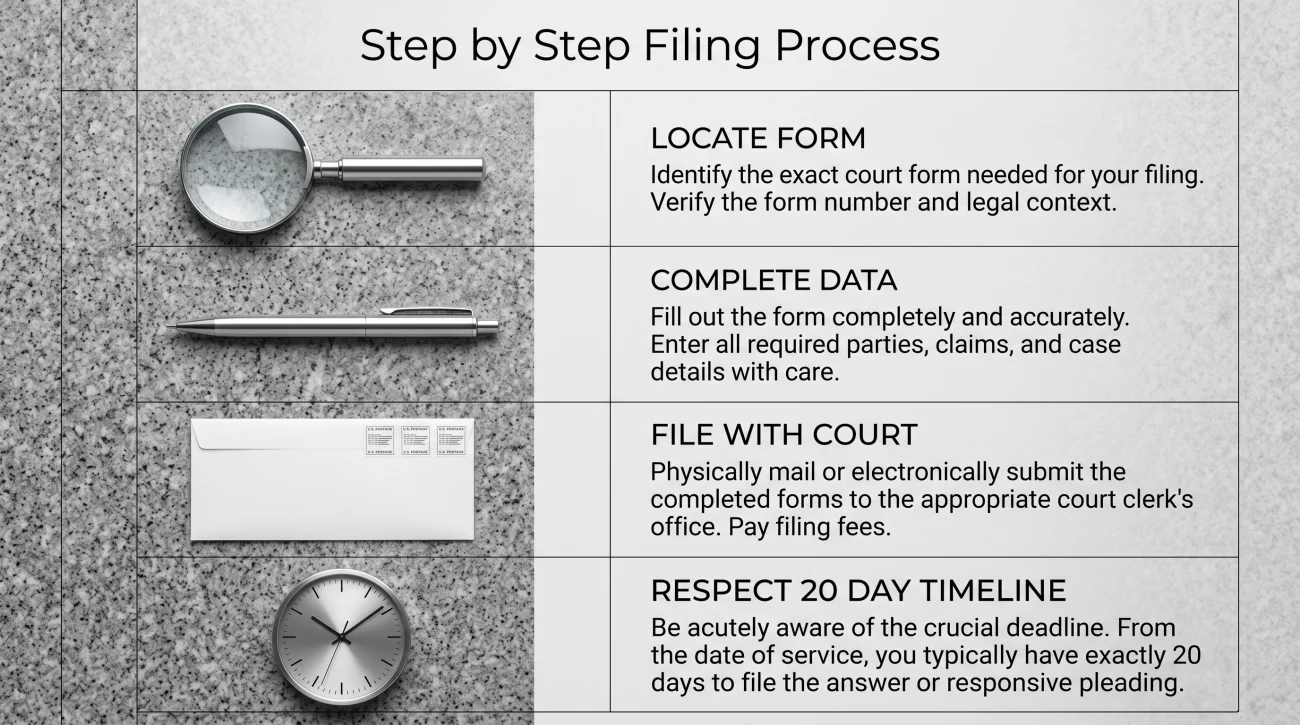
Step 1: Locate the Correct Form
You cannot write a standard letter to the judge. You must use the official Claim of Exemption form designated by the court that issued the garnishment order. In many jurisdictions, the creditor is legally required to include a blank copy of this form when they send you the garnishment notice.
If you did not receive a form, or if you lost it, you must get a replacement immediately. Do not guess. Go directly to the website of the clerk of court in the county where the judgment was entered, or go to the courthouse in person. Always verify the case number by reviewing the original documents sent by the court or your employer.
Step 2: Complete the Form with Hard Data
When you fill out the exemption form, accuracy is everything. You will need to check the boxes that correspond to your exemption claim (e.g., head of household, specific protected income, or financial hardship).
If you are claiming hardship, you will likely need to attach a financial affidavit or an income and expense statement. Be completely honest, but do not leave out irregular necessary expenses. To make your claim easy for a judge to understand, format your list clearly like this:
– Rent/Mortgage: $1,200/month
– Basic Utilities (Water, Electric, Trash): $180/month
– Groceries (Family of 3): $600/month
– Required Medical Prescriptions: $75/month
Note: Do not list credit card payments, streaming services, or eating out. The court only considers survival necessities for a hardship claim.
Step 3: File with the Court (Not the Creditor)
This is where a massive number of consumers make a fatal error. They fill out the paperwork and mail it to the collection agency or the creditor’s attorney.
“During my time at the agency, we frequently received completed exemption forms directly from consumers. As a third-party collector, we had no legal obligation to forward those forms to the court. We simply added them to the file. By the time the consumer realized their mistake, their 20-day window had closed, and the garnishment became permanent.”
You must file the original document with the clerk of court. Depending on your state’s rules, you may also be required to serve a copy (mail it) to the creditor’s attorney and your employer. Use certified mail with a return receipt so you have hard proof of the date it was sent and received.
Step 4: Respect the 20-Day Timeline
Most states give you exactly 20 days to file your claim from the date you receive the notice. Some states offer even less time. This deadline is almost always non-negotiable. If you file on day 21, the creditor will immediately file a motion to strike your claim based on timeliness, and the judge will likely agree. Count your days carefully, starting from the date of receipt, and do not wait until the last minute.
The Danger Zone: Why Withholding Continues While You Wait
There is a dangerous misconception that simply filing the exemption paperwork acts as a pause button on the garnishment. It does not. If you are already stretched thin, this is often the hardest reality you will have to face during the process.
When your employer receives a writ of garnishment, it is a direct order from a judge instructing them to withhold a portion of your wages. Your employer is effectively a bystander. They cannot evaluate your exemption claim, and they cannot legally stop withholding money just because you told them you filed a dispute with the court.
Handing a copy of your exemption form to your HR department and expecting them to stop the deductions on your next paycheck.
Filing the form with the court, understanding that your employer must continue deductions, and preparing your household budget for a temporary reduction in take-home pay.
The deductions will continue until the judge holds a hearing, makes a decision, and issues a new order directing your employer to stop. This process can take several weeks. If you win your exemption hearing, the judge will typically order the creditor to refund the money that was garnished while the hearing was pending. However, you must survive the cash flow shortage in the meantime.
Preparing for the Exemption Hearing
Once you file your claim, the creditor has a short window (usually a few days to a week) to file an objection. If they object, the court will schedule a hearing. This is your moment to prove your case to the judge or magistrate.
You cannot just show up and tell your story. You need documentary evidence. Courts operate on proof, not sympathy. Gather your documents long before the hearing date.
Essential documents to bring:
- Your last three to four pay stubs to prove your exact disposable income.
- Your most recent tax return, especially if you are claiming head of household status to prove you claim dependents.
- Birth certificates of dependents, or court orders showing support obligations.
- Current utility bills, a copy of your lease or mortgage statement, and receipts for essential medical expenses if you are arguing financial hardship.
- Award letters from the Social Security Administration or VA if you are claiming your income is categorically protected.
During the hearing, the creditor’s attorney will try to poke holes in your budget or challenge your dependent status. Stay calm, stick to the numbers, and point directly to your documentation. The judge is looking for factual verification that you meet the statutory requirements for the exemption.
What Happens If Your Claim Is Denied?
If the judge rules against you, or if you fail to provide sufficient proof of hardship, the garnishment order becomes permanent. Your employer will continue deducting the set percentage every pay period until the debt is paid in full. While you generally have the right to appeal the decision, appeals are complex, require an attorney, and rarely succeed if the original judge followed the law.
A denial does not mean you are completely out of options. At this stage, your best pivot is often to negotiate a direct settlement or voluntary payment plan with the creditor, or in severe cases of unmanageable debt, evaluate whether bankruptcy is appropriate.
Common Mistakes That Ruin Exemption Claims
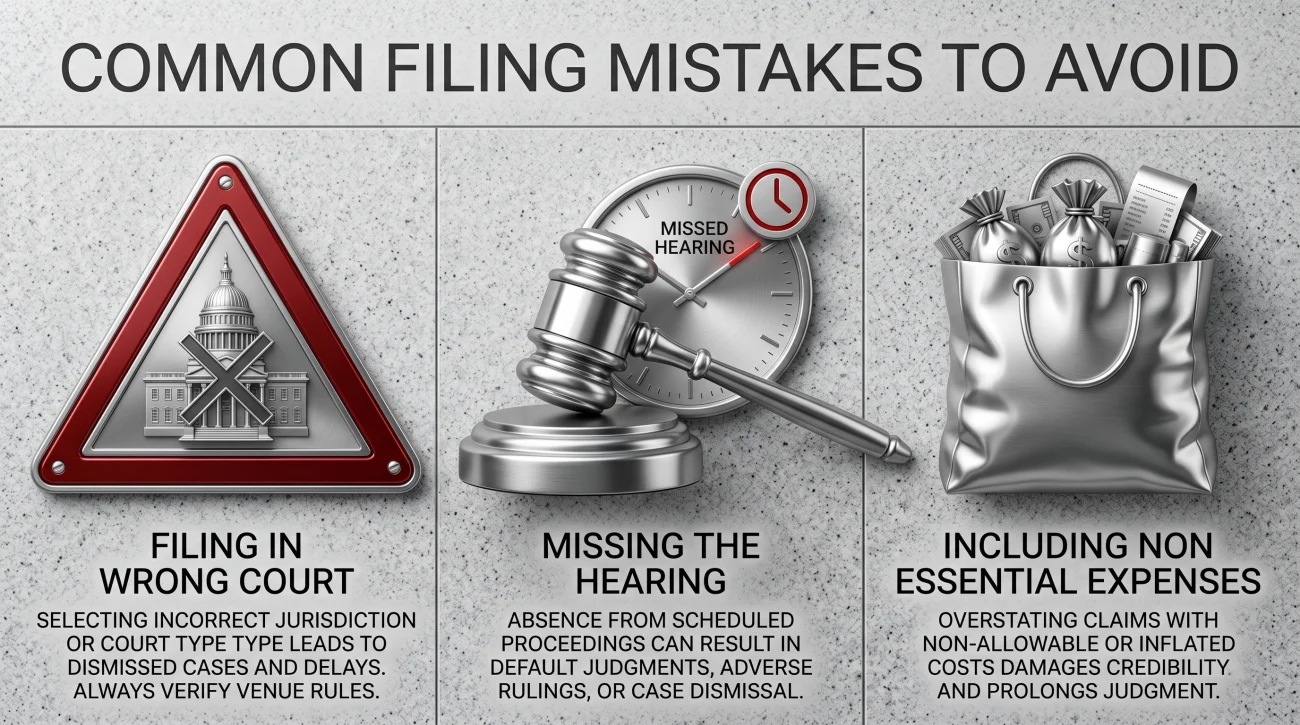
The legal system is unforgiving when it comes to procedural errors. Making a simple mistake can result in your claim being thrown out before the judge ever looks at the merits of your financial situation.
⚠️ Warning: Never ignore the requirement to send a copy to the creditor. If the court rules say you must serve the opposing counsel, and you fail to do so, your hearing can be cancelled or delayed, meaning your wages will continue to be garnished for even longer.
🚫 Filing in the wrong court: You must file your exemption with the specific clerk of court that issued the garnishment order. If the creditor sued you in a neighboring county, filing the paperwork at your local courthouse will not work. Your claim will be rejected, and you will lose valuable time.
🚫 Missing the hearing: Filing the paperwork is only step one. If you do not show up to the scheduled hearing, the judge will automatically deny your claim. Creditors often win simply by default because the consumer got intimidated and stayed home.
🚫 Inflating hardship expenses: Failing to calculate “disposable earnings” correctly on hardship affidavits is a critical error. If you submit an expense sheet that looks artificially inflated because you included voluntary deductions or non-essential lifestyle expenses, the creditor’s attorney will use that to damage your credibility in front of the judge.
Final Thoughts on Claiming Your Exemption
The garnishment system relies heavily on intimidation and the assumption that you will simply accept the paycheck deductions without a fight. Forcing the creditor to prove their right to your specific wages in front of a judge shifts the balance of power back toward you. The key to winning is speed and accuracy. You must respect the strict court deadlines, file the paperwork in the right location, and gather bulletproof documentation to support your claims.
Remember that the exemption process is just one piece of the puzzle. If you miss your window, or if your exemption is denied, you should immediately begin researching broader strategies to halt payroll deductions, such as negotiating a direct settlement, setting up a voluntary payment plan, or exploring bankruptcy protections. Do not let one setback stop you from fighting for your financial stability.
❓ FAQ
⏰ How long do I have to file my exemption claim?
In most states, you have exactly 20 days from the date you receive the official garnishment notice. The clock starts immediately, and this deadline is strictly enforced by the court clerk.
🛑 Will filing the form stop my garnishment right away?
No. Your employer is legally required to continue withholding your wages until a judge issues a new order directing them to stop. This means deductions will continue while you wait for your hearing.
👨👩👧 What qualifies as a head of household for garnishment?
Generally, you qualify if you provide more than half of the financial support for a dependent, such as a minor child, a spouse, or an elderly parent. You must be prepared to prove this support with tax returns and bills.
📝 Where do I actually get the exemption form?
The creditor is often required to mail you a blank form with your notice. If they did not, you can get the standard Claim of Exemption form from the website of the clerk of court in the county where the judgment was filed.
🏦 Can I claim an exemption if my bank account was frozen?
Yes. Bank account levies have their own exemption process, separate from wage garnishment. You must file a claim proving the frozen funds came from a protected source, like Social Security or previously exempt wages.
💼 Does my employer have to help me file this?
No. Your employer is a neutral third party following a court order. They cannot give you legal advice, provide the forms, or advocate for you. You are entirely responsible for filing your own paperwork.
🧑⚖️ What happens if I miss the filing deadline?
The court will reject your claim, making the garnishment permanent. Judges almost never grant extensions unless you can prove severe, documented extenuating circumstances, such as being hospitalized or deployed in the military during the notice period.
💸 Do I get my garnished money back if I win the hearing?
Typically, yes. If the judge rules that you are exempt, they will order the garnishment to stop and usually require the creditor to refund the money that was withheld while your hearing was pending.
📞 Should I just call the collection agency to explain my hardship?
No. Calling the agency does not stop the legal clock. While you can negotiate a settlement over the phone, the only way to legally assert your exemption rights and force the garnishment to stop is by filing the court forms.
📄 What proof do I need to show financial hardship?
You must provide concrete documents showing your income and basic living expenses. This includes recent pay stubs, your lease or mortgage statement, utility bills, and receipts for essential medical care or groceries.
Garnishment sits at the end of a process that starts earlier. These cover the full picture.
- How courts allow collectors to reach your paycheck and your bank
- Received a Wage Garnishment Notice: What It Means and What You Must Do Before the Window Closes
- Federal Student Loan Wage Garnishment: How Administrative Garnishment Works and Why 2025-2026 Changes Everything
- Types of Wage Garnishment: Why the Debt Type Changes Everything About Your Options
- Child Support Wage Garnishment: Why the Rules Are Different - and What You Can Actually Do
Garnishment is a symptom. These cover the options that address what caused it.
- The collector behavior that typically comes before the garnishment order
- How the lawsuit you may have missed is what created the garnishment
- How wage garnishment works and the options available to stop or limit it
- When a collector goes after your bank account instead of your wages
- How settling the underlying debt stops the garnishment permanently
Disclosure: The content on this site reflects direct experience inside the debt collection industry and is grounded in federal law and regulation. It is informational in nature. Reading it does not constitute legal advice and does not create any professional relationship. If you are dealing with a lawsuit, a judgment, or a legal deadline, consult a licensed attorney in your state before acting.