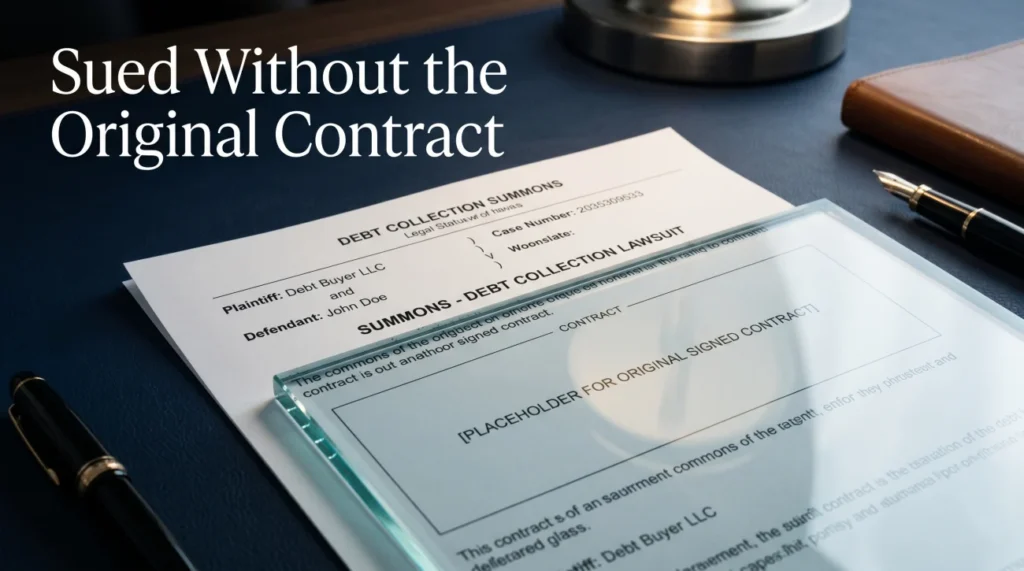
- Debt buyers frequently sue using only a recent billing statement as proof. However, a statement only shows a final balance, while courts require the original signed contract to prove the actual legal terms and your consent to them.
- Debt buyers purchase accounts in bulk portfolios. They receive basic data on spreadsheets, not original signed contracts. Producing the actual agreement is a massive administrative hurdle for them.
- Without the original contract, the debt buyer cannot prove authorized interest rates, collection fees, or their specific right to enforce the debt.
- You can raise the “no original contract” defense in your Answer and demand the document during the discovery phase. Many debt buyer lawsuits are dismissed because they cannot produce this proof.
The Contractual Flaw in Most Debt Buyer Lawsuits
During my years working inside the third-party collections industry, I watched debt buyers purchase millions of dollars in defaulted accounts for pennies on the dollar. When a debt buyer files a lawsuit against you, they project absolute legal authority. The paperwork looks intimidating. The demands are formal. But behind that formal complaint is often a glaring lack of actual evidence.
One of the most common and fatal flaws in a debt buyer lawsuit is the absence of the original credit agreement. When a debt buyer files a suit, they are legally asking a judge to enforce a contract. Yet, in a staggering number of cases, they do not actually have the contract they are trying to enforce.
If you have been sued by a debt collector, they will almost always attach a recent billing statement to the complaint to prove you owe money. A billing statement shows a balance. An original credit agreement shows the terms under which you owe it. The difference between those two documents is monumental.
A debt buyer enforcing a debt without the original agreement is claiming the right to enforce terms they cannot prove exist. Understanding how to exploit this specific documentation gap strips away their legal standing. Here is a look at why this evidence is missing and how to use that fact to dismantle their case.
The Insider Reality: Why Debt Buyers Lack Original Contracts
To understand why this defense works so well, you have to understand how debt is bought and sold. Most consumers picture a banker carefully handing over a thick manila folder with their name on it to a debt collection agency. The reality is much closer to a massive, messy data transfer.
The Spreadsheet Business Model
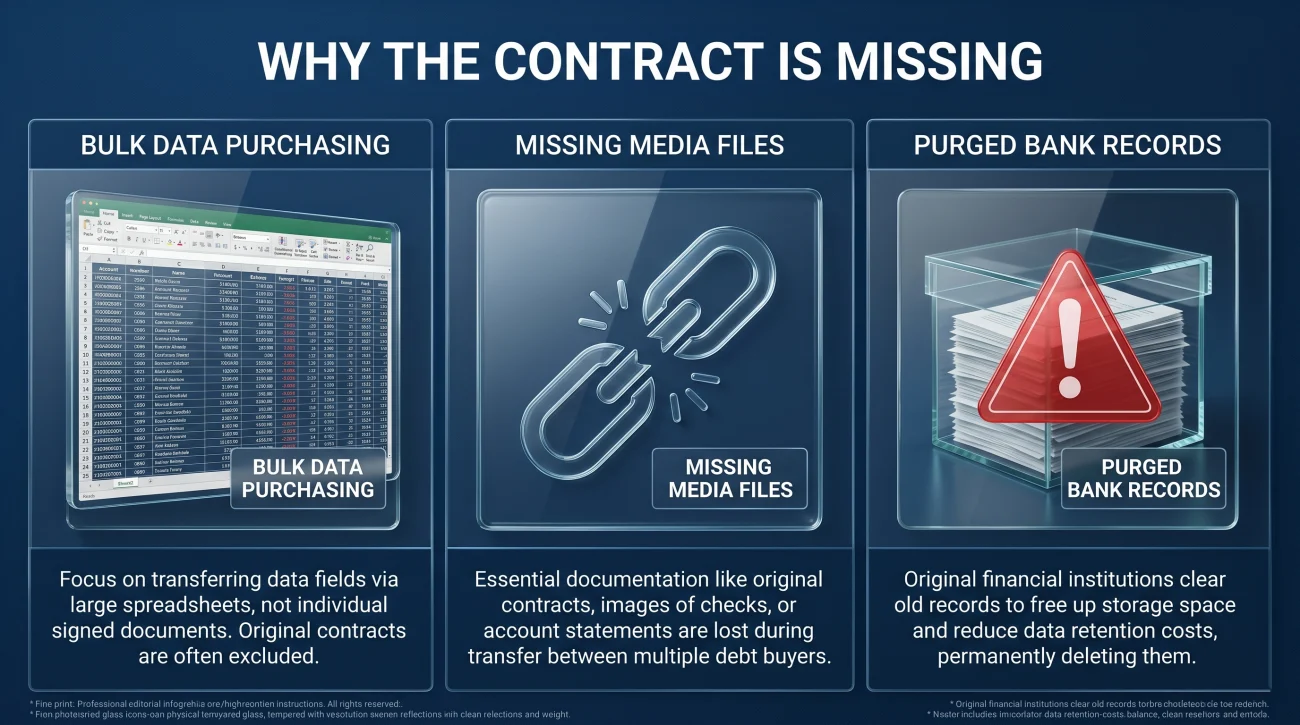
When a major bank writes off defaulted credit card debt, they sell it in massive portfolios containing tens of thousands of accounts. The debt buyer purchasing this portfolio receives a data file, essentially a giant spreadsheet. This spreadsheet contains your name, your last known address, your Social Security number, the account number, and the final balance owed.
What they do not automatically receive are the “media” files. In the collections industry, “media” refers to the actual documents: the original signed credit application, the monthly account statements from year one to year five, and the specific cardmember agreement in effect when the account was opened.
“Inside a debt buying agency, requesting the actual contract from the original creditor is called a ‘media pull.’ It is not automatic. The agency often has to pay the original bank a fee for each document they request, and it can take weeks. Because they file lawsuits by the thousands, they simply do not pull the media unless a consumer fights back and forces them to. Their entire business model relies on you not asking to see the contract.”
By the time a debt has been sold two or three times from one debt buyer to another, the original agreement is often lost to the wind. The original bank may have purged their archives, and the current debt buyer has nothing but a line of data on a spreadsheet.
Why a Billing Statement Cannot Substitute for a Contract
Because they lack the original contract, debt buyers will almost always attach a single billing statement to their lawsuit complaint. They present this statement to the judge as “proof” of the debt. For a consumer who doesn’t know their rights, a statement showing a $4,000 balance looks like undeniable evidence. Legally, it is not.
What a Billing Statement Fails to Prove
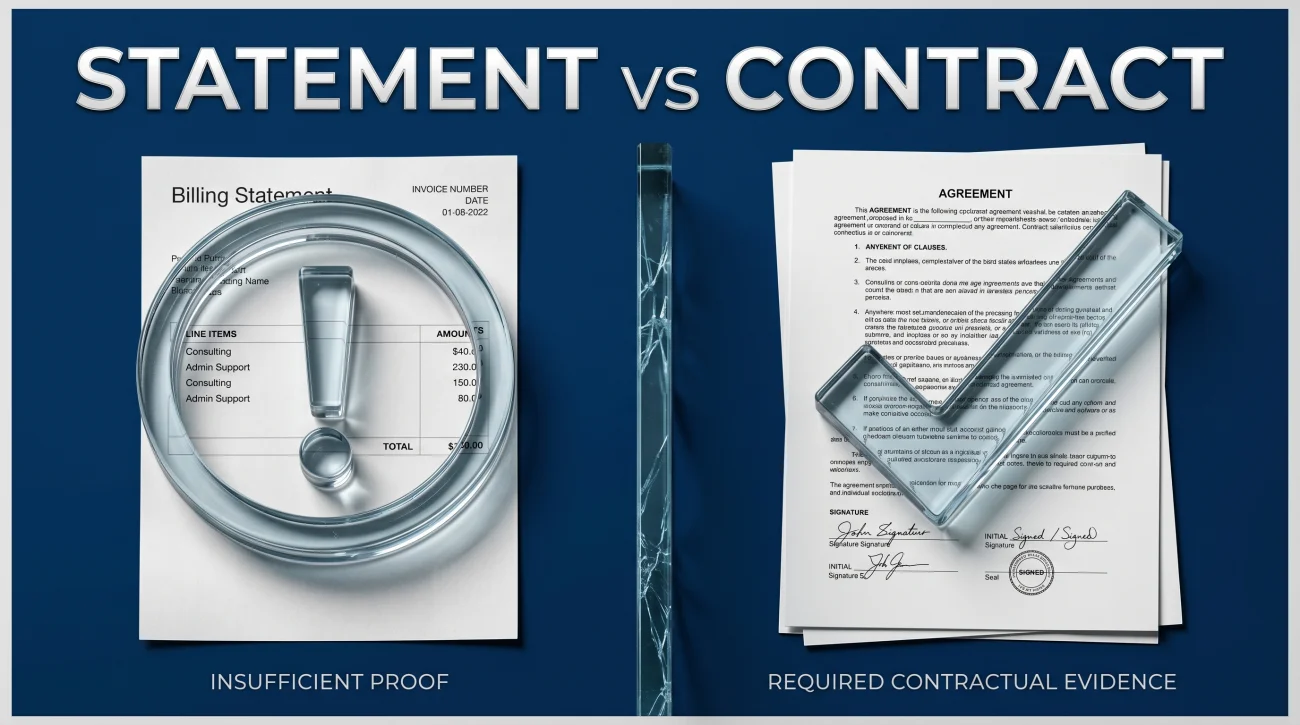
A billing statement can prove that a balance existed at a specific point in time. It cannot prove the contractual terms. This is a critical distinction in civil litigation. Without the original signed agreement or the specific cardmember agreement governing the account, the debt buyer cannot prove several essential elements of their lawsuit:
- The Interest Rate: The debt buyer cannot prove what interest rate was mutually agreed upon. If they are suing you for a balance that includes accumulated interest, they have no proof that the interest was authorized.
- Collection Fees: Many lawsuits include additional attorney fees or collection costs. The debt buyer cannot legally charge these unless the original contract explicitly authorized them. Without the contract, these fees are legally baseless.
- Assignment Rights: The original contract dictates whether the bank had the right to sell your account to a third party. If the debt buyer cannot produce the contract, they cannot prove they had the right to buy and enforce the debt.
- Arbitration Clauses: Many original contracts contain arbitration clauses that dictate how disputes must be handled. The collector cannot enforce the contract while simultaneously hiding the terms that might benefit you.
| Evidence Requirement | What a Billing Statement Shows | What the Original Contract Shows |
|---|---|---|
| The Balance Owed | Yes (at a specific point in time) | No (shows the rules, not the final math) |
| Authorized Interest Rate | No | Yes |
| Authorized Default Fees | No | Yes |
| Right to Sell/Assign the Debt | No | Yes |
| Your Consent to Terms | No | Yes (via signature or digital acceptance) |
What Courts Actually Require from Debt Buyers
When I first started in the collections industry, courts frequently rubber-stamped default judgments based on nothing more than a generic affidavit and a single account statement. Debt buyers relied heavily on judges being too busy to scrutinize the paperwork.
Today, that legal landscape is shifting. Judges are increasingly aware of how debt portfolios are packaged and sold, and they are demanding actual proof of contract. If a consumer actively contests the lawsuit, courts generally require the collector to produce the original written agreement, preferably with a signature or digital equivalent demonstrating consent to the terms.
The Standard is Rising: The New York Example
We can see this shift clearly in recent state legislation. For instance, the New York Consumer Credit Fairness Act (CCFA) of 2022 drastically changed the rules for debt buyers in that state. Under the CCFA, plaintiffs are now required to file the actual contract with the initial complaint. The old strategy of filing vague pleadings and hoping to supply evidence later is no longer viable there.
While not all states have laws as strict as New York’s CCFA, the underlying legal principle remains universal across the country: if a plaintiff sues for breach of contract, the defendant has an absolute right to demand that the plaintiff produce the contract.
How to Raise the “No Original Contract” Defense
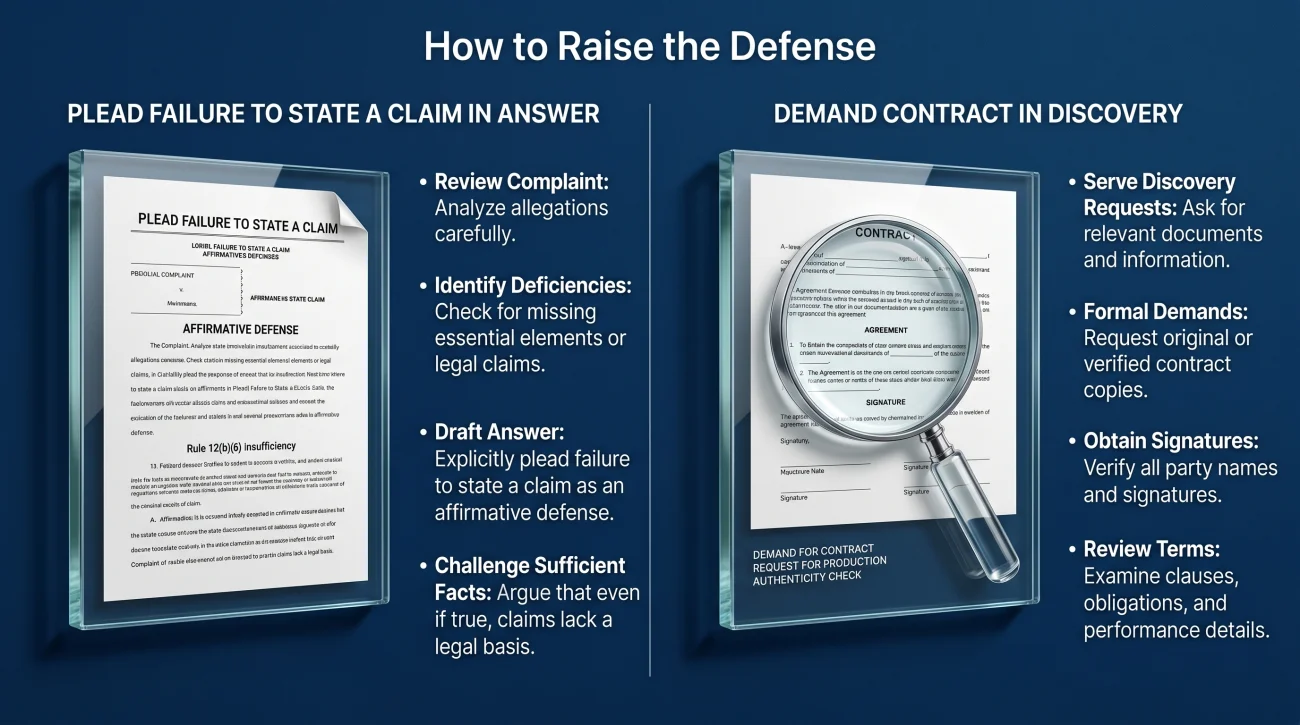
This defense is not automatic. If you do not raise it, the judge will not raise it for you. You must actively force the debt buyer to prove their case by raising this issue in two distinct phases of the lawsuit: the Answer and the Discovery phase.
Telling the judge: “I don’t remember buying these items” or “The balance seems too high.” This keeps the focus on your memory, which is a weak defense.
Stating in your paperwork: “Plaintiff has failed to produce the original agreement and therefore cannot establish the contractual terms they are attempting to enforce.” This shifts the burden of proof entirely onto the collector.
Step 1: Pleading the Defense in Your Answer
When you file your official response to the lawsuit, you must list your affirmative defenses. You want to explicitly state that the plaintiff lacks the underlying contractual documentation. See the hub guide on debt collection lawsuit defenses for how affirmative defenses fit into the broader lawsuit structure.
Here is standard language used to assert the debt buyer no original contract defense:
“Plaintiff has failed to attach or produce a signed copy of the original credit agreement establishing the specific terms, interest rates, and fees under which the alleged debt was incurred. Without the original agreement, Plaintiff cannot establish the contractual basis for its claims or prove that the amounts sought are authorized by agreement.”
Step 2: Demanding the Contract in Discovery
After filing your Answer, you enter the discovery phase. This is where you formally demand that the collector hand over their evidence. A debt buyer lacking original contract documentation fears this phase more than any other.
In your Request for Production of Documents, you should demand the following:
“Produce a true and correct copy of the original signed credit card agreement or cardmember agreement that was in effect at the time the Defendant allegedly opened the account. If a signed application does not exist, produce the specific terms and conditions document that Plaintiff alleges governed this specific account.”
When a debt buyer receives this request and realizes they only have a spreadsheet and a billing statement, they are faced with a choice: spend significant money trying to retrieve archived documents from the original bank, or drop the lawsuit.
💡 Pro Tip: Contract vs. Chain of Title. The original contract defense proves what the rules are. The chain of title proves who owns the right to enforce those rules. A debt buyer must prove both. If you want to challenge their ownership documentation, you must also review how to challenge the chain of title in debt collection lawsuits.
What to Argue at the Court Hearing
If the debt buyer refuses to dismiss the case and you end up in front of a judge, do not get pulled into a debate about your spending history from five years ago. Pivot immediately to the missing documents.
If the collector’s attorney hands the judge a stack of recent statements, your response should be calm and technical:
“Your Honor, the plaintiff has produced only a billing statement, but they have not provided the original signed agreement. Without that contract, there is no proof of the agreed-upon interest rate, authorized fees, or their legal right to sue me. I ask that the case be dismissed for failure to meet their burden of proof.”
By forcing the plaintiff to prove every element of their case, you expose the systemic weakness of the debt buyer business model. Often, the inability to produce the original agreement is all it takes to see a debt collection lawsuit dismissed entirely.
Signs the “No Original Contract” Defense Applies to Your Case
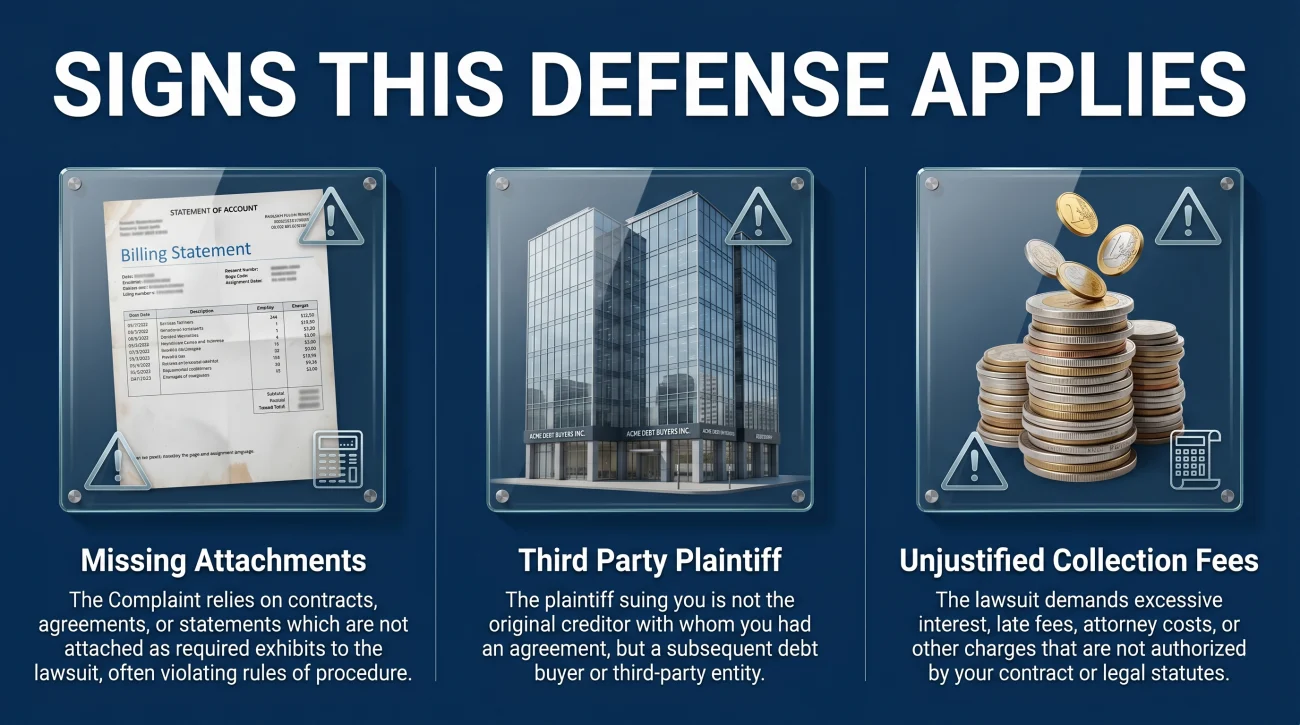
If you are reviewing the lawsuit papers you just received, look for the following red flags that indicate the plaintiff’s attorney is operating with thin evidence. If you spot these, you have a strong tactical advantage.
- 📌 The lawsuit complaint only attaches a single recent billing statement, or no documents at all.
- 📌 The plaintiff suing you is a third-party debt buyer (like Midland Funding, Portfolio Recovery, or LVNV Funding), not your original bank.
- 📌 The debt has been sold multiple times from one debt buyer to another, making it highly unlikely the original media transferred with the file.
- 📌 The amount they are suing for includes massive interest charges or “collection fees” that are not broken down or justified by an attached contract.
- 📌 You sent discovery requests, and the plaintiff’s attorney objected to providing the original agreement, claiming it is “unduly burdensome” to produce.
If you recognize these signs, the debt buyer is likely hoping you will default. Raising this defense aggressively changes their math. If you feel overwhelmed by the process of drafting these documents or arguing them in court, evaluating your options with a debt lawsuit attorney is often the safest way to ensure this defense is executed correctly.
Final Thoughts: Breaking Their Automated Model
Debt collection lawsuits are designed to be fast, cheap, and automated. Debt buyers file complaints by the thousands, attach a generic billing statement, and count on the fact that the vast majority of consumers will simply ignore the summons and accept a default judgment.
When you actively demand the original contract, you break that automated model. You force the collector’s law firm to treat your case as individual litigation. For a debt buyer who paid pennies on the dollar for a spreadsheet of accounts, spending hundreds of dollars in attorney hours and archival retrieval fees to find one specific five-year-old contract is often a losing financial proposition.
The true power of the “no original contract” defense is not just legal; it is economic. By demanding strict proof of the terms they are trying to enforce, you change the math of the lawsuit. You make your file too expensive to pursue, which is often the exact leverage needed to get the case dropped.
❓ FAQ
📄 Do they have to have my actual physical signature?
Not necessarily. While a wet signature is best, many modern credit accounts are opened online. However, the debt buyer must still produce the specific terms and conditions that governed the account at the time you supposedly accepted them, along with proof of your digital acceptance.
💳 What if it was an online credit card application?
Even for online applications, the debt buyer must prove you agreed to the terms. They must produce the exact electronic cardmember agreement that was in effect on the date of application and evidence (like IP logs or electronic signature records) tying you to the agreement.
🏛️ Will the judge automatically dismiss if there is no contract?
No. A judge will not automatically dismiss the case unless you actively raise the defense and file a motion. If you do not show up and demand the contract, the judge will likely accept the billing statements as sufficient and enter a default judgment against you.
🗄️ Can the debt buyer just get the contract from the original bank?
Sometimes they can, but it costs them time and money. Debt buyers refer to this as a “media pull.” Often, if the debt is very old or has been sold multiple times, the original creditor no longer has the archived documents available to send.
📑 Is a final credit card statement enough proof to win?
In a contested lawsuit, a final statement is usually not enough. While it shows a balance, it does not prove the interest rate you agreed to, the fees authorized, or the debt buyer’s right to enforce the contract. You must object to it being used as the sole piece of evidence.
🔗 Is this the same as the chain of title defense?
No. Chain of title involves the bills of sale that prove the debt buyer actually owns your account. The “no original contract” defense challenges whether they can prove the specific terms, rules, and fees of the debt they claim to own. A strong defense raises both issues.
⏳ What if they say they will provide the contract later?
Do not accept vague promises. Use the formal discovery process to demand the documents by a strict deadline. If they fail to produce the contract by the end of the discovery period, you can file a Motion for Summary Judgment or a Motion to Dismiss before trial.
🛑 Does this defense work against the original creditor?
It is much harder to use against original creditors (like Chase or Capital One) because they actually maintain their own archives and can usually produce the original agreement if forced. This defense is highly effective against third-party debt buyers.
⚖️ What if they attach a generic “example” cardholder agreement?
Debt buyers frequently try to use generic, undated, or mismatched cardholder agreements instead of your specific contract. You must object to this. Point out to the judge that a generic template from 2020 does not prove the terms of an account you allegedly opened in 2015.
📝 Can they use my past payments as proof a contract existed?
They will try. Collectors often argue that because you made payments in the past, you implicitly agreed to the terms (an “account stated” claim). However, past payments still do not prove what the specific interest rate was or whether the collection fees they added are authorized.
What each stage of litigation requires and where your leverage sits.
- What the lawsuit process looks like from summons to judgment
- What to file, when to file it, and what happens if you do not
- The legal arguments that can defeat a debt collection lawsuit
- What a default judgment allows collectors to do and how to fight one
- How to negotiate a resolution once litigation has started
Once judgment is entered, collectors gain tools they did not have before.
- The FDCPA violations collectors commonly commit during the collection process
- How to respond to a debt lawsuit and what defenses are available to you
- How a judgment becomes a garnishment order on your paycheck
- When a collector uses a judgment to freeze your bank account instead
- How to settle before the judgment turns into something harder to stop
Disclosure: The content on this site reflects direct experience inside the debt collection industry and is grounded in federal law and regulation. It is informational in nature. Reading it does not constitute legal advice and does not create any professional relationship. If you are dealing with a lawsuit, a judgment, or a legal deadline, consult a licensed attorney in your state before acting.