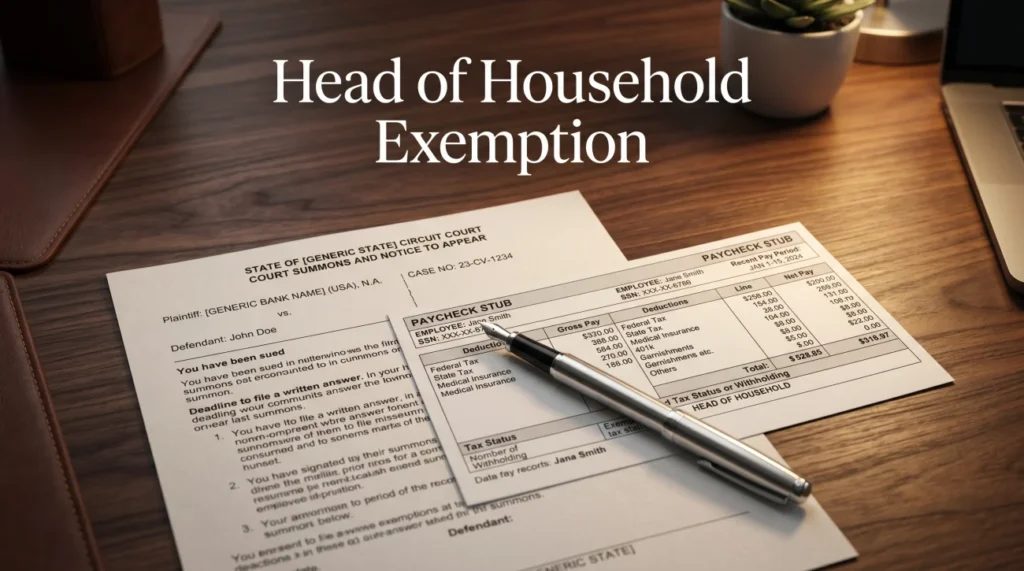
- The head of household exemption protects the wages of family breadwinners from being taken by judgment creditors. Florida offers the strongest version of this law in the country.
- In Florida, if you provide more than half the financial support for a dependent, 100% of your disposable earnings under $750 per week are completely exempt from garnishment.
- A dependent does not just mean a minor child. It can include an elderly parent, an adult child in college, or a non-working spouse whom you financially support.
- The exemption is not automatic. You must affirmatively file a Claim of Exemption with the court, typically within 20 days of the garnishment notice being mailed.
- The hidden danger is the waiver trap. Many credit card and loan contracts contain buried clauses where borrowers unknowingly sign away their right to this protection.
The Legal Shield Designed to Protect Family Breadwinners
Having your paycheck reduced by a debt collector is a stressful event for anyone. But when you are the primary financial provider for a family, a sudden 25 percent reduction in your take-home pay does not just mean cutting back on extras. It often means choosing between keeping the electricity on, paying rent, or putting food on the table for your dependents.
State lawmakers recognize this danger. To prevent families from being pushed into poverty by civil judgments, several states have created specific legal protections for breadwinners. This is known as the head of household exemption from wage garnishment.
During my 12 years working inside third-party collection agencies and a national debt buyer, I saw garnishment orders processed across the entire country. We knew exactly which states made it easy to attach a debtor’s wages and which states put up massive roadblocks. Whenever we pulled a file for a consumer living in Florida who appeared to have a family, our recovery projections instantly dropped. Florida offers the most powerful wage protection for family providers of any state in the nation.
However, this protection is surrounded by procedural hurdles and hidden contractual traps. It is not an invisible shield that automatically blocks a collector’s reach. It is a legal tool that you must pick up and actively use. Understanding how to prove you qualify, how to challenge an unenforceable waiver, and how to meet the strict court deadlines is the only way to keep your paycheck intact.
Understanding the Florida Head of Household Exemption
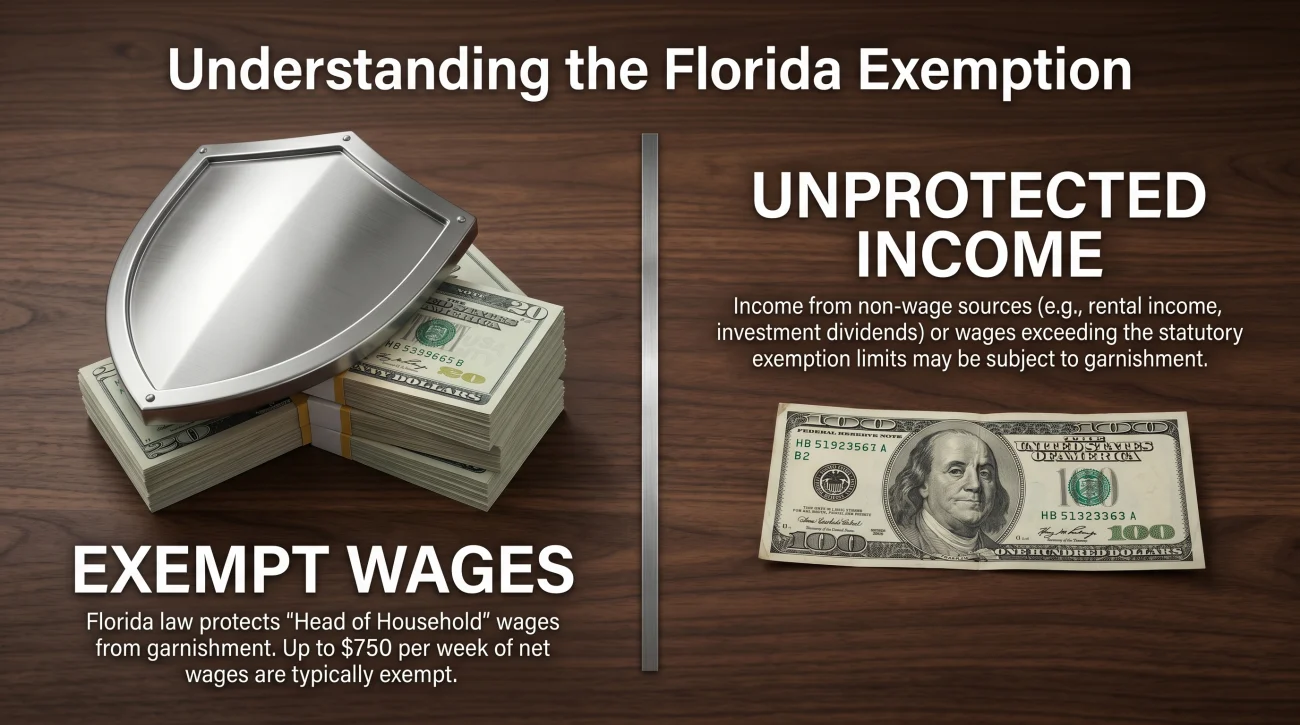
While several states offer partial exemptions for people supporting dependents, Florida Statute 222.11 is the gold standard for wage protection. The law uses the term “head of family,” which is entirely interchangeable with “head of household” in this context.
Under this statute, a debtor who qualifies as a head of family is granted absolute protection over a significant portion of their income. If you qualify, a judgment creditor cannot legally force your employer to withhold your wages for a consumer debt.
The financial math of the Florida statute works in two distinct tiers based on your income:
- Earnings of $750 per week or less: If your disposable earnings are $750 per week or less, 100 percent of your wages are entirely exempt from garnishment. The creditor cannot take a single penny.
- Earnings greater than $750 per week: If your disposable earnings exceed $750 per week, the amount over $750 can technically be garnished. However, the creditor can only garnish that excess amount if you previously agreed in writing to allow your wages to be attached. Without that written agreement, your entire paycheck remains protected regardless of how much you earn.
The Disposable Earnings Trap
To understand the $750 threshold, you must understand the legal definition of “disposable earnings.” It means your gross pay minus legally required deductions like taxes and Social Security. Crucially, voluntary deductions like health insurance premiums, 401(k) contributions, or union dues do NOT reduce your disposable earnings in the eyes of the court.
Many breadwinners are shocked to find their garnishable income is calculated much higher than what actually hits their bank account. If your gross pay is $1,000, your taxes are $200, and your health insurance is $100, your take-home pay is $700. But your legal disposable earnings are $800, putting you above the $750 tier.
“From the inside perspective, when a collector sees a Florida address on a judgment file, they immediately look for two things. First, does the consumer have dependents? Second, did the consumer sign a waiver? If the consumer has dependents and no valid waiver exists, we often closed the garnishment effort immediately to save on court costs. It simply was not worth pursuing.”
While Florida sets the benchmark for shielding family income, this protection is not universal. If you do not live in Florida, you must check your state’s specific rules. Some states offer partial protections for family providers, and four states (Texas, Pennsylvania, North Carolina, and South Carolina) ban wage garnishment for consumer debts entirely. For the national landscape, review our guide on wage garnishment limits by state.
Who Actually Qualifies as a Dependent?
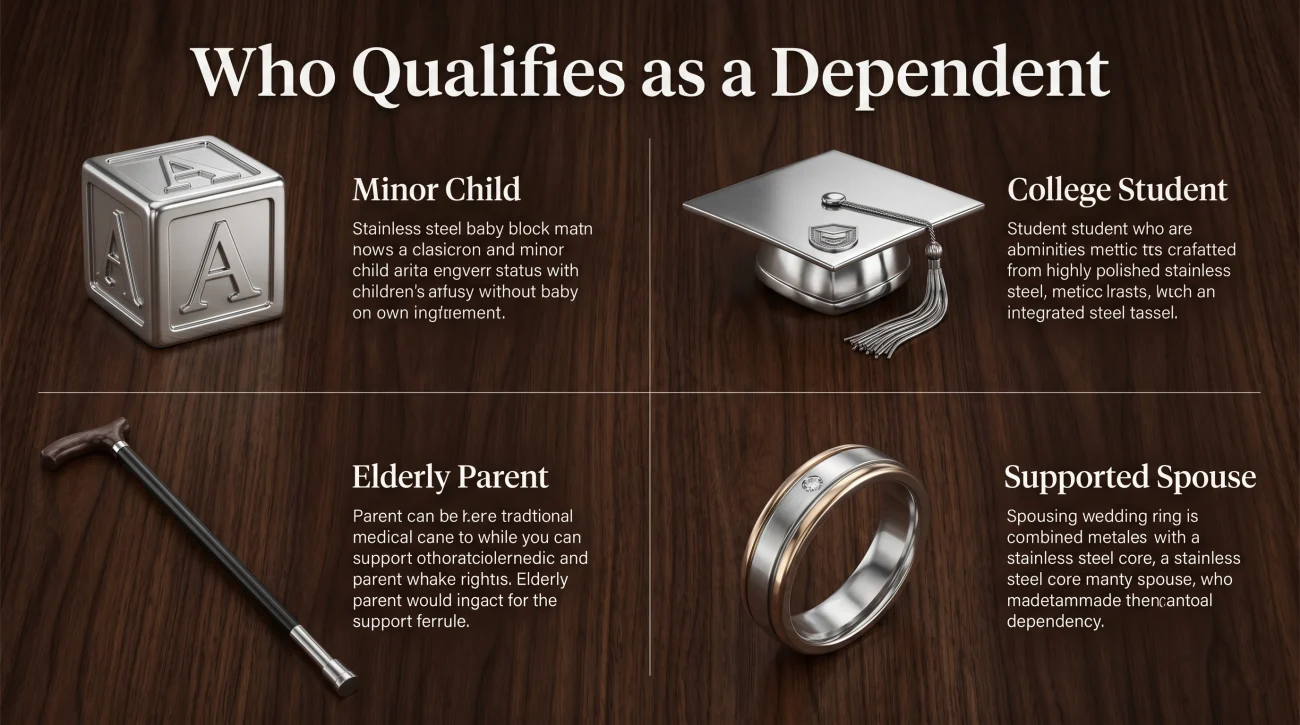
One of the most common reasons people fail to claim this exemption is a misunderstanding of what a “dependent” is. Many consumers assume that to be a head of household, they must be claiming a minor child on their tax return. This is incorrect. The legal definition under the exemption statute is much broader than the IRS tax definition.
To qualify as the head of family, you must simply provide more than half of the financial support for at least one other person. That person does not have to be a minor child.
You may qualify for the exemption if you provide more than 50 percent of the financial support for:
- ✅ A minor child living in your home.
- ✅ A spouse who does not work or earns significantly less than you do.
- ✅ An adult child who is in college and relies on you for tuition, housing, and food.
- ✅ An elderly parent who lives with you or lives elsewhere but relies on your income for their care and housing.
- ✅ A disabled sibling or relative who depends entirely on your financial contributions.
The defining factor is the economic reality of the relationship. Does your income keep a roof over their head and food on their table? If your income were to vanish, would that person be unable to support themselves? If the answer is yes, you likely meet the threshold.
Proving Your Status in Court
If a creditor challenges your head of household status, you will need to prove it to a judge. Effective documentation includes:
– Recent tax returns showing claimed dependents.
– Bank statements showing you pay the primary household bills (rent, mortgage, utilities).
– Receipts for college tuition, medical care, or assisted living facilities for a relative.
– Pay stubs comparing your income to your spouse’s income to prove you are the primary earner.
The Waiver Trap: How You May Have Signed Away Your Rights
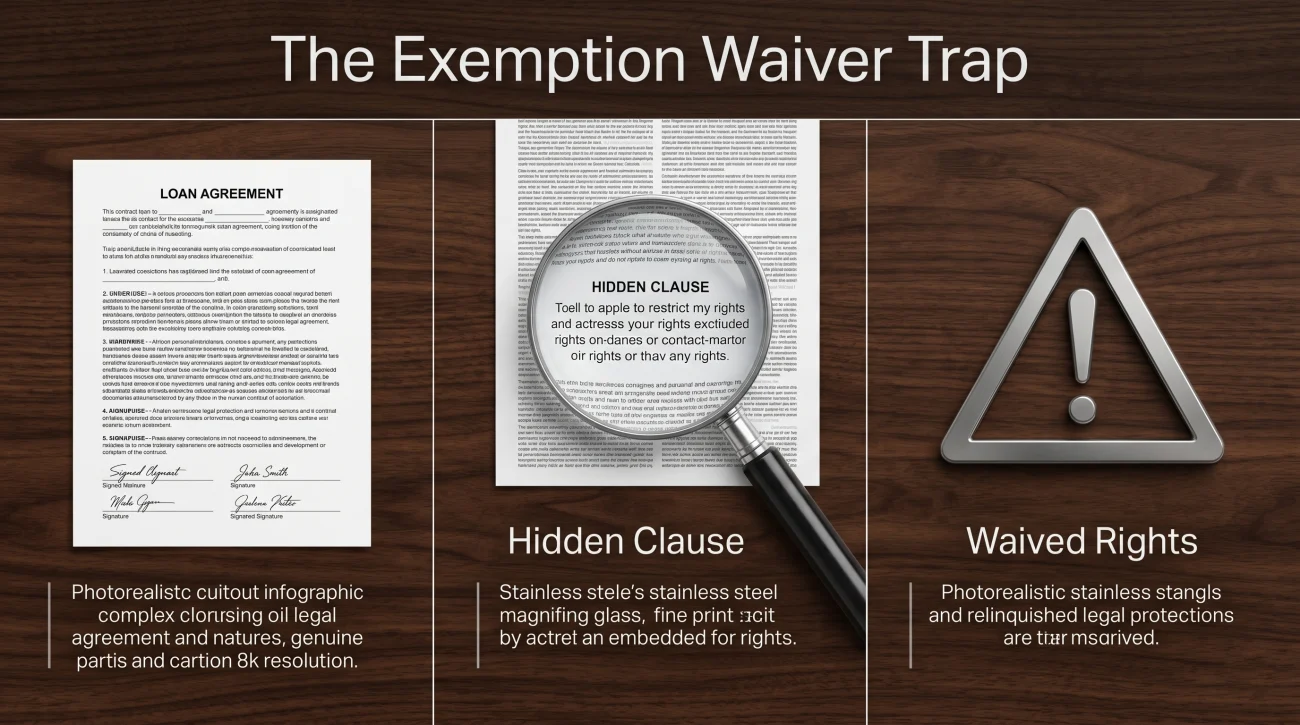
If the head of household exemption is so powerful, why do collectors still manage to garnish the wages of Florida breadwinners? The answer lies in a highly controversial legal mechanism known as the waiver trap.
Creditors know that the Florida exemption is a massive barrier to collecting judgments. To bypass this barrier, banks, credit card companies, and personal loan providers frequently embed a “waiver of head of household exemption” clause deep within the fine print of their standard contracts.
When you sit down to sign a stack of loan documents for a personal loan or click “I Agree” on a credit card application, you are usually focusing on the interest rate and the payment terms. You are likely not reading paragraph 14 on page 6, which might state that in the event of a default, you voluntarily waive your right to claim the head of family exemption from wage garnishment.
If you signed a valid waiver, the fact that you support three children and an elderly parent no longer matters. The creditor can garnish your wages just as they would for a single person with no dependents.
Is Your Waiver Actually Enforceable?
Because these waivers are so devastating to families, state law places strict requirements on how they must be formatted. A debt buyer attempting to enforce a waiver often fails because the original creditor did not follow the exact statutory rules.
For a head of household waiver to be legally enforceable in Florida, it must meet specific criteria:
- It must be attached as a completely separate document from the main contract. It cannot simply be a paragraph buried in the middle of a multi-page agreement.
- It must be printed in at least 14-point font to ensure it is highly visible to the borrower.
- It must contain the exact statutory language stating that the borrower understands their wages would normally be protected but they are voluntarily giving up that protection.
⚠️ Warning: Debt buyers often show up to court with a standard credit card agreement, claiming you waived your rights. If they cannot produce a separately signed, correctly formatted 14-point font waiver document, their waiver is legally invalid. Never take a collector’s word that you waived your rights. Make them prove it to the judge.
The 20-Day Affirmative Claim Requirement
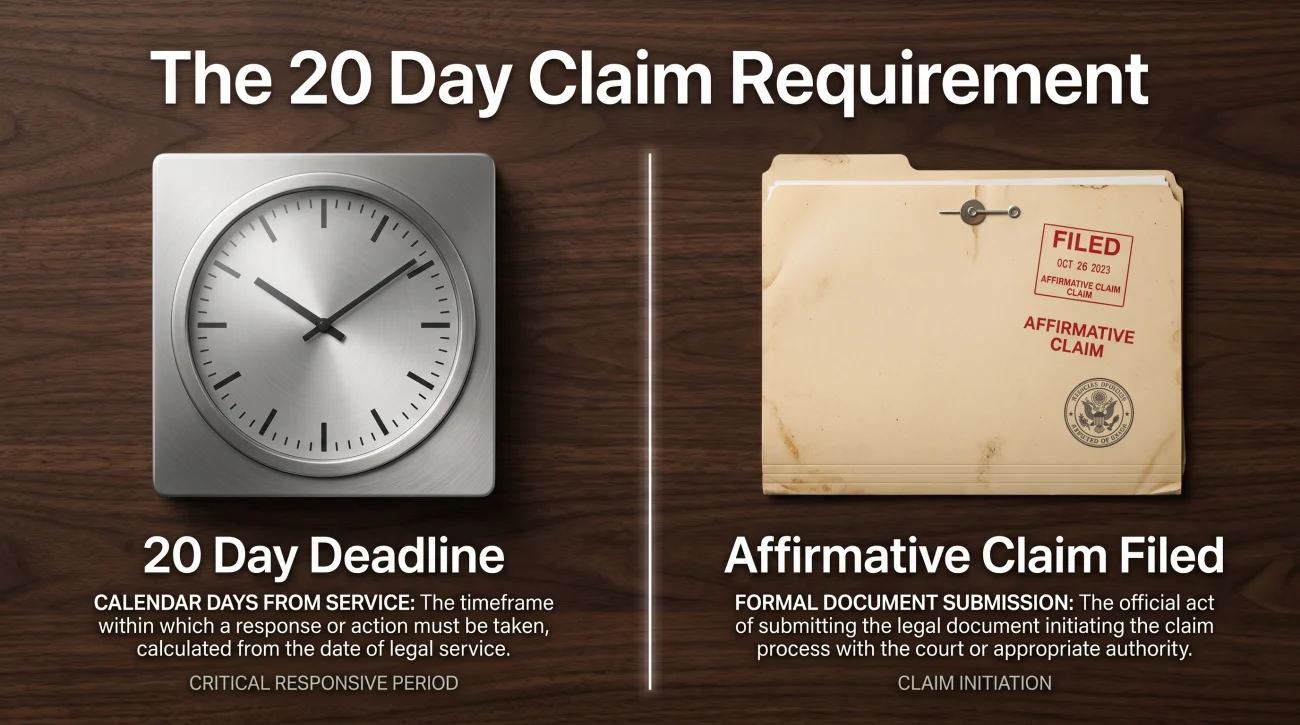
The second biggest reason breadwinners lose their paychecks is the mistaken belief that the law protects them automatically. It does not.
When a creditor wins a judgment and issues a garnishment order to your employer, the employer has no legal right to evaluate your family status. The payroll department cannot look at your file, see that you have two children on your health insurance plan, and refuse the garnishment. They are legally required to start withholding money immediately.
To stop the deductions, you must affirmatively claim your rights by filing formal paperwork with the court. Understanding the general mechanics of this process is covered thoroughly in our overarching guide on wage garnishment, but the exemption timeline is where most people fail.
Telling your HR manager that you are the head of household and asking them to stop the garnishment, then waiting for the problem to resolve itself.
Filling out a sworn Claim of Exemption form, filing it with the clerk of the court that issued the judgment, and serving a copy to the creditor’s attorney within the strict legal deadline.
In Florida, the clock starts ticking the moment the creditor mails you the Notice of Garnishment and the exemption forms. You typically have exactly 20 days from the mailing date to file your Claim of Exemption. This is a very tight window. If you file the paperwork on day 22, the court may rule that you have permanently waived your right to the exemption for this specific garnishment, even if you are undeniably the head of your household.
Once you file the claim, the creditor has a short window to object. If they object, a hearing is scheduled. This is where you bring your tax returns, bank statements, and pay stubs to prove you are the primary financial provider. If you win the hearing, the judge orders the garnishment to stop and often orders the return of any funds that were improperly withheld while the hearing was pending.
For a detailed breakdown of the exact forms and what happens at the courthouse, you should review the step-by-step process on how to claim a wage garnishment exemption.
The Two Critical Edge Cases: 1099 Workers and Bank Accounts
The head of household exemption focuses heavily on traditional W-2 employees, leaving many people confused about how the law applies to other financial situations. There are two major scenarios you need to be aware of.
The 1099 Freelancer and Contractor Rule
If you are an independent contractor, gig worker, or freelancer, you might assume your income is completely exposed because you do not receive a traditional paycheck. Fortunately, in many cases, Florida courts have ruled that the head of family exemption can apply to compensation paid for personal labor or services, depending on the exact nature of your work and contract. If the money you earn is a direct result of your personal effort, you may be able to file a claim of exemption to protect those earnings just as a W-2 employee would.
The Bank Account Trap
The head of household exemption prevents a collector from intercepting your paycheck at your employer’s payroll office. However, once that paycheck is deposited into your personal checking account, it loses its automatic identification as “wages.” A creditor can issue a bank levy to freeze the entire account.
While Florida law allows you to protect those funds if you can trace them directly back to your exempt wages, this is a separate legal battle. You must file a specific exemption claim for the bank levy and prove the money in the account is exclusively from your protected paycheck. Mixing your protected wages with other unprotected funds makes this tracing process incredibly difficult. If even one dollar of non-exempt money is deposited into the same account, the creditor can argue the entire balance is no longer protected and is subject to the levy. If you rely on this exemption, keeping your exempt wages in a dedicated, separate account is a critical defensive strategy.
Signs You Are Losing Money You Don’t Have To
Wage garnishment relies heavily on consumer ignorance. Debt collectors secure judgments and issue writs knowing that the vast majority of people will simply accept the reduced paycheck without a fight.
Signs you need to take immediate action regarding your exemption status:
- You support children, a spouse, or an elderly parent, and your wages are currently being garnished by a consumer debt collector.
- You earn less than $750 per week in disposable income, live in Florida, and are having a percentage of your check withheld.
- You received a garnishment notice in the mail within the last 15 days and have not yet filed any paperwork with the court.
- A debt buyer claims you signed a waiver of your rights, but they have only shown you a standard credit card agreement without a separate, clearly printed waiver document.
If you meet any of these criteria, every pay period that passes is money wrongfully taken from your family. Filing a claim of exemption is a legal procedure that requires precision. If you are facing imminent deadlines, dealing with a collector who claims you signed a waiver, or need help proving your dependent status in court, reviewing your options with a professional is the safest route. You can start by connecting with qualified legal representation through our directory for a wage garnishment attorney.
Final Thoughts: Don’t Let Them Win by Default
Debt collection law firms operate on a business model of least resistance. They send out thousands of garnishment orders hoping that fear and procedural confusion will paralyze consumers into inaction. The head of household exemption is a powerful legal right, but it is a right you must actively enforce. By gathering your documentation, meeting your deadlines, and forcing the collector to prove their case, you transform your file from an easy, profitable win into a difficult legal fight. Step up, file your claim, and protect the paycheck your family relies on.
❓ FAQ
👨👩👧 Does paying child support automatically make me head of household?
Not necessarily. To qualify as the head of family, you must provide more than 50 percent of the financial support for a dependent. Simply paying court-ordered child support for a child who lives primarily with another parent may not meet the 50 percent threshold, depending on the other parent’s income and expenses.
⏳ What happens if I missed the 20-day deadline to file my claim?
If you miss the deadline, you generally waive your right to the exemption for that specific garnishment order. Courts rarely grant exceptions for missed deadlines. However, if you were never properly served with the original lawsuit to begin with, you might be able to file a motion to vacate the underlying judgment entirely, which would stop the garnishment.
🏢 Can my employer just stop the garnishment if I prove to them I support my family?
No. Your employer is legally obligated to comply with the court’s garnishment order. They cannot evaluate your family status or cancel the deduction. Only a judge can order the employer to stop the garnishment after you successfully win an exemption hearing.
⚠️ If I signed a waiver in my loan agreement, is my paycheck defenseless?
Not always. In Florida, a waiver is only enforceable if it meets strict legal requirements, such as being a completely separate document from the main contract and printed in at least 14-point font. Beyond the format requirements, remember that if your disposable earnings exceed $750 a week, your entire paycheck is still protected unless the collector can produce a valid, compliant waiver.
📝 Does the head of household exemption protect me from an IRS tax levy?
No. State-level exemptions, including Florida’s head of household law, only protect you from private civil judgment creditors like credit card companies or medical debt collectors. The IRS uses federal law and has its own specific exemption tables that supersede state protections.
🤝 What if my spouse and I both co-signed the original loan?
If both of you signed the contract, you are both legally liable for the debt. While you can claim the exemption for your own wages as the head of household, the creditor may simply pivot and attempt to garnish your spouse’s wages instead, since your spouse is also a named judgment debtor.
Garnishment sits at the end of a process that starts earlier. These cover the full picture.
- How courts allow collectors to reach your paycheck and your bank
- How Much of Your Wages Can Be Garnished? The 25% Rule and When It Doesn't Apply
- Wage Garnishment Limits by State: Which States Protect More Than Federal Law Requires
- Can Social Security Be Garnished? What's Protected, and the Bank Account Trap That Isn't
- How to Claim a Wage Garnishment Exemption: The Forms, Deadlines, and What Happens Next
Garnishment is a symptom. These cover the options that address what caused it.
- The collector behavior that typically comes before the garnishment order
- How the lawsuit you may have missed is what created the garnishment
- How wage garnishment works and the options available to stop or limit it
- When a collector goes after your bank account instead of your wages
- How settling the underlying debt stops the garnishment permanently
Disclosure: The content on this site reflects direct experience inside the debt collection industry and is grounded in federal law and regulation. It is informational in nature. Reading it does not constitute legal advice and does not create any professional relationship. If you are dealing with a lawsuit, a judgment, or a legal deadline, consult a licensed attorney in your state before acting.