
- Most debt settlement programs require a 24 to 48 month commitment to complete successfully.
- The timeline is driven by the mechanics of collection. Creditors typically refuse to settle until an account is severely delinquent, which is why the first 6 to 12 months often involve waiting while you build your settlement reserve.
- A negotiation cycle for a single account is rarely a quick phone call; it often takes weeks of back and forth approvals to finalize a binding agreement.
- Larger monthly deposits and accounts already held by third-party debt buyers can significantly compress your timeline.
- Stopping payments during the first phase exposes you to collection calls and potential lawsuit risks. If the risk profile of settlement does not fit your timeline, credit counseling offers a different structural path.
The Reality of the 24 to 48 Month Timeline
When you are drowning in monthly minimum payments, two to four years sounds like an eternity. Most people looking into debt relief want the pressure to stop immediately. They assume that once they sign a contract, their representative will call their creditors the next morning, cut a deal by Friday, and clear the slate by the end of the month. When they learn the industry standard timeline is 24 to 48 months, frustration sets in.
During my 12 years working inside third-party collection agencies and national debt buyers, I sat on the receiving end of those exact negotiations. I can tell you that a multi-year timeline is not a sign that a program is inefficient or a scam. It is the mandatory reality of how collection portfolios are managed and evaluated. Banks and collection agencies operate on rigid internal timelines, and forcing them to accept a deep discount requires waiting out their internal clocks.
A legitimate program requires patience because it operates in distinct phases. It relies on your ability to consistently fund a dedicated savings account and depends entirely on the delinquency status of your specific debts. Before you commit to a multi-year financial strategy, you need to understand the broader framework of all available debt relief options. If you determine that settlement is the right mathematical path for your hardship level, here is exactly what those 24 to 48 months will look like behind the scenes.
Phase 1: Account Growth and Strategic Delinquency (Months 1 to 12)
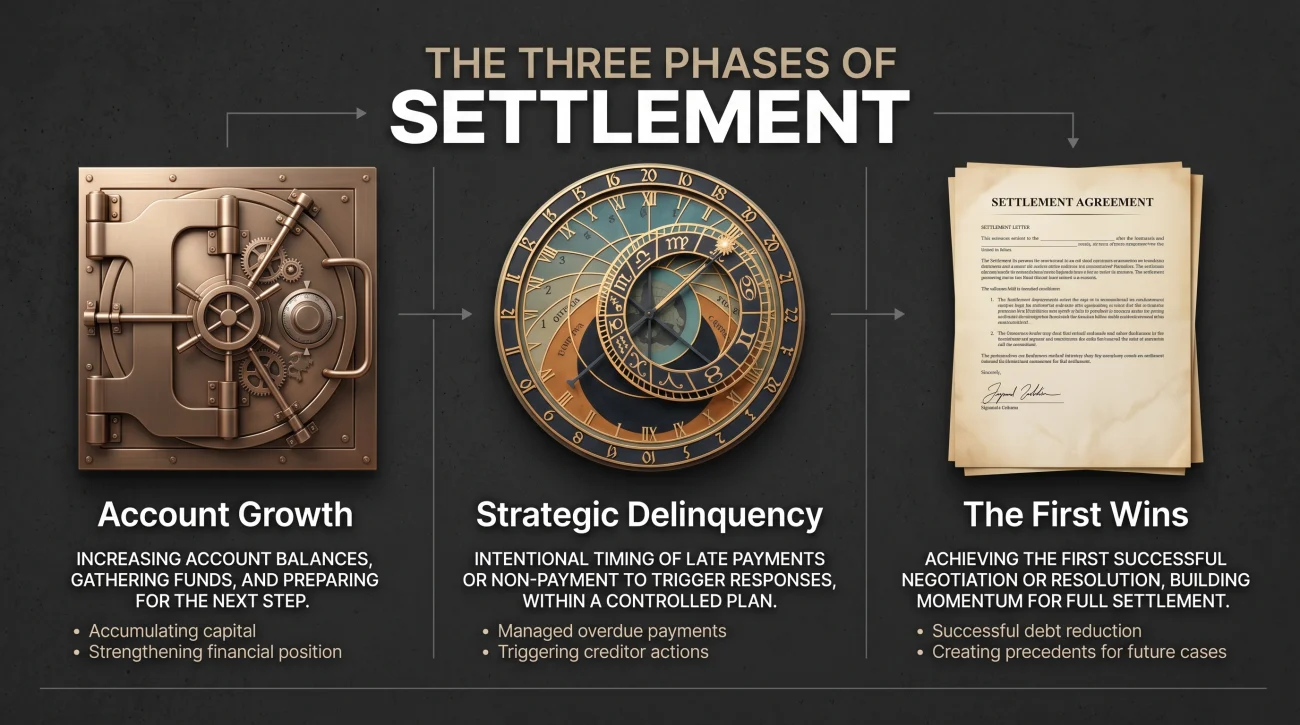
The first year of a settlement program is always the hardest. It requires the most discipline from you while delivering the fewest visible results. During this phase, you stop paying your enrolled creditors directly and instead make a single monthly deposit into an FDIC-insured account held in your name.
Because you are no longer making minimum payments, your accounts become delinquent. Interest and late fees accumulate, causing your balances to grow. Your credit score will drop significantly, and the collection calls will peak. To the average consumer, it feels like moving backward. But this period of strategic delinquency is the foundational requirement for the negotiation process to work.
When I managed accounts on the collection floor, my software literally would not allow me to offer a deep settlement on an account that was only 30 or 60 days past due. The original creditor’s policy required the account to hit at least 120 to 180 days of delinquency (approaching the charge-off threshold) before the primary settlement window unlocked. Until the consumer looked like a total loss on paper, we had no systemic authority to accept pennies on the dollar.
Creditors are not ready to negotiate in month two. They need documented proof that you are genuinely unable to maintain the original agreement. The first 6 to 12 months are spent waiting for your accounts to age into that optimal vulnerability window, while simultaneously building a large enough cash pile in your program account to fund the very first lump-sum offer.
Calling your settlement representative in month four, angry that no debts have been resolved yet, and threatening to quit because your credit score dropped.
Understanding that month four is exactly when your accounts are reaching the prime charge-off status required for deep discounts, and focusing entirely on making sure your monthly deposit clears on time.
Phase 2: The First Settlements (Months 12 to 24)
Once your accounts reach the target delinquency level and you have accumulated sufficient funds, the company begins actively negotiating. Creditors will not all settle at once. To learn the exact step-by-step mechanics of these interactions, you can read our breakdown of exactly how the debt settlement process works.
The timeline for Phase 2 is dictated by triage. A professional settlement firm does not just pick an account at random; they use internal data to target one of two specific profiles first.
- The Most Aggressive Creditors: Inside legitimate settlement firms, negotiators use historical “litigation matrices.” They know exactly which bank tends to file a lawsuit at day 180 and which one waits three years. If an enrolled original creditor has a reputation for aggressive early litigation, the company will prioritize settling that specific account to neutralize your legal risk, even if it requires draining a larger portion of your available funds.
- The Smallest Balances: If there are no immediate legal threats, negotiators often target your smallest balance first. Getting a quick win builds your confidence in the program and permanently eliminates one source of collection calls.
You also have to account for the speed of the negotiation cycle itself. A settlement is rarely achieved on a single five-minute phone call. A negotiator makes a low initial offer. The collection manager rejects it and counters. The negotiator waits a week to create the impression of limited funds, then counters again. Once a verbal agreement is reached, it can take another week to get the official settlement letter faxed and verified. Only after you approve the final offer is the payment released. Following this, the company assesses its fee for that specific account, and your future deposits begin building the reserve for the next target.
This methodical, account-by-account grinding is why the first two years require so much patience. However, once these initial hurdles are cleared, the trajectory of the program changes.
Phase 3: Clearing the Remaining Accounts (Months 24 to 48)
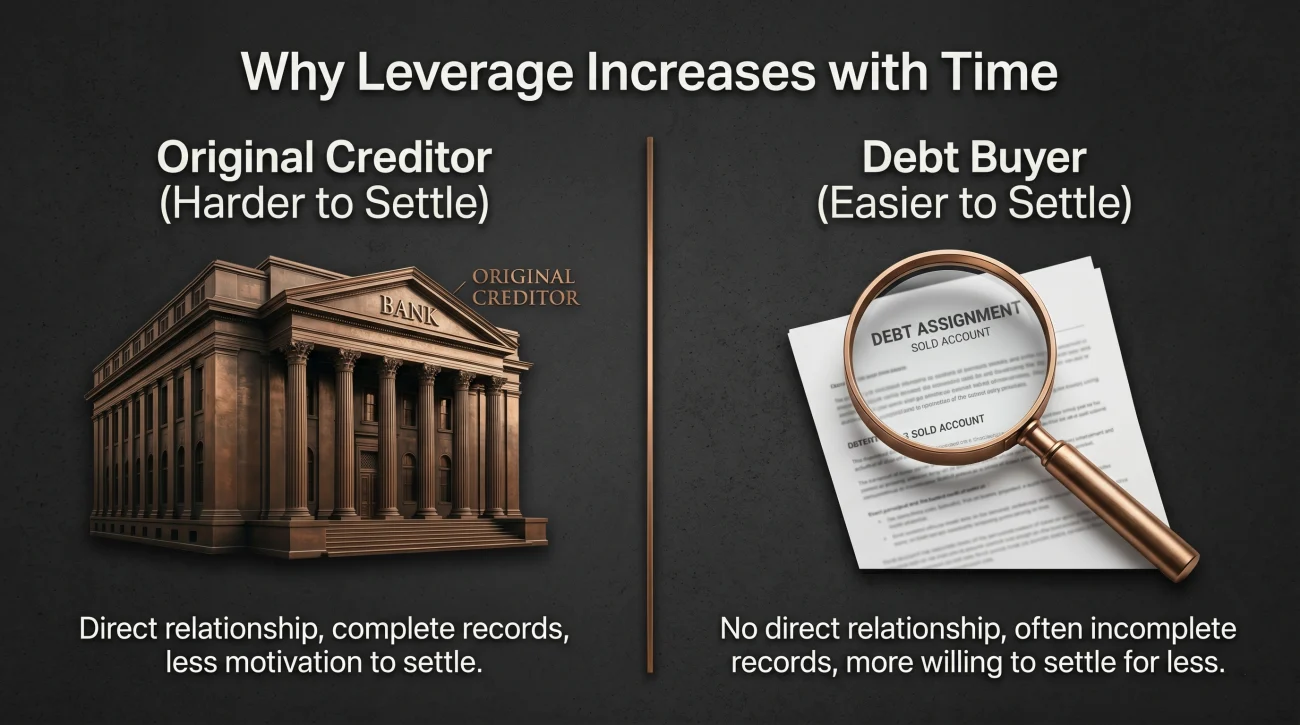
The final phase is where the momentum shifts heavily in your favor due to two converging factors: debt buyer economics and escrow snowballing.
By month 24, your remaining unresolved debts have likely been written off by the original banks and sold to third-party debt buyers. These buyers purchase portfolios of defaulted accounts for pennies on the dollar. Because their cost basis is incredibly low, they have far more flexibility to accept deep discounts. An account that a major bank refused to settle for 60 percent of the balance in year one might be easily settled by a debt buyer for 35 percent in year three.
Simultaneously, the “escrow snowball” takes effect. When you started the program, your monthly deposit was effectively waiting to be split across five or six different creditors. As Phase 2 cleared out a few of those accounts, your monthly deposit did not decrease. Instead, that same monthly contribution is now accumulating rapidly to attack the remaining two or three accounts. The bucket fills much faster when there are fewer leaks. The program reaches official completion when all enrolled accounts are finalized and paid.
What Makes the Timeline Shorter
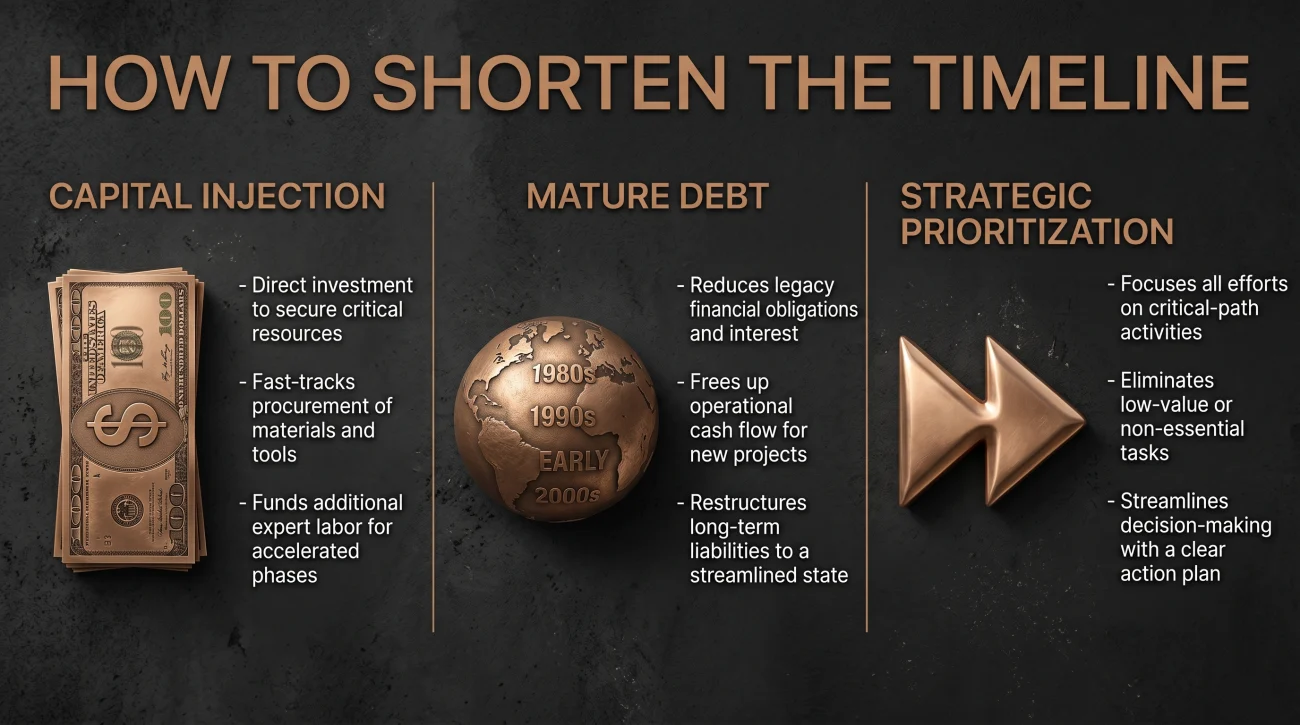
While 24 to 48 months is the standard estimate, your specific timeline is not set in stone. Certain variables can significantly compress the amount of time it takes to reach the finish line.
The most impactful variable is your capital injection rate. The timeline is directly tethered to how fast you fund the program. If you receive a tax refund, a bonus at work, or proceeds from selling a vehicle, adding those lump sums to your dedicated account allows negotiators to make aggressive, immediate offers to creditors who were otherwise scheduled for year three.
The age of your debt upon enrollment also matters immensely. If your enrolled debts are already two years old and have already been sold to third-party debt buyers before you even sign your contract, you skip the Phase 1 waiting period entirely. The company can often begin negotiating those mature accounts within the first 3 to 6 months, accelerating your completion date dramatically.
What Makes the Timeline Longer
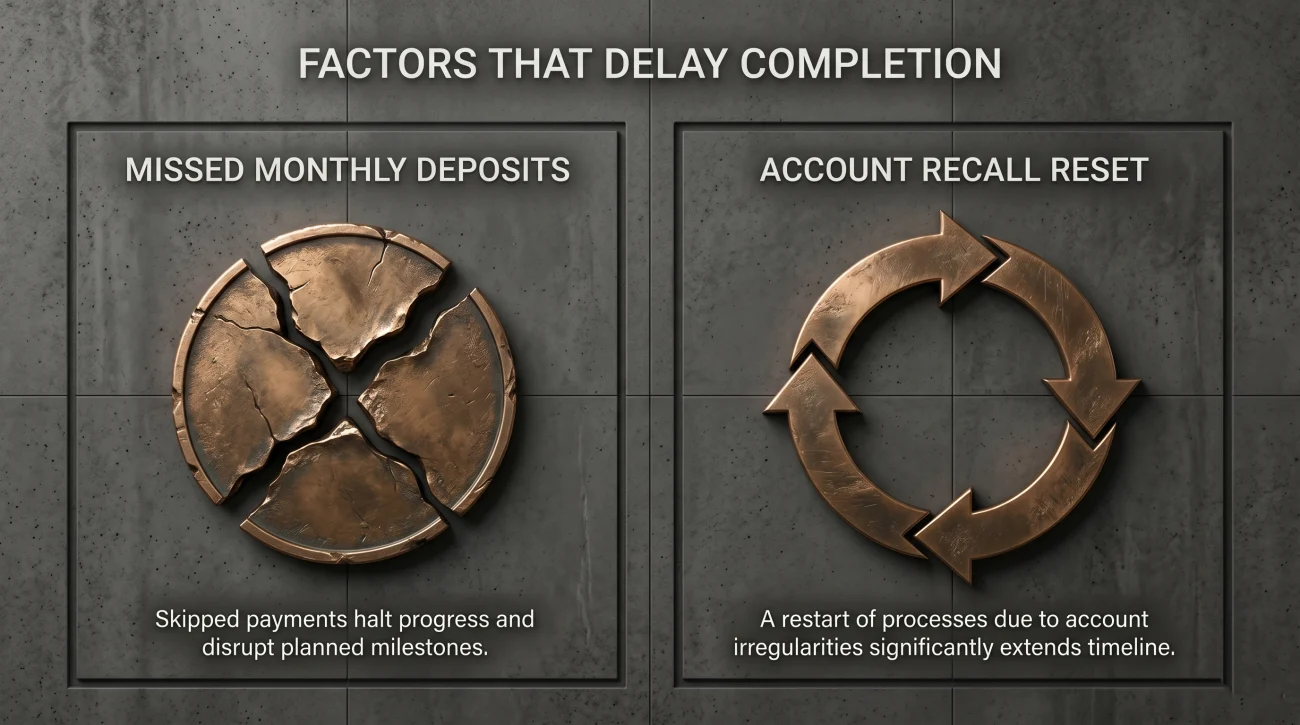
Conversely, the timeline can drag on much longer than anticipated if you encounter specific roadblocks. The most obvious cause of delay is a missed monthly deposit. If you miss a month due to an emergency, the accumulation of leverage halts. A negotiator cannot force a creditor to accept a $2,000 settlement if you only have $1,400 sitting in your account ready to be deployed.
Beyond your own deposits, you may face institutional delays that are entirely out of your control:
- ⏳ Hard-Holdout Credit Unions: Certain credit unions and specific major card issuers have rigid, unforgiving internal policies against deep settlements. They may hold out longer, demand an unreasonably high percentage, or refuse to work with third-party settlement agencies altogether. When this happens, your team has to wait them out until the debt is sold to a more cooperative buyer, extending your timeline.
- ⏳ The Account Recall Delay: Sometimes a negotiator is close to reaching a deal with a collection agency, but the original creditor suddenly recalls the account (pulls it back from that specific agency) to place it with a different vendor or a law firm. This abruptly resets the negotiation cycle. Your team has to start over with a brand new contact, wait for the new agency to process the file, and often face a new collector who demands a higher percentage than the previous one. It is a frustrating industry practice that easily adds months to the timeline for that specific account.
The Mid-Program Lawsuit Risk
There is a specific risk that occurs during Phase 1 that you must be prepared to face. While you are intentionally letting accounts go delinquent to build settlement leverage, the original creditor retains their full legal right to pursue the debt. Some creditors respond to non-payment by filing a lawsuit before you even have enough funds to negotiate.
⚠️ Warning: Legitimate settlement companies will disclose this risk clearly in your enrollment agreement. Signing a contract with a relief program does not legally block a creditor from suing you. If you are sued, ignoring the summons will eventually result in a default judgment, giving the creditor the power to garnish your wages or levy your bank account.
If a creditor files a lawsuit mid-program, it heavily complicates your timeline. Your settlement team will typically pivot to prioritize that specific account to put the fire out. They will attempt to settle the lawsuit before a judgment is entered. Because the creditor has already spent money on filing fees and attorney costs, settling an active lawsuit usually requires offering a higher percentage of the balance. This drains a massive portion of your available funds, setting back the timeline for your other enrolled debts.
If you receive a court summons during your program, you must notify your representative immediately. You also need to know how to evaluate your defense options when a collector takes you to court, as you will likely need to consult a consumer defense attorney to file a formal answer and prevent a default while the settlement firm negotiates.
Leaving Early: What Happens If You Quit?
A multi-year commitment is difficult to maintain. Job losses happen. Medical emergencies drain budgets. Most legitimate programs allow you to exit at any time without a cancellation penalty. If you need to know how to verify a company’s cancellation policy before signing, read our guide on how to choose a legitimate debt settlement firm.
If you leave the program midway through year two, the financial mechanics of your exit are straightforward. You keep the remaining balance of your dedicated funds, minus any fees the company already legally earned for debts they successfully finalized before you quit.
The problem is not retrieving your cash. The problem is the unsettled debt. If you leave mid-program, the accounts that have not yet been resolved are now highly delinquent. You will have to face those aggressive creditors on your own. Restarting direct monthly payments or negotiating hardship plans is nearly impossible once your account history reflects a year or more of intentional non-payment.
Timeline Comparison: Settlement vs. Credit Counseling
If the risk of an early exit, the guaranteed credit score damage, or the mid-program lawsuit threat makes you uncomfortable, you may be wondering if a different structured program offers a better path. The primary alternative is a Debt Management Plan (DMP) administered by a nonprofit credit counseling agency.
While you should read our full guide on comparing the financial impact of debt settlement against credit counseling, it is important to understand that the timeline mechanics operate completely differently.
A DMP typically takes 3 to 5 years (36 to 60 months). This is often longer than a settlement program. However, the experience is entirely different. In a DMP, your monthly payment is disbursed directly to your creditors starting in month one. There is no strategic delinquency period and no cash accumulation phase. The nonprofit agency negotiates a drastically reduced interest rate (often dropping a 24 percent APR down to 6 percent), and you pay back the full principal balance over that extended timeline. To understand the exact mathematics behind those rate reductions, see how a debt management plan functions.
Signs Your Program Is Taking Too Long (When to Worry)
While a multi-year timeline is normal industry practice, there is a distinct line between expected creditor delays and a poorly managed firm that is neglecting your file. If you are experiencing any of the following patterns, your representative may not be actively working your accounts.
- ⚠️ You have been enrolled and making consistent deposits for 18 full months, but zero accounts have been settled.
- ⚠️ The company refuses to provide a clear, documented strategy regarding your largest remaining balances.
- ⚠️ You received a legal summons from an original creditor, and your account manager has ignored your calls or failed to pivot their strategy to address the lawsuit risk.
- ⚠️ The company cannot immediately verify your exact account balance or explain why those funds are not being deployed toward active negotiations.
If you are trapped in a stalled program, or if you are just starting your research and want to avoid companies that drag out timelines unnecessarily, you need to verify the track record of any firm before signing. You can evaluate reputable settlement firms that operate transparently to ensure you are partnering with an agency that respects the timeline.
Final Thoughts on the Settlement Commitment
A debt settlement timeline is a test of your endurance. Watching your credit score drop and enduring collection calls for the first twelve months requires a clear understanding of the mathematical end goal. The 24 to 48 month window is not arbitrary. Strategic delinquency is the uncomfortable mechanism required to force resistant creditors to the negotiating table, and the timeline is simply a reflection of how long it takes to fund the offers they will accept.
If you approach a settlement program expecting a quick fix, you will likely drop out during Phase 1, leaving yourself with heavily damaged credit and unresolved debt. If you understand the timeline as a structured, phased attack on your balances, you can manage the stress of the early waiting period and reach the financial relief waiting at the end.
❓ FAQ
🤷♂️ Is it normal to go 6 months without a single settlement?
Yes. The first 6 to 12 months are almost entirely dedicated to building your savings reserve and allowing your accounts to age into deep delinquency. Most creditors will not even entertain a low settlement offer until an account is near the 180-day charge-off point.
💵 What happens if I get a bonus at work and add it to my account?
Injecting a lump sum dramatically accelerates your timeline. With more cash available immediately, negotiators do not have to wait for your monthly deposits to accumulate. They can target multiple creditors or push for larger settlements months ahead of schedule.
🛑 Can I settle my smallest card myself and let the company handle the big ones?
You can, but it defeats the purpose of the program and complicates the timeline. Paying a creditor directly while in a program can signal to other creditors that you actually have access to cash, which destroys the “financial hardship” leverage your negotiator is relying on.
⚖️ Will enrolling in settlement stop my wages from being garnished?
No. A settlement program is a voluntary negotiation, not a legal shield. If a creditor already has a court judgment against you, they can garnish your wages regardless of your enrollment in a program. Only a formal legal action or bankruptcy immediately halts an active garnishment.
🏦 Do banks treat settlement companies differently than if I called them myself?
Yes and no. The math requirement is the same (they want as much money as possible), but professional negotiators have established channels with bank settlement departments. They know the exact percentage a specific bank will accept on a specific day of the month, removing the guesswork of DIY negotiations.
📞 Can the company force the collection calls to stop during year one?
No. While the company will send letters notifying creditors that you are represented, original creditors often ignore these and continue calling. Third-party debt collectors must legally stop calling you once notified of representation, but the original banks are not bound by the same FDCPA restriction.
🧾 If I leave the program early, do I owe the company fees?
Under federal FTC rules, a debt settlement company cannot charge you a fee until they successfully settle an account and you agree to it. If you quit before any accounts are settled, you walk away with your full savings balance and owe the company nothing.
🔄 Why did my account get transferred to a different collector mid-negotiation?
Original creditors routinely pull accounts back from collection agencies (an “account recall”) if a deal isn’t reached quickly enough, or they sell the portfolio to a new debt buyer. This is a common industry practice that unfortunately resets the negotiation timeline for that specific debt.
📉 Will my credit score start improving as soon as the first account settles?
Typically, no. Settling one account helps, but your other enrolled accounts are still actively accumulating severe negative marks (missed payments, charge-offs) every month. Meaningful credit score recovery generally does not begin until the final months of the program when all accounts reach a zero balance.
⏳ Is there a statute of limitations that forces them to settle faster?
No. In fact, if an account is approaching the statute of limitations (the deadline for a creditor to sue you), the creditor may become far more aggressive, refusing deep discounts and threatening lawsuits to beat the clock. Old debt is easier to settle; expiring debt is highly volatile.
Relief options exist alongside the collection process. These explain both sides.
- The options for resolving debt outside of continued collection
- Debt Settlement vs Credit Counseling: Two Very Different Programs for Two Very Different Situations
- Debt Snowball vs Debt Avalanche: Which Pays Off Debt Faster - and Which One You'll Actually Finish
- Debt Consolidation Loan: When It Saves Money and When It Doesn't
- How to Negotiate Debt Yourself: Hardship Programs and Settlements
Some of these have deadlines attached. Start here if something is already happening.
- What collectors can legally do to you while a settlement program is running
- How to handle a lawsuit on a debt you are actively trying to settle
- What happens to a garnishment order when debt relief is in progress
- How bank levies interact with the debt you are trying to resolve
- How professional settlement programs work and what they actually cost
Disclosure: The content on this site reflects direct experience inside the debt collection industry and is grounded in federal law and regulation. It is informational in nature. Reading it does not constitute legal advice and does not create any professional relationship. If you are dealing with a lawsuit, a judgment, or a legal deadline, consult a licensed attorney in your state before acting.