- The percentage a collector will accept depends entirely on who owns the debt. Debt buyers who purchased your account for pennies on the dollar can settle for 30 percent and still make a massive profit.
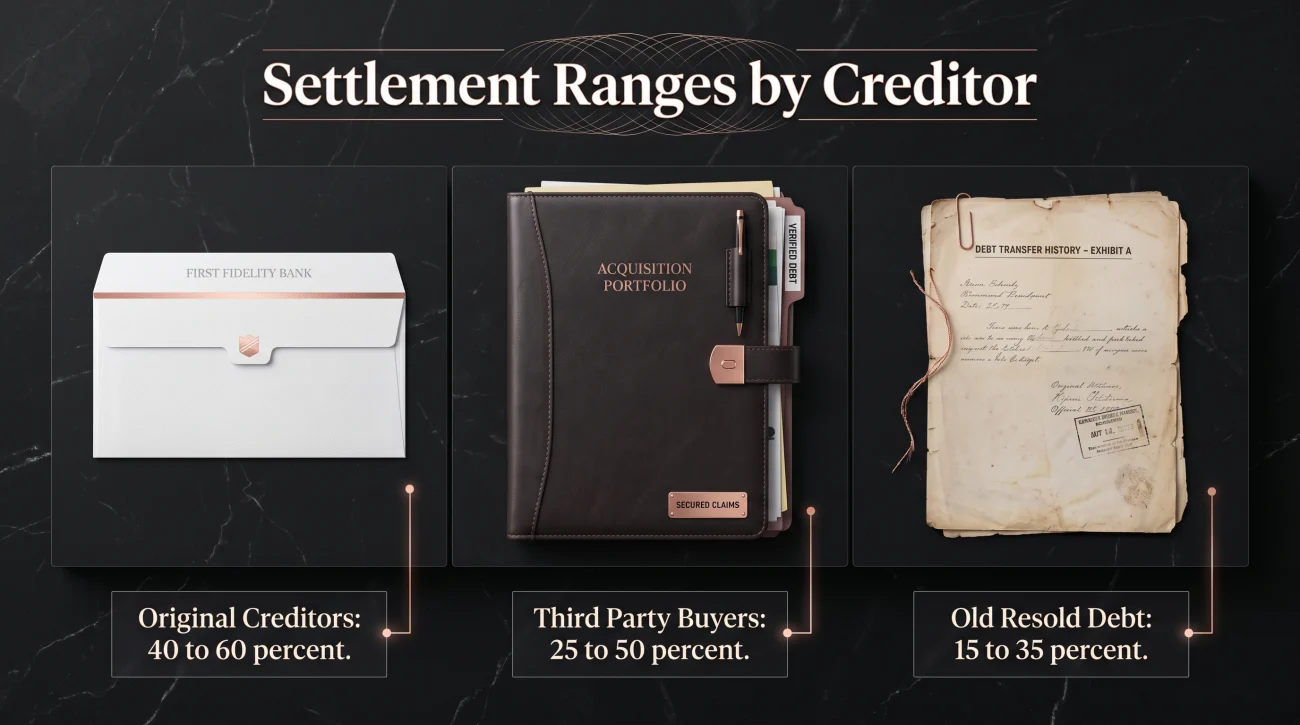
- Original creditors are typically less flexible, often settling between 40 and 60 percent of the balance, while third-party debt buyers frequently accept between 25 and 50 percent.
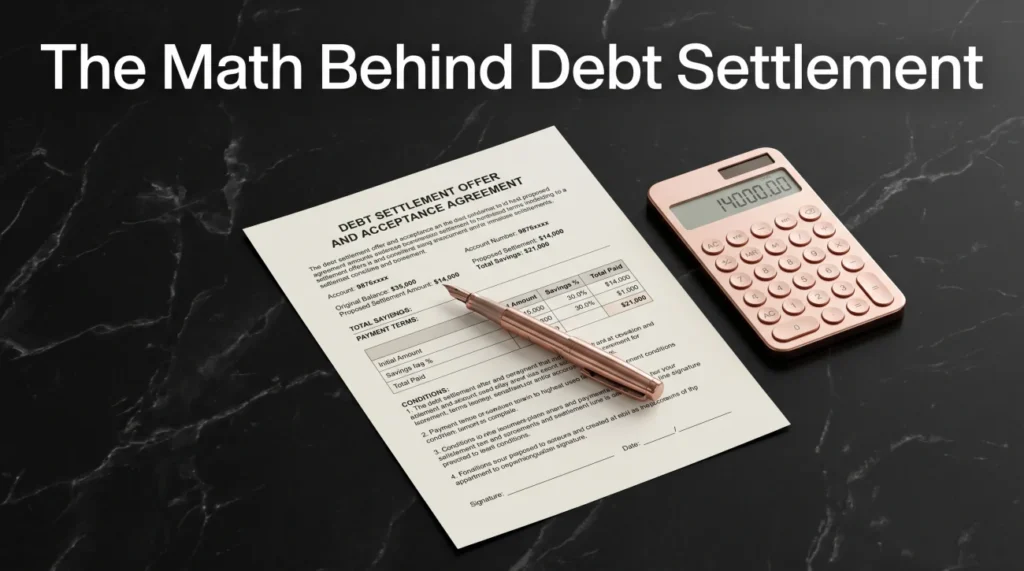
- When using a professional service, you must calculate the net settlement. A 40 percent settlement plus a 20 percent service fee means your total out-of-pocket cost is 60 percent of the original balance.
The Hidden Math Behind Debt Settlement Offers
A debt buyer who paid three cents for every dollar of your balance can settle your account at thirty cents and still earn a five hundred percent return on their investment. An original creditor who lent you the full amount has a completely different financial reality. If you are preparing to negotiate an unpaid account, understanding this distinction is the single most important factor in predicting how much they will accept.
During my twelve years working inside third-party collection agencies and a national debt buyer, I saw consumers constantly overpay on settlements because they assumed the number on the collection letter was firmly fixed. They viewed the balance as a moral absolute rather than a negotiable asset. The collection industry relies heavily on this assumption.
Evaluating your broader options for resolving unsecured debt requires knowing the realistic floor of a settlement. The percentage a collector will accept is not random. It is dictated by a strict set of internal metrics including the age of the account, the quality of their documentation, and most importantly, how much they actually paid to acquire your file.
The Economics of Debt Buying
To understand why settlement is even possible, you have to look at how debt moves through the financial system. When a bank or credit card issuer gives up on collecting an account, they bundle it with thousands of others and sell the portfolio to a third-party debt buyer. They do not sell it for the face value of the balances.
Debt portfolios are typically sold for anywhere from one to fifteen cents on the dollar, depending on how old the accounts are and whether they come with supporting documentation. When a debt buyer purchases a $10,000 credit card balance for $500, their negotiating flexibility is massive. If they call you and settle the account for $3,500, they have made a $3,000 gross profit on a single phone call.
“On the collection floor, agents do not know what the company paid for your specific account. Instead, the floor managers set a ‘settlement floor’ in the software system. An agent might be authorized to accept 40 percent without asking a manager, but they are trained to start the negotiation at 80 percent. The gap between their opening offer and their hidden floor is where your leverage lives.”
This economic reality is exactly why negotiating works. The math exists for creditors to accept significantly less than the full balance while still satisfying their business models.
Realistic Settlement Ranges by Creditor Type
Because the economics change at every stage of the collection cycle, there is no universal settlement percentage. The range you can expect depends almost entirely on who is holding the file and how long it has been delinquent.
Original Creditors (Pre-Charge-Off)
If you are dealing directly with the bank or credit card issuer that originally lent you the money, they are the least flexible. Typically, original creditors will settle for 40 to 60 percent of the balance, though some hold out for 70 percent. They must protect their own loss reserves and answer to shareholders. However, they become highly motivated right before the 180-day delinquency mark. This is the “charge-off” threshold where accounting rules force them to write the debt off as a loss. In month five or six of delinquency, they will often accept a lower percentage just to recover something before selling the file.
Third-Party Debt Buyers
Once the original creditor sells the account, the new owner is a debt buyer. Because they acquired the portfolio at such a steep discount, their acceptable settlement range drops significantly. Debt buyers frequently settle for 25 to 50 percent of the balance. The percentage depends on how recently they bought the portfolio and how aggressively they are trying to liquidate it.
Very Old or Resold Debt
If your debt is three or more years old and has been sold through multiple different collection agencies, the settlement floor drops even further. Accounts in this category often settle for 15 to 35 percent. As debt is resold, the accompanying documentation (like the original signed agreement and full payment history) is frequently lost. Collectors know that without this documentation, they cannot easily win a lawsuit. When you demand an itemized breakdown or the chain of title during negotiations, you expose this exact weakness. A collector who realizes they have no paper trail to back up a lawsuit will usually accept a much lower percentage to close the file quickly.
The Variables That Shift the Final Number
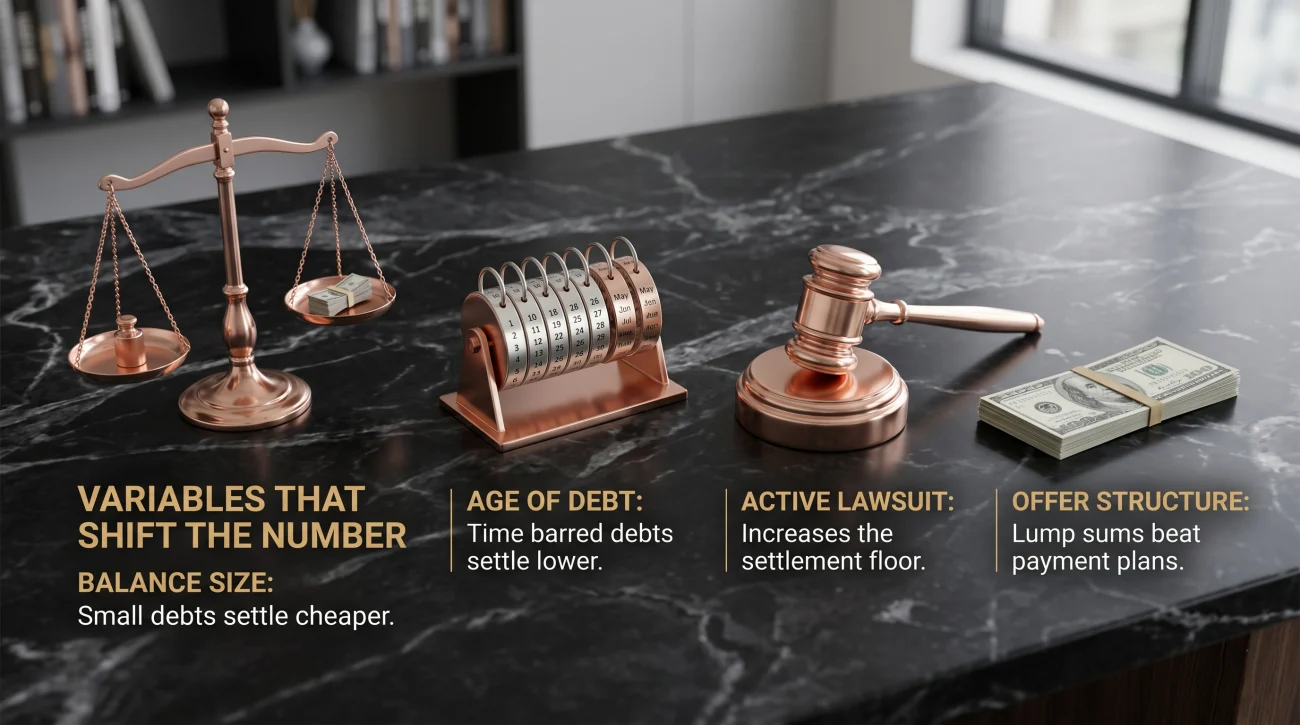
Even within these standard ranges, several specific factors determine whether a collector will push you toward the top of their range or capitulate to the bottom.
The size of the balance plays a surprising role. Very small accounts are often settled faster and at lower percentages because the math of litigation does not support them. A collector will not spend $400 in court costs to pursue a $600 balance, making them more willing to accept a $200 settlement just to close the file. Conversely, larger balances justify heavier collection pressure.
The statute of limitations is another critical variable. If the debt is so old that the legal window to file a lawsuit has expired, it is considered time-barred. Collectors hold very little leverage over time-barred debt because their primary weapon (court action) is gone. In these scenarios, they will often accept steep discounts. Conversely, if a collector has already filed an active lawsuit against you, the settlement percentage typically rises. Once litigation costs are spent, the creditor expects a higher return to justify the expense.
Beyond the debt itself, how you structure your offer changes the math. Offering a single, guaranteed payment today is almost always more attractive to an agency than a payment plan that might default next month.
“I understand the current balance is $8,000. Due to severe financial hardship, I cannot set up a monthly payment plan. I have borrowed a one-time lump sum of $2,500 from a family member to resolve this completely today. That is the maximum I have available.”
⚠️ Warning: If you use this framing, ensure it is truthful. If you claim to have borrowed limited funds but later ask to stretch the settlement into a payment plan, the negotiation will likely collapse as the collector realizes you were bluffing.
Once you navigate these variables and reach an agreement, you still need to calculate what that settlement actually costs you when all fees are factored in.
Calculating Your Net Settlement (The Fee Adjustment)
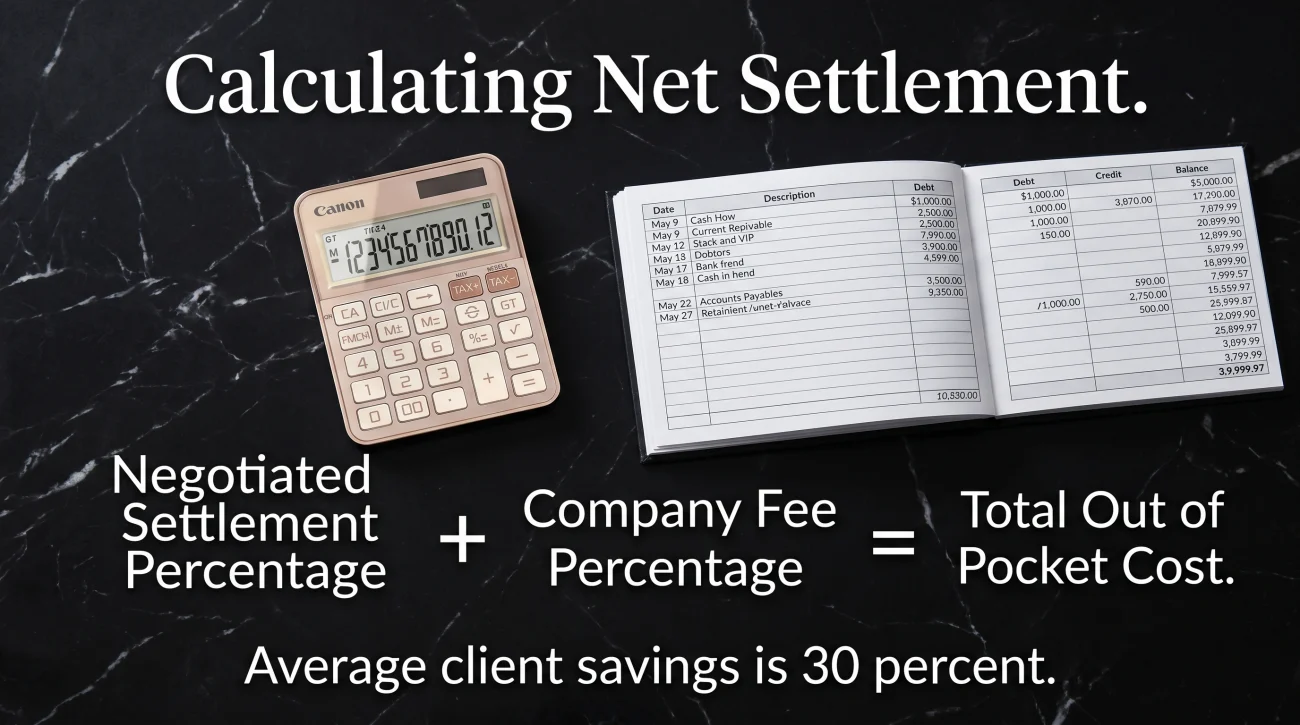
Whether you secure that settlement yourself or bring in help, the final percentage they accept is only part of the equation. If you choose to hire a professional service, you must understand the difference between the negotiated settlement and your actual out-of-pocket cost. Debt settlement companies do not work for free, and their fees must be factored into your financial planning.
Legitimate companies charge a fee that typically ranges from 15 to 25 percent of the enrolled debt balance. This fee is legally only permitted to be charged after a settlement has been reached and you have made at least one payment toward it. To understand your true savings, you must calculate the net settlement.
Negotiated Settlement Percentage + Company Fee Percentage = Total Out-of-Pocket Cost
For example, if you enroll a $10,000 credit card balance and the company negotiates a 40 percent settlement ($4,000), that is $6,000 forgiven by the creditor. If the settlement company charges a 20 percent fee on the enrolled balance ($2,000), your total cost is $6,000. You have effectively paid 60 percent of the original balance, resulting in a net savings of 40 percent. The American Fair Credit Council (AFCC) reports that average client savings are roughly 30 percent after all fees are calculated. Understanding how the debt settlement process actually works ensures you are not caught off guard by these calculations.
DIY Negotiation vs. Professional Representation
Negotiating your own settlement is entirely possible, provided you have the time and emotional distance to treat it like a business transaction. However, the decision of whether to handle the debt negotiation yourself or hire a professional often comes down to industry knowledge and logistics.
The primary advantage of professional settlement companies is their established relationships with the recovery departments of major banks and large debt buyers. They know where each specific creditor sets their internal floor in any given quarter. A DIY negotiator rarely has access to this data, which means you have to guess when a collector’s ‘final offer’ is a script versus an actual limit. However, if you remain objective and push back on early rejections, you can often reach these thresholds yourself.
Additionally, managing multiple delinquent accounts requires significant time. Knowing the realistic timeline for settling multiple accounts is crucial, as the process typically spans two to four years. If tracking correspondence and fielding calls from five different collectors is overwhelming, professional help becomes a matter of convenience and organization rather than just negotiation skill.
Signs You Are Leaving Money on the Table
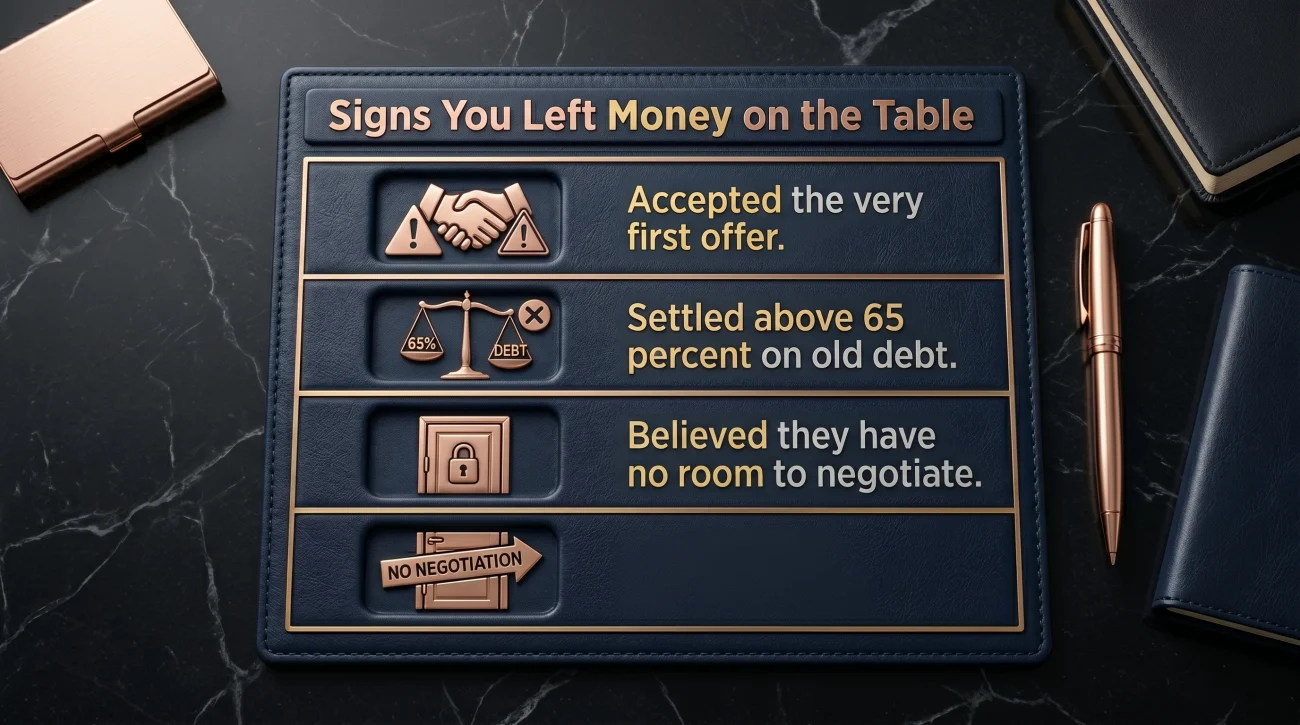
It is easy to panic when a collector offers what sounds like a discount. However, there are clear signs that a settlement is not as favorable as it could be.
First, if you accepted the creditor’s very first offer without any counter-negotiation, you almost certainly left money on the table. The initial offer is an anchor designed to set your expectations artificially high.
Second, if the final agreed amount is above 65 percent of the original balance on an account that has been delinquent for over a year, the collector likely won the exchange. Balances that old typically have significantly more room to move.
Finally, a major red flag is when a collector successfully convinces you that they have absolutely no room to negotiate. In the third-party debt buying space, there is always a floor, and it is rarely their opening number. If you are unsure of how to push back safely, you must evaluate what to look for when evaluating professional settlement organizations.
Final Thoughts on Finalizing a Settlement
Negotiating the percentage is only the first half of the battle. The second half is securing the agreement properly. You should never make a payment toward a settlement until you have the exact terms in writing from the collector. This document must explicitly state the agreed amount and confirm that this payment satisfies the account in full. Verbal promises made over the phone are effectively worthless if the agency later decides to sell the remaining unpaid balance to another collector. If the stress of securing these agreements correctly is too high, consider consulting established debt settlement companies to handle the negotiations and paperwork on your behalf.
❓ FAQ
💰 Should I accept the debt collector’s first settlement offer?
Rarely. The first offer a collector makes is a negotiating anchor, not their actual bottom line. Counter-offering with a lower lump sum tests their actual flexibility and usually results in a better deal.
📉 Do debt collectors ever settle for 10 percent of the balance?
It is possible but highly uncommon. Settlements at 10 to 15 percent typically only occur on very old debt that has passed the statute of limitations or on accounts where the collector is entirely missing the legal documentation required to prove the debt.
🧾 Do I have to pay taxes on the amount the debt collector forgives?
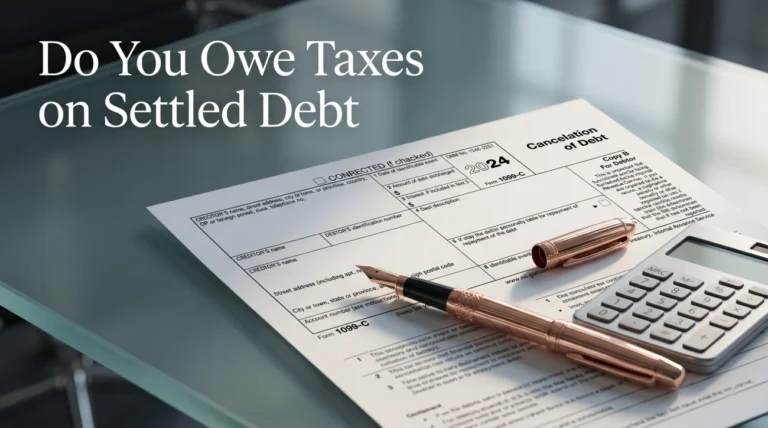
Yes, the IRS generally considers forgiven debt over $600 as taxable income and the collector will send a 1099-C form. However, if you were insolvent (your total debts exceeded your assets) when the debt was settled, you may qualify for a partial or full exclusion.
🏛️ Will a collector still settle if they have already filed a lawsuit against me?
Yes, creditors often settle during active litigation to avoid the uncertainty and cost of a trial. However, because they have already spent money on filing fees and attorney costs, the settlement percentage they are willing to accept is usually higher than it would have been pre-lawsuit.
Relief options exist alongside the collection process. These explain both sides.
- The options for resolving debt outside of continued collection
- How to Choose a Debt Settlement Company: What NDR, FDR, and ADR Actually Offer and the Red Flags to Avoid
- Debt Consolidation Loan: When It Saves Money and When It Doesn't
- Debt Settlement vs Credit Counseling: Two Very Different Programs for Two Very Different Situations
- Debt Relief Scams: How to Spot Them Before You Pay and What the FTC Says About Legitimate Companies
Some of these have deadlines attached. Start here if something is already happening.
- What collectors can legally do to you while a settlement program is running
- How to handle a lawsuit on a debt you are actively trying to settle
- What happens to a garnishment order when debt relief is in progress
- How bank levies interact with the debt you are trying to resolve
- How professional settlement programs work and what they actually cost
Disclosure: The content on this site reflects direct experience inside the debt collection industry and is grounded in federal law and regulation. It is informational in nature. Reading it does not constitute legal advice and does not create any professional relationship. If you are dealing with a lawsuit, a judgment, or a legal deadline, consult a licensed attorney in your state before acting.