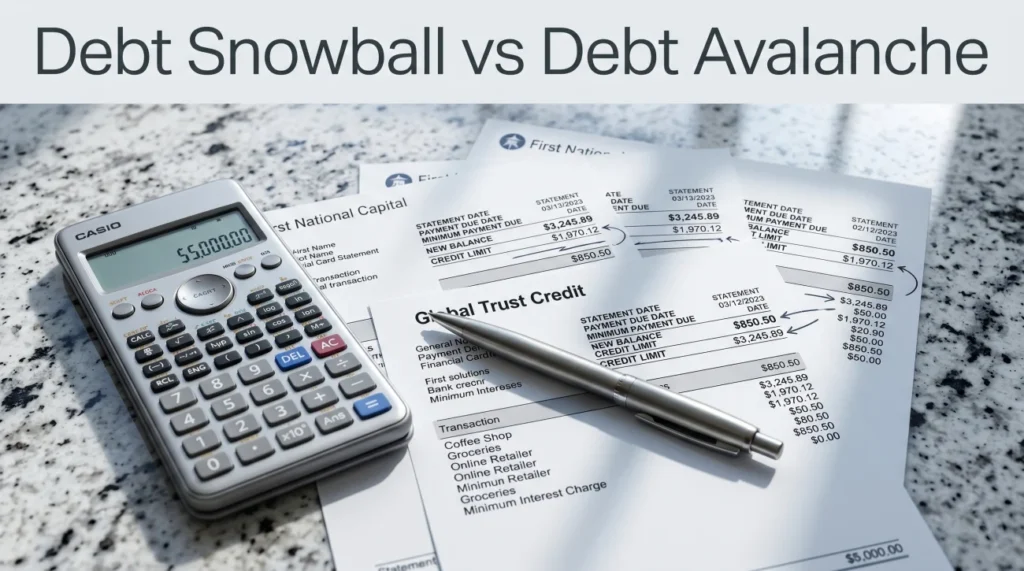
- The math says you should use the debt avalanche method. Behavioral research proves you are much more likely to complete the debt snowball method. The best strategy is whichever one you will actually finish.
- The debt avalanche minimizes total interest by targeting your highest-rate accounts first, but progress can feel painfully slow on large balances.
- The debt snowball builds psychological momentum by eliminating your smallest balances first, creating quick wins that keep you motivated over the long haul.
- In most average debt portfolios, the actual dollar difference between the two methods is smaller than expected – often just a few hundred dollars.
- Neither method works if you do not have a consistent monthly budget surplus to apply toward the principal. If you are struggling with minimums, you need structured relief, not a DIY strategy.
The Reality of Paying Off Multiple Debts
When you are staring at five different credit card balances, a medical bill, and a personal loan, the hardest part is not doing the math. The hardest part is deciding where to send your limited extra cash each month. If you ask a financial advisor, they will tell you to use the debt avalanche method because it mathematically saves you the most money. But if you look at human behavior, the data tells a completely different story.
During my twelve years in the debt collection industry, I watched thousands of consumers try to climb their way out of financial holes. I saw people map out perfect spreadsheets optimized to save every possible penny of interest, only to abandon the entire effort four months later. I also saw people tackle their debts inefficiently but relentlessly, eventually crossing the finish line.
The core problem with paying off debt is that it is a marathon, not a sprint. If your strategy does not keep you motivated, the math simply does not matter. In this guide, we are going to break down exactly how both the debt snowball and debt avalanche methods work. We will look at the real numbers, the psychological traps, and a practical hybrid approach that blends the best of both worlds so you can finally get to zero.
The Minimums-Only Trap: Why You Need a Strategy
Before comparing the two methods, we have to establish why a deliberate strategy is necessary in the first place. Credit card companies design minimum payments specifically to keep you in debt for as long as legally possible. Their business model relies on maximizing the interest you pay over time.
If you have a $5,000 credit card balance at a 22% Annual Percentage Rate (APR), your balance is growing by roughly $91 every single month in interest alone. If your minimum payment is $120, only $29 is actually going toward reducing the principal balance you owe. The rest is pure profit for the bank.
At that pace, paying only the minimum will take you nearly 15 to 20 years to clear that single card, and you will end up paying more in interest than the original $5,000 you borrowed. Both the snowball and avalanche methods are designed to break this cycle by focusing your extra cash flow on one target at a time. If you need help organizing your accounts before starting, you should look at structuring a realistic payoff plan first.
Method 1: The Debt Avalanche (Maximum Interest Savings)
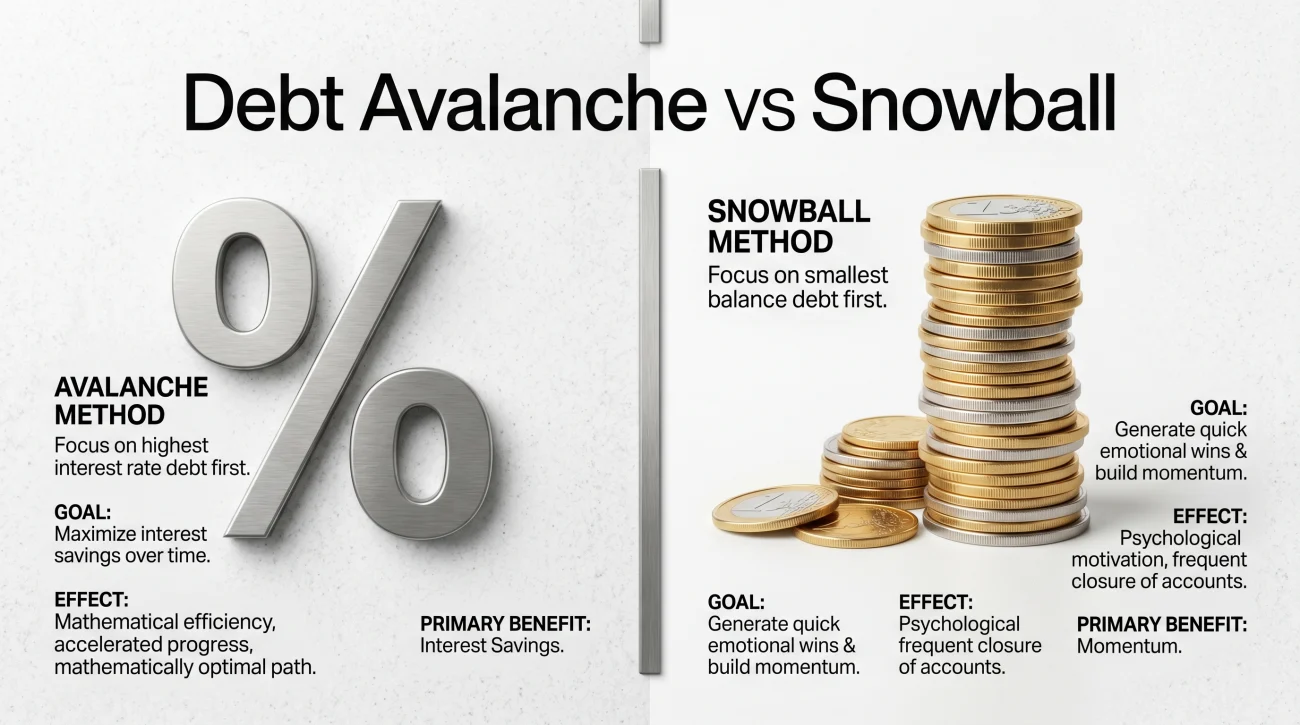
The debt avalanche is the mathematically superior approach. It ignores the size of your balances and focuses entirely on the cost of the money you have borrowed. By neutralizing your most expensive debts first, you minimize the total amount of interest that accrues over your repayment period.
How the Avalanche Works
- 📋 Step 1: List all of your debts in order of interest rate, from highest APR to lowest APR.
- 📋 Step 2: Continue paying the absolute minimum required payment on every single account to prevent late fees and credit damage.
- 📋 Step 3: Take every extra dollar in your budget (your monthly surplus) and apply it directly to the account with the highest interest rate.
- 📋 Step 4: Once that highest-rate debt is completely paid off, take the entire amount you were paying toward it (the minimum plus your surplus) and roll it into the debt with the next-highest interest rate.
This method works like a financial fire extinguisher. You are aiming it at the hottest part of the fire first. For people who are deeply analytical and motivated purely by numbers, the avalanche is the logical choice.
The Psychological Flaw
The problem with the avalanche method appears when your highest-interest debt is also your largest balance. If you have a $12,000 credit card balance at 24% APR and a $300 medical bill at 0% interest, the avalanche method dictates that you ignore the quick win of the medical bill and pour everything into the credit card.
If your extra budget is $150 a month, you could be attacking that $12,000 balance for nearly a year before you feel like you have made any visible progress. This is the exact point where most people get discouraged, experience budget fatigue, and quit the program.
Method 2: The Debt Snowball (Maximum Psychological Momentum)
The debt snowball method completely ignores interest rates. Instead, it leverages human psychology to build momentum. The goal is to get quick, decisive wins early in the process to train your brain that progress is actually happening.
How the Snowball Works
- 📋 Step 1: List all of your debts in order of balance size, from smallest total balance to largest total balance. Ignore the interest rates entirely.
- 📋 Step 2: Pay the required minimum on every single account.
- 📋 Step 3: Take your extra budget surplus and throw it entirely at the smallest balance on your list.
- 📋 Step 4: Once that small balance is gone, take the money you were using for it and roll it into the next smallest balance.
When reviewing financial statements with consumers who had defaulted after trying to pay their way out, I almost always saw the same pattern. They tried to tackle an $18,000 personal loan at 16% first because the math made sense, while ignoring three separate $250 utility and medical collections. Six months later, they felt like they had made zero progress on the big loan, lost motivation, and gave up entirely. The math was right, but the human behavior failed.
The snowball method works because crossing an account off your list releases dopamine. When that $250 medical bill disappears in month two, you feel a surge of accomplishment. You now have one less bill to track, one less due date to remember, and proof that your sacrifices are working. That momentum carries you into the larger, more intimidating balances.
I will endure a long period of no visible progress to optimize my interest savings and clear my debt in the most mathematically efficient way possible.
I need quick wins to prove to myself that this is working. The psychological momentum is worth paying slightly more in interest over the long run.
The Real Math Difference: Let’s Look at the Numbers
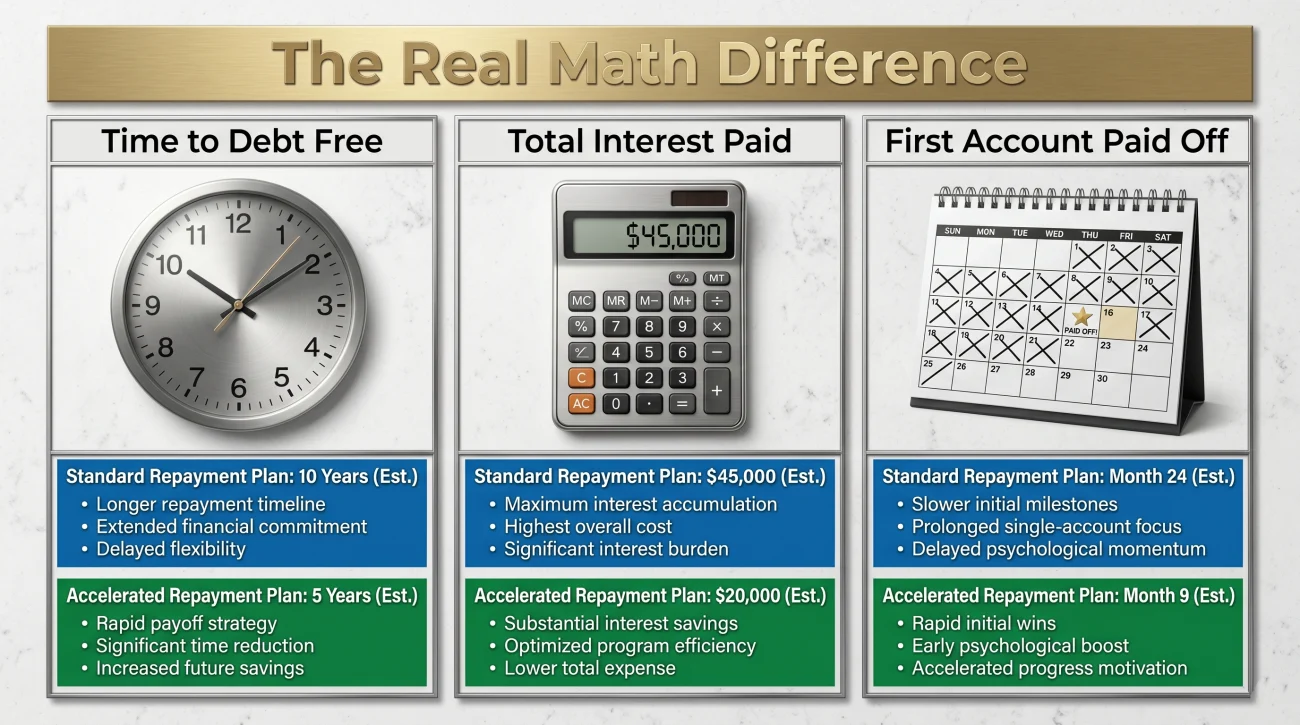
Financial purists hate the snowball method because you are knowingly paying more in interest. But how much more are we actually talking about? To see the real difference, let’s look at a realistic consumer debt portfolio.
Imagine you have four accounts totaling $17,500. Your monthly budget to put toward debt is $800.
- Debt A: $500 Medical Bill (0% APR)
- Debt B: $2,000 Credit Card (19% APR)
- Debt C: $5,000 Auto Loan (7% APR)
- Debt D: $10,000 Credit Card (24% APR)
Here is what happens when you run those exact numbers through both payoff strategies side-by-side.
| Metric | Debt Avalanche (Math Focus) | Debt Snowball (Momentum Focus) |
|---|---|---|
| Time to Debt-Free | 28 Months | 29 Months |
| Total Interest Paid | $3,850 | $4,380 |
| First Account Paid Off | Month 14 (The $10k Card) | Month 1 (The Medical Bill) |
| Accounts Managed | Drops very slowly | Drops quickly (Less stress) |
*Note: The figures above are approximate estimates based on standard amortization assumptions to illustrate the comparison.
The math is clear. The avalanche method saves you roughly $530 over a two-and-a-half-year period. But look at the third row. With the avalanche method, you have to grind for 14 straight months before you get to celebrate paying off a single account. With the snowball method, you eliminate an account in the very first month, and another one a few months later.
Is saving $530 over nearly three years worth waiting 14 months for your first victory? For most people dealing with daily financial stress, the answer is no. The gap only becomes massive if you have one outlier debt with a drastically higher interest rate, such as a payday loan at 150% APR. In those extreme cases, ignoring the high-rate debt is dangerous. But for standard consumer debt, the variance is narrow enough that completion rates matter more than perfect math.
What I Saw in Collection Portfolios
You do not have to guess which method is more successful in the real world. When my agency bought portfolios of defaulted credit cards, we had access to the payment histories showing the months before the accounts charged off. I could see exactly when a consumer gave up.
The accounts that ended up on my desk usually belonged to people who tried to optimize. They paid the minimums on four small retail cards so they could throw every spare dollar at their massive $15,000 balance. Months went by. The big balance barely moved due to the heavy interest headwind. Meanwhile, the four small cards kept generating statements, requiring logins, and demanding mental energy. Eventually, the fatigue of managing five different payments with no visible progress caused them to miss a payment, then another, until the whole house of cards collapsed.
The people who successfully avoided collections were the ones who ruthlessly eliminated the “noise” first. By knocking out the small balances early, they reduced their total number of monthly obligations. It gave them fewer due dates to manage, less margin for error, and the psychological momentum to keep going.
A Practical Hybrid Approach
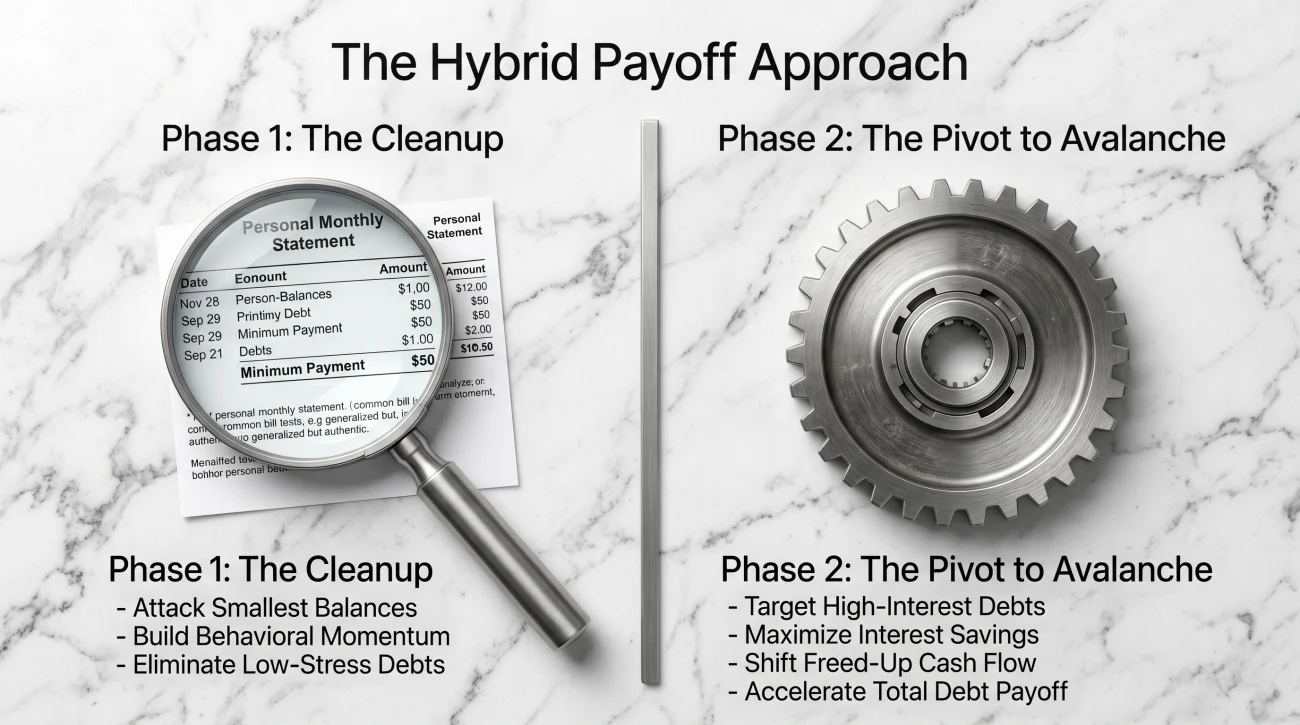
You do not have to choose strictly between the two. For many consumers, a hybrid approach offers the perfect balance of psychological momentum and financial efficiency.
Imagine you have a $150 store card, a $400 medical bill, and two $8,000 credit cards at high interest rates. Here is how the hybrid strategy works in practice:
- 📌 Phase 1: The Cleanup. Pause the optimization. Look at your list of debts and identify the tiny “nuisance” balances under $500. Throw your entire surplus at the $150 store card and the $400 medical bill. Clearing them out over 30 to 60 days gives you immediate wins and reduces the mental clutter of managing too many accounts.
- 📌 Phase 2: The Pivot. Once those two small accounts are gone, you only have the two heavy credit cards left. You already have your momentum. Now, switch to the Avalanche method and target the $8,000 card with the highest interest rate. You can optimize for savings without feeling overwhelmed.
💡 Pro Tip: If you are struggling with high interest rates across the board, do not just accept them. Before starting your payoff plan, look into utilizing a 0% introductory offer or securing a lower fixed rate to reduce the headwind you are fighting. Lowering the rate makes both the snowball and avalanche work faster.
What Both Methods Absolutely Require
There is a harsh reality that many personal finance guides gloss over: neither the snowball nor the avalanche method works if you do not have a monthly budget surplus. Both strategies rely entirely on your ability to pay consistently more than the minimum requirements.
If your monthly take-home pay exactly matches your rent, utilities, food, and minimum debt payments, you cannot run a snowball. You cannot run an avalanche. You are simply treading water. If you only find $20 extra a month, accelerating a $15,000 debt pile is going to take decades. So what do you do if you currently have no surplus at all?
How to Find Your Surplus
In collections, we call this the “capacity problem.” How do you create a surplus if you currently have none? If your income exactly matches your expenses, you have to temporarily manufacture a gap. This means a ruthless 90-day audit: pausing non-matched retirement contributions, canceling passive subscriptions, or taking on temporary weekend gig work. You only need to manufacture this intense surplus long enough to kill the first few debts, which then frees up their minimum payments to keep the snowball rolling. But if you cannot manufacture even $100 of surplus after cutting your budget to the bone, DIY methods will not save you.
Common Payoff Mistakes to Avoid
Even with a strong budget surplus, I have seen people sabotage their own progress by making these easily avoidable errors:
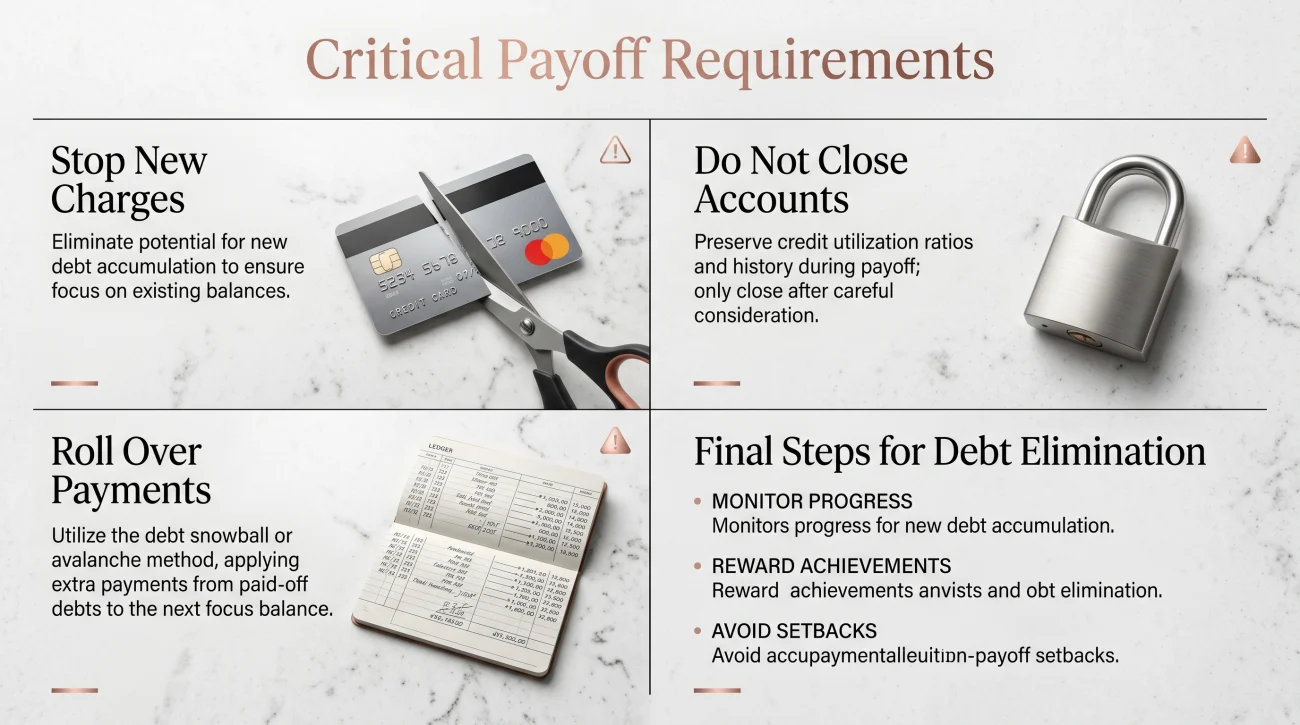
- Continuing to use the cards: You cannot dig yourself out of a hole while continuing to dig. Once you commit to a payoff strategy, you must stop charging new purchases to your accounts.
- Closing accounts immediately: When you celebrate paying off a card, your instinct might be to call the bank and close the account. Do not do this. Closing credit accounts reduces your overall available credit and shortens your credit history, both of which will damage your credit score. Cut the physical card up, but leave the account open.
- Forgetting to roll the payment over: The magic of both methods is the “roll-over.” When you finish paying a $100 minimum bill, that $100 must be added to the payment of your next target. If you absorb that $100 back into your lifestyle spending, the acceleration stops.
Signs You Need Structured Help Rather Than DIY
The snowball and avalanche methods are Do-It-Yourself (DIY) strategies. They require you to be current on your accounts and financially capable of making progress. But if you have fallen too far behind, DIY optimization is no longer the right tool for the job. You need to recognize when a different path is required.
- ⚠️ You have audited your expenses and simply cannot find any budget surplus to apply toward the principal.
- ⚠️ Your minimum payments alone consume more than 25% of your total take-home pay.
- ⚠️ Several of your accounts have already charged off and been sold to third-party collection agencies.
- ⚠️ You are actively receiving threatening phone calls and need to know what to do if you are facing aggressive collection tactics.
If these signs describe your current situation, you need to transition from trying to pay the full balances to exploring structured intervention. You should look into evaluating all available structured relief paths, which range from nonprofit credit counseling to debt settlement.
Final Thoughts: Choose Execution Over Perfection
Do not let analysis paralysis keep you trapped in the minimum-payment cycle. From a debt collector’s perspective, the banks love when you spend months agonizing over spreadsheets trying to find the perfect mathematical payoff route. Why? Because while you are calculating and hesitating, they are still charging you 22% interest every single month. Time is their greatest asset and your biggest enemy.
Pick the method that honestly fits your personality. If you are highly disciplined and hate paying an extra dime to a bank, use the avalanche. If you need visible motivation and get easily overwhelmed by large numbers, use the snowball. Commit to the strategy today, stop adding new debt, and roll your payments forward. If your situation is too severe for either method to make a dent, do not hesitate to explore professional debt settlement intervention as a viable alternative.
❓ FAQ
💸 Which method actually pays off debt faster?
Mathematically, the debt avalanche method pays off debt faster and saves you the most money in interest. However, behavioral studies show that people using the debt snowball method are more likely to actually finish the process.
🏔️ How exactly does the debt avalanche work?
You list your debts from the highest interest rate to the lowest. You pay the minimum on everything, but apply every extra dollar to the debt with the highest rate until it is gone, then move to the next highest rate.
⛄ How exactly does the debt snowball work?
You list your debts from the smallest total balance to the largest, ignoring interest rates. You pay the minimum on everything and throw all your extra cash at the smallest balance to get quick psychological wins.
📉 Does the snowball method cost a lot more money?
It depends on your interest rates, but for average credit card debt, the difference is often smaller than expected – typically a few hundred to a couple of thousand dollars over a multi-year payoff period.
🔄 Can I switch between the two methods?
Yes. A common hybrid strategy is to use the snowball method to clear out tiny “nuisance” balances quickly, and then pivot to the avalanche method to optimize interest savings on the larger remaining accounts.
💳 Should I close my credit cards after paying them off?
No. Closing old accounts reduces your available credit and shortens your credit history, which can damage your credit score. It is better to cut up the physical card but leave the account open with a zero balance.
🛑 What if I cannot afford more than the minimum payments?
If you have no budget surplus, neither the snowball nor the avalanche will work effectively. You will need to explore alternatives like a Debt Management Plan (DMP), debt consolidation, or debt settlement.
🏦 Do these methods work for student loans?
Yes, both methods work for private student loans. However, federal student loans offer income-driven repayment plans and forgiveness options that you should explore before aggressively paying them down.
📈 Will paying off multiple debts quickly hurt my credit?
No. Paying down your principal balances lowers your credit utilization ratio, which is one of the biggest positive factors in calculating your credit score. Your score will generally improve as balances drop.
⚖️ Is it better to consolidate my debt instead?
A consolidation loan is only better if the new fixed interest rate is significantly lower than the average rate of your current debts. If you cannot qualify for a low rate, the snowball or avalanche might be superior.
Relief options exist alongside the collection process. These explain both sides.
- The options for resolving debt outside of continued collection
- Debt Settlement vs Credit Counseling: Two Very Different Programs for Two Very Different Situations
- Debt Relief Scams: How to Spot Them Before You Pay and What the FTC Says About Legitimate Companies
- How to Choose a Debt Settlement Company: What NDR, FDR, and ADR Actually Offer and the Red Flags to Avoid
- What Debts Can Be Settled or Included in a Debt Relief Program - and What Can't
Some of these have deadlines attached. Start here if something is already happening.
- What collectors can legally do to you while a settlement program is running
- How to handle a lawsuit on a debt you are actively trying to settle
- What happens to a garnishment order when debt relief is in progress
- How bank levies interact with the debt you are trying to resolve
- How professional settlement programs work and what they actually cost
Disclosure: The content on this site reflects direct experience inside the debt collection industry and is grounded in federal law and regulation. It is informational in nature. Reading it does not constitute legal advice and does not create any professional relationship. If you are dealing with a lawsuit, a judgment, or a legal deadline, consult a licensed attorney in your state before acting.