- Medical debt is fundamentally different from credit card debt because most hospitals are required under their nonprofit status to offer financial assistance programs.
- The 2025 CFPB rule finalized the removal of medical debt from consumer credit reports, changing the leverage collectors have over you.
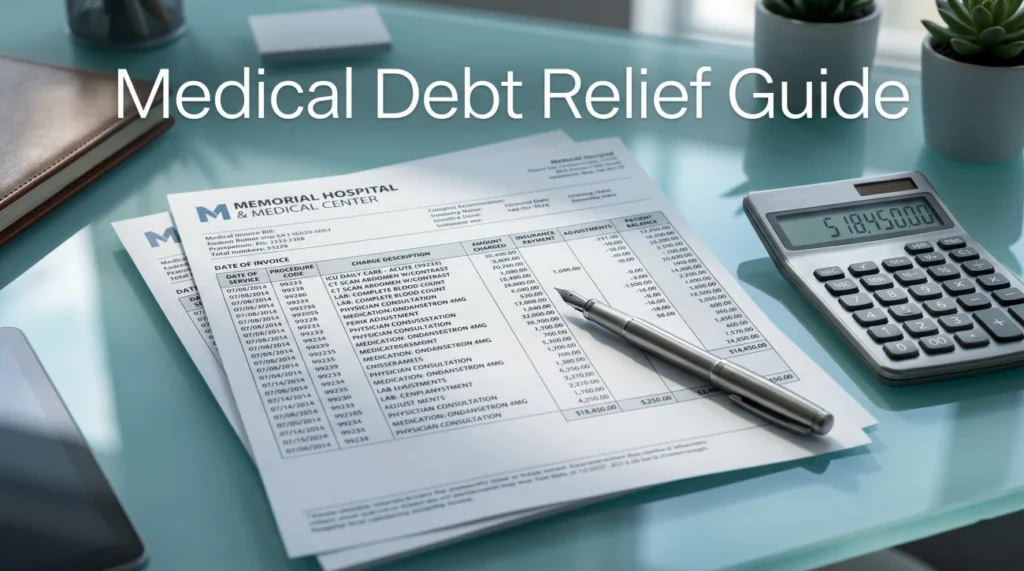
- Before paying any medical bill, always request an itemized statement with CPT codes, as an estimated 80 percent of hospital bills contain errors.
- If your income is below 300 to 400 percent of the Federal Poverty Level, you may qualify for complete forgiveness or massive reductions through hospital charity care.
- When a hospital account is sold to a third-party debt buyer, the economics shift completely, opening the door for deep settlement discounts.
Medical Debt Operates by Different Rules
In my 12 years working inside third-party collection agencies and a national debt buyer, medical paper was always handled differently than credit card accounts. When we collected on unpaid credit cards, the original creditor had provided a clear ledger. The consumer used the card, agreed to the terms, and owed the balance. Medical debt is rarely that clean. People do not plan to go to the emergency room, they do not sign terms agreeing to an exact price beforehand, and the billing process involves layers of insurance adjustments and coding errors.
The most important thing I can tell you about medical debt is that the system expects you to negotiate. Collection agencies know they bought your unpaid hospital bill for pennies on the dollar. Yet, most consumers assume a medical bill is a fixed legal demand that must be paid in full immediately.
If you are overwhelmed by medical bills, you have more leverage than you realize. There are federal rules regarding hospital charity care, new consumer protections regarding credit reporting, and standard industry practices that allow for massive reductions in what you owe. You just need to know which process applies to the specific stage your bill is in.
The 2025 Credit Reporting Rule Change
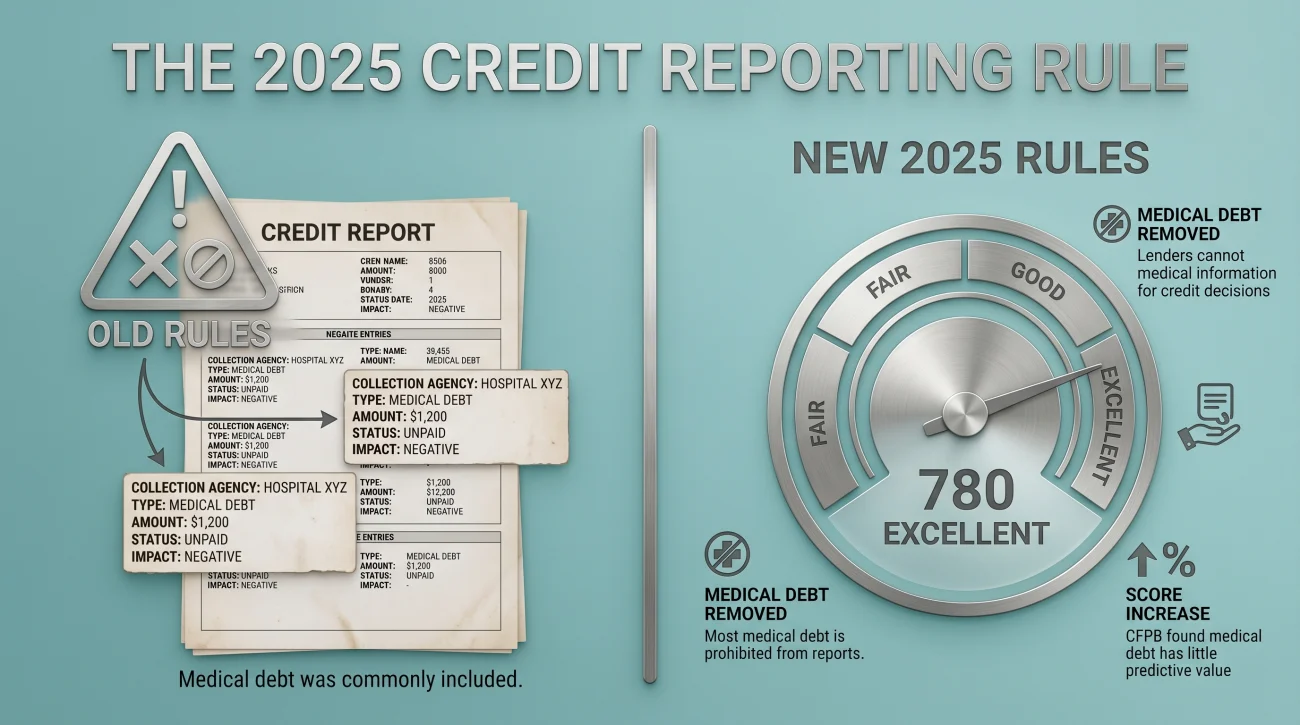
For decades, the primary weapon a medical debt collector had was your credit report. They knew that if an unpaid hospital bill dropped your score by 80 points, you would eventually have to pay it if you ever wanted to buy a car, rent an apartment, or secure a mortgage. That leverage shifted dramatically recently.
In January 2025, the Consumer Financial Protection Bureau finalized a rule removing medical debt from consumer credit reports entirely. This builds on earlier changes that removed paid medical debts and debts under a certain dollar threshold. The new rule covers an estimated 15 million Americans and billions in outstanding medical bills, meaning that an unpaid hospital bill should no longer impact your FICO score or appear on your standard credit history.
“When medical debt was on credit reports, we would regularly see consumers call in to pay full balance just days before closing on a house. The collector did not even have to negotiate. Removing that reporting mechanism takes away the collector’s strongest passive collection tool.”
However, there is a critical distinction you must understand. Removing a debt from your credit report does not erase the debt itself. The hospital or the collection agency still maintains the legal right to collect what you owe. They can still call you, send letters, and in some cases, file a lawsuit against you. The rule simply removes the passive credit damage. Furthermore, with shifts in federal administrations, enforcement priorities can change, so it is always wise to pull your actual credit report to verify your specific status.
Charity Care: The Requirement Hospitals Rarely Advertise
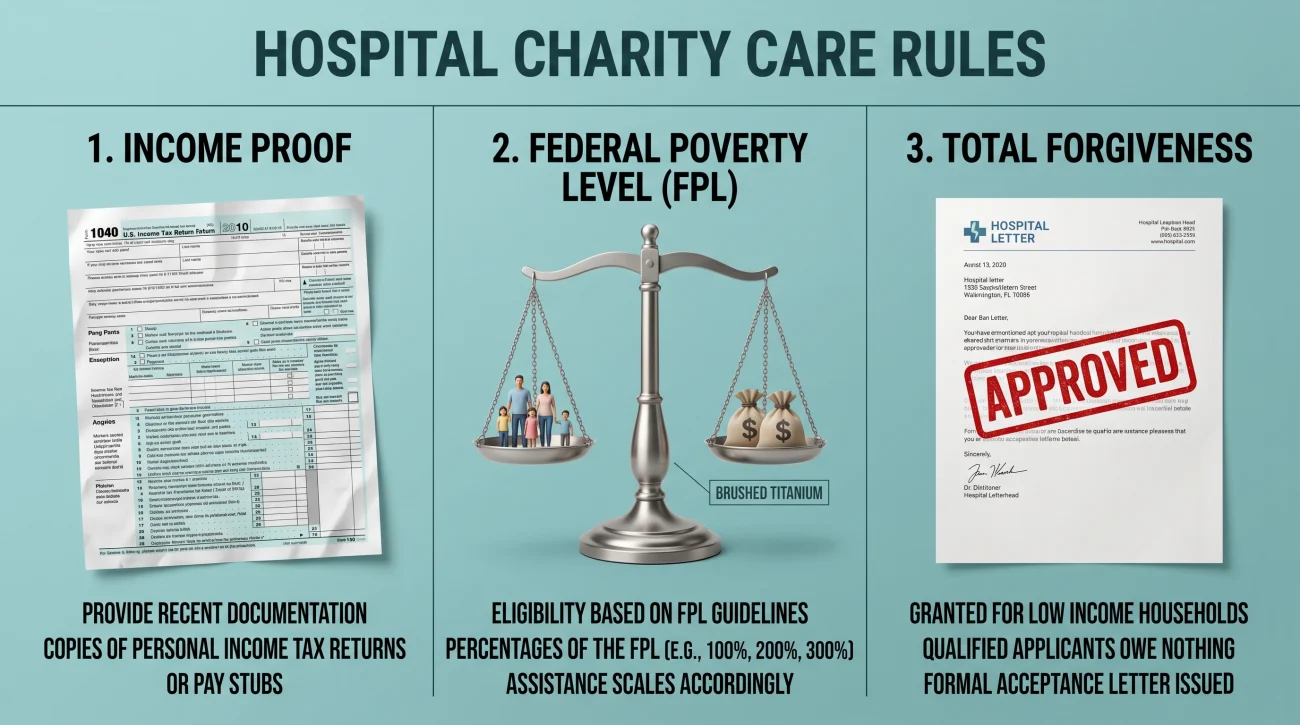
If your bill is still with the original hospital, your first step has nothing to do with negotiation. It has to do with eligibility for forgiveness. All 501(c)(3) nonprofit hospitals are required under their nonprofit operating status to maintain a Financial Assistance Policy. These programs are commonly referred to as charity care.
Because the majority of hospitals in the United States operate as nonprofits, there is a very high probability that the facility treating you is bound by this rule. These operating guidelines mandate that these hospitals offer discounted or entirely free care to patients who qualify based on their household income. The problem is that many hospitals do not actively inform patients about these programs during admission or on the initial billing statement. You have to ask for the application.
Income Thresholds for Financial Assistance
Eligibility for charity care is almost always tied to the Federal Poverty Level. While every hospital sets its own specific internal policy, it is standard practice to offer 100 percent forgiveness for households earning under 200 percent of the poverty line, and sliding-scale discounts for households earning up to 300 or 400 percent.
| Household Size | 100% of FPL (2025 Base) | 200% of FPL (Often 100% Forgiven) | 300% of FPL (Often Heavily Discounted) |
|---|---|---|---|
| 1 Person | $15,060 | $30,120 | $45,180 |
| 2 People | $20,440 | $40,880 | $61,320 |
| 3 People | $25,820 | $51,640 | $77,460 |
| 4 People | $31,200 | $62,400 | $93,600 |
This means a single person earning $40,000 a year might easily qualify for a 50 percent reduction on a massive emergency room bill, simply by filling out a form and providing a tax return or pay stubs. Before you offer to make a payment plan, call the hospital’s patient financial services department and ask specifically for their Financial Assistance Policy application.
Auditing the Itemized Bill and Splitting the Charges
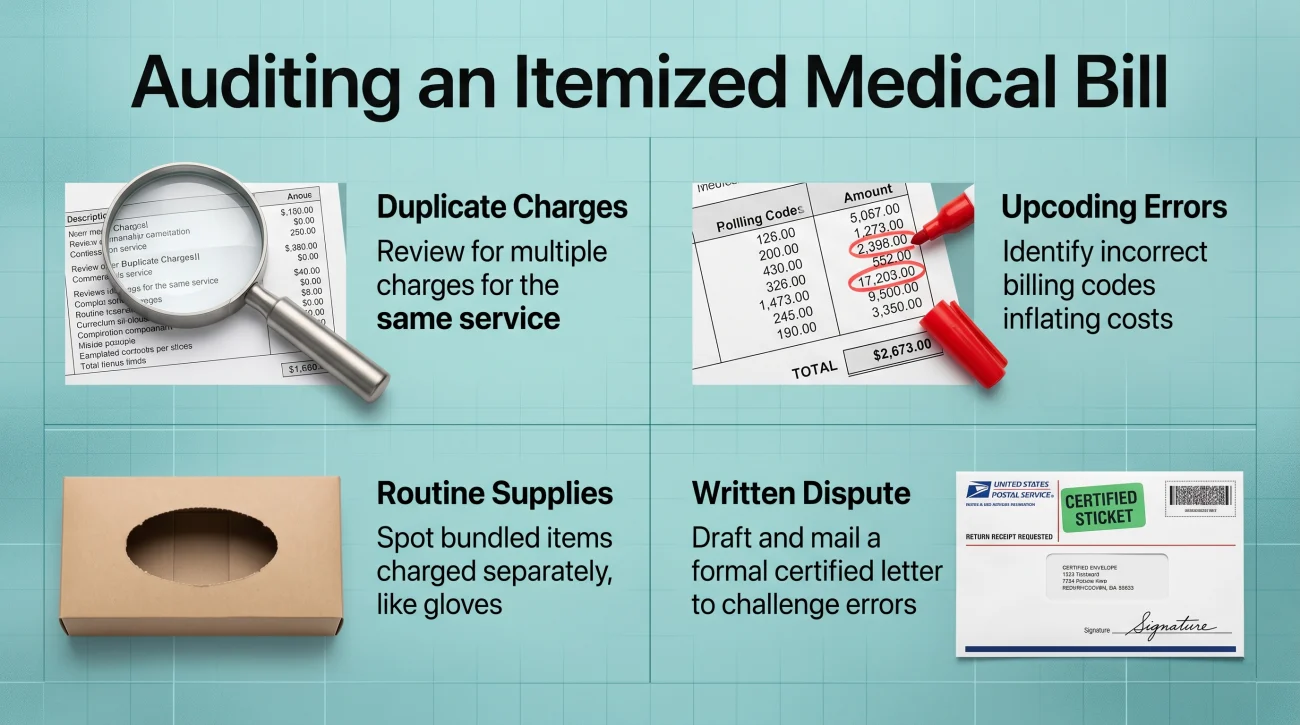
If you do qualify for complete forgiveness, your work is done. But if you fall outside those income limits, or if you have a high-deductible insurance plan that left you with a massive balance, your next move before paying anything is verifying the bill itself is even accurate. Medical billing advocates estimate that up to 80 percent of hospital bills contain errors.
When I reviewed medical files from the agency side, the most common source of confusion for consumers was the multiple-bill structure. A single emergency room visit often generates a facility fee from the hospital, a separate bill from the attending physician group, and another from the radiologist. You must audit each of these separately.
You cannot negotiate a summary bill that just says “Emergency Room Services: $5,000.” You must request an itemized statement that includes CPT codes. These are the standardized numerical codes used to describe exactly what procedure was performed.
The Audit Formula: To do this correctly, request the itemized bill with CPT codes, physically highlight any duplicate charges or mismatched dates, and submit your dispute via certified mail directly to the billing department.
Once you have the itemized bill, look for these specific common errors:
- Duplicate charges where a medication or supply was billed twice in the same day by mistake.
- Canceled procedures that remained on the final invoice.
- Upcoding, which happens when a facility bills for a more expensive or complex service than was actually provided.
- Routine supplies like gloves or standard gowns being billed individually, as these should be included in the base room charge.
When you find an error, do not just call and complain. Submit a written dispute. Print the itemized bill, circle the incorrect CPT code in red, and mail it via certified mail with a letter explaining why the charge is invalid. Hospitals are highly motivated to correct these internally before they become regulatory compliance issues.
Negotiating Directly With the Hospital
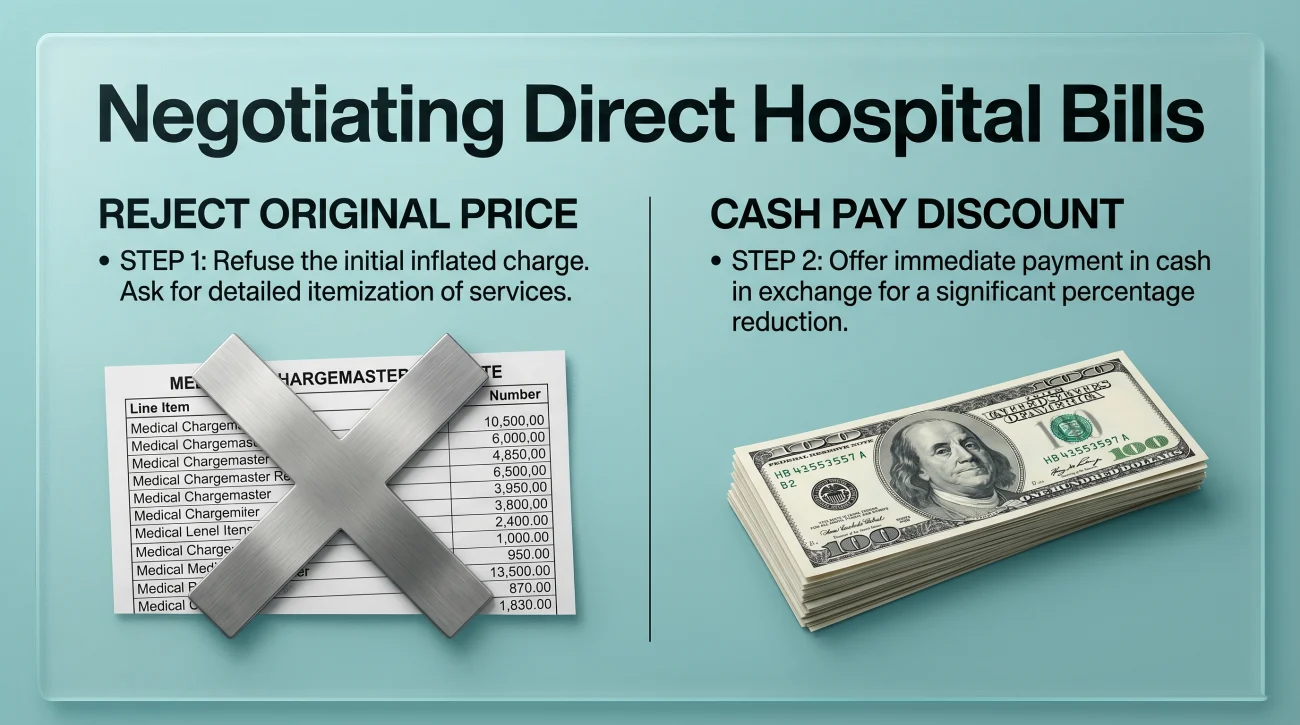
Once you know the bill is accurate and you have exhausted charity care options, you can begin direct negotiation. To do this successfully, you need to understand the “chargemaster” rate. This is the hospital’s artificially inflated list price. Nobody actually pays the chargemaster rate. Insurance companies negotiate it down by contract, and Medicare pays a fraction of it by law. As a self-pay patient, you are unfairly billed this highest possible tier.
Your goal is to bring the balance down to what the hospital actually accepts from major insurers. If you have the ability to pay a lump sum, you hold significant leverage. Call the billing department and offer a cash pay discount. It is common for hospitals to accept 20 to 40 percent off the total balance if you can pay the remainder immediately.
Calling the hospital, complaining about the high cost, and asking them to lower it without making a concrete offer. They will simply offer you a standard payment plan for the full balance.
“I have reviewed my itemized bill. I cannot afford the chargemaster rate. I can offer a one-time lump sum payment of $1,500 today to settle the $3,000 balance in full.”
If you have insurance but are stuck with a high deductible, your script changes slightly because the hospital has already applied the insurance adjustment. You have to focus strictly on financial hardship.
“Hello, my account number is 12345. My insurance paid their portion, but I am left with a $4,000 deductible balance. I simply do not have $4,000. I have $1,800 in savings that I can transfer today if you can accept it as payment in full. If not, I will have to set up a minimal payment plan, but I would prefer to resolve this for you today.”
If they refuse a lump sum, ask them to reprice the bill to the Medicare rate. Hospitals know exactly what Medicare pays for any given CPT code in your zip code. Asking them to accept the Medicare rate is a highly reasonable request. If that fails, ask for an interest-free payment plan, which almost all hospitals will provide for terms of 12 to 24 months. But not every direct negotiation succeeds, and not every bill waits for you to act.
When the Medical Bill Goes to Collections
If your direct negotiations with the hospital fail, or if the bill simply goes unpaid for roughly 90 to 180 days, the hospital will usually write it off as bad debt. They will then assign it or sell it to a third-party collection agency. Once it lands on a collector’s desk, the rules change completely.
Debt buyers purchase portfolios of defaulted medical accounts for pennies on the dollar. If they bought your $2,000 ER bill for four cents on the dollar, their break-even point is just $80. This underlying math is exactly why figuring out what debts can be settled always starts with identifying who currently owns the paper. Because the debt buyer’s cost basis is so low, they have incredible flexibility to accept a reduced amount.
“When I worked the collection floor, the medical accounts that settled the fastest were the ones where the consumer understood our margins. If a debtor offered me 35 percent of a 2-year-old medical balance as an immediate lump sum, I approved it almost every time because it was pure profit for the agency.”
A standard settlement offer on a medical debt held by a collection agency often lands between 30 and 50 percent of the face value. If you are communicating with a collector, remember to keep the conversation strictly factual. They do not need to hear the emotional story of your medical procedure. They only care about closing the file.
💡 Pro Tip: Before paying a collection agency, confirm if the debt is still legally enforceable. Every state has a limit on how long a collector can sue you. Review the statute of limitations for medical bills to see if your account is already time-barred, which gives you total leverage.
The Tax Reality of Forgiven Medical Debt
There is a secondary issue that surprises many consumers after they successfully negotiate a large hospital bill down to a fraction of the cost. If a creditor forgives $600 or more of a debt, they are generally required to report that canceled amount to the IRS. The IRS typically views forgiven debt as taxable income. For example, if you settle a $5,000 medical collection for $2,000, the remaining $3,000 might be treated as income on your next tax return.
However, there is a major exception that protects most consumers in financial distress. If you were legally insolvent at the time the debt was forgiven, meaning your total liabilities exceeded the total fair market value of your assets, you can often exclude that forgiven amount from your taxable income. You must file Form 982 with your tax return to claim this exclusion. It is highly recommended that you review the rules on whether you owe taxes on settled debt to understand how the insolvency calculation works.
When DIY Medical Negotiation Stops Working
Navigating itemized bills, charity care applications, and collection agencies works well if you are dealing with one or two isolated medical events. But financial hardship rarely happens in a vacuum. The system becomes unmanageable when your medical bills trigger a cascade of other financial failures.
If you are facing a massive, complex hospital bill but your credit cards are otherwise current, you might consider hiring a Medical Billing Advocate. These are independent professionals who audit hospital bills and negotiate on your behalf, usually taking a percentage of the money they save you. They are highly effective for complex coding disputes.
However, if your medical debt has already caused you to default on multiple credit cards, and you are fielding dozens of collection calls a week across different accounts, a billing advocate cannot help you. They only handle medical disputes. In a situation involving heavy, mixed unsecured balances that have gone to collections, DIY tactics usually fail because of the sheer volume of pressure.
If your total unsecured debt load has spiraled past the point where you can manage the minimums, evaluating reputable debt settlement organizations can provide a centralized way to handle both the medical paper and the credit cards, allowing a representative to negotiate lump sum settlements on your behalf while stopping the daily harassment.
Final Thoughts on Medical Debt Resolution
Medical debt should never be handled with the same urgency as a secured auto loan or a mortgage. Your shelter and your transportation must come first. The biggest mindset shift you can make is realizing that the number printed on your hospital bill is not a fixed legal demand.
The hospital generated that number knowing it is merely the starting point of a negotiation. Always audit the itemized statement, apply for charity care regardless of whether you think you will be approved, and never accept the initial list price as the final word. If you decide to negotiate on your own, you can follow the structured steps for how to handle debt negotiation, keeping your offers factual and getting the final agreement in writing. By treating the process as a business transaction rather than a moral failing, you strip the emotion out of the room and take back control of your financial recovery.
❓ FAQ
⚖️ What is the No Surprises Act?
Enacted in 2022, this federal law protects you from unexpected out-of-network charges if you receive emergency services, or if you are treated by an out-of-network provider at an in-network facility without your prior consent. If you receive a surprise bill of this nature, you can dispute it through the CMS federal portal.
💳 Can I negotiate a medical bill if I have insurance?
Yes. If you have a high deductible or an out-of-pocket maximum that leaves you with a balance you cannot afford, you can still ask the billing department for a financial hardship discount or an extended, interest-free payment plan.
🤝 Should I hire a medical billing advocate?
If you have a very large, complex hospital bill (typically over $10,000) and suspect coding errors or insurance denials are to blame, a professional advocate can be highly effective. They usually charge an hourly rate or a percentage of the total amount they save you.
🏛️ Do nonprofit hospitals actually sue patients?
Yes. While their status requires them to offer charity care, if a patient ignores the bill and fails to apply for financial assistance, many nonprofit hospital systems will eventually file civil lawsuits to obtain judgments or garnish wages.
✂️ What if my wages are already being garnished for a medical bill?
Once a wage garnishment is active, standard negotiation is usually too late because the creditor already won a court judgment. Your options shift to claiming state exemptions, filing a motion to modify the garnishment, or consulting a bankruptcy attorney.
🚑 Can a hospital send me to collections while I am paying?
If you are making small monthly payments without a formally agreed-upon payment plan in writing, the hospital can still send your account to collections. You must have a documented payment arrangement to protect the account.
👨⚕️ Am I responsible for my deceased spouse’s medical debt?
This depends heavily on your state laws. In community property states, or states with specific “doctrine of necessaries” laws, a surviving spouse may be held responsible. In other states, the debt belongs only to the deceased person’s estate.
📑 Does a HIPAA violation erase my medical debt?
No. While a privacy violation by a provider or debt collector is a serious regulatory issue that can result in fines against them, it does not legally invalidate the fact that you received medical services and owe the balance.
🏥 Why am I getting a bill from a doctor I never met?
This frequently happens with radiologists, pathologists, or anesthesiologists who review your scans or assist in your procedure behind the scenes. They bill separately from the hospital facility. You must verify these charges against your medical records.
🛑 Can a debt collector arrest me for unpaid medical bills?
Absolutely not. You cannot be arrested or go to jail for failing to pay a civil medical debt. Any debt collector who threatens you with jail time or police action is committing a severe violation of the Fair Debt Collection Practices Act.
Relief options exist alongside the collection process. These explain both sides.
- The options for resolving debt outside of continued collection
- Debt Snowball vs Debt Avalanche: Which Pays Off Debt Faster - and Which One You'll Actually Finish
- How Does a Debt Management Plan Work: How Nonprofit Credit Counseling Actually Helps You Pay Off Debt
- How to Pay Off Credit Card Debt: A Working Plan Based on What You Can Actually Afford
- How Debt Settlement Actually Works: What Happens from Enrollment to Final Settlement
Some of these have deadlines attached. Start here if something is already happening.
- What collectors can legally do to you while a settlement program is running
- How to handle a lawsuit on a debt you are actively trying to settle
- What happens to a garnishment order when debt relief is in progress
- How bank levies interact with the debt you are trying to resolve
- How professional settlement programs work and what they actually cost
Disclosure: The content on this site reflects direct experience inside the debt collection industry and is grounded in federal law and regulation. It is informational in nature. Reading it does not constitute legal advice and does not create any professional relationship. If you are dealing with a lawsuit, a judgment, or a legal deadline, consult a licensed attorney in your state before acting.