- The Upfront Fee Rule: Federal law (TSR) makes it illegal for any debt relief firm to charge you before they settle a debt. This is the single most effective “scam detector” you have.
- Manufactured Urgency: Scammers use scripts designed to trigger panic. If they claim a “government bailout” is expiring in 24 hours, they are likely lying to prevent you from doing your own research.
- Control Your Funds: Legitimate programs use FDIC-insured escrow accounts in your name. You decide when to pay a creditor, not the company. If you lose control of your money, you’ve lost your leverage.
The Predatory Side of Debt Relief: Protecting Your Recovery
During my twelve years in the collection industry, I saw many files where the consumer had already been bled dry by a “debt relief” company before the account ever reached my desk. These people were trying to do the right thing. They wanted to pay their debts. But they fell into the trap of predatory firms that promised the world and delivered nothing but a smaller bank account and more aggressive collection calls. As a former insider, I can tell you that the most dangerous part of a financial crisis is not the debt itself, but the scammers who view your stress as a business opportunity.
The debt relief industry is heavily regulated, but scammers operate in the shadows of these regulations. They use sophisticated marketing, official-sounding names, and high-pressure sales tactics to convince you that they have a “special relationship” with your bank or access to a government program that doesn’t exist. My goal is to show you exactly how these scams operate from the inside, why the Federal Trade Commission (FTC) has a zero-tolerance policy for upfront fees, and how you can identify a legitimate path toward financial freedom without being victimized again.
“In the agencies where I worked, we actually preferred dealing with legitimate settlement companies because they had a process. However, when we saw a consumer was with a known scam firm, we knew the file would likely end in a lawsuit. Why? Because the scammer told the consumer to ignore our calls while they pocketed ‘administrative fees’ instead of actually negotiating the debt.”
Understanding the difference between a legitimate service and a predatory one comes down to one thing: following the money. If the company’s profit comes before your progress, you are in danger. Let’s look at the legal framework that protects you and the red flags that should send you running in the other direction.
The Vulnerability Trap: The Anatomy of a Debt Scam
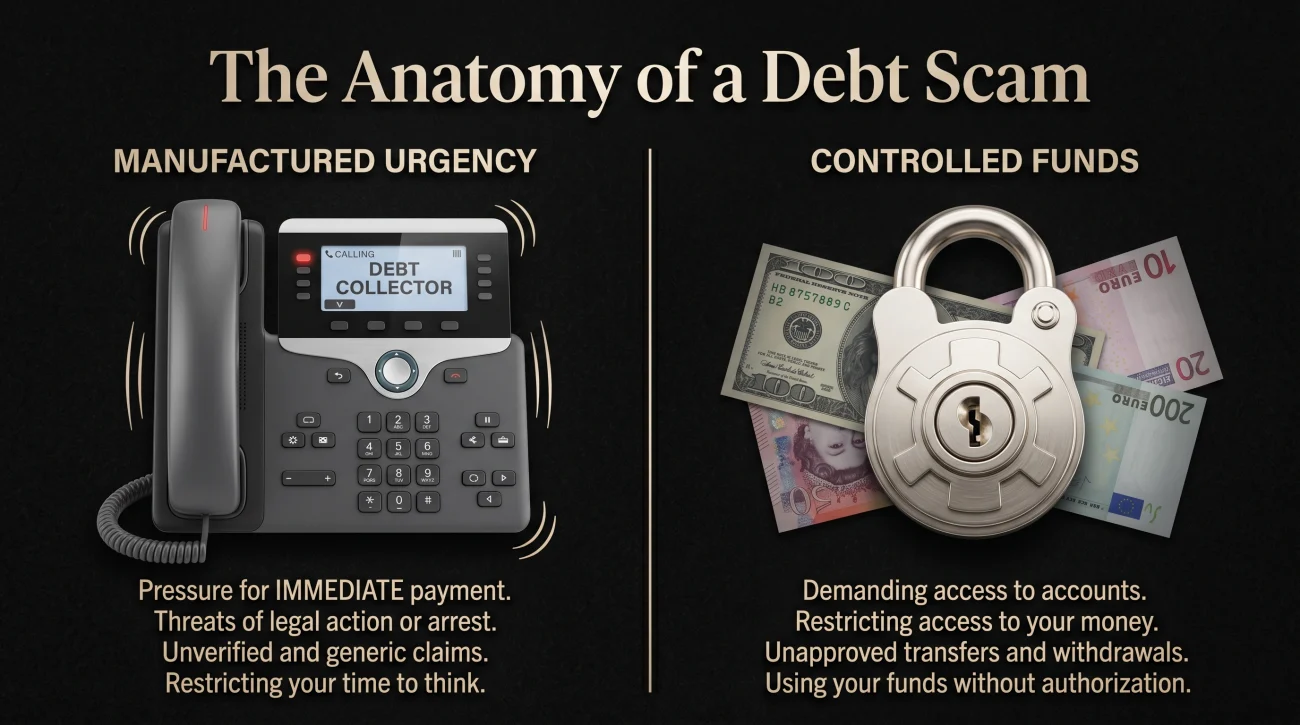
Being overwhelmed by debt is exhausting. When you are receiving ten collection calls a day, your decision-making brain shifts into survival mode. You aren’t looking for a multi-year financial plan; you’re looking for a rescue. Scammers know this, and they use a psychological tactic called “Manufactured Urgency” to shut down your critical thinking.
“Mr. Smith, I’m looking at your file and your bank is about to move this to their litigation department tomorrow. But because of the new Federal Stimulus Act, I can lock in a 30% settlement right now. I just need a one-time enrollment fee of $500 to pull your file from the legal queue. If you wait until tomorrow, this offer is gone forever.”
In the industry, we call this “flipping the debtor.” They take your fear of a lawsuit and turn it into a reason to hand over money they haven’t earned. In reality, legitimate debt relief options never expire in 24 hours. Banks do not move files to legal that quickly, and there is no “Federal Stimulus Act” that allows a private company to bypass your bank’s internal policies. If you feel pushed to make a snap decision, the person on the other end of the phone is likely a predator, not a partner.
The FTC Telemarketing Sales Rule: Your Strongest Protection
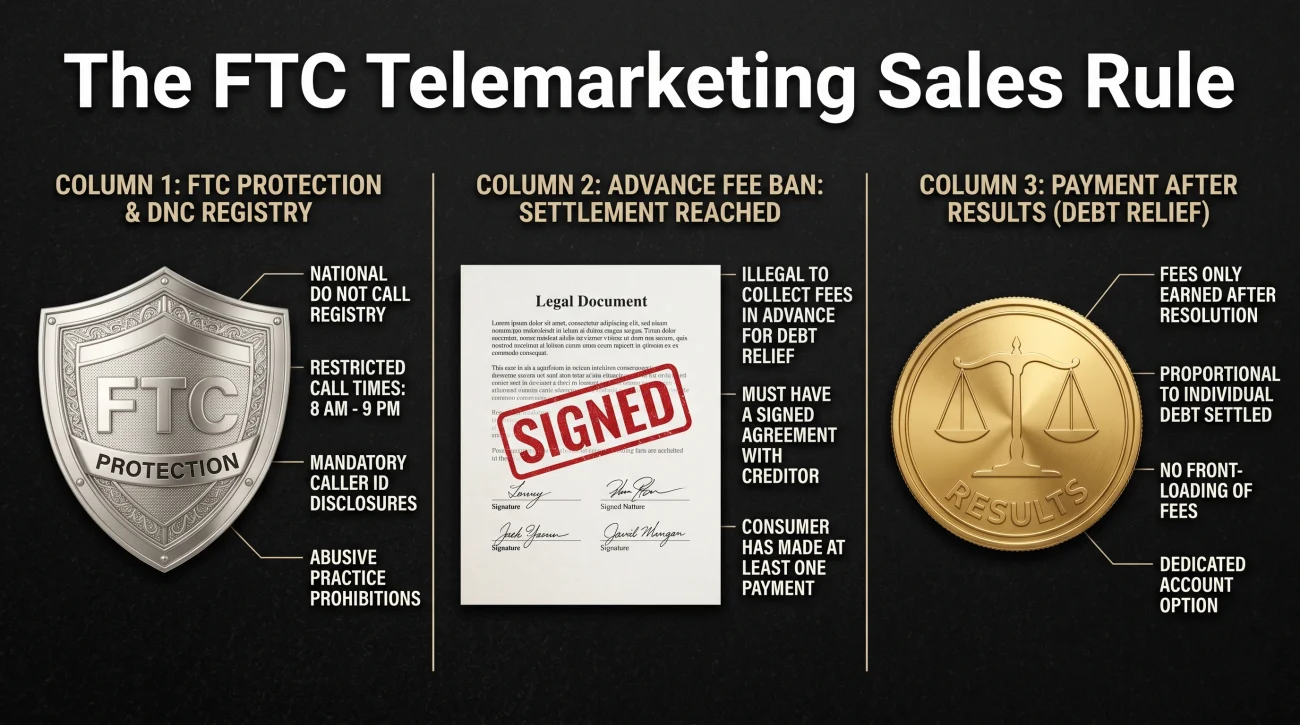
Knowing why you’re a target is step one, but your real weapon is knowing the specific laws that scammers hate. The Telemarketing Sales Rule (TSR) prohibits debt relief companies from charging any fee until they have actually settled a debt. This rule, amended by the FTC in 2010, is the single most important barrier between you and a fraudster.
How the “No Upfront Fee” Rule Works in Practice
A legitimate debt settlement company can only charge you a fee if three conditions are met:
- ✅ They have successfully negotiated a settlement or altered the terms of at least one debt.
- ✅ You have signed a settlement agreement with that specific creditor.
- ✅ You have made at least one payment to the creditor under that new agreement.
I’ve seen many consumers get confused by “administrative fees.” A scammer might say, “We don’t charge a settlement fee until the end, but we need $49 a month for account maintenance.” Under the TSR, this is still illegal if it is charged before a settlement is reached. Any money coming out of your pocket and going into the company’s pocket before your debt is reduced is a violation of federal law.
This is not just theory; here is how it played out from the collector’s side during my time in the agency.
“During my years training collectors, we were instructed to ignore ‘representation notices’ from companies that we knew charged upfront fees. We knew they weren’t compliant with the FTC, so we assumed they wouldn’t actually be around to finish the negotiation. We would continue calling the consumer directly because the scam firm was essentially a ghost.”
Top Red Flags: What They Won’t Tell You
Scammers operate by withholding information. While they promise quick fixes, they ignore the two things that every legitimate program must disclose: the timeline and the tax consequences.
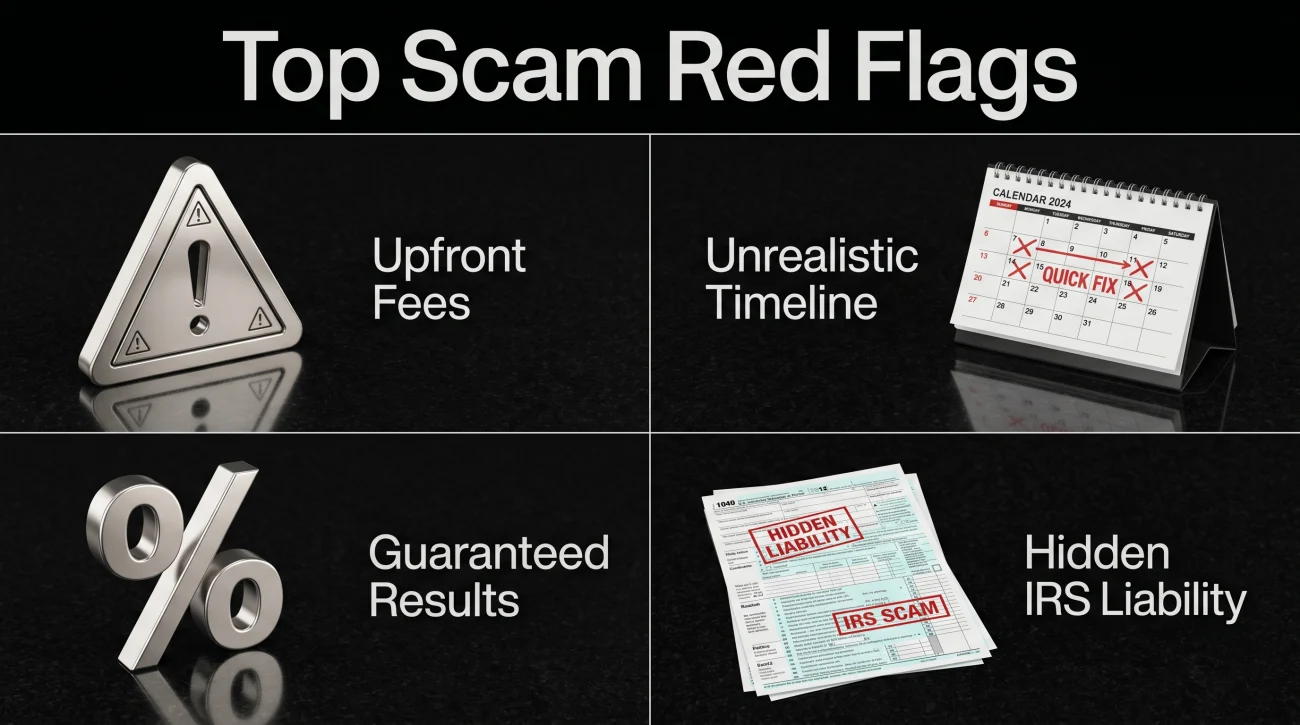
1. The “100% Guaranteed” Lie
No one can guarantee that a bank like Chase or Amex will accept a specific percentage. Banks have internal “settlement floors” that change based on the economy. A company claiming they can “settle for 30 cents, guaranteed” is lying. A legitimate company will show you averages but warn that results vary.
2. The Hidden 1099-C Liability
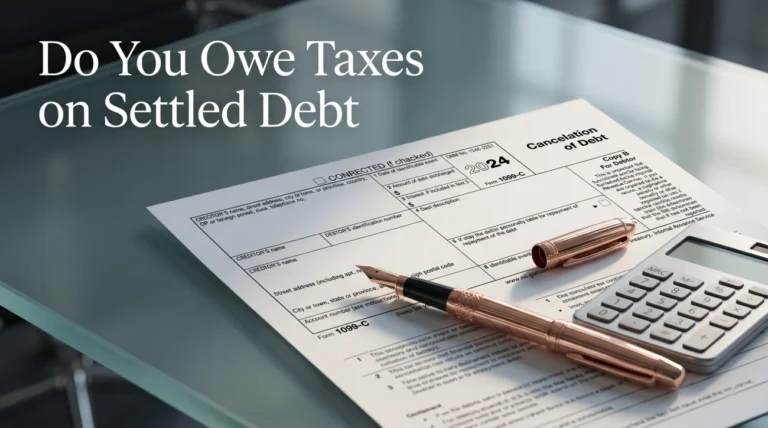
One of the biggest red flags is a company that never mentions taxes. When a debt is forgiven (settled for less than you owe), the IRS often treats that forgiven amount as taxable income. If you settle a $10,000 debt for $4,000, you might receive a Form 1099-C for the $6,000 difference.
Legitimate firms will discuss this with you upfront, including the “Insolvency Exclusion.” If your total liabilities were greater than your total assets at the time of the settlement, you may not have to pay taxes on that forgiven amount. Scammers omit this because they don’t want you thinking about the IRS. You should always consult our guide on taxes on settled debt before signing any agreement.
| Tactic | What Scammers Say | What Actually Happens |
|---|---|---|
| Fees | “Pay a setup fee today.” | No fees until a debt is settled. |
| Timeline | “Fixed in 30-90 days.” | 24 to 48 months of consistent deposits. |
| Results | “Guaranteed 50% reduction.” | Results vary by bank and delinquency. |
| Communication | “Never talk to your bank.” | “Log your calls and send us notices.” |
The “Phantom” Scam: Posing as Debt Collectors
While most debt relief scams want to be your “friend,” a newer variant wants to be your “jailer.” You get a call from someone claiming to be a “legal investigator” regarding a debt you don’t recognize. They threaten immediate arrest or a lawsuit that will result in your wages being garnished by the end of the week.
This is often a “lead-gen” scam. They scare you into a state of panic so that you will immediately agree to join their “protection program”, which is just a high-fee debt relief scam. From an insider’s perspective, this is the most effective way to harvest desperate clients. If a caller cannot provide a physical address or a written debt validation notice within five days, you are dealing with a scam. Legitimate collectors may be aggressive, but they are bound by the FDCPA; scammers are bound by nothing.
The Verification Protocol: How to Vet a Company
The jump from “panicked debtor” to “informed consumer” happens when you start asking the right questions. If you are considering professional help, treat the enrollment like a job interview. Use this four-step protocol to separate the compliant firms from the fly-by-night predators.
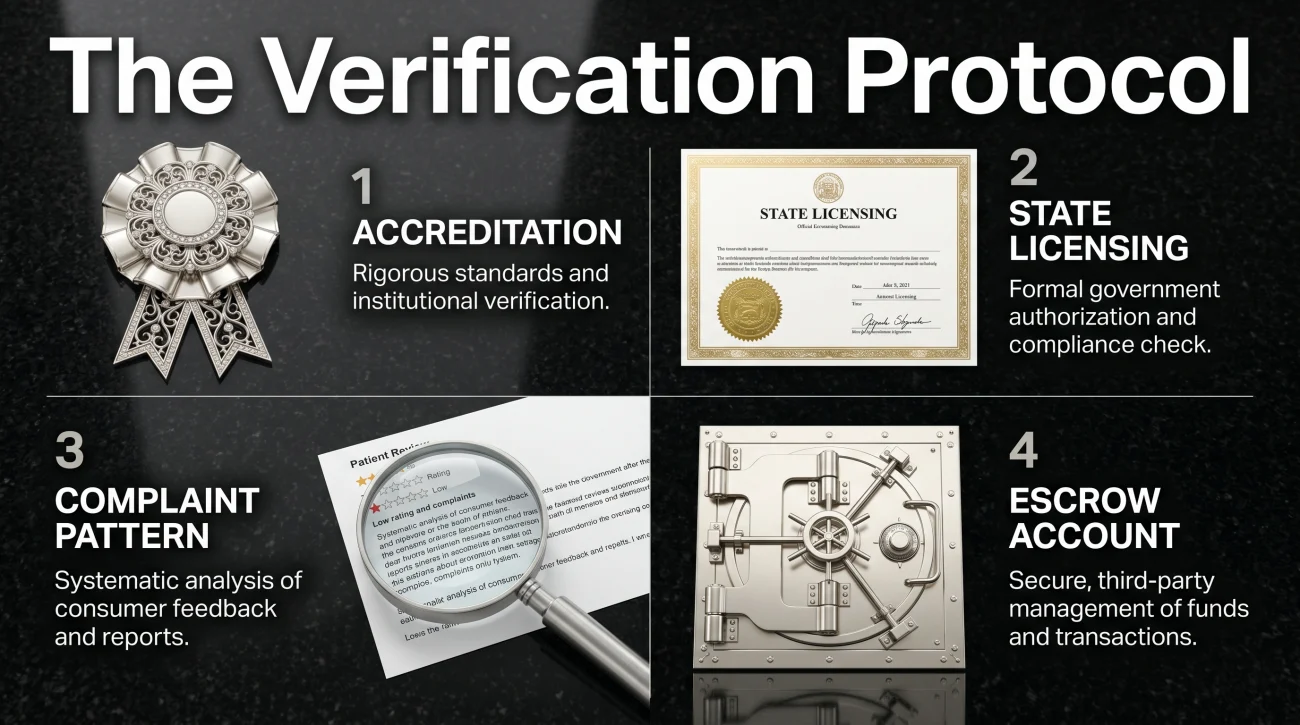
1. Check for Industry Accreditation (ACDR/IAPDA)
Legitimate firms are usually members of the American Association for Consumer Credit Professionals (AACCP, formerly ACDR). Membership requires them to follow the FTC’s no-upfront-fee rule. If a company isn’t on the ACDR or IAPDA lists, they are likely operating outside the law. NDR and FDR are founding members of these associations for a reason; they value the industry’s long-term reputation.
2. The “Complaint Pattern” Analysis
Every large company will have some BBB complaints. What you’re looking for is a pattern of “I paid and they did nothing.” If you see high ratings (A or A+) combined with responses that show the company is actually settling debts, that is a positive sign. National Debt Relief (NDR), Freedom Debt Relief (FDR), and Accredited Debt Relief (ADR) maintain these high ratings because they actually perform the negotiations, even if the 24 to 48 month timeline frustrates some users.
3. Verify State Licensing
Many states, such as Oregon, Washington, and Illinois, require debt settlement companies to be licensed or registered with the State Attorney General or the Department of Financial Regulation. Check your state’s official website. If a company is soliciting you in a state where they are not licensed to operate, it is a sign that they are ignoring the law and your consumer protections.
4. The FDIC Escrow Test
Ask: “Who owns the account where my monthly deposits go?” If they say the company manages it, hang up. In a legitimate debt settlement process, your money goes into an FDIC-insured escrow account in your name. You should have login access to see your balance 24/7. The company only has authority to release those funds when you approve a settlement.
If a company passes all four of these checks, you are likely dealing with a legitimate operation. If it fails even one, walk away immediately.
What to Do if You Have Already Been Scammed
If you have already paid money to a company that has done nothing, do not let embarrassment keep you from acting. The faster you respond, the better your chances of recovery. Scammers count on your silence to keep their operation running. Here is the operational sequence for victims of debt relief fraud.
1. Stop the Bleeding
Immediately cancel any automatic withdrawals or “ACH” authorizations you gave the company. Call your bank and tell them that the company is a fraudulent enterprise. If you paid by credit card, initiate a chargeback under the Fair Credit Billing Act, citing “failure to provide services.”
2. File Official Complaints
Documentation is your only leverage. You should file reports with the FTC at reportfraud.ftc.gov and your State Attorney General. In the collection world, we saw that agencies only changed their behavior when the “complaint volume” reached a level that triggered a regulatory audit.
3. Contact Your Creditors Directly
Call your banks and explain that you were victimized. Most banks are aware of these schemes and may be more willing to work with you through their internal hardship programs once they know you’ve been exploited. From their perspective, a dollar recovered through a legitimate hardship plan is far better than seeing that same dollar lost to a fraudulent third party.
Final Thoughts: Your Intuition is a Tool
I have spent over a decade watching how money moves in the collection world. My best advice is this: if it feels too good to be true, it is. The law is designed to protect you, but it can only do so if you know where the lines are drawn. A legitimate company will tell you that debt settlement is hard, that it will hurt your credit in the short term, and that it takes time. A scammer will tell you it is easy, fast, and painless.
In the agencies I worked for, we had a saying: “A debtor who knows the law is a debtor we can’t bully.” The same applies to debt relief companies. When you demand to see their ACDR membership and refuse to pay a setup fee, you signal that you are not an easy target. Don’t let the noise of collection calls push you into the arms of a predator. Take a breath, verify the credentials, and choose a legitimate debt settlement partner that values your recovery as much as you do.
❓ FAQ
💸 What counts as an “upfront fee” according to the FTC?
An upfront fee is any charge, including “consultation fees,” “enrollment fees,” or “administrative setup fees,” that the company takes before they have successfully settled a debt and you have made at least one payment toward that settlement. Even $10 is illegal if taken before results are delivered.
👮 Can a debt relief company stop me from being arrested?
No, because you cannot be arrested for consumer debt in the first place. If a company claims they can “stop your arrest warrant,” they are playing on your fears to sell you a scam. This is a massive red flag.
🏦 Why do legitimate companies use escrow accounts?
The escrow account ensures your money is safe and that the debt relief company only gets paid after they’ve done their job. It also ensures that the funds are available to pay the bank the moment a settlement is reached, which is your primary goal.
🏷️ Is National Debt Relief a legitimate company?
Yes. NDR is one of the industry leaders, is fully accredited by the ACDR, and follows the FTC’s no-upfront-fee rules. While they are a for-profit business and their fees range from 15-25%, they are a legitimate operation, not a scam.
⚖️ What happens if a creditor sues me while I’m in a debt relief program?
Legitimate companies will tell you this is a risk. If it happens, they should prioritize that account for negotiation. Scammers will tell you to “just ignore the summons,” which can lead to a default judgment and wage garnishment.
📝 What should I look for in a debt settlement contract?
Look for three things: a clear list of fees (only earned after settlement), a disclosure of the potential impact on your credit score, and a clear explanation of your right to cancel and receive a refund of your escrow balance.
🕵️ How do I know if a “government debt bailout” is real?
It isn’t. The federal government regulates debt relief, but it does not provide “bailouts” or “forgiveness grants” for private credit cards or personal loans. Any company using government logos or stimulus language is running a scam.
📉 How much will my credit score drop in a debt relief program?
Expect a drop of 50 to 150 points in the first year. Because you must stop paying creditors for the program to work, your score will suffer significantly before it begins to recover after your debts are settled.
🔄 Should I choose debt settlement or credit counseling?
If you can afford to pay back the full principal at a lower interest rate, nonprofit credit counseling is better for your credit. If you cannot afford the principal at all, debt settlement may be your only path out of bankruptcy.
📞 What is the best way to handle calls from fake debt collectors?
Hang up. Do not argue. If you aren’t sure if the collector is real, tell them you will only communicate in writing. A real collector will send you a notice; a scammer will keep calling from different spoofed numbers.
Relief options exist alongside the collection process. These explain both sides.
- The options for resolving debt outside of continued collection
- Medical Debt Relief: How to Negotiate Hospital Bills, What the 2025 Rules Changed, and What Actually Gets Forgiven
- How to Pay Off Credit Card Debt: A Working Plan Based on What You Can Actually Afford
- Debt Snowball vs Debt Avalanche: Which Pays Off Debt Faster - and Which One You'll Actually Finish
- Balance Transfer Cards for Debt: The 0% APR Strategy
Some of these have deadlines attached. Start here if something is already happening.
- What collectors can legally do to you while a settlement program is running
- How to handle a lawsuit on a debt you are actively trying to settle
- What happens to a garnishment order when debt relief is in progress
- How bank levies interact with the debt you are trying to resolve
- How professional settlement programs work and what they actually cost
Disclosure: The content on this site reflects direct experience inside the debt collection industry and is grounded in federal law and regulation. It is informational in nature. Reading it does not constitute legal advice and does not create any professional relationship. If you are dealing with a lawsuit, a judgment, or a legal deadline, consult a licensed attorney in your state before acting.