- The math of credit card debt is unforgiving. Paying only the minimum on a high interest account can trap you in a repayment cycle lasting 15 to 20 years.
- A successful payoff strategy depends entirely on your financial reality. You must match your plan to your budget surplus and your current credit score.
- If your monthly interest charges eat up more than 40 percent of your minimum payments, a do it yourself strategy is likely failing. You may need structured program intervention.
The Brutal Math of High Interest Balances
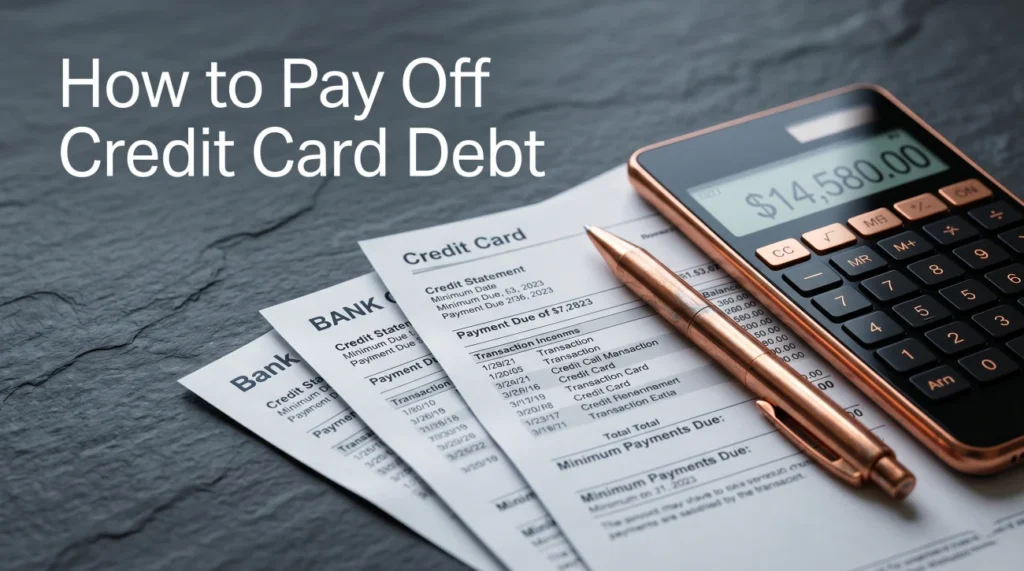
The math of credit card debt is designed to test your endurance. At a 22 percent annual percentage rate, a $5,000 credit card balance grows by roughly $91 every single month in interest alone. If you only make the minimum payment requested by the bank, you will spend a decade or longer paying off that single account. You will also pay more in interest than you originally borrowed.
During my years working inside collection agencies and debt buying firms, I reviewed thousands of consumer account histories. The most frustrating accounts to look at were the ones where a person had been trying to do the right thing for years. They made their minimum payments every month, never missing a due date, yet their balance barely moved. They were running on a treadmill, burning cash but covering no distance.
Getting out of credit card debt does not start with generic motivation. It starts with diagnosing exactly where you are financially and applying a strategy that fits your specific reality. A plan that works perfectly for someone with a high credit score and a large monthly budget surplus will fail immediately for someone who is already behind on payments. You need a working framework based on what you can actually afford today.
What Happens If You Ignore the Balances?
Many people freeze when facing insurmountable credit card debt. They stop opening mail and send payments late, hoping the situation will resolve itself. In the collection industry, we rely on this paralysis.
When you stop paying or fall severely behind, the lifecycle of your debt accelerates. First come the late fees and penalty interest rates, which inflate your balance faster. Next come the collection calls from the bank’s internal recovery department. If the account reaches 180 days past due, it is legally “charged off.” The bank writes it off as a loss and sells it to a debt buyer for pennies on the dollar.
Once a debt buyer owns your account, your risk profile changes. They have the resources and are in a position to file a lawsuit against you. If you ignore a court summons, they will obtain a default judgment, which can lead to wage garnishment or frozen bank accounts. Doing nothing is not a pause button—it is a dangerous escalation.
Step One is the Full Debt Inventory
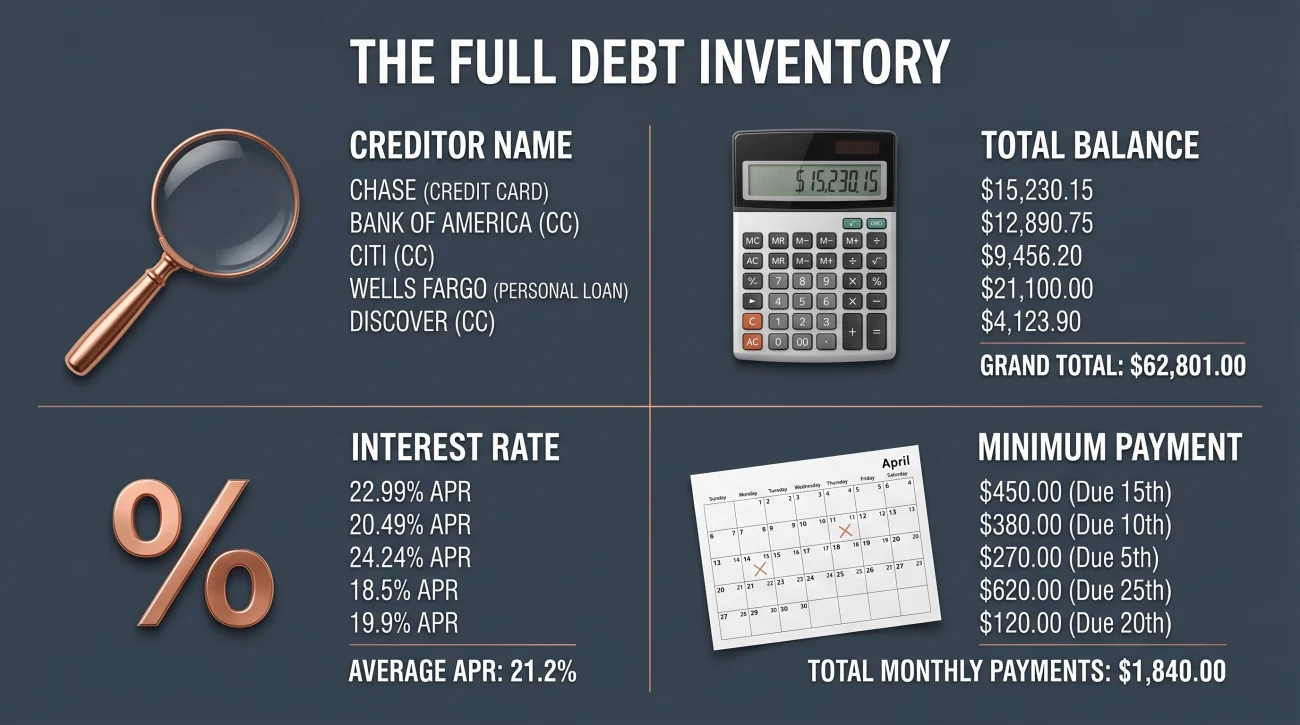
Most people who are overwhelmed by credit cards avoid looking at their total balances. The fear of seeing the final number keeps them operating in the dark. You cannot defeat an opponent you refuse to measure.
Before you choose a payoff strategy, you must list every single account. This means pulling the most recent statement for every credit card you carry. You need to log four specific pieces of information for each account.
| Creditor Name | Total Balance | Interest Rate (APR) | Minimum Monthly Payment |
|---|---|---|---|
| Chase Sapphire | $4,200 | 24.99% | $125 |
| Capital One | $2,800 | 28.50% | $95 |
| Citi Double Cash | $5,100 | 21.24% | $155 |
Once you have this list, add up the total balance column and the total minimum monthly payment column. This gives you your baseline. This baseline represents the absolute minimum amount of money you must spend each month just to keep the accounts in good standing. Any strategy to actually eliminate the debt will require moving beyond this baseline.
Step Two is Finding Your Monthly Surplus
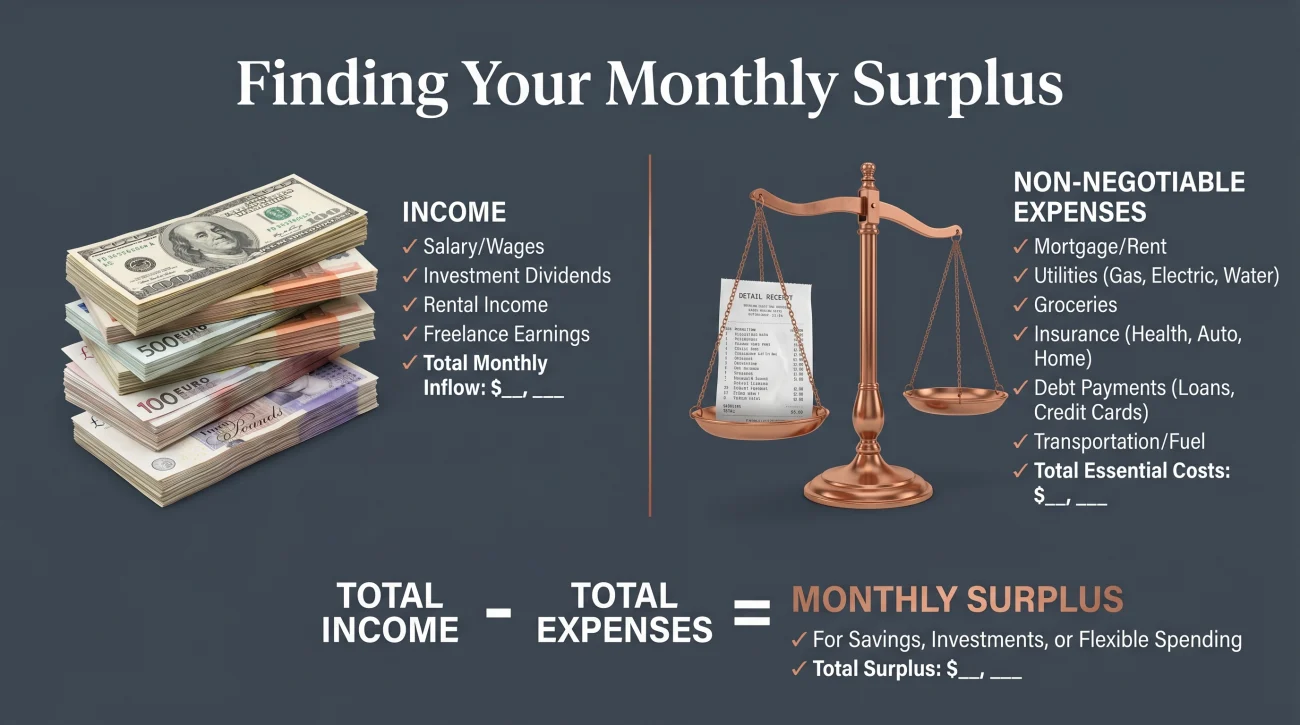
Debt is paid off with surplus. Surplus is the money left over after you subtract your non-negotiable living expenses from your take-home pay. If you do not know your exact surplus, your payoff plan is just a wish.
Non-negotiable expenses include your rent or mortgage, basic utilities, essential groceries, necessary transportation, insurance, and the minimum payments you calculated in your debt inventory. Everything else is discretionary. Dining out, subscription services, entertainment, and vacations are where your surplus currently hides.
“When I trained collectors, we specifically listened for consumers who said they could not afford a payment, but then mentioned paying for premium cable or weekend trips. We knew the money existed, it was just being allocated to comfort instead of debt. A successful payoff requires temporarily reallocating that comfort money toward principal.”
Calculate your income and subtract your bare-bones living costs. The positive number that remains is your acceleration fuel. If you find you have $300 a month in true surplus, you have options. If that number is zero or negative, your strategy completely changes.
Stopping the Bleeding Before You Pay
The minimum payments on high rate credit cards are specifically engineered to maximize interest revenue for the issuing bank. If you can only afford to send the minimum, your first objective must be to reduce the interest rate. Pumping extra money into an account charging 28 percent interest is like trying to bail out a sinking boat while ignoring a massive hole in the hull.
Whether you use a hardship program, a balance transfer, a consolidation loan, or a structured nonprofit program, lowering the rate is what stops the bleeding. Without a rate reduction, your extra payments are fighting a massive headwind. Every dollar of interest you avoid is a dollar that pays down your principal.
Lowering the rate changes the math completely. Let’s look at a concrete example of how payment size alters your timeline.
Key Point: Your timeline to becoming debt free depends entirely on your interest rate and your payment size. A $10,000 balance at 22 percent APR requires roughly $350 a month to clear in three years. Bumping that payment to $500 a month clears it in two years. Use a payoff calculator to set a specific target date. A date on the calendar creates accountability.
Step Three is Matching Your Strategy to Your Reality
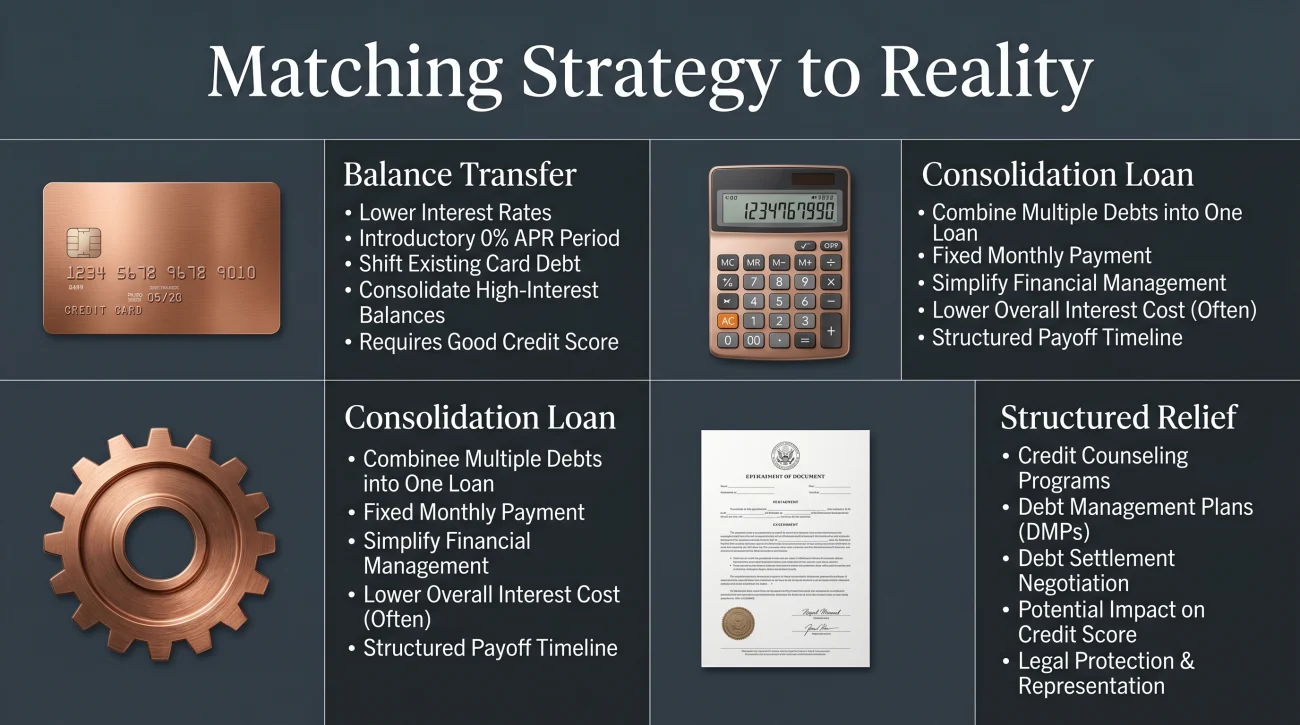
Now that you know your total debt and your monthly surplus, you can select a payoff path. Do not try to force a strategy that requires excellent credit if your score is currently damaged. Use the decision tree below to find the exact path that fits your situation.
Path 1: You Have a Surplus and a Credit Score Above 680
If you have good credit and a documented monthly surplus, your goal is to dramatically lower your interest rate so your extra payments attack the principal directly. You have two primary tools for this.
The first is moving your balances to a new credit card offering a zero percent introductory period. This stops interest accumulation entirely for a set window, usually 12 to 21 months. You can learn exactly how to execute this by reading our guide on using a balance transfer for credit card debt.
The second tool is taking out a new fixed-rate personal loan to pay off all the high interest cards at once. This leaves you with one predictable monthly payment. You can see the math behind this strategy in our breakdown of debt consolidation loans. Both of these paths require discipline. You must not charge new balances on the credit cards you just cleared, or you will double your debt load.
📌 Note: The Balance Transfer Trap. The most common reason Path 1 fails is that consumers transfer their balance, see a zero balance on their old cards, and start using them again for daily expenses. You must put the cleared cards away immediately, or you will quickly find yourself with twice the debt you started with.
Path 2: You Have a Surplus but a Credit Score Below 650
If your credit score prevents you from qualifying for low interest balance transfers or consolidation loans, you must rely on a do it yourself acceleration strategy. You will use your monthly surplus to attack the debts directly.
You can choose to target the account with the smallest balance first for quick psychological wins, or target the account with the highest interest rate to save the most money over time. We compare the mechanics of these two distinct approaches in our debt snowball versus avalanche comparison. The most important factor here is consistency. Apply your surplus to one specific target account every month until it is gone, then roll that entire payment amount into the next target.
Path 3: You Have No Surplus but Are Still Current
If your non-negotiable expenses and minimum payments consume your entire paycheck, but you have not missed any payments yet, you are in a precarious position. One unexpected car repair will push you into default. You need breathing room immediately.
Your best move is to contact your credit card issuers directly and ask for a temporary hardship program. Most major banks—including Chase, Citibank, and Capital One—have internal loss mitigation departments designed to help consumers who are struggling but still current. These programs are rarely advertised, but they exist and are highly effective.
A typical hardship arrangement lasts 6 to 12 months. The bank may lower your interest rate to zero or single digits, waive late fees, or temporarily reduce your minimum payment. In exchange, they will likely suspend or close your card to prevent new charges. On your credit report, this arrangement is usually marked as “paying under a partial payment agreement”—which is significantly less damaging than a string of missed payments.
“I am calling to request assistance through your hardship program. I have experienced a recent reduction in income and I am struggling to meet my minimum payments. I want to avoid falling behind. What temporary rate reductions, fee waivers, or payment deferral options are available for my account?”
Path 4: You Are Already Behind and Cannot Make Minimums
If you are already missing payments, your credit is damaged, and you have no monthly surplus, do it yourself strategies will not save you. You need structured professional intervention.
You can pursue a nonprofit debt management plan where an agency negotiates lower interest rates on your behalf, or you can consider a debt settlement program where a company negotiates to reduce the total principal you owe. You can review all of these structured paths in our comprehensive guide to consumer debt relief options. If you are leaning toward a nonprofit approach, you should understand exactly how a debt management plan works before enrolling.
Quick Strategy Summary
| Your Situation | Credit Score | Recommended Path |
|---|---|---|
| Budget Surplus Available | Above 680 | Balance Transfer or Consolidation Loan (Path 1) |
| Budget Surplus Available | Below 650 | DIY Payoff: Snowball or Avalanche (Path 2) |
| No Surplus, Still Current | Any | Direct Creditor Hardship Programs (Path 3) |
| Already Behind, No Surplus | Damaged | Credit Counseling (DMP) or Debt Settlement (Path 4) |
The Insider Diagnostic Rule: When DIY Stops Working
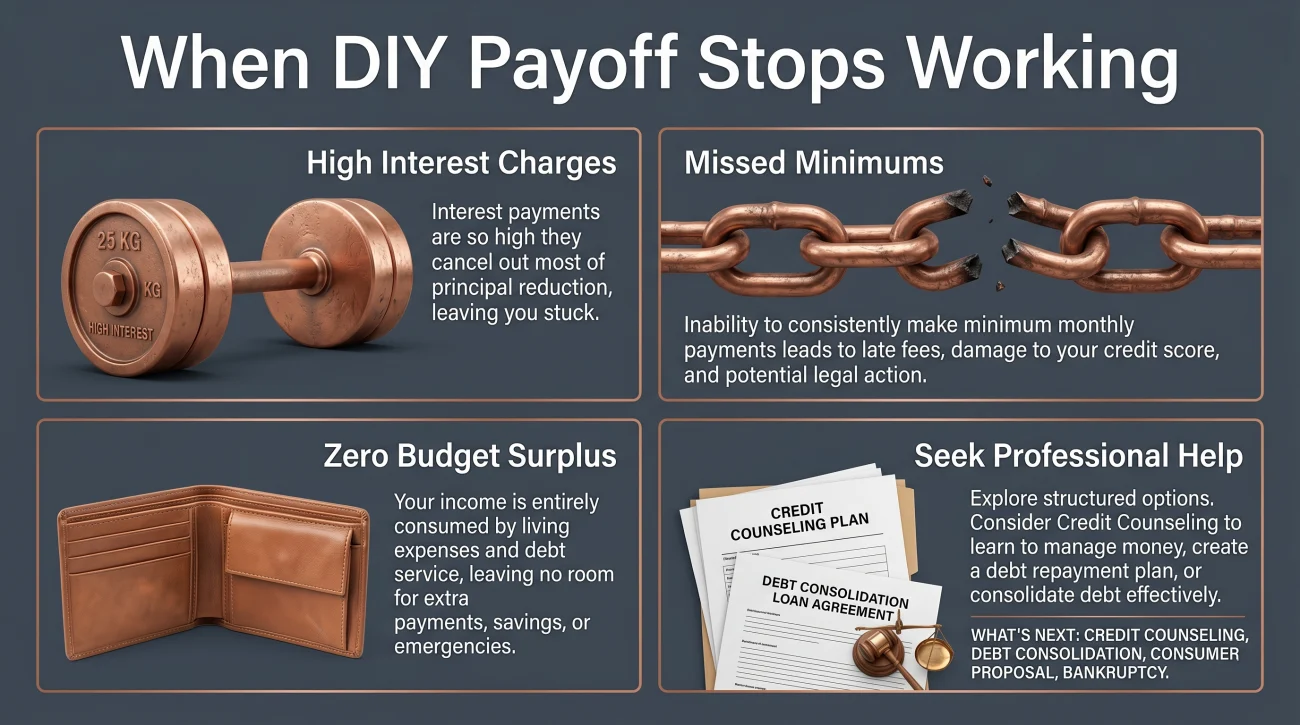
There is a specific mathematical tipping point where trying to pay off debt on your own stops making sense. In the collection industry, we knew exactly when a consumer had crossed this line. The diagnostic test is simple: look at the relationship between the interest you are charged and the minimum payment you are making.
⚠️ Warning: If your monthly interest charges exceed 40 percent of your total minimum payments across all cards, you are in a hole that is deepening faster than a standard DIY plan can fill.
Let us look at a concrete example. Assume your total minimum payments across three credit cards equal $500 a month. You look at your statements and see that the interest charges for those three cards total $250 for the month. That means 50 percent of your payment is vaporizing into interest. You are paying $500 to the bank, but your actual debt balance only goes down by $250. At that pace, clearing a massive balance will take an agonizing amount of time. Hitting the 40 percent threshold is the clearest signal that you need to evaluate a structured relief program.
Signs You Need Structured Program Help
It is difficult to admit when a financial situation has grown beyond your ability to manage it alone. Many consumers waste years of time and thousands of dollars trying to outwork a system that is mathematically stacked against them. You are likely a candidate for structured program help if you are experiencing the following realities.
First, your required minimum payments now exceed 25 percent of your total take-home pay. This leaves almost no room for rent, food, or unexpected emergencies, guaranteeing you will eventually rely on credit cards just to survive the month.
Second, you have been carrying these high balances for three or more years without seeing any meaningful reduction in the principal amount owed. You are treading water.
Third, you have tried budgeting and payoff plans in the past, but the balances continue to grow anyway because the interest rates are simply too aggressive to overcome.
If these scenarios describe your daily life, trying to squeeze a few extra dollars out of your budget is not the answer. You need to fundamentally restructure the debt. If you are severely behind and cannot make your minimums, it may be time to evaluate whether a settlement program is the right choice for your family. You can research how to evaluate your options by understanding what legitimate debt settlement companies actually offer and how to spot the red flags.
What to Do With a Cleared Account
Whether you use a DIY method or successfully complete a structured program, when you finally pay a credit card down to a zero balance, your first instinct will be to call the bank and close the account. Do not do this.
Closing an old account reduces the average age of your credit history. More importantly, it removes that available credit limit from your overall credit utilization ratio. If you close a card with a $5,000 limit, your total available credit drops, which makes the balances on your remaining cards look heavier to the credit bureaus. This can drag your credit score down just when you are making progress.
Instead of closing the account, keep it open. Take the physical plastic card, cut it into pieces, and throw it in the trash. Remove the card number from all of your online shopping accounts and digital wallets. Leave the account open with a zero balance, and take the monthly payment you were sending to that bank and aim it directly at your next target debt.
Final Thoughts on Reclaiming Your Income
Credit card debt steals your future income to pay for past decisions. The bank relies on you feeling overwhelmed so that you simply accept the minimum payment as a permanent monthly bill. You break this cycle by pulling your statements, facing the real numbers, and calculating your actual surplus.
Once you see the math clearly, the emotional weight of the debt usually begins to lift. You transition from feeling trapped to executing a plan. Choose the strategy that fits your current credit score and your real world budget, execute it consistently, and do not hesitate to seek professional program help if the interest math proves impossible to beat on your own.
❓ FAQ
🚀 How do I start paying off my credit cards?
Start by pulling the most recent statements for every card you own. List the total balance, interest rate, and minimum payment for each account in a single document. You must know your total debt load before you can choose an effective strategy.
📉 What happens if I only pay the minimum on my credit card?
Paying only the minimum ensures the bank maximizes their profit. A large balance at a high interest rate can take 15 to 20 years to pay off with minimum payments, and you will likely pay more in interest charges than the original amount you spent.
✂️ Should I close my credit card after paying it off?
No, you should keep the account open but stop using it. Closing the account reduces your total available credit, which can cause your credit utilization ratio to spike and lower your credit score. Cut up the physical plastic instead.
⚖️ How do I know if I have too much credit card debt?
A clear warning sign is when your total minimum credit card payments consume more than 25 percent of your take-home pay, or when the monthly interest charges make up more than 40 percent of your minimum payment amounts.
📞 Can I ask my credit card company to lower my interest rate?
Yes. If you are experiencing financial difficulties but have not missed a payment yet, you can call the customer service number and ask to speak with their hardship department. They may offer temporary rate reductions or payment deferrals.
🎯 Is it better to pay off a large amount or a little on multiple cards?
It is almost always better to pay the minimum on all your accounts and focus every extra dollar you have onto one specific target account. Spreading extra money thinly across multiple cards dilutes your impact and slows down your overall progress.
⏱️ How long does it take to pay off ten thousand in credit card debt?
The timeline depends heavily on the interest rate and your payment size. At a 22 percent interest rate, paying $350 a month will clear a ten thousand dollar balance in roughly three years. Paying $500 a month will clear it in about two years.
⚡ What is the fastest way to get out of credit card debt?
The fastest mathematical path is to lower your interest rate to zero using a balance transfer card, and then apply a massive monthly surplus toward the principal. If your credit is damaged, the fastest path may involve a structured debt relief program.
📊 Does paying off a credit card hurt my credit score?
Paying down a balance improves your credit score by lowering your credit utilization ratio. However, if you close the account completely after paying it off, you might see a temporary drop in your score due to the reduction in your total available credit.
🛑 What do I do if I can no longer afford my minimum payments?
If you cannot afford your minimums, doing it yourself is no longer viable. You must evaluate structured relief options such as a nonprofit debt management plan to lower interest rates, or a debt settlement program to negotiate a reduction in the principal.
Relief options exist alongside the collection process. These explain both sides.
- The options for resolving debt outside of continued collection
- How Long Does Debt Settlement Take: The Realistic 2-4 Year Timeline and What Affects It
- What Percentage Do Debt Collectors Actually Settle For - and Why the Answer Depends on Who Owns the Debt
- How Does a Debt Management Plan Work: How Nonprofit Credit Counseling Actually Helps You Pay Off Debt
- Medical Debt Relief: How to Negotiate Hospital Bills, What the 2025 Rules Changed, and What Actually Gets Forgiven
Some of these have deadlines attached. Start here if something is already happening.
- What collectors can legally do to you while a settlement program is running
- How to handle a lawsuit on a debt you are actively trying to settle
- What happens to a garnishment order when debt relief is in progress
- How bank levies interact with the debt you are trying to resolve
- How professional settlement programs work and what they actually cost
Disclosure: The content on this site reflects direct experience inside the debt collection industry and is grounded in federal law and regulation. It is informational in nature. Reading it does not constitute legal advice and does not create any professional relationship. If you are dealing with a lawsuit, a judgment, or a legal deadline, consult a licensed attorney in your state before acting.