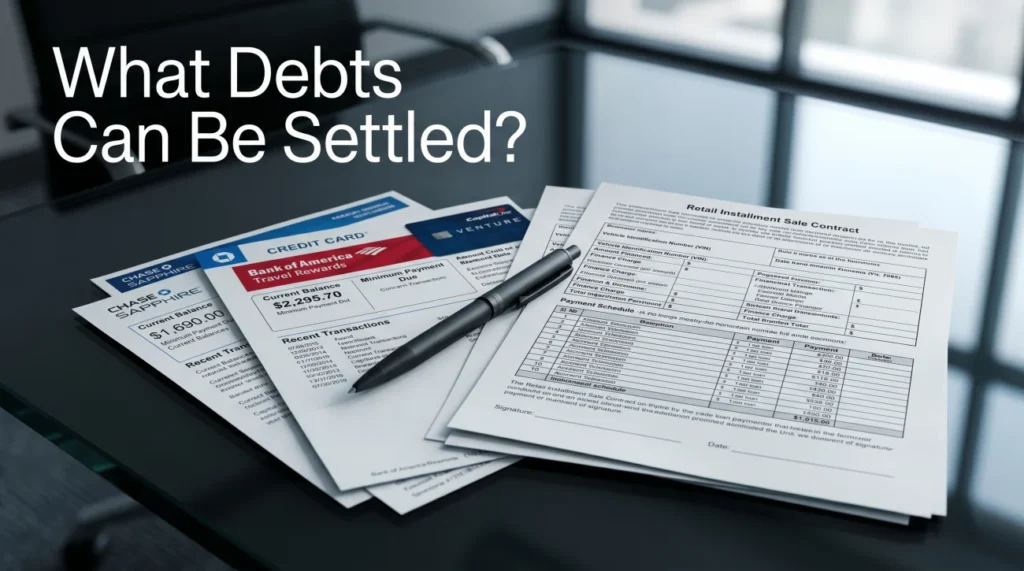
- Most debt relief and settlement programs only accept unsecured consumer debt, such as credit cards, personal loans, and certain medical bills.
- Secured debts, like auto loans and mortgages, generally cannot be settled because the creditor holds the right to repossess or foreclose on the collateral.
- Federal student loans have their own specific government repayment programs and cannot be settled or legally reduced by private debt relief companies.
- If you have a mix of debt types, the standard strategy is to maintain payments on your secured assets while enrolling only your qualifying unsecured accounts into a relief program.
The Dividing Line That Determines Your Relief Options
In my 12 years working inside third-party collection agencies and a national debt buyer, I regularly listened to phone calls where consumers tried to apply the wrong solution to the wrong type of debt. A consumer would call in hoping to negotiate a massive reduction on a defaulted car loan, using the exact same script they successfully used to settle a credit card the week prior. It rarely worked, and they were often left frustrated when the collector refused to budge.
The type of debt you have dictates what relief options actually exist for you. The rules of collection are not universal. They are entirely dependent on leverage.
When you are looking into debt relief, whether you are planning to handle negotiations yourself or hire a professional program, you have to understand the fundamental difference in how creditors view what you owe.
The Foundational Rule: Secured vs. Unsecured Debt
To understand why a company will gladly negotiate a credit card balance but refuse to touch your auto loan, you have to look at the situation from the creditor’s perspective. The entire debt relief industry is built around one concept: unsecured debt.
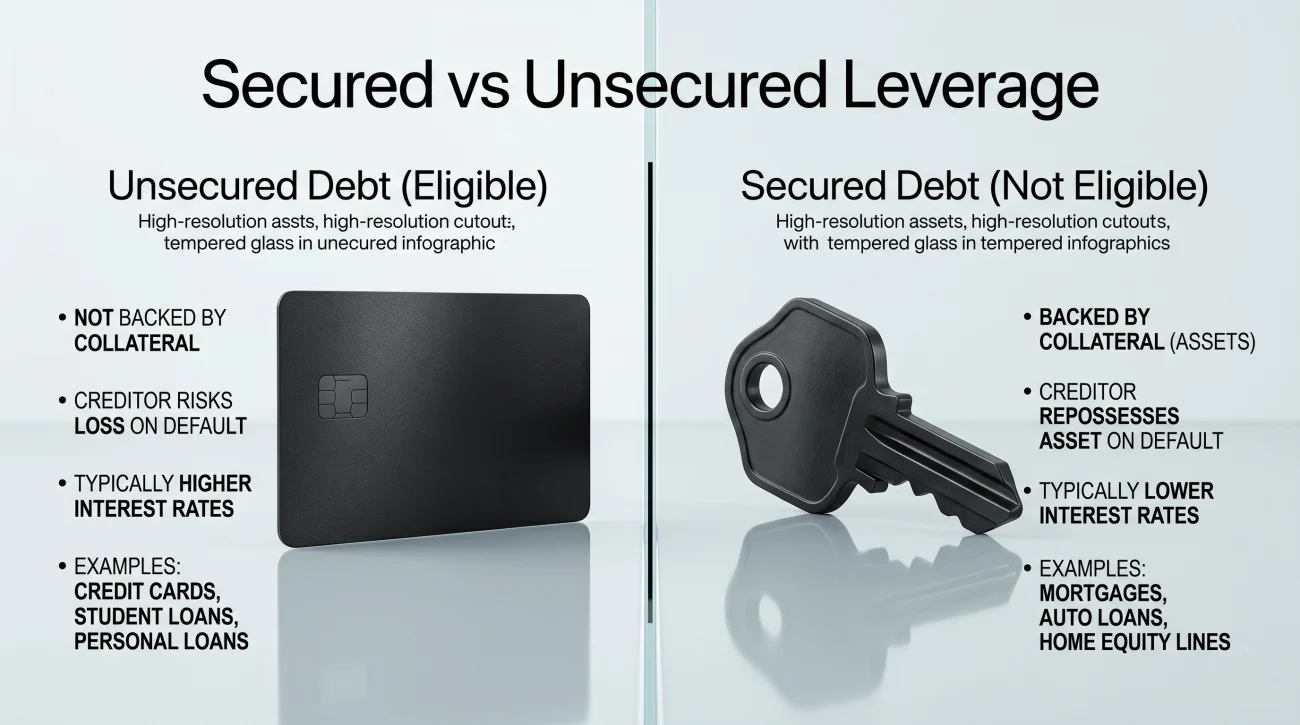
Unsecured Debt (Eligible for Relief)
Unsecured debt means there is no physical collateral tied to the loan. When you opened a credit card, the bank issued you a line of credit based purely on your promise to repay it. If you default on an unsecured debt, the creditor has a problem. Their only legal recourse to force payment is to file a lawsuit, win a judgment in court, and then attempt to execute that judgment.
Lawsuits are expensive. They take time. And even if a creditor wins, the consumer might not have the money or garnishable wages to pay the judgment. Because the creditor’s leverage is limited, they have a strong financial incentive to negotiate a settlement or agree to a modified payment plan. They would rather accept a guaranteed partial payment today than risk getting nothing after a long legal battle.
“Working on the agency floor, the difference in how we handled unsecured accounts was obvious. If we were collecting on an old credit card account that our agency bought for pennies on the dollar, we had massive flexibility to settle. Our leverage was low, so our willingness to negotiate was high. We were trained to secure whatever cash we could get in the door.”
Secured Debt (Not Eligible for Relief)
Secured debt is backed by a specific asset. An auto loan is secured by the vehicle. A mortgage is secured by the house. If you stop paying a secured debt, the creditor does not need to sue you to recover their losses. They already have the ultimate leverage built into the contract: the right to repossess or foreclose.
Because the creditor can simply take the asset back and sell it to recoup their money, they have almost zero incentive to forgive a large portion of the principal balance. No private debt settlement company can force a secured lender to take a loss when that lender holds the title to the collateral.
Stopping payments on your auto loan because you believe a debt settlement program will negotiate the balance down for you.
Continuing to prioritize your auto loan payments to protect your vehicle, while enrolling only your unsecured credit cards into a relief program.
Debts That Can Be Included in Relief Programs
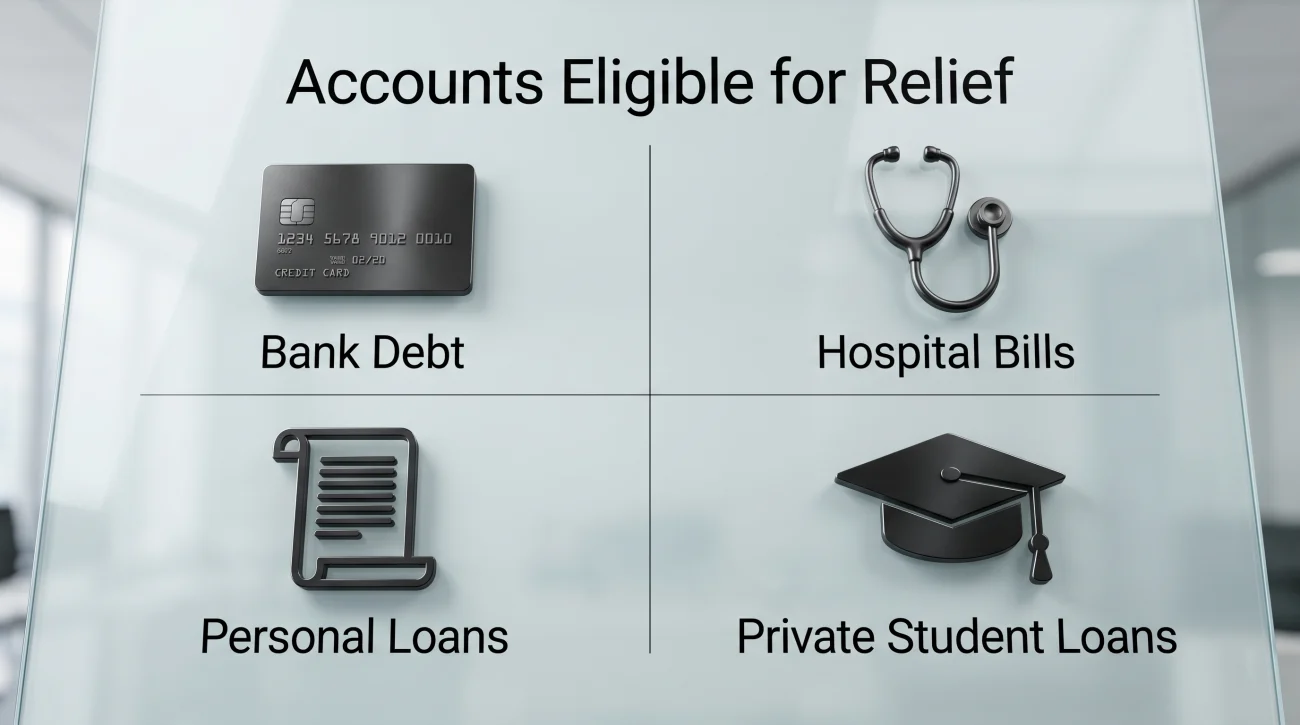
If you are exploring structured debt relief, these are the types of accounts that programs are built to handle. Whether you are looking at paying full principal at a lower interest rate or negotiating to pay less than you owe, these unsecured categories are your primary targets.
Credit Card Debt
Credit card debt is the most common type of account enrolled in relief programs. Because interest rates on credit cards often hover between 20 and 30 percent, balances can spiral out of control quickly. All major credit card issuers, including banks like Chase, Bank of America, Capital One, Discover, and Citibank, have established departments specifically designed to handle accounts enrolled in relief programs.
However, timing is everything. In my experience on the agency floor, if you catch a credit card account right around the 150-to-180-day mark of delinquency, just before the bank is forced to write it off as a total loss, their internal recovery departments are often suddenly willing to discuss lump-sum settlements they aggressively rejected just a month prior.
Medical Bills
Medical debt is unsecured, meaning it can technically be settled or included in some programs, but it requires a very specific approach. Before you ever attempt to settle a medical bill through a third party, you should address it directly with the hospital. Under the Affordable Care Act, nonprofit hospitals are legally required to offer financial assistance programs, commonly known as charity care.
If charity care does not cover the balance, medical debt can still often be negotiated down or settled, but it requires understanding specific billing codes and hospital policies. Because the collection environment for medical bills is highly specialized and constantly shifting under new federal rules, you should review our dedicated guide on how to navigate medical debt relief before paying a third-party settlement company.
Unsecured Personal Loans
Personal loans that are not tied to an asset can generally be included in relief programs. I used to see this scenario play out daily: a consumer would try to settle an unsecured personal loan with their original bank and hit a brick wall. But six months later, after that same bank sold the defaulted loan to a debt buyer, we could suddenly settle it for 40 cents on the dollar. The loan didn’t change; the owner’s leverage did.
Certain Private Student Loans
Private student loans are a wildcard category. Because they are not backed by the federal government, they are technically unsecured consumer debt. Some private student loan servicers will negotiate settlements or agree to modified payment plans, particularly if the account has been in default for an extended period. However, eligibility varies wildly from lender to lender. Some relief programs accept them, while others refuse to touch them due to the difficulty of negotiation.
💡 Pro Tip: Before calling any creditor to negotiate, pull your original loan agreement. Look for the words “security interest” or “collateral.” If those words are missing, you are likely holding an unsecured debt and have much more room to maneuver.
Debts That Cannot Be Settled Through Standard Programs
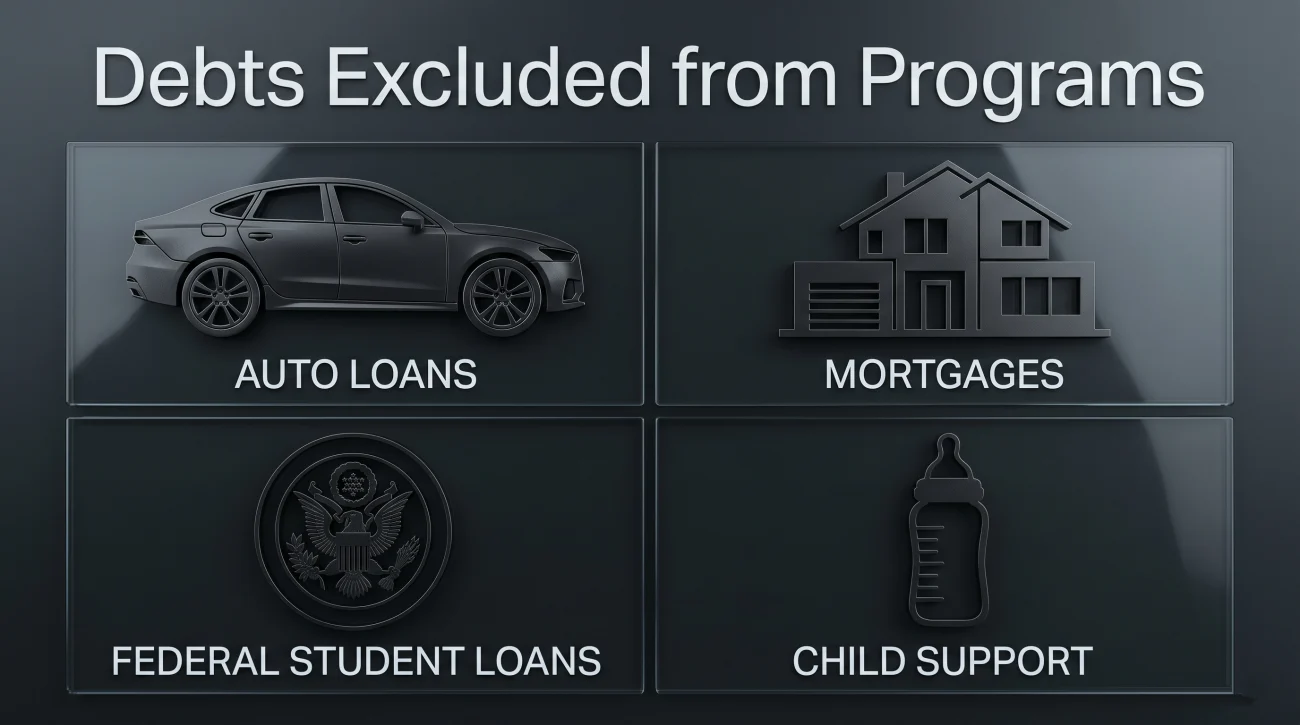
This is where consumers often get into trouble. Enrolling in a program under the assumption that it will magically fix every financial obligation you have is a dangerous mistake. Legitimate companies will explicitly tell you that the following debts are excluded.
| Type of Debt | Why It Is Excluded | Your Actual Options |
|---|---|---|
| Auto Loans | The creditor holds the right to repossess the vehicle. | Maintain payments, voluntarily surrender the vehicle, or sell/trade the car. |
| Mortgages | Defaulting triggers the legal foreclosure process. | Work directly with your mortgage servicer on loan modification or forbearance programs. |
| Federal Student Loans | Private companies have no authority over government-backed loans. | Apply directly for federal Income-Driven Repayment (IDR) plans or deferment at StudentAid.gov. |
| Government Debt (Taxes) | The IRS and state agencies have extraordinary collection powers, including immediate wage garnishment. | Set up an IRS installment agreement or submit an Offer in Compromise directly to the tax authority. |
| Child Support | Court-ordered obligation that cannot be discharged. | Petition the family court for a modification of the support order. |
The Federal Student Loan Trap
Federal student loans require a dedicated warning. If you have Direct Loans, FFEL, or Perkins loans, they cannot be settled by a private debt relief company. The federal government offers its own specific relief paths, such as Income-Driven Repayment plans, Public Service Loan Forgiveness, and hardship deferments. These federal programs are free to apply for.
⚠️ Warning: There is a massive sub-industry of scam companies that target consumers with federal student loans. They will charge you upfront fees, claiming they can “settle” your federal loans or enroll you in a special forgiveness tier. I have heard these operations use manipulative pitches like, “We can get you into the closed Obama-era forgiveness program before funding runs out,” which is a completely fabricated urgency tactic. Over the years, I watched consumers hand over $3,000 in upfront fees for paperwork they could have submitted for free during their lunch break. A legitimate debt relief company will immediately tell you that they cannot service your federal student loans.
The Mixed Debt Situation: How to Handle Both
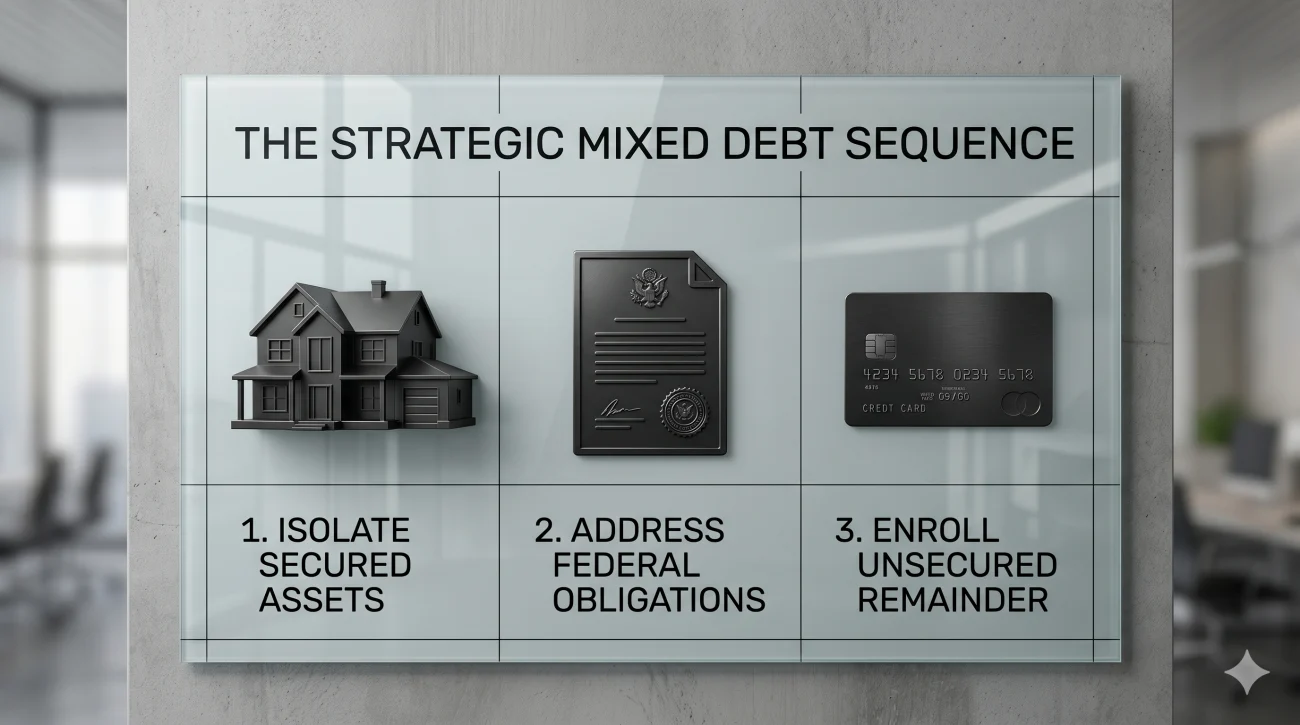
The reality is that very few people have only one type of debt. The most common scenario I saw in the industry was a consumer juggling a car loan, federal student loans, and four maxed-out credit cards.
You cannot use a single approach for your entire financial picture. Instead of looking for a one-size-fits-all program, you need to sequence your actions to protect what matters most.
- 📌 Isolate your secured assets: Your first financial priority must always be the assets you need to live and work. Keep your mortgage and auto loan payments current before allocating a single dollar to unsecured debt negotiation.
- 📌 Address federal obligations directly: Go to the official federal student aid website and apply for an income-driven repayment plan. This can often drop your monthly federal student loan payment to zero if you are experiencing severe financial hardship. Deal with the IRS directly for any tax debt.
- 📌 Enroll the unsecured remainder: Once your secured assets and federal obligations are stabilized, look at the unsecured debt that is left over. This is the portion you can actively target for relief. If you can still afford a reduced monthly payment, you might explore how a debt management plan works to lower your interest rates. If you can no longer afford minimum payments at all, this unsecured portion is what you would enroll in a settlement program.
By compartmentalizing your debt, you secure the roof over your head and the car you need for work first, clearing the runway to aggressively negotiate the unsecured balances left behind.
Signs You May Have Enrolled in the Wrong Program
It is incredibly common for consumers in financial distress to sign a contract without fully understanding the boundaries of the program they just joined. You might realize you are in the wrong program if the representative promised they could negotiate a reduced principal balance on your federal student loans—a massive red flag indicating a deceptive operation.
Similarly, if your largest financial burdens are a car loan or a mortgage, and you enrolled in a standard debt settlement program expecting them to handle it, you have been misled. I have seen consumers stop paying their auto loans because they assumed the relief program’s blanket “stop payment” instructions applied to every account they had, only to wake up to a repossessed vehicle. Furthermore, if you are paying ongoing monthly fees to a company claiming they are currently negotiating your IRS tax debt, but they have never asked you for the detailed financial disclosure forms required by the government, you are likely wasting your money.
Realizing you are in the wrong program is stressful, but stepping back to re-evaluate is better than losing assets. If you have confirmed that your debts are primarily unsecured and you need professional help negotiating them, you can evaluate legitimate options to see if the math works in your favor.
Final Thoughts: Matching the Tool to the Problem
The debt collection system is highly rigid, operating strictly on the leverage established in your original contracts. By actively separating the accounts where your property is at risk from those where creditors hold little power, you protect yourself from predatory programs and retain ultimate control over your financial recovery.
Data Source Notification: Information regarding the FTC Telemarketing Sales Rule protections and general debt reporting guidelines referenced in this article are based on official documentation from the Federal Trade Commission and the Consumer Financial Protection Bureau.
❓ FAQ
🚗 Can debt settlement cover my car loan?
No. Auto loans involve collateral. If you default, the lender will recover the vehicle instead of negotiating the balance.
💳 What debts qualify for a debt management plan?
Debt management plans (DMPs) through nonprofit credit counseling agencies primarily accept unsecured credit card debt and certain personal loans. They negotiate lower interest rates on these accounts so you can pay off the full principal faster.
🏥 Can medical bills be included in debt settlement?
Yes, medical debt is unsecured and can often be settled. However, you should always apply for the hospital’s financial assistance or charity care program first, as you may qualify for complete forgiveness before ever needing a settlement company.
🎓 Does debt relief work for student loans?
Private debt relief companies cannot settle federal student loans. Federal loans have their own government-run hardship and income-driven repayment programs. Some private student loans may be negotiated, but it varies heavily by lender.
⚖️ Can a debt settlement program handle lawsuit judgments?
Once a creditor wins a court judgment against you, their leverage increases significantly, making settlement much harder. While judgments can sometimes be negotiated, most standard debt settlement programs prefer to negotiate accounts before they reach the judgment phase.
🏦 Are personal loans eligible for debt settlement?
Yes, as long as the personal loan is unsecured (not tied to a vehicle or property), it can generally be included in a debt settlement program. They are often negotiated similarly to credit card accounts.
Relief options exist alongside the collection process. These explain both sides.
- The options for resolving debt outside of continued collection
- How Long Does Debt Settlement Take: The Realistic 2-4 Year Timeline and What Affects It
- What Percentage Do Debt Collectors Actually Settle For - and Why the Answer Depends on Who Owns the Debt
- Do You Owe Taxes on Settled Debt? The 1099-C, the Insolvency Exclusion, and What to Do
- Debt Consolidation Loan: When It Saves Money and When It Doesn't
Some of these have deadlines attached. Start here if something is already happening.
- What collectors can legally do to you while a settlement program is running
- How to handle a lawsuit on a debt you are actively trying to settle
- What happens to a garnishment order when debt relief is in progress
- How bank levies interact with the debt you are trying to resolve
- How professional settlement programs work and what they actually cost
Disclosure: The content on this site reflects direct experience inside the debt collection industry and is grounded in federal law and regulation. It is informational in nature. Reading it does not constitute legal advice and does not create any professional relationship. If you are dealing with a lawsuit, a judgment, or a legal deadline, consult a licensed attorney in your state before acting.