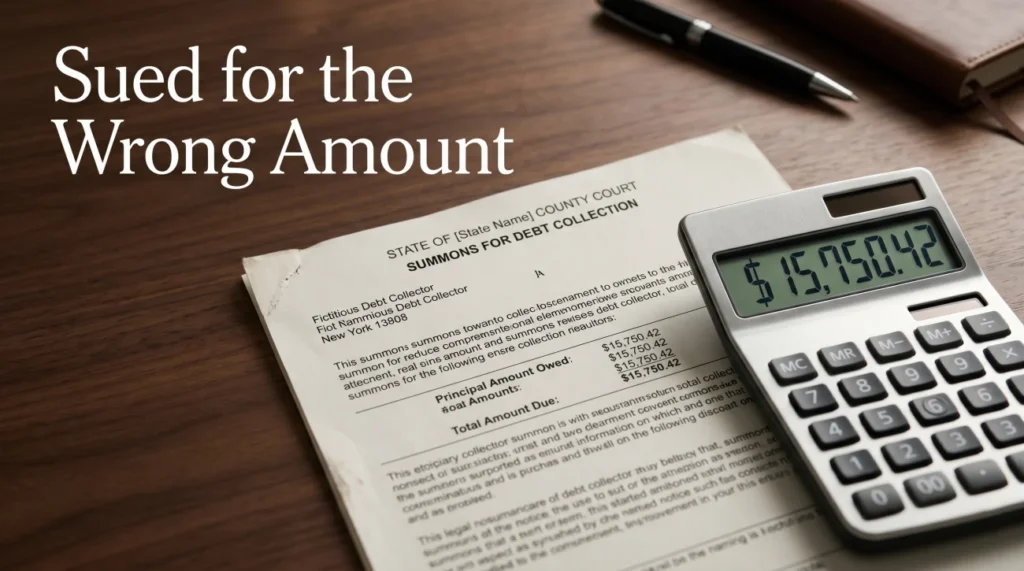
- You can dispute the amount a debt collector is suing you for without denying that a debt exists, and this is a complete defense against the inflated portion of their claim.
- Debt buyer lawsuit balances are frequently inflated with unauthorized post-default interest and collection fees that the original contract never allowed.
- Under the FDCPA, collectors cannot legally collect any amount that is not expressly authorized by the original agreement creating the debt.
When the Math Does Not Match Reality
During my 12 years working inside third-party collection agencies and a national debt buyer, I saw thousands of account screens. The balance field was always prominent, usually highlighted in red. But here is the secret most people outside the industry do not know: the collector on the phone rarely has any idea how that specific number was calculated. They are simply trying to collect the total figure loaded into their system.
If you are looking at court papers and thinking that the balance is far higher than anything you remember spending, you are likely looking for a wrong amount debt collection lawsuit defense. You are not alone in this. A significant percentage of civil complaints filed by debt buyers contain bloated figures that include unauthorized fees, miscalculated interest, or uncredited payments.
Many consumers make a critical mistake at this stage. Because they recognize the original creditor’s name and know they missed payments years ago, they assume they have to accept the lawsuit’s total balance as fact. They think that fighting the lawsuit requires claiming the debt is entirely fake. It does not.
You have the legal right to challenge the math. If a debt collector is suing for an incorrect balance, requiring them to prove the exact itemization of that amount is a powerful defensive strategy. In many cases, because of how debt is bought and sold, they simply cannot produce the paperwork to back up their numbers.
How Lawsuit Balances Become Inflated
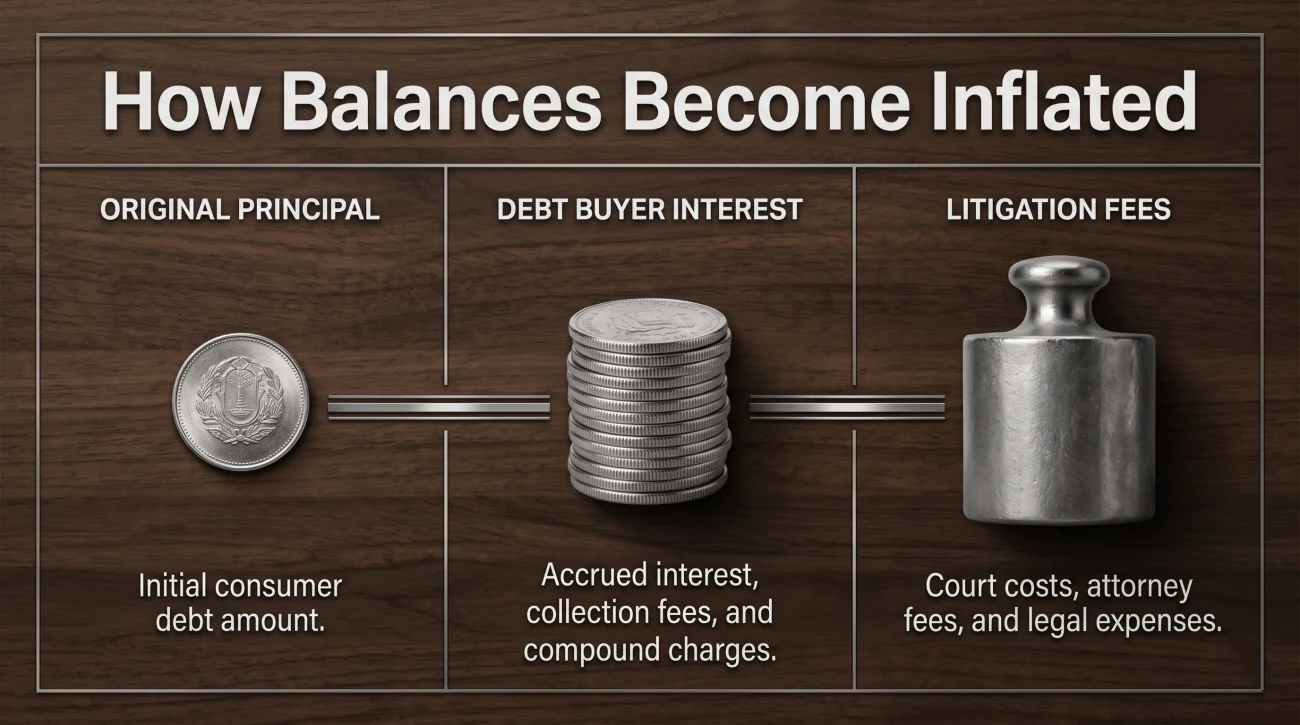
To understand how to fight an inflated debt amount lawsuit defense, you first have to understand how the inflation happens. Balances do not randomly double overnight, but they do grow through a systematic layering of fees as the account moves through the collection lifecycle.
When you stop making payments on a credit card, the original creditor eventually “charges off” the debt, usually after 180 days. At that point, the balance often includes the principal you spent, plus late fees and penalty interest applied during those six months. That is the first layer.
Then, the original creditor sells the account to a debt buyer. The debt buyer purchases a massive portfolio of accounts. What they receive is often just a spreadsheet containing your name, your account number, and a single “balance due” figure. They do not receive a line-by-line accounting of every purchase and fee from the last five years.
“From my operational experience, when a debt buyer sends an account to a collection law firm for litigation, the law firm routinely tacks on its own pre-judgment interest or ‘collection costs’ before filing the complaint. The result is a lawsuit figure that no single document in the chain of title actually reflects.”
A typical state court guide, such as the one provided by the Nebraska Judicial Branch, clearly summarizes this reality: “Debt collectors and debt buyers sometimes sue for amounts that are incorrectly calculated. Common errors include unauthorized interest or fees not permitted by the original contract or Nebraska law.”
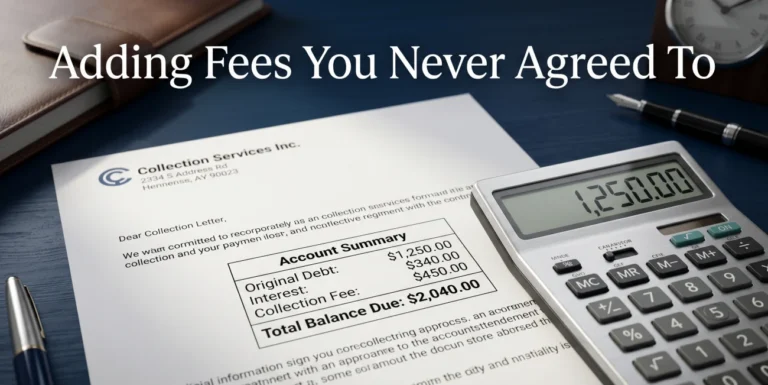
Let me give you a concrete example of how this looks on paper. Suppose your original credit card charged off with a balance of $3,200. Over two years, the debt buyer accumulates another $640 in interest. When they hand it to a litigation firm, that firm tacks on $500 in collection costs. The lawsuit is filed for $4,340. That $1,140 difference is exactly what you need to challenge.
This means you are frequently dealing with three different layers of math: the original creditor’s final calculations, the debt buyer’s internal interest accrual, and the litigation firm’s added fees. The ultimate reality is that no single document in the chain of title actually authorizes all the charges making up that total balance.
The Federal Law Restricting Unauthorized Fees
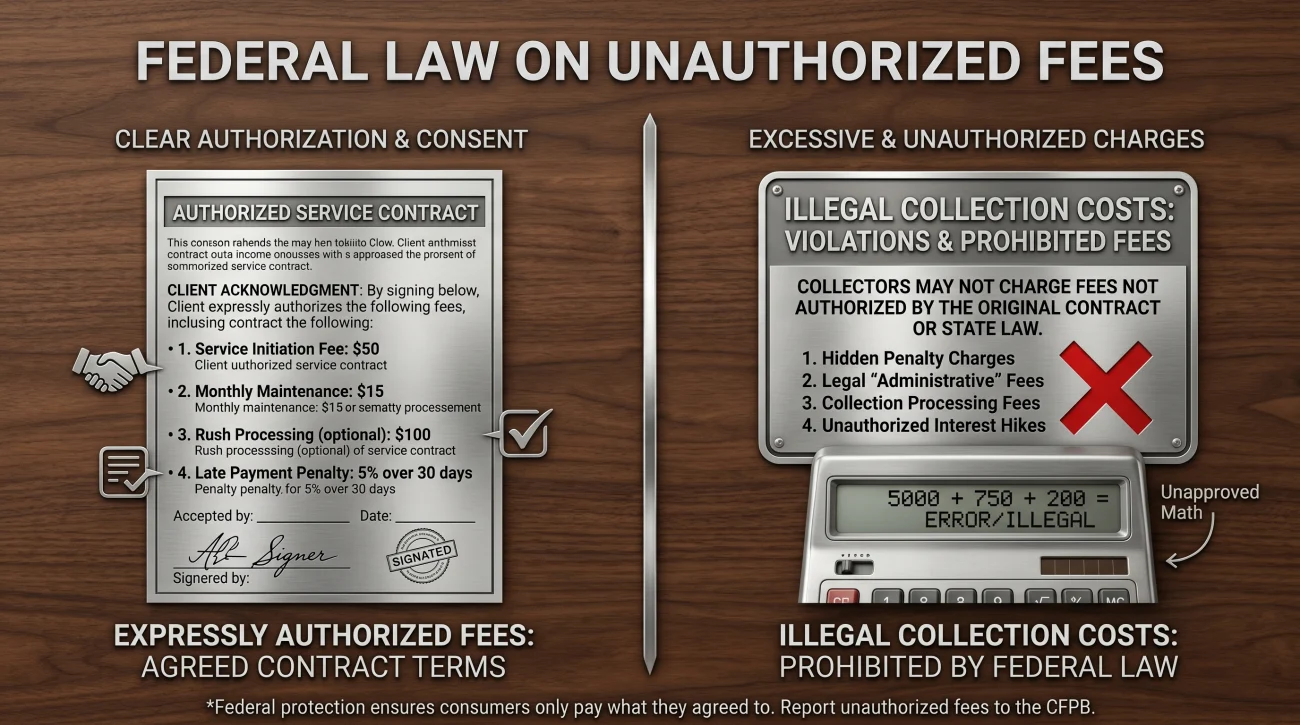
You do not have to rely on goodwill to get a fair accounting. You are protected by federal law. The Fair Debt Collection Practices Act (FDCPA) sets strict boundaries on what third-party debt collectors and debt buyers can financially demand from you.
Specifically, 15 U.S.C. § 1692f(1) prohibits the collection of any amount (including any interest, fee, charge, or expense incidental to the principal obligation) unless such amount is expressly authorized by the agreement creating the debt or permitted by law.
This is the core of the unauthorized fees debt lawsuit defense. For the debt buyer to legally win a judgment for the amount they are claiming, they must be able to produce the original credit agreement you signed, and that agreement must explicitly allow the specific types of fees and interest rates they have added to your balance.
Arguing with the plaintiff’s attorney over the phone that their fees seem “too high” or “unfair.” Fairness is not a legal defense.
Filing a formal written Answer that disputes the claimed balance, followed by discovery requests demanding the original contract that authorizes the specific fees.
Signs You Must Act Immediately to Protect Yourself
Before looking at the exact steps to raise this defense, start with a quick situation check. Being sued for an inflated debt requires a rapid response. If you see any of these red flags, the clock is ticking:
- ⚠️ The balance listed in the summons and complaint is significantly higher than your last known account statement.
- ⚠️ The lawsuit complaint provides no itemized breakdown, only a single lump-sum figure.
- ⚠️ You made partial payments to a previous collection agency, but the current lawsuit balance does not reflect those credits.
- ⚠️ The plaintiff is a debt buyer you do not recognize, claiming interest calculated at a rate you never agreed to.
- ⚠️ Your deadline to file a response with the court is approaching within the next 10 days.
A missed deadline means the court will likely award the collector a default judgment for the exact, inflated amount they asked for, simply because you did not show up to challenge their math. If your balance is large, or the fee calculations are complex, this is the exact moment where evaluating your defense options with a professional can protect your assets. Learn how to get your lawsuit reviewed by a qualified consumer defense attorney.
How to Raise the Wrong Amount Defense in Your Answer
The first step is knowing how to read the complaint you just received. Look closely at the “Prayer for Relief” or the final demand section at the end of the document. If you only see a single lump-sum figure with zero itemization explaining how they calculated interest or fees, that is an immediate red flag. It is the clearest signal that you need to raise this defense.
To successfully dispute the amount a debt collector is suing you for, you must formally state your objection in the written Answer you file with the court. You cannot wait until the day of the hearing to suddenly mention that the math is wrong.
When you draft your Answer, you will respond to each numbered paragraph in their complaint (usually by admitting, denying, or stating you lack sufficient knowledge to answer). After those paragraph responses, you must include a section for “Affirmative Defenses.” This is where you lay your cards on the table.
If you believe the balance is inflated with unauthorized charges, you can use a structured statement. Here is an example of how this defense is commonly worded in legal pleadings:
Affirmative Defense: Payment of a Lesser Amount / Unauthorized Fees
Defendant asserts the defense of payment of a lesser amount. The amount claimed by Plaintiff includes fees, collection costs, and interest not authorized by the original credit agreement or permitted by applicable state law. Defendant disputes the claimed balance of $[Insert Amount] as incorrect, unauthorized, and demands a strict itemized accounting of all charges from the inception of the account.
By placing this in your Answer, you are not saying “I owe nothing.” You are legally stating, “I dispute your numbers, and the burden is now on you to prove them.” For a complete overview of other defensive strategies you might raise simultaneously, review our guide to affirmative defenses against debt collectors.
Forcing Their Hand During the Discovery Phase
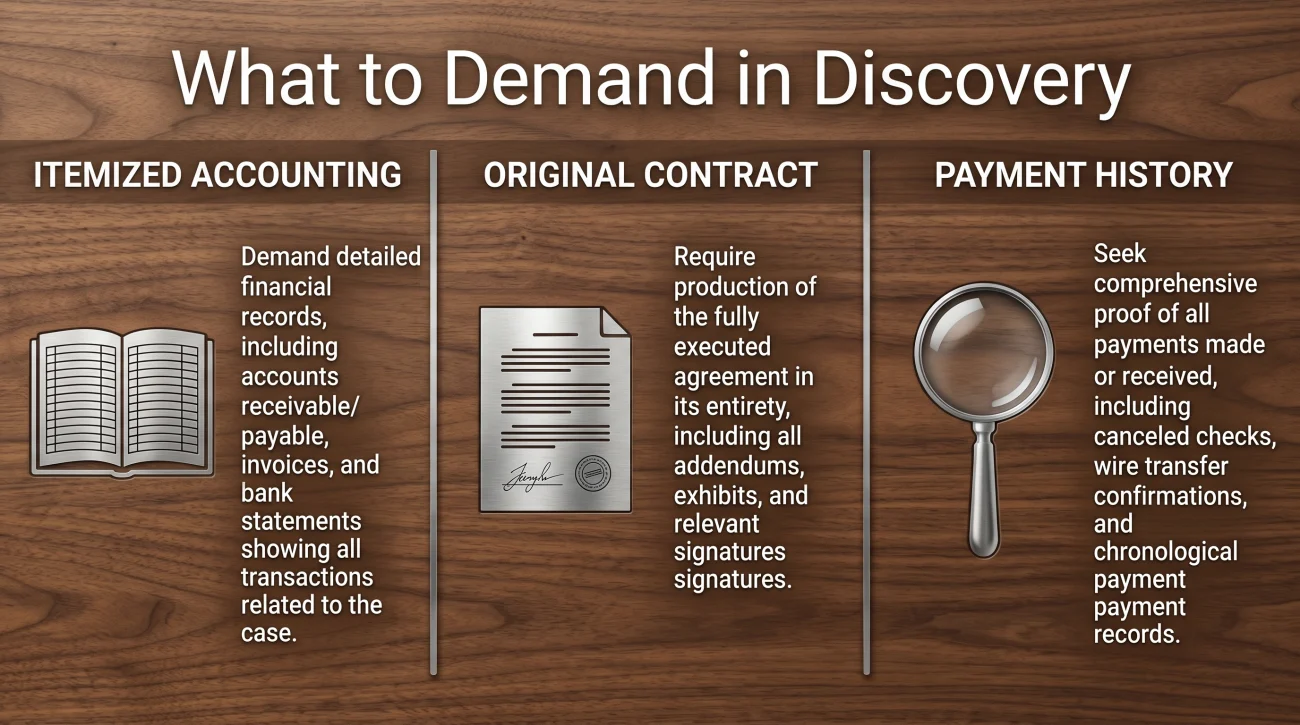
Filing the Answer preserves your right to fight. The “Discovery” phase is where you actually win the fight. Discovery is the period before trial where both sides can demand documents and evidence from each other.
When a debt buyer is suing for a wrong balance, they are hoping you never ask to see their homework. You must ask. You will send them a formal “Request for Production of Documents.”
To expose an inflated balance claim during discovery, your discovery requests should specifically demand:
- A complete, itemized accounting showing the balance progression from the day the account was opened to the date it was charged off by the original creditor.
- A line-item breakdown of every fee, interest charge, and penalty added to the account *after* it was charged off.
- A copy of the original, signed credit agreement that explicitly authorizes the plaintiff to charge the specific fees and interest rates they have applied.
- A complete ledger of all payments credited to the account, including any payments made to prior third-party collection agencies.
Key Point: If you made payments to a previous collector that were not forwarded to the debt buyer, you must raise a specific payment defense. You can read the mechanics of that process in our guide on the debt already paid lawsuit defense.
This is where debt buyer lawsuits frequently hit a wall. Because they purchase accounts in bulk, they rarely possess the original signed credit agreement, nor do they usually have a zero-to-present day itemized accounting. When they realize they cannot legally prove the math to a judge, they are often forced to either drop their demands significantly or face a potential motion for dismissal.
When Bad Math Becomes an FDCPA Counterclaim
There is a significant difference between a collector making a slight clerical error and a collector systematically suing people for fees they have no legal right to collect. If the plaintiff’s attorney has knowingly layered unauthorized collection fees onto your balance, this is not just a defense for you; it is an offensive weapon.
Because 15 U.S.C. § 1692f strictly forbids collecting unauthorized amounts, a collector who sues you for those amounts has violated federal law. You can potentially file a counterclaim against them in the exact same lawsuit.
If you succeed on an FDCPA counterclaim, the collector may be ordered to pay you statutory damages (up to $1,000), actual damages, and, most importantly, your attorney’s fees. The moment a debt collector realizes their inflated math has exposed them to paying your legal bills, their willingness to aggressively pursue the lawsuit plummets. You can learn more about how to leverage their violations against them in our FDCPA lawsuit counterclaim guide.
Common Mistakes When Disputing the Claimed Amount
Even with a solid defense, it is remarkably easy to accidentally hand leverage back to the collection law firm. Avoid these operational mistakes if you are challenging their numbers.
Mistake 1: Admitting the debt over the phone.
If you call the plaintiff’s attorney and say, “I know I owe the $2,000, but I’m not paying the $1,500 in fees you added,” you have just verbally confessed to the principal balance. The attorney will take notes. Limit your phone communication and keep your disputes strictly to formal, written court filings.
Mistake 2: Failing to ask for dismissal.
If the collector entirely fails to produce the original contract or itemized accounting during discovery, do not just wait for the trial. You or your attorney should proactively file a motion asking the court to throw the case out because the plaintiff lacks evidence. You can read the procedural paths for this in our overview on getting a debt collection case dismissed.
Mistake 3: Admitting to a partial balance in writing.
If you send an email or letter stating “I only owe $2,000, not $3,500,” you have just provided them with written evidence that validates the $2,000 principal. You have done half their work for them. Keep your communications focused on demanding their proof, not offering your own concessions.
Final Thoughts on Fighting an Inflated Balance
When facing a debt collection lawsuit with the wrong amount, the most critical shift you can make is viewing the bloated balance not as a threat, but as their structural weakness. Every unauthorized fee they tack on gives you a specific point to attack. By challenging their math, you force a volume-based debt buyer to do something they hate doing: spend time and money trying to locate old paperwork.
By raising the affirmative defense of unauthorized fees and aggressively demanding an itemized accounting during discovery, you shift the case from a routine, profitable default judgment into an expensive, document-heavy ordeal for the debt buyer. Often, that shift alone is enough to change the outcome in your favor. If you need a broader understanding of the legal landscape you are navigating, start with our foundational guide on what to do when you are sued by a debt collector.
❓ FAQ
⚖️ Can a debt collector sue me for more than I originally owed?
Yes, but only if the original contract you signed, or your state’s specific laws, explicitly allow for the addition of post-default interest, late fees, or collection costs. If the contract does not authorize it, they cannot legally collect it.
🧮 What if I agree I owe some money, but the balance they are suing for is wrong?
You can and should file an Answer with the court disputing the total amount claimed. You can raise an affirmative defense regarding unauthorized fees or demand an itemized accounting to force them to prove exactly how they arrived at that specific number.
📄 What if I don’t have a copy of the original agreement?
You are not required to have it. The collector is. Since they are the ones suing to enforce the contract, they bear the burden of producing it. If they cannot provide the original signed agreement in discovery, you have strong grounds to push for dismissal. Read more about what happens when a debt buyer has no original contract.
🧾 Will a billing statement be enough for the collector to prove the amount?
In many jurisdictions, a simple final billing statement is not enough to prove an inflated balance, especially if it contains unitemized collection fees. You can demand the original credit agreement to verify that the interest rates and fees shown on the billing statement were actually authorized.
🛑 Can I just ignore the lawsuit or call the attorney to clear this up?
No to both. Ignoring the lawsuit results in a default judgment for the exact, inflated amount. Calling the attorney does not stop the court clock and risks you accidentally admitting liability over the phone. You must formally respond to the court in writing.
What each stage of litigation requires and where your leverage sits.
- What the lawsuit process looks like from summons to judgment
- What to file, when to file it, and what happens if you do not
- The legal arguments that can defeat a debt collection lawsuit
- What a default judgment allows collectors to do and how to fight one
- How to negotiate a resolution once litigation has started
Once judgment is entered, collectors gain tools they did not have before.
- The FDCPA violations collectors commonly commit during the collection process
- How to respond to a debt lawsuit and what defenses are available to you
- How a judgment becomes a garnishment order on your paycheck
- When a collector uses a judgment to freeze your bank account instead
- How to settle before the judgment turns into something harder to stop
Disclosure: The content on this site reflects direct experience inside the debt collection industry and is grounded in federal law and regulation. It is informational in nature. Reading it does not constitute legal advice and does not create any professional relationship. If you are dealing with a lawsuit, a judgment, or a legal deadline, consult a licensed attorney in your state before acting.