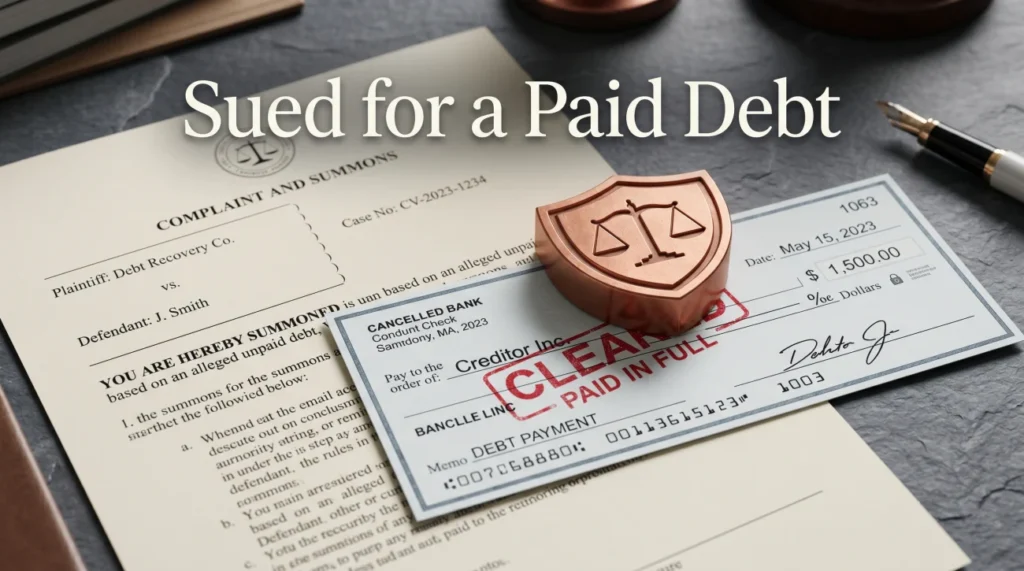
- If you already paid the debt, your payment is a complete and absolute defense to the lawsuit. The plaintiff cannot legally win a case for an unpaid balance that does not exist.
- Debt buyers often sue on paid accounts by mistake. Payments made to the original creditor right before the debt was sold frequently do not transfer over to the buyer’s spreadsheet.
- You must formally raise “payment” or “accord and satisfaction” as an affirmative defense in your written Answer to stop the lawsuit from resulting in a default judgment.
The Shock of Being Sued for a Settled Account
It is incredibly frustrating to be handed a lawsuit summons for an account you already took care of. You wrote the check, you settled the balance, and you moved on with your life. Now, months or even years later, a debt collector is dragging you into court claiming you still owe them money. If you are sitting there thinking “I paid this debt but being sued anyway,” you are not alone.
During my twelve years working inside third-party collection agencies and national debt buyers, I saw this exact scenario play out on the collection floor constantly. Consumers would call in, angry and confused, holding a court summons for a debt they knew they had paid. Most people assume the collection agency is intentionally trying to scam them out of a double payment. While bad actors exist, the reality of why this happens is usually a massive, systemic documentation failure.
However, the reason they are suing you matters less than how you respond. The plaintiff in a civil lawsuit bears the burden of proving that an unpaid debt actually exists. If you have already paid it, you hold the ultimate trump card. You just need to know how to properly play that card in the legal system to get the case shut down.
Two Forms of the Payment Defense
When you are fighting a debt collection lawsuit, payment is classified as an “affirmative defense.” This means that even if everything the collector says in their complaint is technically true (you opened the account, you used the card, you missed a payment at some point), you have a separate fact that cancels out their right to win the case. There are two primary ways this defense takes shape in court.
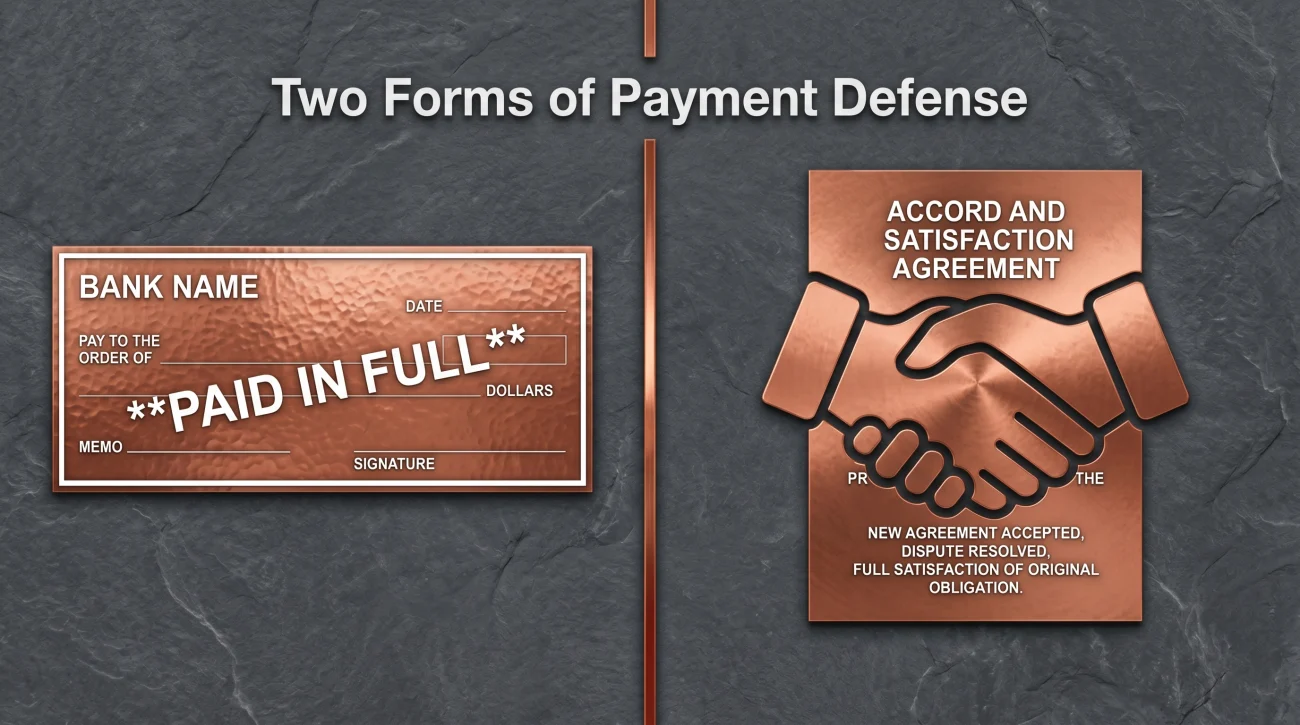
1. Paid in Full Debt Lawsuit Defense
This is the most straightforward scenario. You paid the entire balance owed directly to the original creditor or to a prior collection agency that was handling the account. You did not negotiate a discount. You paid exactly what was stated on your final statement, bringing the balance to zero. If a new debt collector sues you later, your proof of that full payment acts as a complete shield.
2. The Accord and Satisfaction Defense
This scenario is slightly more complex but equally powerful. You owed a balance, but you negotiated a settlement with the original creditor or a previous debt collector for less than the full amount. They agreed to accept your reduced payment as full resolution of the account. In legal terms, this agreement is called an “accord and satisfaction.”
If you paid the agreed-upon settlement amount, the remainder of the debt is legally forgiven. A subsequent debt buyer cannot buy the “forgiven” portion of the balance and sue you for it. As long as you have the written settlement agreement showing the lesser amount was accepted to satisfy the debt, you have a complete accord and satisfaction debt lawsuit defense.
Why Debt Buyers Sue on Paid Accounts
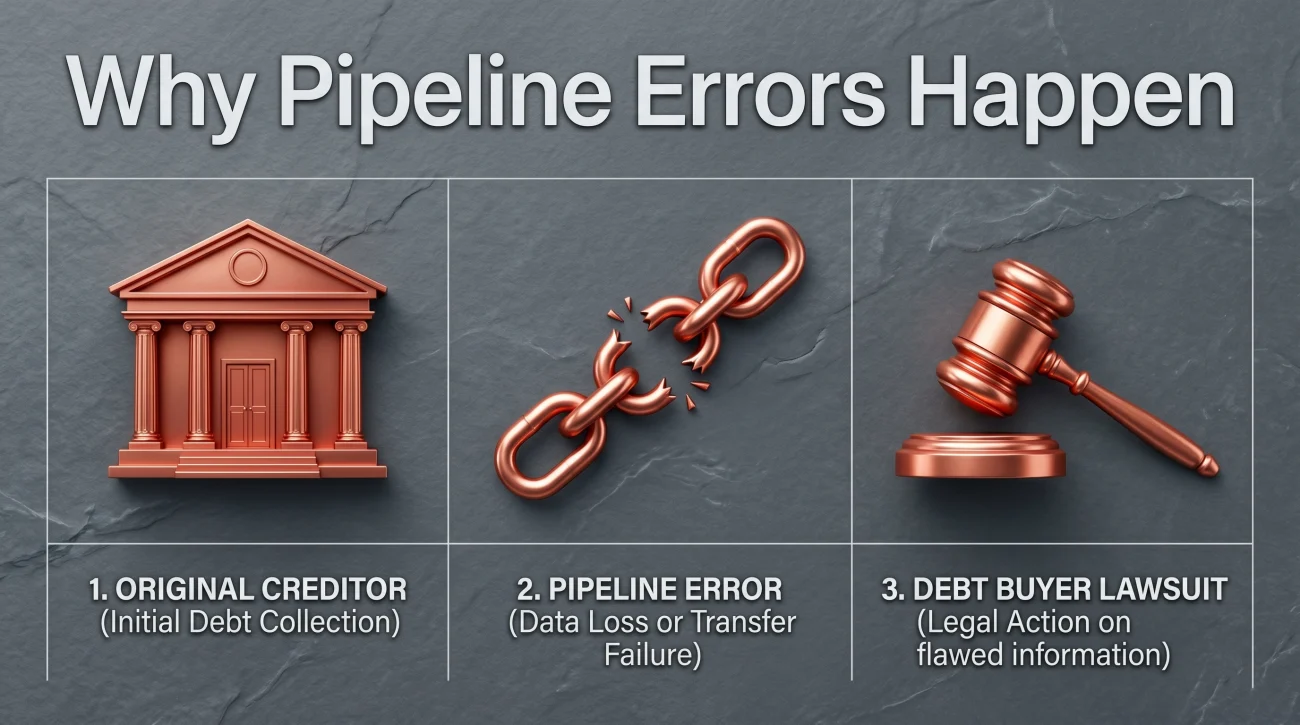
To fight this effectively, it helps to understand why a debt paid collector still suing scenario happens in the first place. When a bank or credit card company decides to sell off delinquent accounts, they bundle thousands of accounts into a massive portfolio and sell it to a debt buyer for pennies on the dollar.
This transaction is finalized on a specific date. If you mailed a final payment or finalized a settlement with the original creditor right around the time that portfolio was being packaged for sale, your payment may not have been fully processed and attached to your file before the data was handed over to the debt buyer.
“Inside the debt buying industry, we called this a pipeline error. The debt buyer receives a spreadsheet showing your name, your account number, and an outstanding balance of $3,500. They have absolutely no record that you paid the original bank $3,500 two days before the file was transferred. The buyer is genuinely unaware that the debt was cleared, which is why they eventually forward it to a law firm to file a lawsuit.”
This context is important because it means the plaintiff’s attorney filing the lawsuit likely has no idea the account is settled. They are acting on bad data. That bad data is exactly why you need to verify whether this defense applies to your situation before doing anything else.
Signs This Defense Applies to Your Lawsuit
Before you dive into drafting legal documents, you should confirm that your situation actually qualifies for this specific defense. Being sued is intimidating, but you should not let a formal summons convince you that you somehow still owe a debt you resolved.
You likely have a case-winning payment defense if you notice these indicators:
- 📌 You have a clear memory of writing a final check or agreeing to a phone settlement for this exact account.
- 📌 The account currently shows up as “Paid,” “Closed,” or “Settled in Full” on your credit report.
- 📌 The plaintiff suing you is a third-party debt buyer, making it highly probable they missed a final pipeline update from the original creditor.
If your situation matches these points, you are in a very strong position. However, knowing why the error happened gives you confidence, but it will not stop the lawsuit on its own. Here is exactly how to bring your proof into the legal process.
How to Assert the Payment Defense in Your Answer
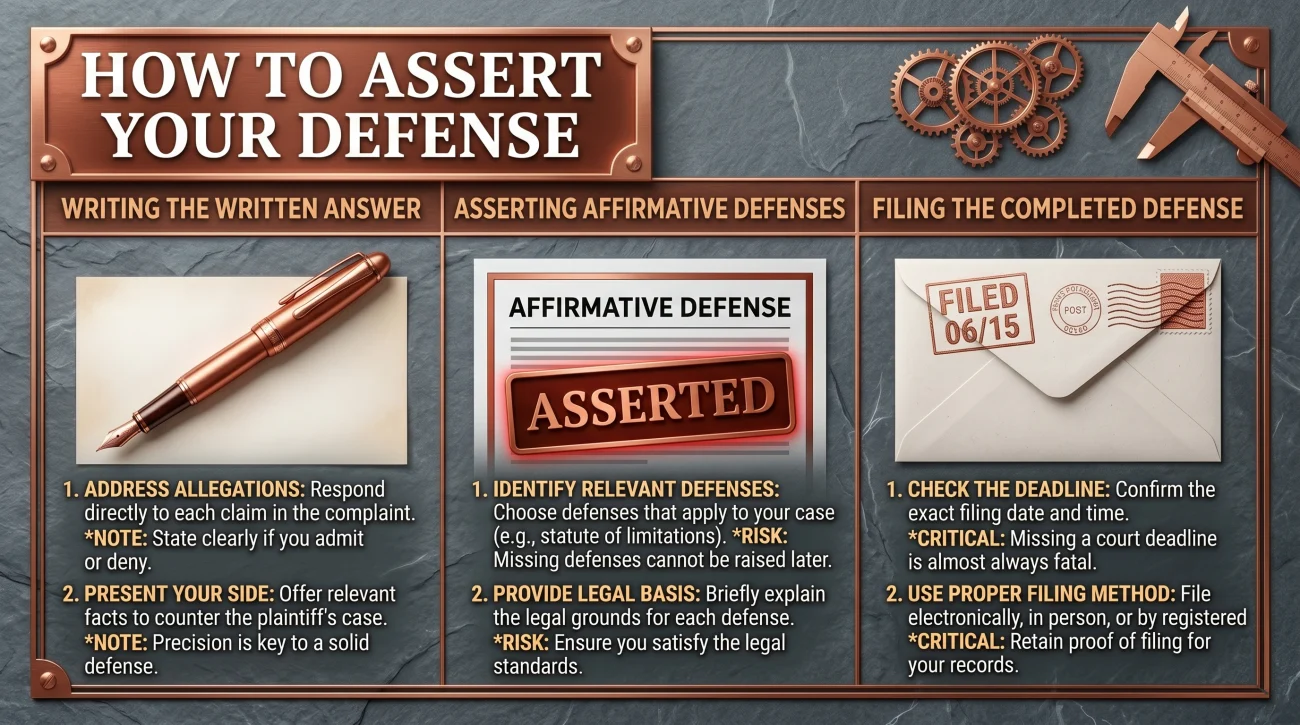
Having proof of payment is only helpful if you formally introduce it to the court. You cannot just call the collection agency, tell them you paid, and assume the lawsuit will vanish. You must file a written Answer with the court before your deadline expires.
In your written Answer, after you respond to the numbered paragraphs in the collector’s complaint, you must include a specific section for your Affirmative Defenses. If you do not raise the payment defense debt collection lawsuit strategy in your Answer, you risk waiving your right to use it later.
Here is how you can phrase this defense depending on your specific situation:
“Defendant asserts the affirmative defense of payment. Defendant paid the alleged debt in full to [Name of Original Creditor or Prior Collector] on or about [Date]. Therefore, no outstanding balance exists and Defendant is not liable for the amount claimed by Plaintiff.”
“Defendant asserts the affirmative defense of accord and satisfaction. On or about [Date], Defendant and [Name of Creditor/Collector] entered into a settlement agreement to resolve this account for a reduced amount. Defendant made the agreed payment of $[Amount] in full compliance with the agreement, which satisfied the alleged debt in its entirety. This agreement bars the current lawsuit.”
If you are also disputing extra fees or inflated interest that the collector tacked onto the balance, you can raise that as an entirely separate issue. For guidance on how to fight inflated numbers, you should review how to handle a wrong amount debt collection lawsuit defense.
The Documentation You Need to Win
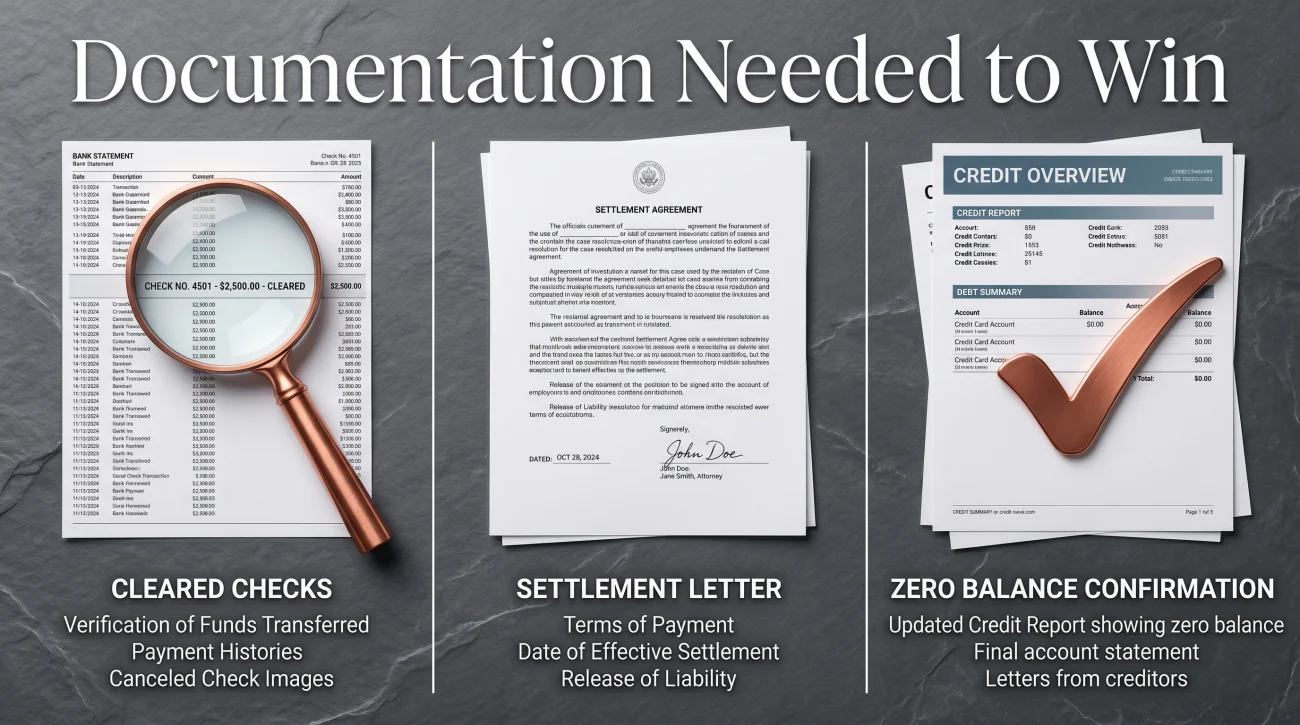
If you assert that you already paid the debt, the judge will expect to see hard proof. A verbal statement that you paid three years ago will rarely hold up against a collector’s account statement showing an unpaid balance.
To successfully execute a debt already paid lawsuit defense, you need to gather specific pieces of documentary evidence:
- Bank Statements or Cleared Checks: This is your strongest evidence. A bank statement showing a withdrawal or a copy of a cleared check made out to the original creditor proves the money left your hands.
- A Payoff or Settlement Letter: If you settled the debt, you should have a letter from the creditor stating they agree to accept a specific amount to resolve the account.
- Zero Balance Confirmation: Final “Account Closed” statements generated after your payment processes.
- Credit Reports: Pull your official credit reports from all three major bureaus. If the original creditor reported the specific account as “Paid,” “Closed,” or “Settled for Less Than Full Balance,” that serves as powerful third-party verification of your defense.
Having the documents is only step one; you must submit them correctly. When you file your written Answer, you can attach copies of these documents as “Exhibits” (for example, labeling your cleared check as Exhibit A). Always bring at least three physical copies of every document to your court date: one for the judge, one to hand to the opposing attorney, and one for your own records.
Showing up to the hearing empty-handed and hoping the judge takes your word that you mailed a money order to the bank four years ago.
Attaching a copy of your cleared check to your Answer as an Exhibit, forcing the debt buyer’s attorney to look at hard evidence before the trial date.
What to Do If You Lost Your Proof of Payment
It is a common scenario for consumers to pay off a stressful debt, shred the paperwork in a moment of relief, and move on. If you are sued years later and no longer have your bank statements or the settlement letter, you have to do some quick detective work to rebuild your paper trail.
First, contact the bank or credit union you used at the time you made the payment. Financial institutions archive statements and cleared check images for up to seven years. You can usually request archival copies for a small fee. Having the exact month and year you made the payment will speed up this search dramatically.
Second, contact the original creditor directly. Explain that you paid the account off on a certain date and request a “Statement of Account Status” showing a zero balance. Even if they sold the rest of their bad debt portfolio to the debt buyer who is currently suing you, their internal archives should still show your final payment clearing their system.
If you absolutely cannot find the payment record, your defense strategy may need to pivot. You might need to force the debt buyer to prove they actually own the debt in the first place. You can learn more about how this systemic weakness works by reviewing the debt buyer no original contract defense.
What Happens at the Court Hearing
If the case makes it all the way to a hearing, having your evidence organized changes the entire dynamic. Often, the real action happens before you even step in front of the judge. It is very common for the debt buyer’s attorney to pull you aside in the hallway to try and negotiate a payment plan.
This hallway negotiation is exactly when you hand them a copy of your cleared check or settlement agreement. Once the attorney sees indisputable proof of payment, they realize they have a losing case based on a pipeline error. They know a judge will not rule in their favor against a cleared check. In many instances, the attorney will step away to call their client, confirm the error, and voluntarily dismiss the case right there to avoid wasting the court’s time.
If the attorney decides to proceed and you go before the judge, you will present your affirmative defense of payment and hand over your three copies of the exhibits. If you show the court documentation of payment and the plaintiff cannot produce overwhelming evidence to counter it, the court will shut the case down. For a broader look at the various ways cases get thrown out, you can explore how to get a debt collection lawsuit dismissed.
Final Thoughts: Do Not Let Them Double Dip
The legal system is built on evidence. A debt collector might file a lawsuit against you based on bad data, a missing spreadsheet row, or a pipeline error during a portfolio sale. But their mistake does not magically obligate you to pay the same bill twice.
Your job is simply to correct the record. By formally raising the payment defense in your Answer and bringing your cleared checks or settlement letters to the table, you force the legal process to acknowledge reality. Do the legwork to dig up your old bank statements. That single hour of searching through your financial archives is the exact effort required to protect your wallet and shut their lawsuit down permanently.
❓ FAQ
📝 What happens if I am sued for a debt I paid off?
You must file a written Answer with the court and raise “payment” as an affirmative defense. If you provide proof that you paid the debt, the judge will dismiss the lawsuit.
🏦 Why is a debt collector suing me for an account I already settled?
This usually happens when an original creditor sells a massive portfolio of debts to a buyer. If your settlement processed right around the time of the sale, the buyer likely received outdated data showing an unpaid balance.
📄 How do I prove I already paid a debt in court?
The best proof includes a copy of the cleared check from your bank, a bank statement showing the withdrawal, a settlement letter from the creditor, or an official zero-balance statement.
🤝 What is an accord and satisfaction defense?
It is a legal defense used when you previously negotiated to settle a debt for less than the full balance and successfully made the agreed-upon payment.
🔍 What if I lost my receipt or bank statement for the payment?
You should immediately contact the bank you used at the time to request archival copies of your statements. You can also contact the original creditor and ask for a statement showing the account status as paid.
⚖️ Can I just call the collector and tell them I paid it?
No. Once a lawsuit is filed, verbal conversations do not stop the legal clock. You must respond through the proper legal channels to avoid a default judgment.
📊 Does my credit report count as proof of payment?
A credit report showing the account as “Paid” or “Settled” is strong supporting evidence. However, you should still try to pair it with actual bank records showing the financial transaction.
❌ Will the lawsuit automatically drop if I mail them proof?
Many debt buyer attorneys will voluntarily dismiss the case once you send them solid proof during the discovery phase, as they know they cannot win at trial. However, you must still file your Answer first to protect yourself.
🛡️ Is paying a settlement to a previous collector a valid defense?
Yes. If you settled the account with a prior collection agency authorized to handle the debt, that settlement binds any future debt buyers who purchase the account later.
⏰ Is there a deadline to prove I paid the debt?
Yes. You must assert your payment defense in your written Answer, which must be filed before the deadline listed on your court summons (typically 14 to 30 days after you are served).
What each stage of litigation requires and where your leverage sits.
- What the lawsuit process looks like from summons to judgment
- What to file, when to file it, and what happens if you do not
- The legal arguments that can defeat a debt collection lawsuit
- What a default judgment allows collectors to do and how to fight one
- How to negotiate a resolution once litigation has started
Once judgment is entered, collectors gain tools they did not have before.
- The FDCPA violations collectors commonly commit during the collection process
- How to respond to a debt lawsuit and what defenses are available to you
- How a judgment becomes a garnishment order on your paycheck
- When a collector uses a judgment to freeze your bank account instead
- How to settle before the judgment turns into something harder to stop
Disclosure: The content on this site reflects direct experience inside the debt collection industry and is grounded in federal law and regulation. It is informational in nature. Reading it does not constitute legal advice and does not create any professional relationship. If you are dealing with a lawsuit, a judgment, or a legal deadline, consult a licensed attorney in your state before acting.