- The statute of limitations (SOL) is an absolute defense that can get a debt lawsuit dismissed, but courts will not apply it automatically. You must actively raise it.
- If you file an Answer without formally listing the SOL as an affirmative defense, you waive the right to use it. The court will let the collector win even if the debt is a decade old.
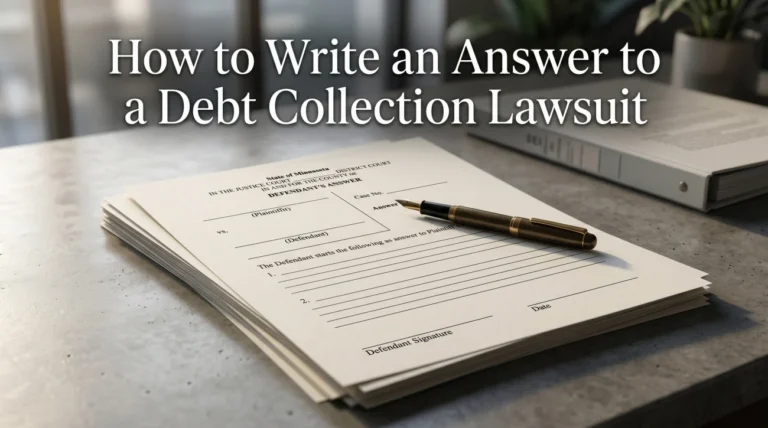
- To assert this defense, you must add a specific “Affirmative Defenses” section in your written response to the court.
- A general denial (“I deny I owe this”) is not the same as an affirmative defense. You need both to fully protect yourself.
- Bringing bank statements or credit reports that prove the date of your last payment is how you make the defense stick at a hearing.
The Trap of the Time-Barred Debt Lawsuit
A stack of court papers just landed in your hands, and as you read through the complaint, you realize the debt they are suing you for is five, six, or maybe even ten years old. You probably know that old debts eventually expire. What you might not know is that a debt collector can still legally sue you for an expired debt in many jurisdictions, betting on one simple fact: they believe you don’t know how to raise a statute of limitations affirmative defense debt lawsuit.
During my twelve years inside third-party collection agencies and a national debt buyer, I saw exactly how this plays out. Debt buyers purchase massive portfolios of old, defaulted accounts for pennies on the dollar. They know many of these accounts are past the legal deadline for litigation. They file the lawsuits anyway.
Why? Because the statute of limitations is not a shield that magically deploys itself. It is a legal argument that you, the defendant, must actively raise in your written Answer to the court.
This sounds straightforward, but in practice, it is where thousands of consumers lose cases they should have won easily. They write to the judge saying, “I don’t owe this money,” but they forget to say the magic words: “This lawsuit is time-barred.” In this guide, I will walk you through exactly how to formally assert this defense, what happens if you forget, and how to make it stick so you can close the case for good.
Why You Must Raise the SOL Defense in Your Answer (The Waiver Rule)
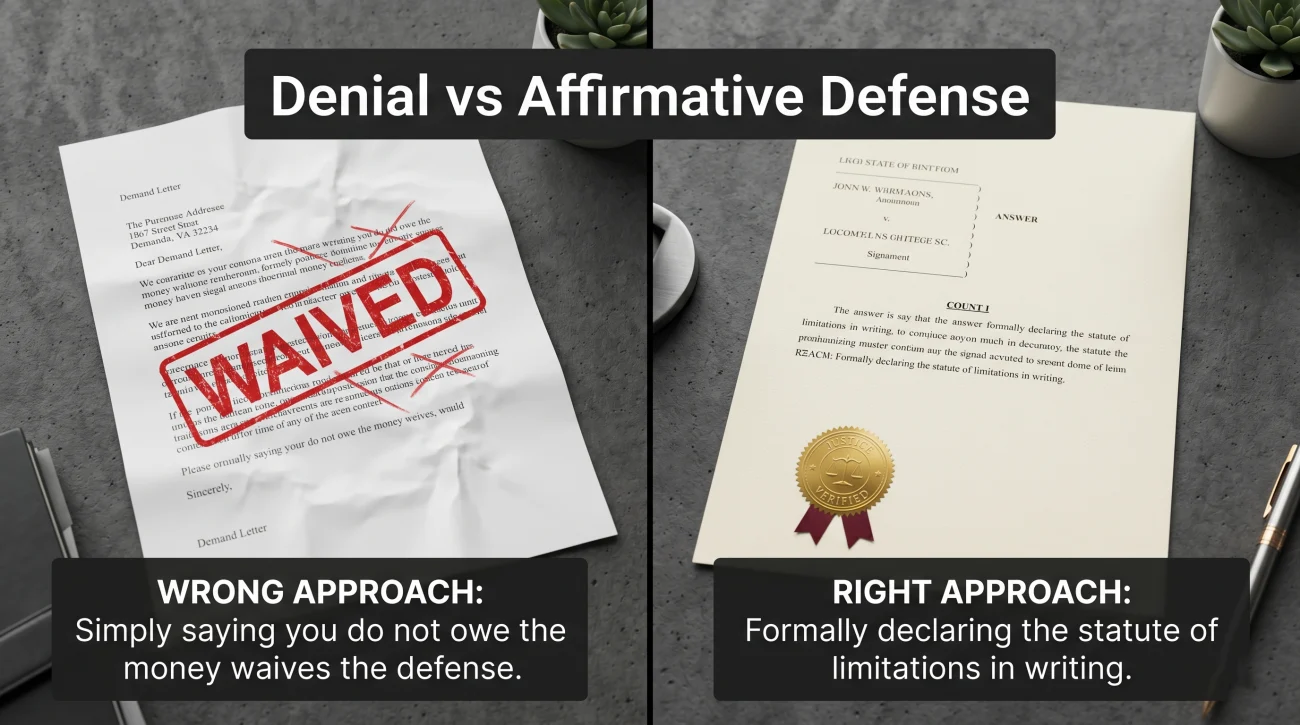
To understand why so many people get trapped by old debt, you have to understand the difference between a “denial” and an “affirmative defense.” When you file a response to a debt collection summons, simply denying that you owe the money forces the collector to prove their case. But denying the debt does not address the age of the debt.
The statute of limitations (SOL) is an affirmative defense. In the legal world, an affirmative defense basically means, “Even if everything the plaintiff says is true, I still win because of this other legal rule.” Under the Federal Rules of Civil Procedure Rule 8(c) and equivalent state rules, a defendant must raise SOL defense answer documents in writing.
If you forget to include it, the court assumes you have waived your right to use it.
“When I reviewed litigation files for a debt buyer, our attorneys loved seeing Answers written by consumers who just said, ‘I dispute this debt.’ If the account was seven years old, but the consumer failed to write ‘statute of limitations’ in their Answer, our attorneys knew the defense was waived. We could proceed to judgment on a debt that was legally dead.”
Recent updates to state legal guidelines across the country highlight how strict this rule is. Many state court rules and self-help guides explicitly warn consumers: “If you do not plead an affirmative defense in your written Answer, you generally lose the right to raise it later.”
You cannot simply show up to the court hearing months later and tell the judge the debt is too old. The judge will look at your filed Answer, see that you did not assert the defense, and tell you it is too late. You must assert it in the paperwork.
How to Assert the SOL Defense in Your Lawsuit Answer
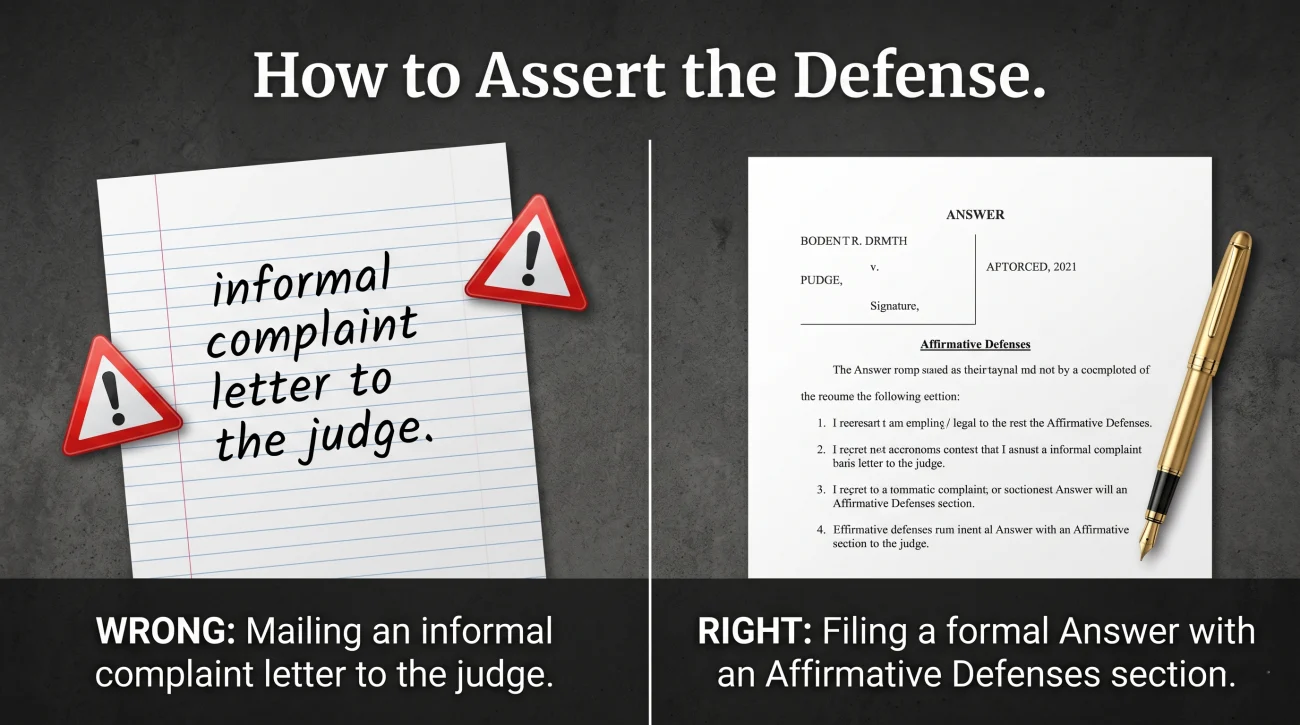
If you are drafting your response, you want to know exactly how to assert this defense correctly without needing a law degree. The good news is that you do not need to cite complex case law. You just need to clearly state your position in the proper section of your document.
A standard Answer document has two main parts. First, you respond to the numbered paragraphs in the collector’s complaint (admit, deny, or lack of knowledge). Second, you list your affirmative defenses. This is where the SOL belongs.
Here is the specific language you can adapt for your situation:
Section Heading: Affirmative Defenses
Defendant asserts the affirmative defense of the statute of limitations.
The alleged debt arises from an account for which the date of last payment was made on approximately [Month, Year]. Under [Your State] law, the applicable statute of limitations for this type of debt is [X] years. Plaintiff’s lawsuit, filed on [Date the lawsuit was filed], was commenced after the limitations period expired and is therefore time-barred.
By putting this in your Answer, you have successfully preserved the defense. You do not need to attach all your proof to the Answer itself; you are simply planting the flag so the court knows this is your argument.
Mailing a letter to the court saying, “I shouldn’t have to pay this, it’s from eight years ago and the collector is harassing me.” This does not legally preserve the defense.
Filing a formal Answer document that includes a specific “Affirmative Defenses” section, listing the statute of limitations explicitly, and serving a copy to the plaintiff’s attorney.
Using Multiple Defenses Together
You are not limited to just one defense. In fact, relying on a single defense is risky if your calculation of the timeline is off by a few months. When defending against debt buyers, you should always combine the SOL defense with a challenge to their documentation.
For example, you can raise the SOL while also asserting lack of standing in a debt collection lawsuit. If the debt buyer cannot prove an unbroken chain of assignments from the original creditor to them, their case fails regardless of how old the debt is. By layering your defenses, you force the collector to fight a multi-front war.
Calculating the Clock: How to Know If the Defense Applies
To successfully raise the SOL affirmative defense debt collection attorneys will challenge, you need to know exactly how the clock is calculated. The statute of limitations varies wildly depending on two factors: the state you live in (or the state whose laws govern the contract) and the type of debt.
| Debt Type | Typical SOL Range | Clock Start Date |
|---|---|---|
| Credit Cards (Open-ended) | 3 to 6 years in most states | Date of last payment or date of default |
| Medical Debt | 3 to 6 years | Date of service or date payment was due |
| Personal Loans (Written Contract) | 4 to 10 years | Date the contract was breached (missed payment) |
The most critical date in this entire process is your date of last payment. In the vast majority of cases, the SOL clock begins ticking the moment you miss a payment and never bring the account current again.
If you live in a state with a 4-year statute of limitations on credit card debt, and your last payment to Chase Bank was in May 2020, the clock expired in May 2024. If a debt buyer files a lawsuit against you in August 2024, the debt lawsuit statute of limitations waived their right to a judgment – provided you assert the defense.
For a broader understanding of how this timeline fits into the entire legal process, it is essential to review the complete framework of understanding the complete debt collection lawsuit process. The SOL is just one piece of the puzzle when you are served with a summons.
The Accidental Reset: When the SOL No Longer Protects You
Calculating the right date is only half the battle. There is a massive trap hiding in these rules, and debt collectors exploit it every single day. The SOL clock can be restarted.
If you are being sued on a six-year-old debt in a state with a four-year SOL, you might think you are completely safe. But if you made a “good faith” payment of just $10 to a collection agency six months ago just to get them off the phone, you likely reset the clock back to day one.
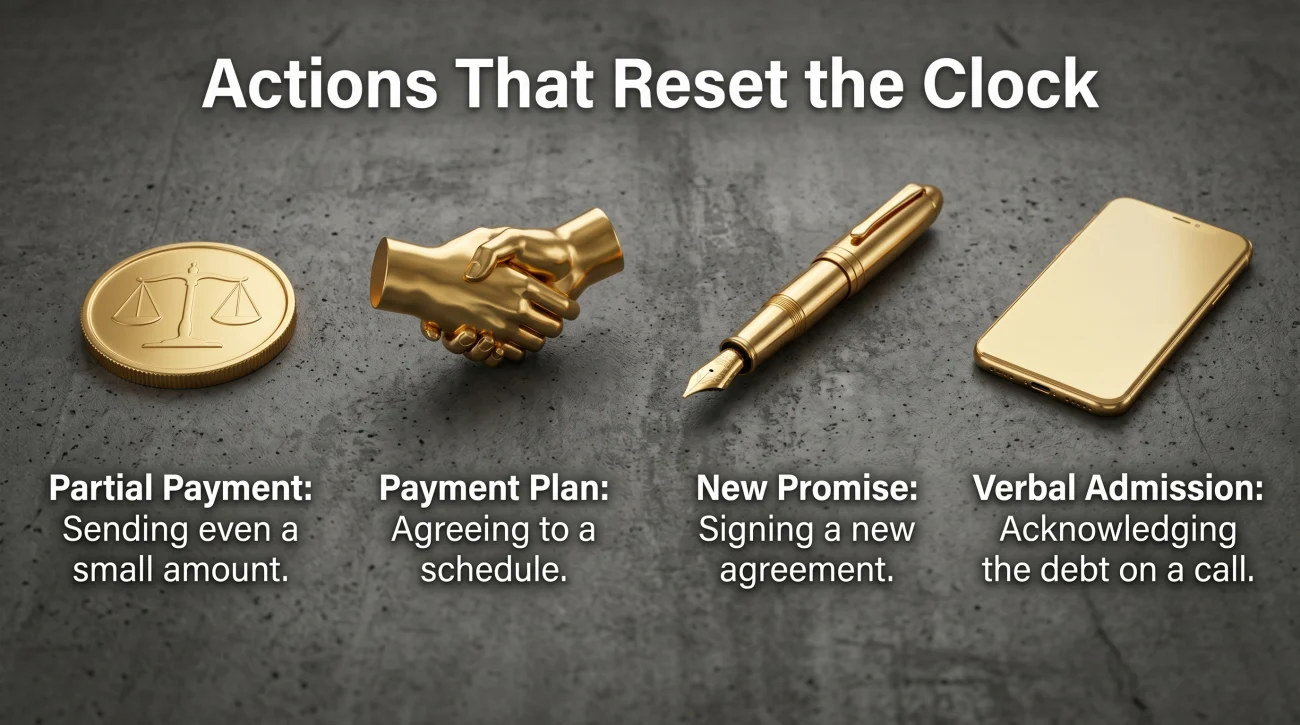
Depending on your state’s laws, the following actions can restart the statute of limitations, destroying your ability to use the defense:
- Making a partial payment on the old debt.
- Agreeing to a formal payment plan.
- Signing a new written promise to pay.
- In some states, simply acknowledging verbally that the debt is yours and you intend to pay it.
⚠️ Warning: Never make a “small payment” to a collector on an old debt until you know your state’s SOL rules. A $5 payment on a $5,000 time-barred debt gives the collector the legal right to sue you for the remaining $4,995 for another several years.
What the Court Does When You Prove the SOL Has Expired
Filing your Answer with the SOL defense is just the first step. Months may pass before you reach a hearing or a motion for summary judgment. When that day comes, the dynamics of the courtroom change dramatically because the burden of proof shifts.
You do not need to hire an expensive forensic accountant to make your case. You just need to show the judge exactly when the account went delinquent. Bring copies of your old bank statements showing your final payment, or bring a copy of your credit report showing the “Date of First Delinquency” or the “Date of Last Activity.”
In most jurisdictions, once you assert that the debt is time-barred and present basic evidence of your last payment date, the burden falls entirely on the debt collector to prove the clock has not expired. They must produce accounting records showing a more recent payment that reset the timeline. If they cannot produce this proof, their case collapses.
The SJ Consumer Law Center in California confirms this reality plainly: “The statute of limitations is an absolute defense – the court must dismiss a case if the debt is past the statute of limitations.” It is not a negotiation. It is not up to the judge’s discretion. An expired SOL is a complete bar to recovery.
What Happens After the Case Is Dismissed?
Getting a lawsuit thrown out is a major victory, but readers often have two immediate questions afterward: “Is it off my credit report?” and “Can they sue me again?”
If the judge dismisses the case based on an expired statute of limitations, it is usually dismissed “with prejudice,” meaning that specific collector cannot refile a lawsuit against you for this debt. However, winning the lawsuit does not automatically erase the account from your credit report. The credit reporting period (typically 7 years from the date of first delinquency) is entirely separate from the legal statute of limitations. The debt may still appear on your report until that 7-year window closes naturally.
There is also a powerful offensive move you can make after the dismissal. If a debt buyer sued you on a debt they *knew* was time-barred, they likely violated the Fair Debt Collection Practices Act (FDCPA). Suing on a time-barred debt is a strict liability violation. This means the tables turn, and you might actually have grounds for an FDCPA counterclaim or a separate lawsuit against the collector for damages.
Signs You Need to Assert the SOL Defense Immediately
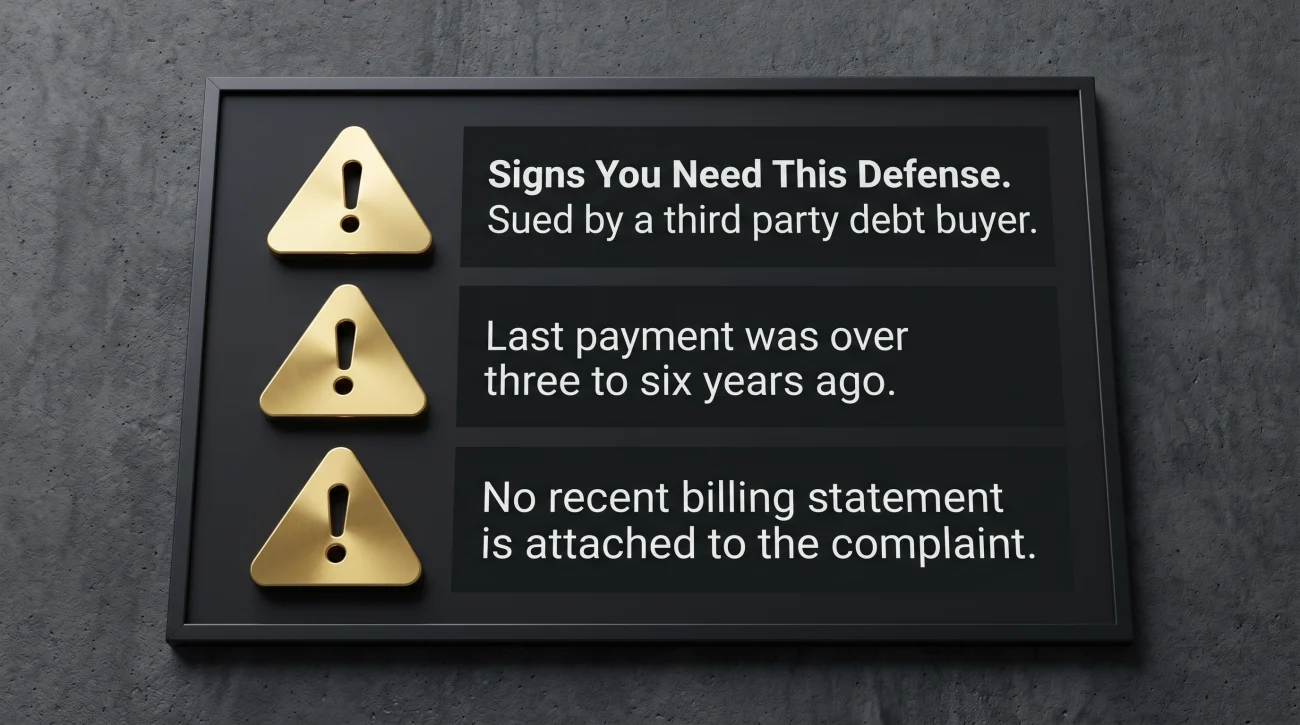
Figuring out your exact legal standing when a process server hands you a stack of papers is overwhelming. Before you panic or assume you have to empty your savings account to settle, look closely at the timeline. You need to act immediately and prepare this specific defense if your situation meets any of these criteria:
- The complaint is from a third-party debt buyer you don’t recognize, not the original bank you did business with.
- Your last payment on the account was more than 3 to 6 years ago (depending on your state’s laws).
- You can document the date of your last payment using old bank records or a recent credit report.
- The collector’s complaint does not attach a recent billing statement, which is often a sign of challenging a debt buyer with no original contract or recent activity.
If these signs are present, you likely have a strong path to dismissal. However, calculating exact legal deadlines can be tricky. If the debt balance is large, or if you are unsure how to calculate your state’s exact expiration date, getting professional eyes on your response is the safest move. I highly recommend consulting a debt lawsuit attorney who can ensure your affirmative defenses are locked in tight before your court deadline passes.
Final Thoughts on Fighting Old Debt
The statute of limitations is arguably the most powerful weapon a consumer has against the debt collection industry. It strips the collector of their ultimate threat: the power of the court. But the legal system is designed to favor those who know the procedural rules.
A debt collector will never voluntarily tell you the debt is too old to sue over, and a judge will rarely dig through the file to dismiss it out of kindness. The responsibility rests entirely on your shoulders to calculate the dates and formally present the argument on paper. If you take the time to raise it properly, you force the debt buyer to play by the rules – and when it comes to old, recycled debt, the rules are very much on your side.
❓ FAQ
🗓️ How do I use the SOL defense in a debt lawsuit?
You must include it in the “Affirmative Defenses” section of your written Answer filed with the court. State clearly that the debt is time-barred because the applicable statute of limitations has expired since your last payment.
⚖️ What happens if I forget to raise the SOL in my Answer?
If you fail to plead the SOL as an affirmative defense in your written Answer, you generally waive the right to use it. The court will allow the lawsuit to proceed, and the collector can win a judgment even if the debt is ten years old.
⏱️ When does the statute of limitations clock actually start?
For most consumer debts like credit cards, the clock starts on the date of your last payment, or the date the account first went into default and was never brought current again.
🛑 Can a debt collector still sue me if the SOL has expired?
Yes, they can file the lawsuit. It is not physically impossible for them to file the paperwork. It is up to you to raise the expired SOL as a defense to get the case dismissed. However, suing on a known time-barred debt violates federal law.
📝 Is a general denial enough to stop a debt lawsuit?
No. A general denial forces the collector to prove you owe the debt, but it does not address the age of the debt. You must include affirmative defenses, like the statute of limitations, separately in your response.
💸 Does making a small payment restart the SOL clock?
In almost all states, yes. Making any payment, no matter how small, or making a written promise to pay an old debt, resets the statute of limitations clock back to day one.
What each stage of litigation requires and where your leverage sits.
- What the lawsuit process looks like from summons to judgment
- What to file, when to file it, and what happens if you do not
- The legal arguments that can defeat a debt collection lawsuit
- What a default judgment allows collectors to do and how to fight one
- How to negotiate a resolution once litigation has started
Once judgment is entered, collectors gain tools they did not have before.
- The FDCPA violations collectors commonly commit during the collection process
- How to respond to a debt lawsuit and what defenses are available to you
- How a judgment becomes a garnishment order on your paycheck
- When a collector uses a judgment to freeze your bank account instead
- How to settle before the judgment turns into something harder to stop
Disclosure: The content on this site reflects direct experience inside the debt collection industry and is grounded in federal law and regulation. It is informational in nature. Reading it does not constitute legal advice and does not create any professional relationship. If you are dealing with a lawsuit, a judgment, or a legal deadline, consult a licensed attorney in your state before acting.