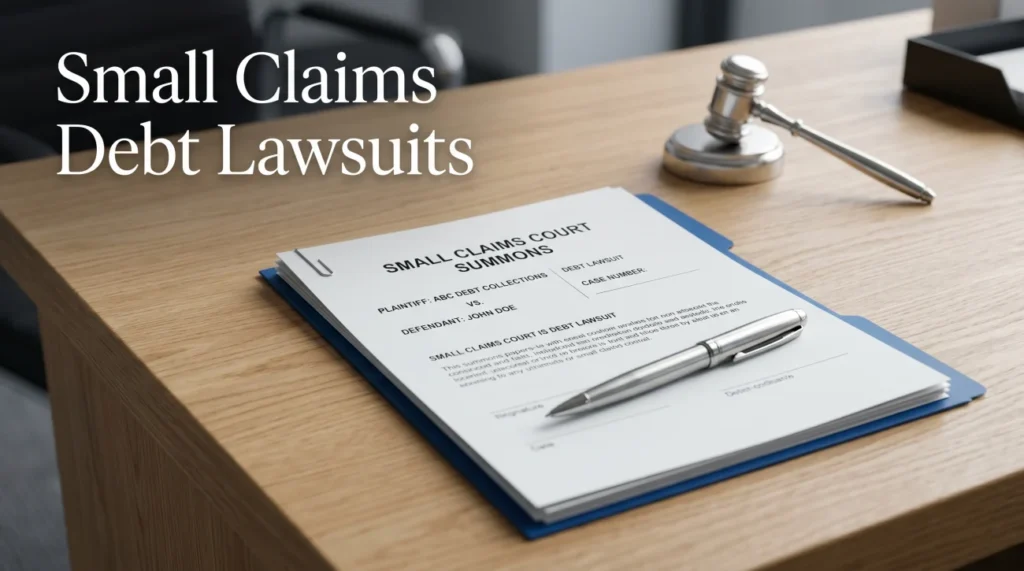
- Most debt collection lawsuits are filed in small claims or justice courts because the filing fees are low and debt buyers expect you not to show up.
- Submitting a written response forces the debt buyer to prove their case with actual documentation, shifting the burden of proof back where it belongs.
- Small claims court is informal, but you still must respond in writing before the deadline. Deadlines in these courts are often as short as 14 days.
The Reality of Being Sued for Debt in Small Claims
When a process server hands you a stack of legal papers, your mind immediately goes to television courtrooms. You picture a jury, a judge with a gavel, and high-priced corporate lawyers ready to tear apart your finances. You imagine a process that is going to cost you thousands of dollars just to participate in.
In my years working inside third-party collection agencies and a national debt buyer, I saw how these cases actually play out. The truth is far less dramatic. Most debt collection lawsuits are not filed in standard civil courtrooms. They are filed in small claims court, justice court, or magistrate court. This is not an accident. It is a highly calculated business decision.
Debt buyers file in small claims specifically because the procedures are fast, the filing costs are minimal, and they know the vast majority of consumers will be too intimidated to respond. They are counting on your fear of the legal system to secure a default judgment. Once you understand why they chose this specific legal venue, the process becomes much less intimidating.
You do not need a law degree to defend yourself in small claims court. You just need to understand the rules of engagement and recognize that showing up is your biggest advantage.
The Insider Math: Why Debt Buyers Choose Small Claims
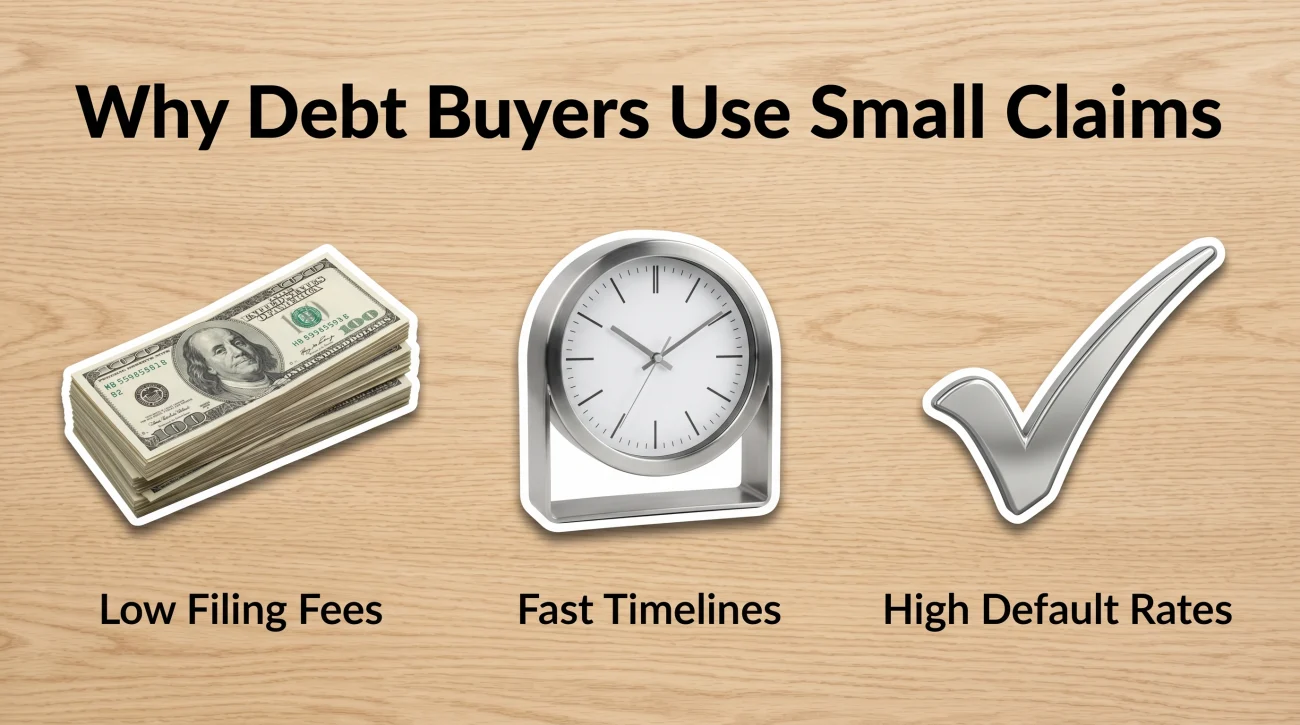
To understand what is happening with your lawsuit, you have to look at it from the desk of the collector’s attorney. When I reviewed account portfolios for litigation, we did not look at them as individual human stories. We looked at them as a numbers game.
A debt buyer purchases a portfolio of thousands of old credit card accounts for pennies on the dollar. They then hand a batch of these accounts to a local law firm. The law firm has to decide where to file the lawsuits.
If they file in general civil court, the filing fee might be $250 per case. The evidentiary rules are strict. The timeline is long. If they file in small claims or justice court, the filing fee might only be $40 to $80. The rules are relaxed, and the timeline is incredibly fast.
“During my time at a national debt buyer, we routinely packaged accounts for local litigation firms in batches of 100 or more. The firm would file them all in the local justice court. We fully expected 80 of those 100 people to never respond, handing us 80 default judgments for minimal effort. The 20 people who actually fought back were the anomalies.”
Filing 100 cases at $50 each costs the firm $5,000. If 80 people fail to respond, the firm secures 80 default judgments. If the average balance is $2,000, they just secured $160,000 worth of garnishable judgments for a $5,000 investment. This is why small claims court is the engine of the debt buying industry.
The entire model depends on you not responding. When you file a written answer, you instantly become the exception in their calculation. You force them to spend time and resources on a file they expected to win automatically.
Often, that alone is enough to change their strategy. But you only get to disrupt their model if you act before their clock runs out. This brings us to the most critical part of the process: timing.
Signs You Need to Act Immediately on a Small Claims Summons
The most dangerous thing about a small claims lawsuit is the accelerated timeline. Readers frequently assume they have a month to figure things out, only to discover they have already lost by default. The confusion over court names and deadlines is exactly where consumers lose their leverage.
You need to take immediate action if you notice any of the following signs on your paperwork:
- ⚠️ The court name on the summons contains the words Justice Court, Magistrate Court, JP Court, or Small Claims Division.
- ⚠️ The response deadline printed on the summons is 14 days or less. Some justice courts have incredibly short windows compared to general civil courts.
- ⚠️ The complaint is suspiciously thin, often just a page or two, and references an “account stated” rather than attaching your original signed credit agreement.
- ⚠️ You do not recognize the plaintiff’s name at all, which means it is a third-party debt buyer who purchased the account long after you stopped paying.
- ⚠️ You have already been sitting on the paperwork for a week, hoping the problem would resolve itself.
If your deadline is approaching rapidly, if the balance is uncomfortably large, or if you believe the collector violated federal laws during their previous phone calls, consulting a professional to evaluate your defense options is often the safest move to protect your income from garnishment.
How Small Claims Court Benefits the Consumer
While debt buyers love small claims court for its speed and low costs, the venue also provides distinct advantages to you as a defendant. The system is explicitly designed for people who do not have legal representation.
An Informal Environment
There is no jury in a small claims or justice court. You will not have to stand at a podium and deliver a dramatic opening statement. In many jurisdictions, the hearing takes place in a small room across a conference table from a judge or magistrate. The judge’s primary goal is to get to the basic facts of the dispute quickly and efficiently.
You are allowed to speak in plain English. You do not need to memorize Latin legal phrases or cite complex case law. If you want to argue that the debt is too old to be collected, you simply tell the judge the date of your last payment and state that the statute of limitations has expired.
The Evidence Standard and the Spreadsheet Problem
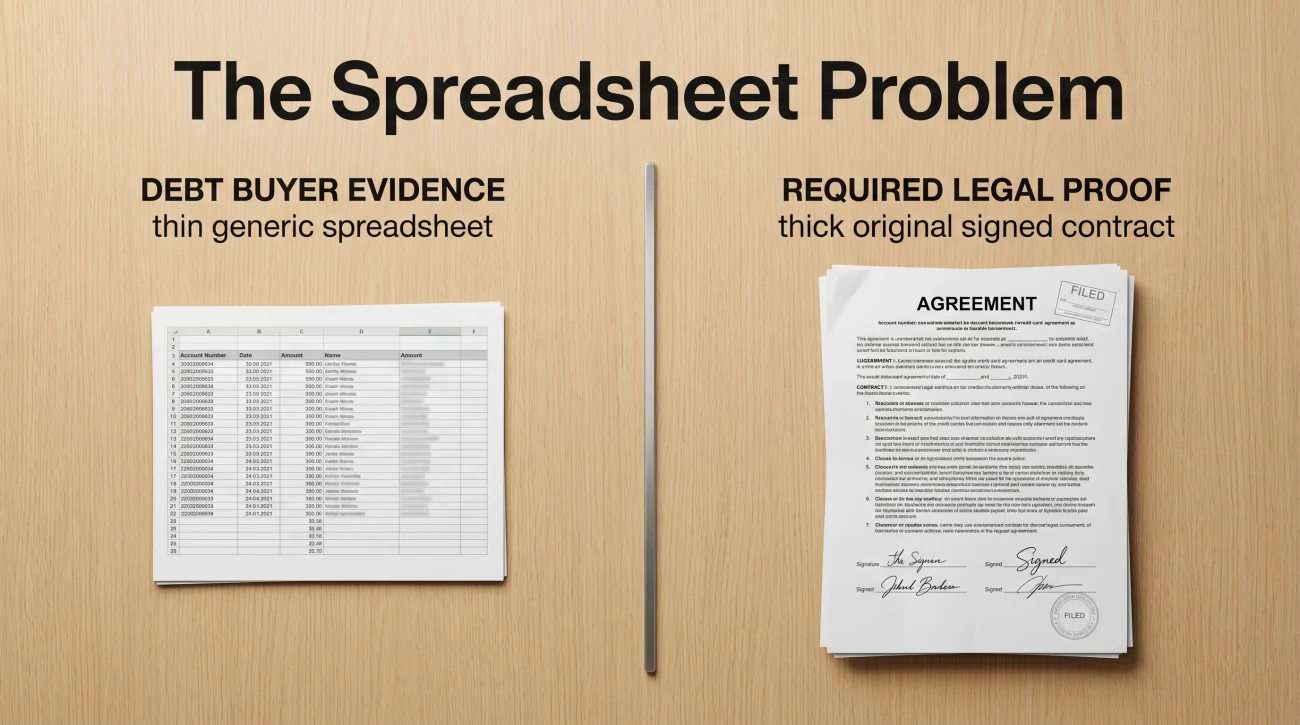
Because the rules of evidence are relaxed, debt buyer attorneys often show up to small claims court with very little documentation. They frequently bring nothing more than a generic affidavit signed by their own employee and a single line from a spreadsheet showing your name and a balance.
This is where you have power. From the inside, we knew our documentation was thin on these bulk portfolios. When defendants actually challenged the evidence, judges routinely rejected our generic spreadsheets. A printout with your name on it is not a contract, and an affidavit signed by a debt buyer’s employee does not prove an unbroken chain of title from the original bank.
Telling the judge “I don’t think I owe this much” without challenging their documents. The judge may just accept the collector’s spreadsheet because you admitted the debt exists.
Telling the judge “The plaintiff has only provided a spreadsheet created by their own company. They have not provided the original signed agreement or a complete chain of title to prove they own this specific account.”
When you calmly point out that the collector has no original documentation, judges in small claims courts frequently rule in the consumer’s favor or force the collector to dismiss the case.
What Remains the Same in Small Claims Court
The simplified procedures of small claims court do not change the legal weight of the outcome. A judgment from this venue is just as dangerous as one from the highest civil court in your state.
The Threat of Default Judgment
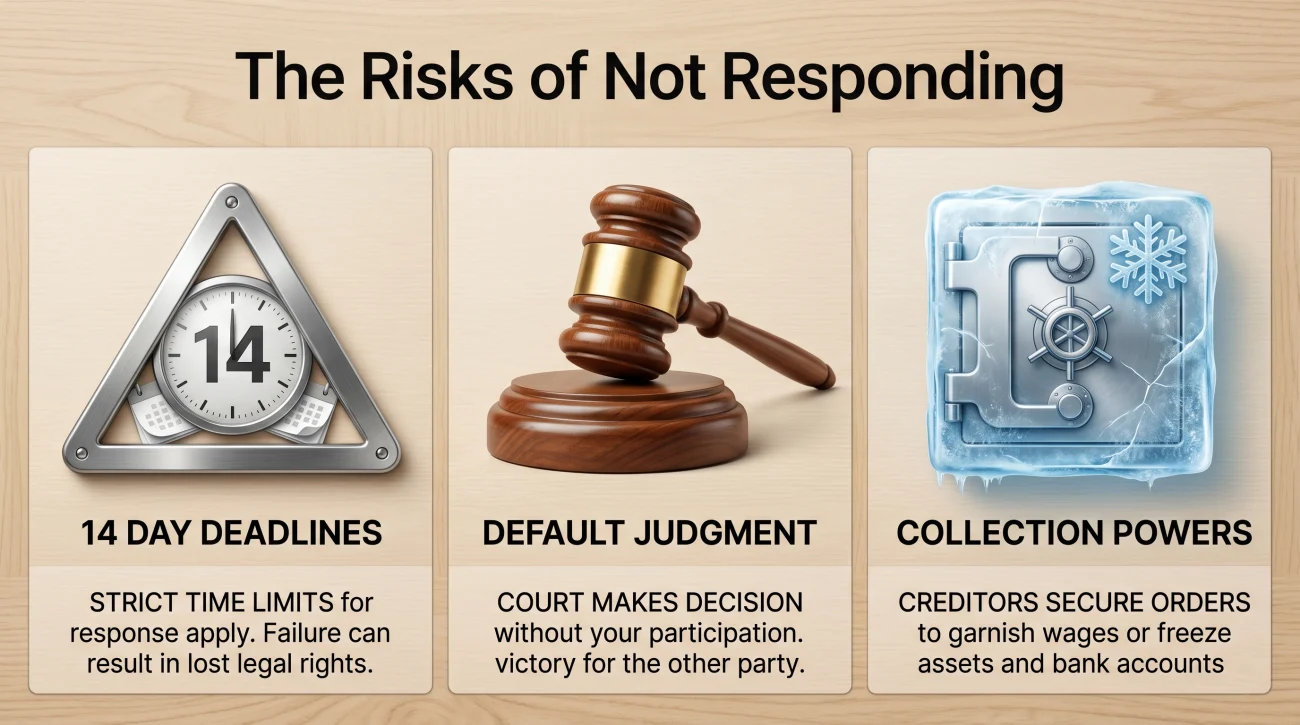
The most important rule applies everywhere: if you do not respond, you lose. A default judgment from a justice of the peace gives the collector the exact same legal authority to garnish your wages, freeze your bank accounts, and place liens on your property.
You cannot simply call the court and say you disagree. You must file a formal, written document. If you are unsure how to start that process, you need to understand filing your official written response before your time runs out.
Strict Deadlines
The informal setting does not mean flexible deadlines. While a standard civil court might give you 30 days to answer a complaint, many justice courts give you only 14 days from the moment you are served.
📌 Note: The clock starts ticking the day the papers are handed to you or legally delivered to your home, not the date printed at the top of the document. You must physically look at the summons to find your exact deadline.
If you just realized your 14-day window closed yesterday, do not assume it is over. You may still be able to file a Motion to Vacate a default judgment if you act immediately. Courts will sometimes set aside a default if you can prove excusable neglect (like a medical emergency) or improper service (the papers were given to the wrong person).
Your Legal Defenses
Every defense available to you in civil court is available to you in small claims. If the debt is past the statute of limitations, or if you are a victim of identity theft, those defenses work just as well here. Furthermore, if the collector violated the Fair Debt Collection Practices Act (FDCPA) by harassing you, calling your employer, or threatening arrest before the lawsuit, you can often file a counterclaim. This means you are actually suing them back within the same case. Raising a valid counterclaim creates immediate financial risk for the collector and often forces a favorable settlement, though you will likely need an attorney to execute this maneuver properly.
How to Handle the Small Claims Process
Navigating this venue requires preparation, but it is entirely manageable for the average consumer. Most people who show up and assert their rights do surprisingly well.
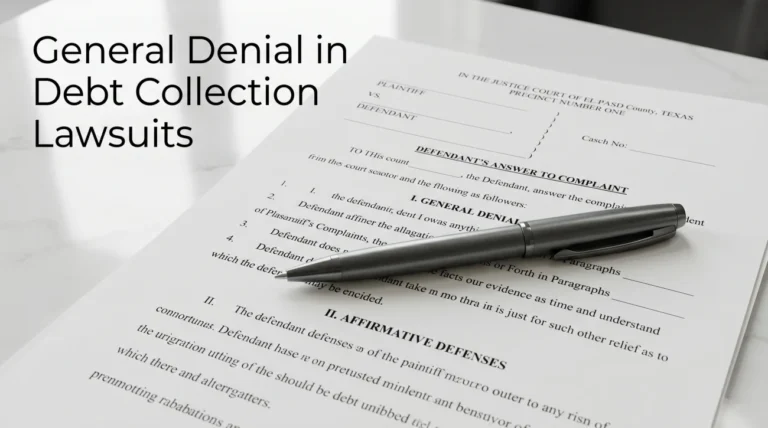
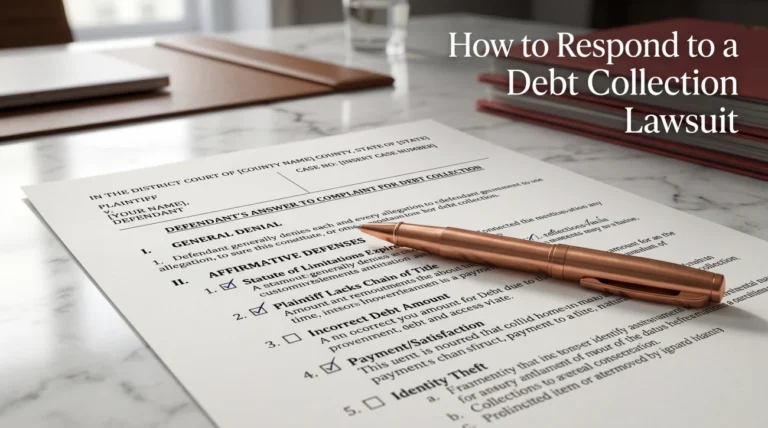
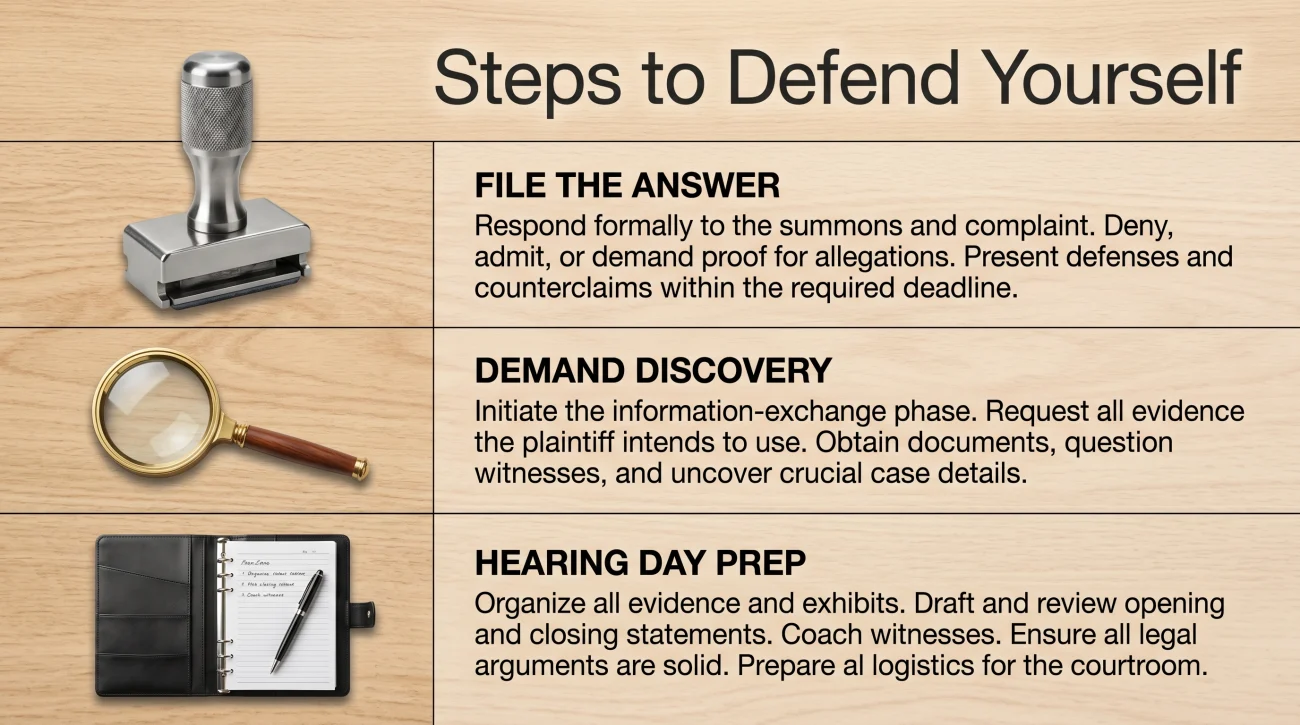
If you are planning on defending yourself without legal representation, your first step is to file the Answer. Many small claims courts have simple, fill-in-the-blank Answer forms available at the clerk’s office or on the court’s website. You check the box that says you deny the claim, list your defenses, and file it with the clerk.
The Pre-Hearing Strategy: Discovery and Negotiation
Filing the Answer is just the beginning. Between filing and your court date, you have a window to demand proof. Even in small claims, many states allow you to request “discovery.” This means you can send a formal request demanding the collector produce the original signed contract and the complete chain of assignment documents before the hearing.
Because finding these documents is expensive and time-consuming for a debt buyer, simply asking for them often triggers a settlement offer. If you know their documentation is weak, this is the time to offer a settlement for pennies on the dollar, often 20% to 30% of the balance, in exchange for a dismissal and a “pay-for-delete” agreement on your credit report.
Hearing Day Psychology
If the case proceeds to a hearing, preparing for that day does not require building a massive legal binder. It requires knowing what to say and when to stop talking.
- Bring three copies of your filed Answer.
- Bring any account statements or payment confirmations you have.
- If arguing the debt is too old, bring proof of the date of your very last payment.
- Bring a notepad and pen.
- Write down your two or three main defenses on a single sheet of paper so you do not forget them when speaking to the judge.
When you arrive, the collector’s attorney will likely pull you aside in the hallway before you see the judge. They will try to pressure you into signing a consent judgment or a settlement agreement right there in the hall. This is a standard tactic. They do this because they know their documentation is weak and they do not want to stand in front of the judge with you. You have the right to politely decline their hallway offer and tell them you prefer to let the judge hear the case.
When you step into the room, remember that the judge is just looking for facts. You do not need to sound like a lawyer. The exact words you use matter less than the substance of your argument. What you need to communicate is something like this: “I dispute this debt, and the plaintiff has not provided the original signed contract or proven they legally own this account.” Do not let the collector’s attorney interrupt or intimidate you. They are relying on your nervousness. For more details on this dynamic, you should research what to expect on the day of your hearing.
💡 Pro Tip: If the collector’s attorney realizes you are prepared to challenge their evidence and you will not back down in the hallway, they will frequently ask the judge to dismiss the case voluntarily rather than risk a ruling against them on the record.
Final Thoughts on Small Claims Debt Lawsuits
Finding out your case is in small claims court should actually bring you a sense of relief. It means the system is accessible to you. The debt buyers rely heavily on the intimidation factor of legal documents to secure their revenue, but their operational weakness is exposed the moment you step into the courtroom.
If the judge dismisses the case because the collector had no evidence, your immediate problem is solved. However, you must pay attention to how it was dismissed. If the case is dismissed “without prejudice,” the debt buyer might simply package your account and sell it to another collection agency down the road. Keep your court documents, your filed Answer, and the dismissal order in a safe place. If a new collector pops up two years from now, you will have the exact paperwork needed to shut them down instantly. If you need more context on how this fits into the bigger picture, start by understanding the broader debt lawsuit process.
❓ FAQ
⚖️ Do I need a lawyer for small claims court against a debt collector?
No. Small claims courts are designed for people without lawyers. The procedures are simplified. However, if the balance is very large or you believe your rights under the FDCPA were violated, consulting an attorney is highly recommended.
⏰ How long do I have to answer a small claims debt lawsuit?
It depends entirely on your state and the specific court, but 14 to 20 days is very common in justice and magistrate courts. Look directly at the summons document you were served; the exact deadline will be printed there.
📄 What happens if the debt collector only brings a spreadsheet to small claims?
If you challenge it, a spreadsheet is often not enough. You must point out to the judge that the plaintiff has failed to provide the original signed credit agreement or a proper chain of title proving they own the account.
🛑 Can a default judgment from small claims court garnish my wages?
Yes. Once the court enters the judgment, the collector can take that legal order to your local sheriff or directly to your employer to initiate the withholding process. The court type does not limit their collection power.
🗣️ Will I have to argue in front of a jury?
No. Small claims and justice courts resolve cases quickly without juries. You will present your defenses directly to a single judge or magistrate, who will usually make a decision on the spot based on the documents provided.
🤝 Should I talk to the collector’s attorney in the hallway before the hearing?
They will likely approach you to negotiate a settlement or ask you to sign a consent judgment. You can listen to their offer, but you are never obligated to agree. Do not sign anything in the hallway if you are unsure.
📅 Can I use the statute of limitations defense in small claims?
Yes, and it is one of the strongest defenses you have. If the legal time limit to sue has expired, the case generally cannot proceed. You must raise this clearly in your written Answer and bring proof of your last payment date to court.
🏢 Is justice court the same thing as small claims?
In many states, yes. Justice of the Peace (JP) courts, magistrate courts, and municipal courts often serve the function of small claims courts, handling disputes below a certain dollar threshold with simplified rules.
✉️ What if I ignore a small claims court summons?
If you ignore it, the debt collector will ask the judge for a default judgment. Because you are not there to dispute the amount or the evidence, the judge will almost certainly grant it, giving the collector full collection powers.
📉 Why do debt buyers sue for such small amounts in these courts?
Because the filing fees are very low. A debt buyer can afford to file a lawsuit for a $600 debt if the court fee is only $40, especially knowing that 80 percent of people will simply default and let them win.
What each stage of litigation requires and where your leverage sits.
- What the lawsuit process looks like from summons to judgment
- What to file, when to file it, and what happens if you do not
- The legal arguments that can defeat a debt collection lawsuit
- What a default judgment allows collectors to do and how to fight one
- How to negotiate a resolution once litigation has started
Once judgment is entered, collectors gain tools they did not have before.
- The FDCPA violations collectors commonly commit during the collection process
- How to respond to a debt lawsuit and what defenses are available to you
- How a judgment becomes a garnishment order on your paycheck
- When a collector uses a judgment to freeze your bank account instead
- How to settle before the judgment turns into something harder to stop
Disclosure: The content on this site reflects direct experience inside the debt collection industry and is grounded in federal law and regulation. It is informational in nature. Reading it does not constitute legal advice and does not create any professional relationship. If you are dealing with a lawsuit, a judgment, or a legal deadline, consult a licensed attorney in your state before acting.