- Filing an FDCPA counterclaim allows you to sue the debt collector back within the same lawsuit they filed against you.
- If the collector violated federal law during the collection process, you can demand actual damages, up to $1,000 in statutory damages, and attorney fees.
- A counterclaim drastically shifts the settlement leverage, as the collector now faces financial liability and the risk of paying your legal costs.
- You must assert your counterclaim within one year of the violation occurring, regardless of when the lawsuit was filed.
Turning the Tables on a Debt Collector
Most people reading a debt collection summons feel like they are already backed into a corner, assuming the lawsuit is a one-way street. But if the agency crossed the line before they filed those papers, the dynamics of an FDCPA counterclaim debt collection lawsuit change entirely. You are not just a defendant anymore. You have the ability to go on the offensive.
During my years working inside third-party collection agencies, I watched how the tone of a file changed the moment a consumer recognized their rights. A collector’s goal is to maximize recovery while minimizing cost. Filing a lawsuit is a calculated business decision. But when a consumer files a counterclaim against debt collector operations, that math breaks. Suddenly, the agency is no longer just spending a few hundred dollars to get a default judgment. They are actively defending themselves against federal violations that could cost them thousands.
This guide will walk you through what happens when a debt collector violated FDCPA counterclaim rules, how you can use their illegal tactics as leverage, and what you need to do to protect your rights in court. Understanding this process shifts the power back to where it belongs.
What Exactly Is a Counterclaim in a Debt Lawsuit?
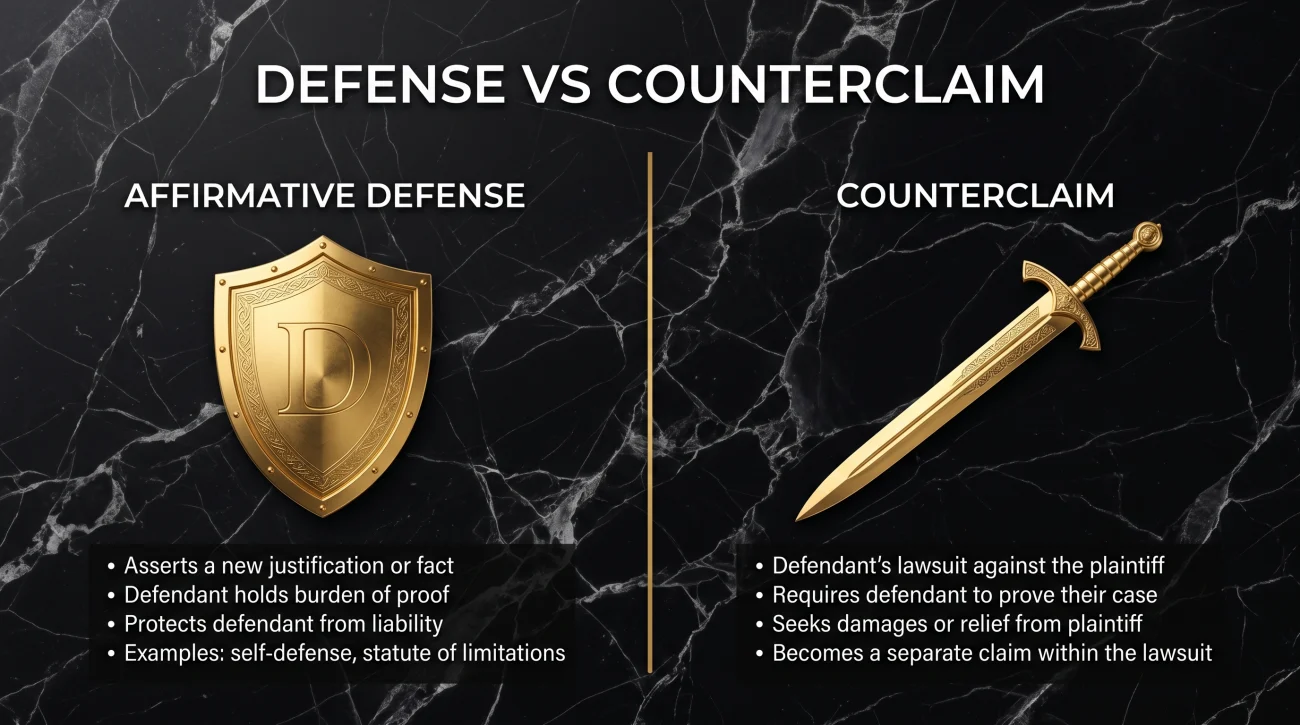
To understand how to use this tool, we first have to separate a defense from a counterclaim. Many people confuse the two, but they serve completely different legal functions in the courtroom.
A defense is your explanation for why you do not owe the money the collector is asking for. For example, if you are challenging an inflated balance or unauthorized fees, or arguing that the statute of limitations has expired, you are using an affirmative defense. A defense acts as a shield. It says, “Even if you have the right person, your claim is legally invalid.”
A counterclaim is a sword. When you file an FDCPA counterclaim debt lawsuit, you are stating that the plaintiff (the debt collector) broke the law and now owes you money for the damages they caused. You are bringing your own lawsuit, but you are doing it inside the existing case rather than starting a brand new one from scratch.
“Inside the agency, we processed thousands of accounts a month. We expected consumers to either ignore the lawsuit or argue they couldn’t pay. When an Answer arrived containing an FDCPA counterclaim, it was immediately pulled from the standard workflow and sent to compliance or the managing attorney. It is one of the few things that forces a collection operation to hit the brakes.”
You can raise defenses and a counterclaim at the same time. In fact, it is common to argue that the collector cannot prove they own the debt while simultaneously suing them for harassing you over it. If you need help structuring your defensive arguments, I recommend reviewing the core strategies for building your affirmative defenses before drafting your documents.
Which Violations Support a Debt Collection FDCPA Violation Counterclaim?
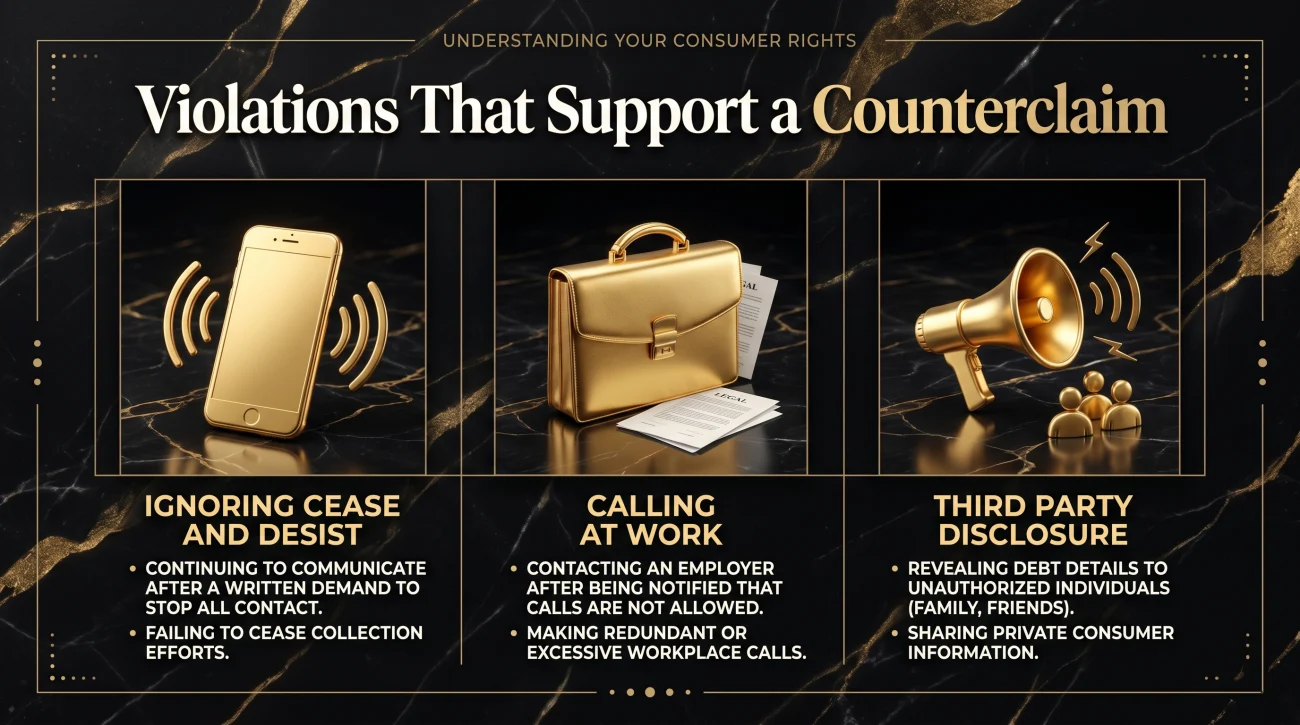
The Fair Debt Collection Practices Act (FDCPA) is a strict liability statute. This means that if a collector violates the rules, they are liable, even if they did not mean to break the law. You do not have to prove malicious intent. You only have to prove that the violation happened.
From an insider perspective, not all violations are created equal when it comes to settlement leverage. The violations collectors fear most are the ones that leave a clear, undeniable paper trail. If you experienced any of the following behaviors, you may have grounds to sue debt collector back counterclaim style:
- 📞 Calling after a written cease and desist: If you sent a letter telling them to stop communicating with you, and they called you anyway, that is a violation. This is highly actionable if you kept your certified mail receipt as proof.
- 🏢 Calling at work: If you told the collector that your employer does not allow personal calls, and they continued to call your workplace. Agencies hate defending this because workplace phone records and HR complaints serve as hard evidence.
- 🛑 Threatening arrest or jail: Debt is a civil matter. It is illegal for a collector to imply or state that you will go to jail or face criminal charges. While harder to prove on unrecorded calls, saving threatening voicemails makes this a slam dunk.
- 🗣️ Third-party disclosure: If the collector discussed your debt with your neighbor, boss, or family members, they violated your privacy rights. Having a witness willing to confirm the call instantly strengthens your case.
- ⏱️ Suing on time-barred debt: If the collector filed a lawsuit on a debt they know is past the statute of limitations, this is an actionable violation easily proven by your credit report or last payment date.
- 📄 Failing to provide a validation notice: Collectors must send a written notice within five days of their initial communication detailing your right to dispute the debt. Failing to send this is a common operational failure that is difficult for them to justify in court.
If you believe the collector does not even have the legal right to sue you in the first place, you should read up on attacking their chain of title and standing, as suing without legal authority can sometimes trigger its own FDCPA issues.
FDCPA Damages in a Debt Collection Lawsuit: What Can You Recover?
Filing a counterclaim is not just about making a point. It is about financial accountability. The law specifies exactly what you are entitled to demand when a debt collector violates your rights. Understanding these numbers is crucial when you are evaluating whether to file.
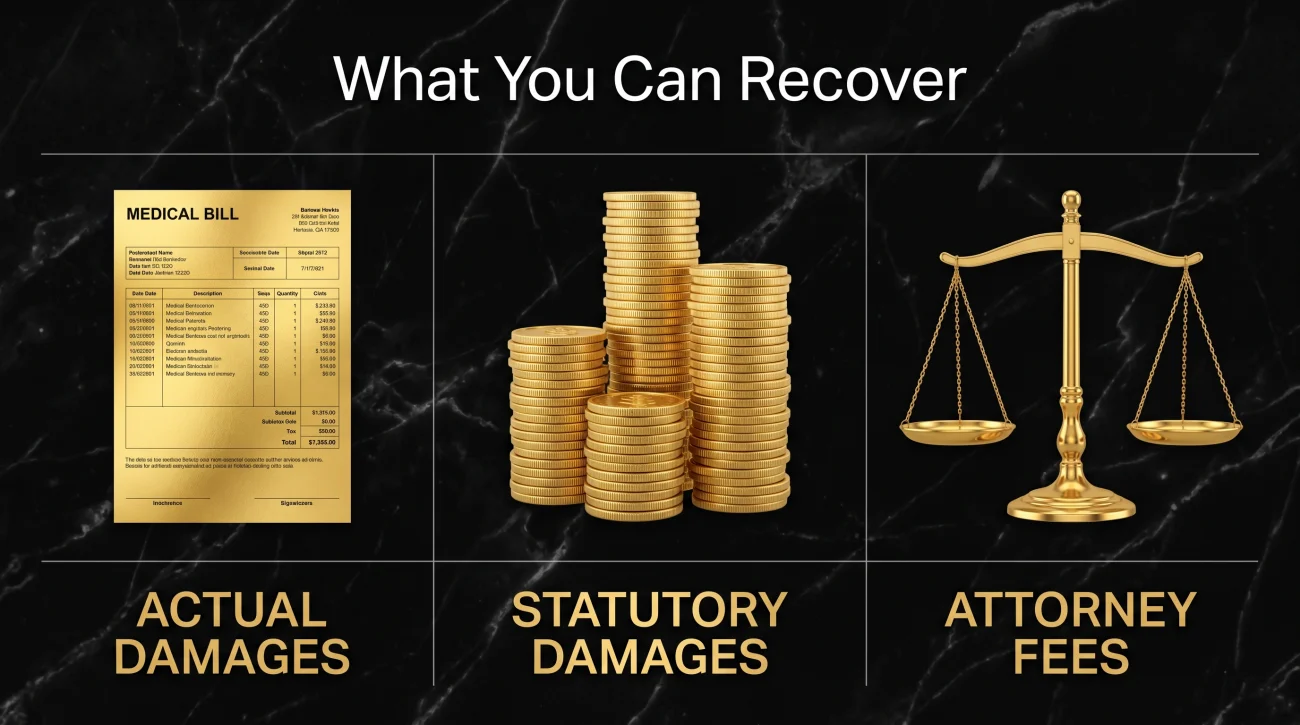
There are three main categories of FDCPA damages debt collection lawsuit plaintiffs face when a counterclaim is filed against them:
1. Actual Damages
These are the real, out-of-pocket costs you suffered because of the collector’s illegal behavior. Actual damages can be difficult to prove, but they are uncapped. If their illegal calls to your workplace caused you to be reprimanded or fired, your lost wages are actual damages. But actual damages go beyond direct financial loss. They can include the monetary value of the time you spent dealing with the harassment, out-of-pocket costs to change your phone number, or documented emotional distress and medical bills resulting from severe anxiety.
2. Statutory Damages
Because actual damages are hard to document, the FDCPA allows consumers to claim statutory damages of up to $1,000 per lawsuit. You do not need to prove that you lost a single penny to claim this money. You only need to prove that the violation occurred. It is important to note that this is up to $1,000 per lawsuit, not per violation. If the collector violated the law 15 times, your statutory damages under the FDCPA cap at $1,000, though other laws might stack on top of this.
3. Attorney Fees and Court Costs
This is the true nightmare for the collection agency. Under the FDCPA, a successful consumer is entitled to have their attorney fees and court costs paid by the debt collector. This means if your attorney bills $4,000 to defend you and pursue the counterclaim, the collector writes that check. This provision was specifically designed so that everyday consumers could afford to stand up to billion-dollar debt buyers.
💡 Pro Tip: The Telephone Consumer Protection Act (TCPA) is another powerful tool. If the collector used an auto-dialer or a pre-recorded voice to call your cell phone without your express consent, the TCPA allows for damages of $500 to $1,500 per call. These damages do not cap at $1,000 and can be added to an FDCPA counterclaim.
The Insider Reality: How a Counterclaim Shifts Settlement Leverage
The threat of having to pay your attorney fees on top of statutory and actual damages is exactly what alters the collector’s strategy. When you understand the financial mechanics of a collection law firm, you understand why a counterclaim is so effective.
Plaintiff’s attorneys in debt collection cases are typically volume litigators. They file hundreds of cases a week. They expect the vast majority to end in default judgments because the consumer simply does not show up. They operate on thin margins per case, relying on massive volume.
When you file a counterclaim, that volume model crashes into a wall.
The collection attorney now has to stop processing defaults. They have to call their client (the debt buyer or original creditor) and explain that the agency is now facing liability. They have to spend hours drafting responses to your claims. And hanging over their head is the fact that if they lose, they have to pay your attorney fees.
Key Point: The consumer attorneys at Ginsburg Law Group (Feb 2026) perfectly summarize this dynamic: “A violation of the FDCPA isn’t just a simple mistake. It’s a legal opening. Each violation gives you powerful leverage for a settlement.”
Collectors with FDCPA counterclaim exposure frequently settle aggressively. In many cases, a collector will offer a “walkaway” agreement, where they agree to dismiss their lawsuit against you, zero out the debt, and sometimes even write you a check for damages, just to make the liability disappear. If you want to understand how to get the case thrown out entirely, this is often the fastest path. Review the broader tactics on strategies to get the case thrown out for more context on dismissal strategies.
The One-Year Time Limit Trap
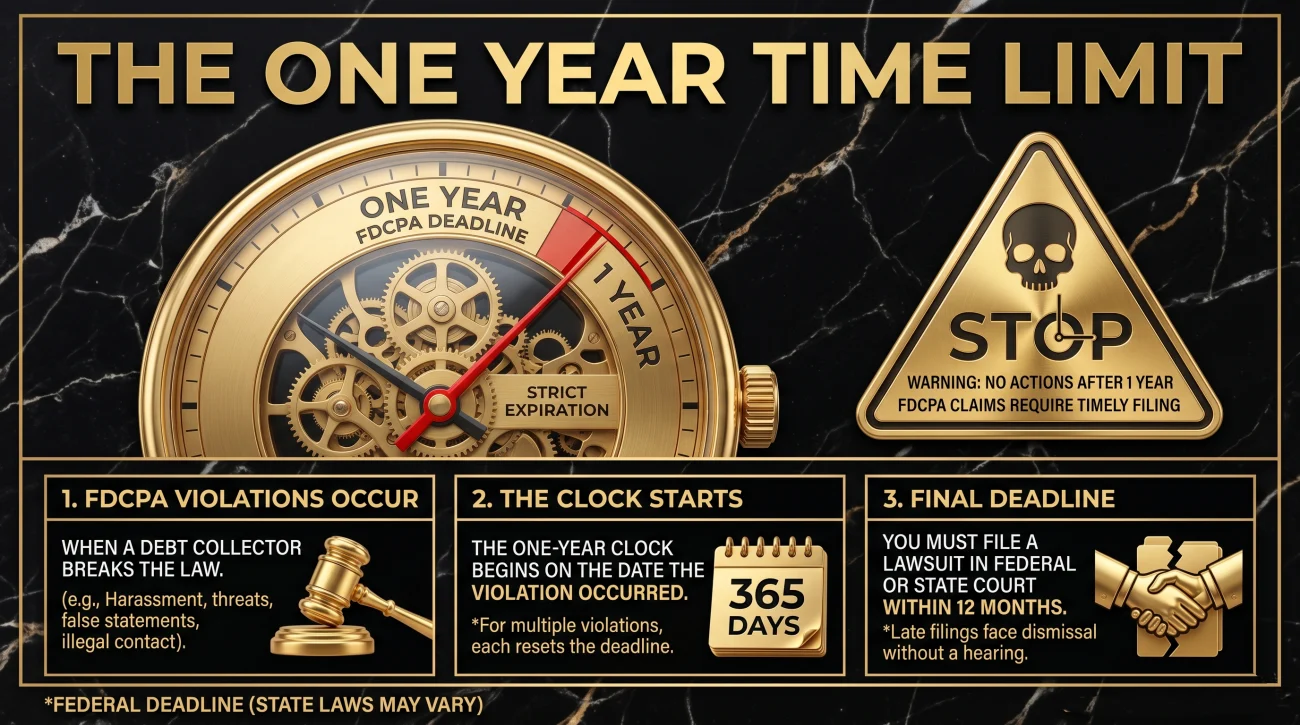
There is a strict deadline for bringing these claims. Under 15 U.S.C. § 1692k(d), you must file an FDCPA claim within one year from the date the violation occurred. This is a hard deadline.
The tricky part is that the clock on your counterclaim runs independently of the lawsuit clock. For example, if a collector threatened you with arrest in January, but they did not file their lawsuit until November, you only have a few weeks left to assert your counterclaim based on that January threat. If you wait until February of the following year to file your Answer, the collector’s lawsuit will still be valid, but your FDCPA counterclaim will be expired.
This is why you must evaluate the collector’s behavior immediately. If you suspect they crossed the line, start reviewing your call logs, voicemails, and letters the moment you are served.
Signs You Need to Act on Their Violations Immediately
It is easy to get so overwhelmed by the lawsuit that you ignore what the collector did to get there. But certain violations create undeniable leverage because they are easily proven. You are in a strong position to fight back right now if you recognize any of these urgency signals:
- You have a concrete paper trail: You sent a written cease and desist letter via certified mail, and you have call logs showing they ignored it and continued contacting you.
- Third-party witnesses exist: The collector called your employer, friends, or family members to disclose that you owe a debt. (Collectors fear this because it is hard to deny when others can testify).
- The one-year window is closing: The agency threatened you with arrest or garnished wages without a judgment months ago, and your deadline to file a claim under the FDCPA is fast approaching.
- Digital evidence of TCPA violations: You received automated, pre-recorded messages on your cell phone without consent, which leaves a clear digital footprint that can stack massive damages.
- The underlying lawsuit is fatally flawed: The agency is suing you for a debt that you can easily document passed the statute of limitations years ago, or they completely failed to send the mandatory validation notice.
If you possess this kind of hard evidence, you are holding the leverage. You do not have to handle a complex federal counterclaim on your own. Connecting with a professional can help you navigate the process; you can learn more about having a professional handle the litigation to ensure your rights are fully protected and the collector is held accountable before your window closes.
How to File FDCPA Counterclaim Paperwork
If you decide to handle the paperwork yourself or just want to understand the mechanics, you assert your counterclaim within the same document you use to respond to the lawsuit, which is called the Answer. You do not file a separate, brand new lawsuit in a different court.
Typically, the structure of your Answer document will follow a specific flow. First, you respond to the collector’s allegations (admit, deny, or lack of knowledge). Second, you list your affirmative defenses. Finally, you create a new section specifically designated for your counterclaim.
Here is an example of what that formatting often looks like in practice:
COUNTERCLAIM AGAINST PLAINTIFF
1. Defendant brings this counterclaim against Plaintiff for violations of the Fair Debt Collection Practices Act (15 U.S.C. § 1692 et seq.).
2. On or about [Date], Plaintiff’s agent contacted Defendant by telephone and stated [insert illegal threat or statement].
3. This communication was a direct violation of 15 U.S.C. § 1692e, which prohibits the use of false, deceptive, or misleading representation in connection with the collection of any debt.
4. As a result of Plaintiff’s violations, Defendant has suffered actual damages and is entitled to statutory damages of up to $1,000, plus reasonable attorney’s fees and costs pursuant to 15 U.S.C. § 1692k.
Keep in mind that court procedures vary heavily by jurisdiction. Filing a counterclaim often requires paying a separate filing fee, although you can request a fee waiver if you qualify based on income. Many consumers successfully navigate this process on their own, but when federal violations are involved, the stakes get high quickly.
Writing a long, emotional essay in your Answer about how mean the collector was to you on the phone, without citing specific dates or federal laws.
Stating clearly that on a specific date, the collector took a specific action that violated a specific section of the FDCPA, and demanding statutory damages as a result.
Final Thoughts on Suing the Collector Back
A debt collection lawsuit is designed to make you feel powerless. The system relies on defendants feeling too intimidated to fight back. But the law holds debt collectors to a strict standard of conduct, and when they fail to meet it, they open themselves up to significant financial risk.
Filing a counterclaim forces the collector to play by a different set of rules. It is no longer just about whether you owe a balance; it is about their illegal behavior. If a collector has crossed the line, recognizing those violations and utilizing them in your legal response is often the most effective way to protect your finances and reach a favorable resolution. If you believe the agency is still engaging in abusive behavior right now, take a moment to review how to start identifying illegal harassment tactics so you can build your case.
❓ FAQ
📞 Can I sue a debt collector if they already sued me?
Yes. You can file a counterclaim directly within the same lawsuit they filed against you. This allows you to address their FDCPA violations while defending against their claims simultaneously.
💰 How much money can I get from an FDCPA counterclaim?
You can recover any actual damages you suffered (like lost wages or medical bills), plus up to $1,000 in statutory damages per lawsuit. The collector may also be ordered to pay your attorney fees.
⏱️ How long do I have to file a counterclaim against a collector?
You have exactly one year from the date the FDCPA violation occurred. If you miss this window, you lose the right to sue for that specific violation, even if the lawsuit is still active.
🛑 Will filing a counterclaim stop the lawsuit against me?
It will not automatically stop the lawsuit, but it significantly changes the collector’s leverage. Many debt buyers will offer to dismiss their lawsuit entirely if faced with a strong counterclaim that exposes them to liability.
📱 What if they used robocalls to contact my cell phone?
If they used an automated dialing system or pre-recorded voice without your consent, they may have violated the TCPA. This can be added to your counterclaim and carries penalties of $500 to $1,500 per illegal call.
🗣️ Does a counterclaim work if I actually owe the debt?
Yes. Owing the debt does not give a collector the right to break federal law. You can still hold them accountable for FDCPA violations even if the judge ultimately decides the debt is valid. In many cases, the damages from a strong counterclaim (especially with attorney fees attached) can offset or completely wipe out the original balance you owed, forcing the collector to settle the entire matter just to walk away.
📄 How do I prove they violated the law?
You need documentation. Keep a detailed log of all phone calls, save all voicemails, print out your cell phone records, and keep copies of every letter the collector sends you or that you send to them.
🤝 Will the collector settle if I file a counterclaim?
Collectors are often highly motivated to settle when facing a counterclaim. Because they risk paying your attorney fees if they lose, settling the account and walking away is frequently their most cost-effective option.
🏢 Can I file an FDCPA counterclaim against the original creditor?
Generally, no. The FDCPA primarily applies to third-party debt collectors and debt buyers. However, some state laws mirror the FDCPA and apply to original creditors, so check your local consumer protection laws.
📝 Do I need an attorney to file an FDCPA counterclaim?
While you can file pro se (without an attorney), FDCPA counterclaims are complex federal matters. Because FDCPA attorneys often work on contingency (getting paid from the collector’s penalty), getting professional help is highly recommended and often costs you nothing upfront.
What each stage of litigation requires and where your leverage sits.
- What the lawsuit process looks like from summons to judgment
- What to file, when to file it, and what happens if you do not
- The legal arguments that can defeat a debt collection lawsuit
- What a default judgment allows collectors to do and how to fight one
- How to negotiate a resolution once litigation has started
Once judgment is entered, collectors gain tools they did not have before.
- The FDCPA violations collectors commonly commit during the collection process
- How to respond to a debt lawsuit and what defenses are available to you
- How a judgment becomes a garnishment order on your paycheck
- When a collector uses a judgment to freeze your bank account instead
- How to settle before the judgment turns into something harder to stop
Disclosure: The content on this site reflects direct experience inside the debt collection industry and is grounded in federal law and regulation. It is informational in nature. Reading it does not constitute legal advice and does not create any professional relationship. If you are dealing with a lawsuit, a judgment, or a legal deadline, consult a licensed attorney in your state before acting.