- Learning about a debt collection lawsuit for the first time through a frozen bank account or a wage garnishment often means you were a victim of “sewer service” or improper delivery of court papers.
- Process servers sometimes falsely certify that they delivered lawsuit papers when they actually dumped them or delivered them to an incorrect old address.
- You can uncover this by requesting the Affidavit of Service from the court clerk and checking it for physical discrepancies, unknown names, or incorrect locations.
- Proving you were never properly served can give you the legal grounds to vacate a default judgment, which unfreezes your accounts and forces the collector to start the process over.
The Shock of a Lawsuit You Never Knew Existed
Imagine waking up on a regular Tuesday, logging into your banking app to pay a utility bill, and seeing a zero balance. A red banner across the screen says your funds are restricted due to a legal levy. Or perhaps you receive your paycheck and notice a massive deduction, and your human resources department hands you a garnishment order from a court.
When you call the court to find out what is happening, the clerk tells you that a debt collector sued you six months ago and won a default judgment because you never responded. But you never received any court papers. No one knocked on your door. Nothing came in the mail. You had absolutely zero idea this lawsuit existed until your money was taken.
If you first learned a lawsuit existed when your wages were garnished or your bank account was frozen, you may never have been properly served. In the collection industry, we know this happens constantly. It is not an isolated clerical error. It is a documented phenomenon that has affected hundreds of thousands of people, and understanding how it works is your first step toward getting your paycheck back.
What Sewer Service Actually Is
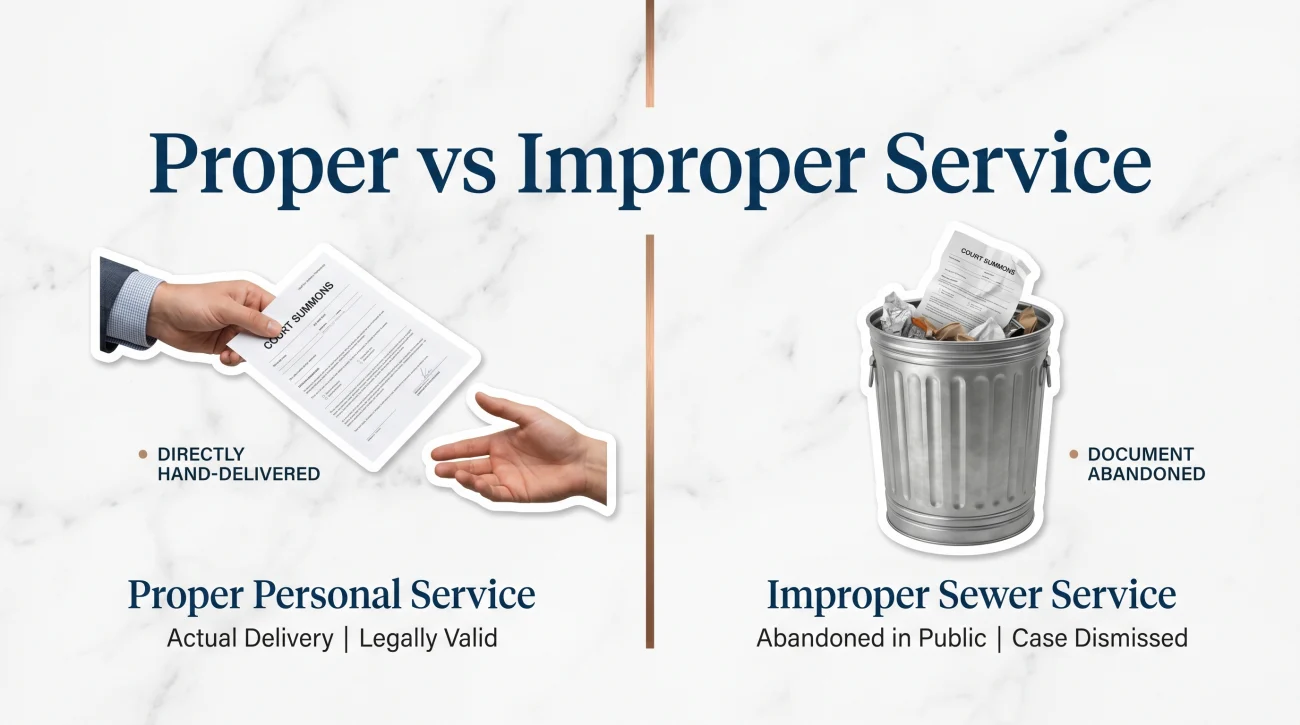
To understand how a judgment happens without your knowledge, you have to understand the mechanics of filing lawsuits at scale. Debt buyer law firms file thousands of lawsuits every month. To deliver the summons and complaint to each defendant, they hire third-party process serving companies. Process servers are typically paid per delivery. The faster they complete their route, the more money they make.
This volume-based pay structure creates a dangerous incentive. A documented practice in debt collection known as “sewer service” occurs when process servers falsely certify they served court papers when they actually did not. The term comes from the old practice of process servers literally throwing the paperwork down a sewer grate rather than spending the time trying to track down the defendant, then filing a fraudulent affidavit swearing the papers were delivered.
“When I reviewed account files at a national debt buyer, we relied completely on the affidavits returned by third-party process servers. The debt buyer itself has no idea if the server actually knocked on your door or just filled out a form from their car. The entire system operates on the assumption that the process server is telling the truth, which leaves a massive blind spot that heavily favors the collector.”
This is not a theoretical conspiracy. It is a matter of extensive public record. In New York, the practice was widespread enough that a massive class action lawsuit involving the law firm Mel Harris and Associates resulted in a $59 million settlement. More importantly for consumers, that settlement resulted in approximately 200,000 default judgments being vacated. Even with heavy regulations put in place after that settlement, a June 2025 investigation by New York Focus confirmed the practice persists. Process servers are still occasionally caught using GPS-spoofing apps or submitting logged service times that are physically impossible.
Why the System Rewards Improper Service
You might wonder why a law firm would tolerate process servers cutting corners. The answer lies in the economics of debt collection litigation. The debt buyer business model relies on default judgments. A defendant who does not know they are being sued cannot file a response.
If you are properly served and decide to file a response, the collector is forced to actually litigate the case. This requires them to locate your original account documentation and pay an attorney to attend a hearing. But if you never receive the papers, you miss the deadline. The court assumes you are ignoring the lawsuit, and no response equals an automatic default judgment.
A default judgment gives the collector incredible power. It grants them wage garnishment and bank levy authority without the collector ever having to prove the debt is valid in front of a judge. Knowing what happens after an answer is filed illustrates exactly what the collector avoids when a defendant never shows up. Improper service acts as a shortcut to profitability. Understanding exactly how process servers cut those corners starts with knowing what the rules actually require them to do.
What Proper Service Typically Requires
To successfully sue you, the plaintiff must follow strict rules designed to ensure you receive actual notice of the lawsuit. If they fail to follow these rules, the court lacks the legal jurisdiction to issue a judgment against you. While specific rules vary heavily by state, proper service generally falls into a few acceptable categories.
The most standard method is personal delivery. The process server hands the documents directly to you. They must confirm your identity, but if you refuse to take the papers after they identify you, they can legally drop them at your feet. You cannot avoid a lawsuit simply by keeping your hands in your pockets.
If you are not home, most states allow substitute service. This means the server can leave the documents with another adult who lives at your residence, often followed by a requirement to also mail a copy to the same address. Leaving papers with a twelve-year-old child, a visiting plumber, or a neighbor down the hall is generally not valid substitute service.
Service at an old address is the most common legitimate error. Debt buyers purchase portfolios containing addresses that might be five years out of date. The process server goes to the old apartment, knocks on the door, hands the papers to whoever answers, and records it as substitute service. The court thinks you were served, but the papers went to a stranger living in your old unit.
If the process server fails to execute one of these valid methods, the service is legally defective. Without proper service, the court never establishes personal jurisdiction over you, meaning any judgment they issue is fundamentally invalid and can be challenged.
How to Check the Affidavit of Service
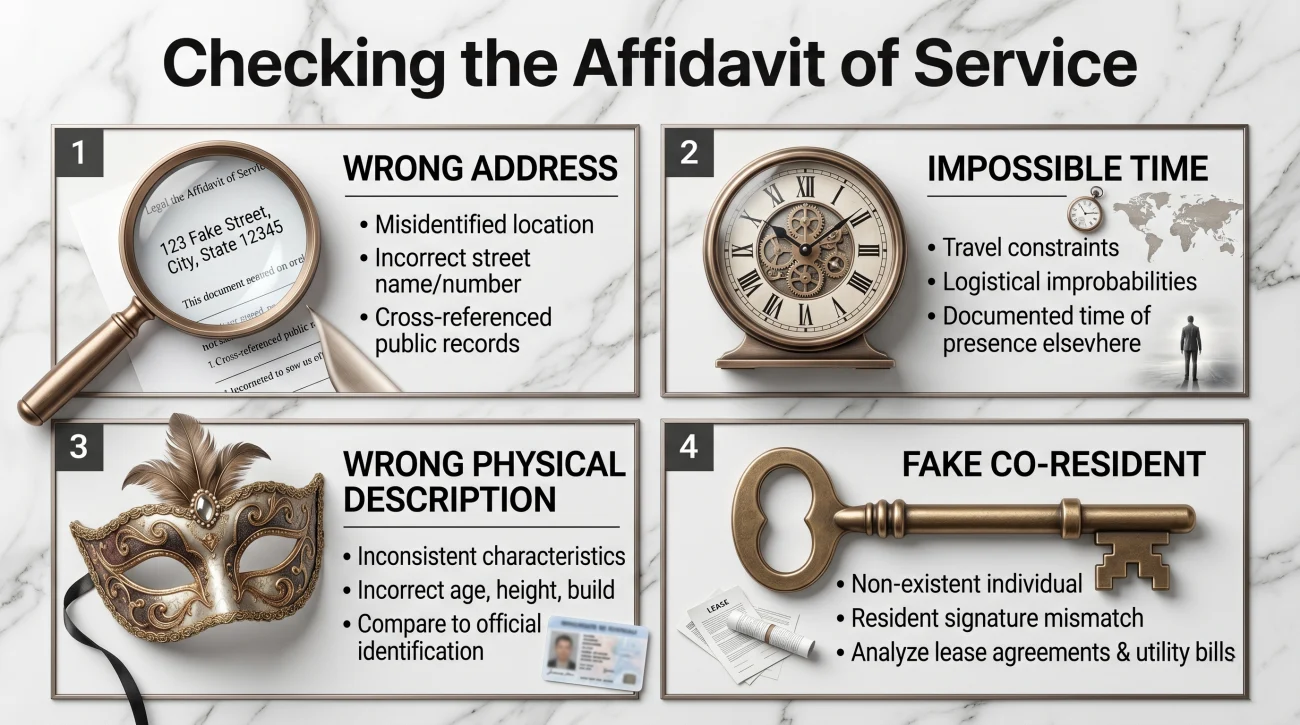
If you suspect you were a victim of sewer service or an honest address mistake, you must obtain the proof. That proof lives in your court file. Whenever a process server claims they delivered papers, they must sign a document under penalty of perjury called an Affidavit of Service or Proof of Service, and file it with the court.
You need to get a copy of this document immediately. Call or visit the civil clerk of the court where the judgment was entered. Give them your name or the case number and ask for a copy of the entire case file, specifically requesting the Affidavit of Service.
Sample script for the court clerk:
Once you have the affidavit in your hands, read it like a detective. It will state the exact date, time, and location the server claims the delivery occurred. It will also include a description of the person who accepted the papers. This is where the fraud or error usually reveals itself.
What to look for on the Affidavit of Service:
1. The Address: Is it an old address where you no longer lived on the date of service? Do you have a lease or utility bill proving you lived somewhere else on that specific date?
2. The Physical Description: If it claims personal service, does the description match you? I have seen affidavits describing a 6-foot tall blonde man when the actual defendant was a 5-foot tall brunette woman.
3. The “Relative” Trick: Does it claim substitute service on a “John Doe, Brother” or “Jane Doe, Co-resident” at a time when you lived alone?
4. The Time: Does it claim you were served at home at 2:00 PM on a Tuesday, but you have timecards proving you were clocked in at work across town?
What Improper Service Means for a Default Judgment
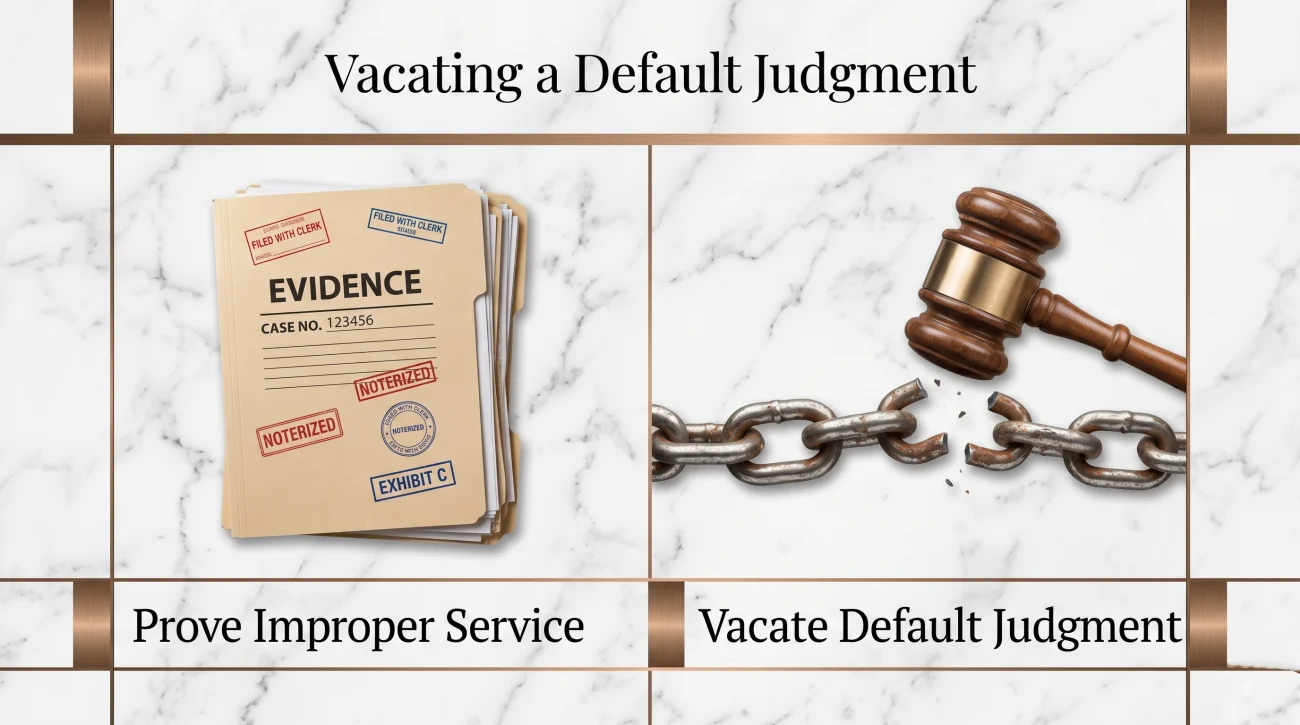
Finding a major discrepancy on the affidavit is your golden ticket. If you can prove you were not properly served, the court lacked the legal authority (personal jurisdiction) to proceed against you. This gives you grounds to file a motion to vacate the default judgment.
Calling the debt collector angrily to tell them you were never served and demanding they return your money. They will ignore you because they already hold a valid court order.
Gathering hard evidence that contradicts the affidavit of service (a lease, a timecard, a utility bill) and using it to file a formal motion to vacate the judgment with the court.
Vacating a judgment is a specific legal process. You must present your evidence to a judge and ask them to cancel the ruling. If the judge agrees that service was improper, the judgment is set aside. The immediate result is that the wage garnishment must stop and any frozen bank accounts must be released. Because the exact procedures and deadlines to challenge a judgment vary significantly by state, reviewing an overview of the lawsuit process is vital for understanding your structural position.
Improper Service Does Not Make the Case Disappear
Here is the reality check that many consumers misunderstand. Proving improper service does not automatically mean you win the case forever. It does not erase the debt.
When a judge vacates a default judgment due to bad service, the case does not usually get thrown out permanently. Instead, the clock resets. The case returns to the very beginning. The court is essentially saying, “The collector did it wrong the first time, so we are throwing out the penalty and giving the defendant a fair chance to fight.”
Once the judgment is vacated, you are officially involved in the lawsuit. You will typically be required to file a formal Answer to the complaint. You must learn how to identify the summons and complaint and ensure you do not miss your new deadline. Understanding your exact debt collection lawsuit response deadline becomes critical at this stage.
This is actually a massive victory. It pulls your money out of the collector’s hands and shifts the burden back to them. Because many debt buyers lack the documentation required to win a contested trial, forcing them to restart the process often leads to highly favorable settlements or voluntary dismissals.
Signs Your Service May Have Been Improper
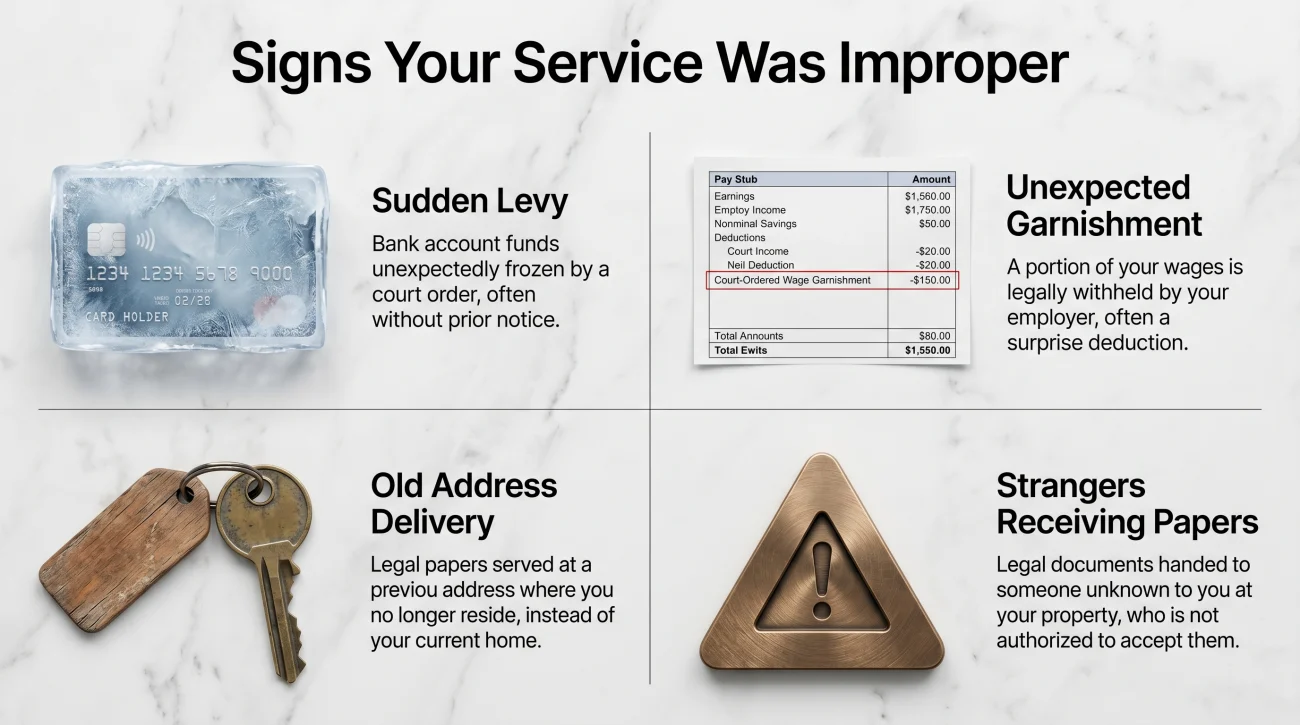
A frozen bank account or a sudden wage garnishment is the end result of a process that likely broke down months ago. To unwind it, look for these specific indicators in your court file that the process server failed to do their job correctly.
- You first learned of the lawsuit from a bank levy notice or an employer garnishment warning.
- The affidavit of service lists an address where you no longer lived on the date of delivery.
- The physical description of the person served on the affidavit looks nothing like you or anyone in your household.
- The affidavit claims the papers were left with a relative, but you live entirely alone.
- A neighbor or building manager handed you a stack of legal papers they found in a common hallway or lobby area.
Unwinding a default judgment based on bad service requires strict adherence to court procedures. If you have evidence that the affidavit is fraudulent, or if the funds currently frozen in your account are needed for basic survival, you should evaluate your representation options. If you need help filing the motion to vacate and forcing the collector to release your money, consulting a debt lawsuit attorney can provide the leverage needed to halt the collection machinery.
Final Thoughts on the Hidden Lawsuit Problem
Discovering a judgment against you for a lawsuit you knew nothing about is a terrifying experience. The natural reaction is panic and a feeling that the legal system has failed you. But once you understand that sewer service and address errors are common, documented business problems in the collection industry, the situation becomes less emotional and more mechanical.
You have rights. Courts take fraudulent or improper service very seriously because it undermines their entire authority. The collector relies on you feeling too overwhelmed to investigate. By requesting your court file, reading the affidavit, and gathering proof of your actual location, you disrupt their automated process. You strip away the default judgment shortcut and force the debt buyer to rely on the actual documentation they hold, which is the true purpose of responding to a lawsuit.
❓ FAQ
📝 What is an affidavit of service?
It is a sworn legal document signed by a process server stating the exact date, time, location, and method they used to deliver court papers to a defendant.
🗑️ Why is it called sewer service?
The term originated from dishonest process servers who would throw legal documents down a sewer grate instead of delivering them, then sign a fraudulent affidavit claiming successful delivery to earn their fee faster.
🚪 Can they just leave the papers at my door?
In most states, simply leaving papers on a doorstep (called “nail and mail”) is only permitted after multiple documented failed attempts at personal delivery, and it usually requires a follow-up mailing. Simply dropping them on a first attempt is rarely valid.
📫 Is it legal to serve me by mail?
It depends entirely on your state’s civil procedure rules. Some states allow service by certified mail with a return receipt requested, while others strictly require an initial attempt at physical personal delivery.
🏢 What if they serve papers to my old address?
If you can prove you did not live at that address on the date the papers were delivered, the service is generally considered improper. You will need a lease, utility bill, or driver’s license showing your actual residence on that date to prove it.
👥 Can my roommate accept the papers for me?
Yes. Most states allow substitute service, meaning the papers can be left with an adult of suitable age and discretion who resides in your home. If a roommate accepts them, you are legally considered served.
⚖️ Does improper service cancel my debt?
No. Proving improper service can vacate a default judgment and stop a garnishment, but it only resets the lawsuit. You will still have to defend against the collector’s underlying claim that you owe the money.
⏳ Is there a time limit to claim I was never served?
In many jurisdictions, challenging a judgment based on a complete lack of personal jurisdiction (meaning you were never properly served) has no strict time limit. However, you should always act immediately upon discovering the judgment.
📞 Can I just call the court and tell them I wasn’t served?
A phone call will not change the legal status of the case. You must file a formal written motion to vacate the judgment and present your evidence to a judge at a hearing.
🛑 Can I avoid service by refusing to open the door?
Evading a process server rarely works in the long run. If a process server documents that you are actively avoiding them, courts will often grant permission for alternative service methods, such as publishing a notice in a local newspaper, which allows the lawsuit to proceed without you.
What each stage of litigation requires and where your leverage sits.
- What the lawsuit process looks like from summons to judgment
- What to file, when to file it, and what happens if you do not
- The legal arguments that can defeat a debt collection lawsuit
- What a default judgment allows collectors to do and how to fight one
- How to negotiate a resolution once litigation has started
Once judgment is entered, collectors gain tools they did not have before.
- The FDCPA violations collectors commonly commit during the collection process
- How to respond to a debt lawsuit and what defenses are available to you
- How a judgment becomes a garnishment order on your paycheck
- When a collector uses a judgment to freeze your bank account instead
- How to settle before the judgment turns into something harder to stop
Disclosure: The content on this site reflects direct experience inside the debt collection industry and is grounded in federal law and regulation. It is informational in nature. Reading it does not constitute legal advice and does not create any professional relationship. If you are dealing with a lawsuit, a judgment, or a legal deadline, consult a licensed attorney in your state before acting.