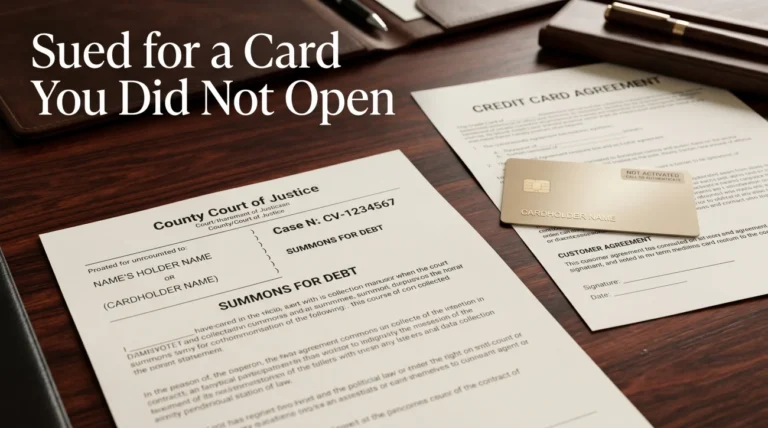
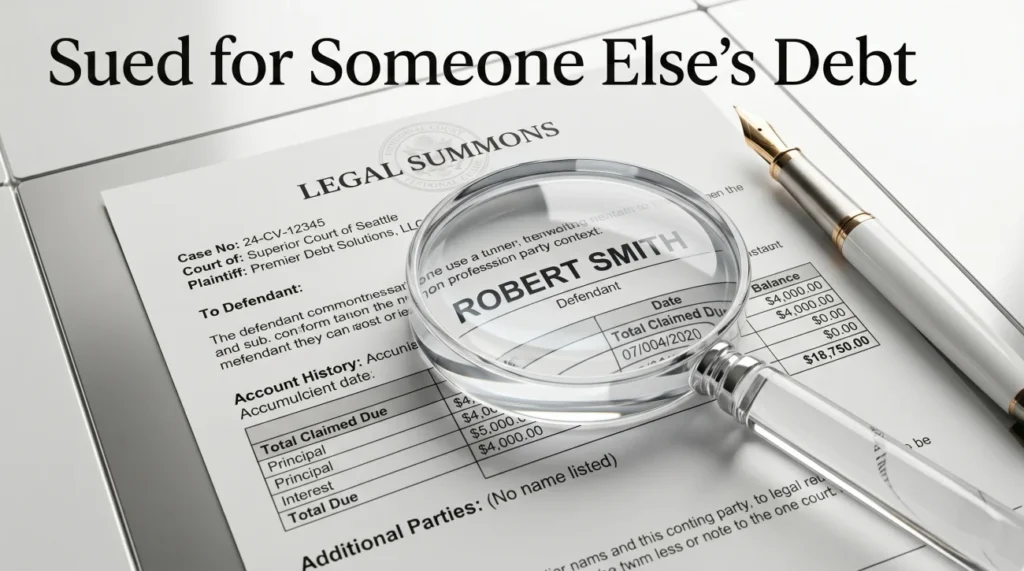
- If you are sued for a debt that does not belong to you, the plaintiff bears the absolute burden of proving that you are the person who incurred the debt.
- Debt buyers frequently sue the wrong person due to automated skip-tracing errors, mismatched names, and incomplete data purchased in bulk portfolios.
- Mistaken identity and identity theft are two different scenarios. Mistaken identity means they have the wrong person; identity theft means someone fraudulently used your information to open the account.
- Filing an Answer with a specific affirmative defense of mistaken identity is mandatory. If you ignore the lawsuit simply because the debt is not yours, the collector will get a default judgment against you anyway.
- Never agree to settle or make a small payment on a debt that is not yours just to make the lawsuit go away. Paying any amount can create severe legal complications and imply liability.
Mistaken Identity or Not Your Debt
Opening your front door to find a process server handing you a lawsuit summons is stressful enough. Discovering that the lawsuit is for a debt you have absolutely no knowledge of takes that stress and turns it into pure frustration. You check the documents. You do not recognize the creditor. The account number means nothing to you. You know with complete certainty that this is not your debt, yet a collection law firm is demanding thousands of dollars and threatening your financial security.
The natural reaction is to call the law firm, explain the mistake, and expect them to drop the case. During my 12 years working inside third-party collection agencies and debt buying firms, I saw consumers try this logical approach every single day. Unfortunately, the debt collection legal machine does not operate on logic or benefit of the doubt. A phone call will not stop a filed lawsuit. If you simply tell them they have the wrong person and then ignore the court papers, they will proceed to secure a default judgment against you, giving them the power to freeze your bank account for a debt you never owed.
To defeat a lawsuit for a debt that isn’t yours, you have to use the court system’s own rules against the collector. The most powerful rule is also the simplest: you do not have to prove that the debt is not yours. The collector must prove that it is. Understanding how to force them to meet that burden of proof is the key to getting these mistaken identity lawsuits dismissed.
The Golden Rule: The Burden of Proof Inversion
When consumers are sued for someone else’s debt, they immediately start frantically searching for ways to prove their innocence. They try to gather past leases, old utility bills, and bank statements to prove they did not live at the address associated with the account. While gathering your own records is helpful, it misses the fundamental structure of civil litigation.
In a debt collection lawsuit, the plaintiff (the debt collector) bears the absolute burden of proving every single element of their case. They must prove that the debt is valid, that the amount is correct, that they own the legal right to collect it, and crucially, that YOU are the specific individual who applied for the credit, signed the agreement, and authorized the charges.
“The California Consumer Law Center, a recognized authority on debt defense (SJ Consumer Law), provides the exact framing you need to remember: ‘Remember that the burden of proof is on the plaintiff to establish that you made or authorized each and every charge. You do not have to prove that the debt is not yours.'”
This burden of proof inversion is your shield. You simply have to formally deny the claim and demand that the collector produce the documentation connecting you to the account. In cases of mistaken identity, that documentation simply does not exist. By demanding it through the proper legal channels, you expose the fatal flaw in their lawsuit.
To understand the broader context of how the burden of proof operates in these cases, I highly recommend reviewing our comprehensive guide on what actually happens when a debt collector sues you.
Mistaken Identity vs. Identity Theft: Knowing Your Scenario
Before you draft your defense, you need to identify exactly why you are being sued for a debt you do not recognize. “Not my debt” generally falls into one of two very different legal categories. You must know which one applies to you, because the required response is different for each.
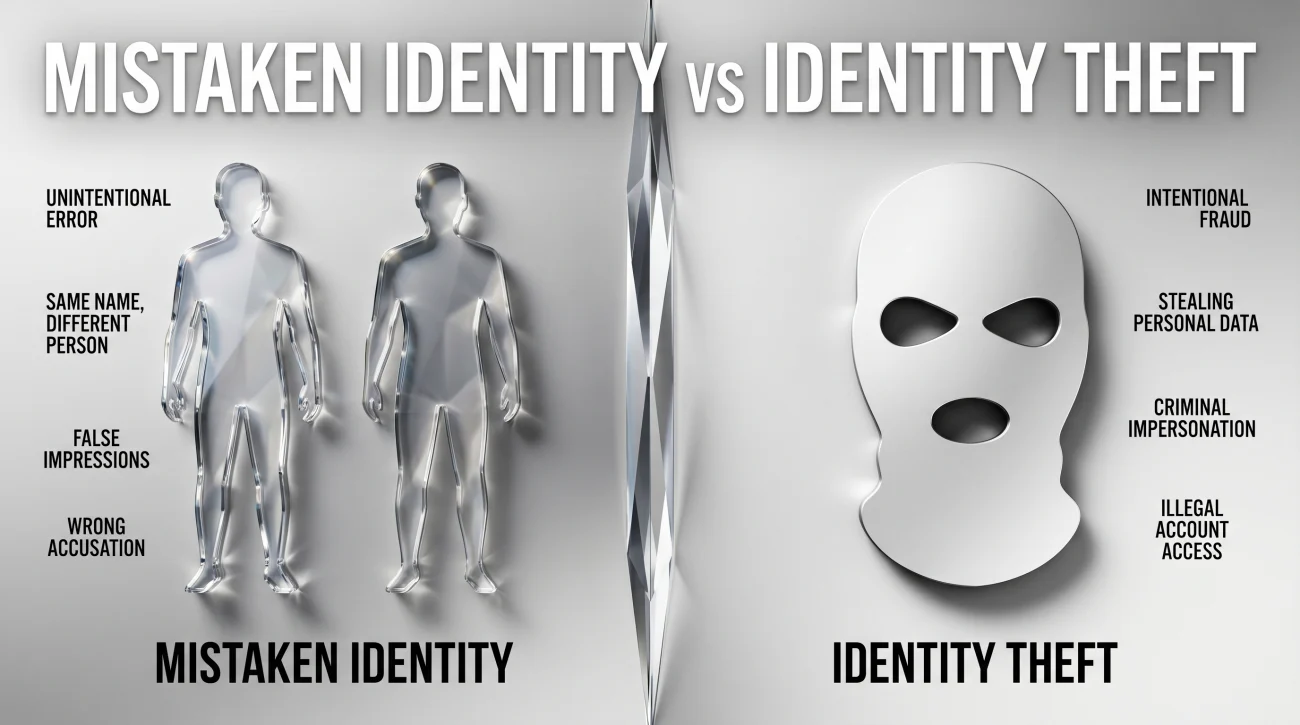
Scenario 1: True Mistaken Identity
This occurs when the debt actually exists and belongs to a real person, but that person is not you. The collector has simply tracked down the wrong individual. This is incredibly common with common names (e.g., John Smith, Maria Garcia) or instances where a father and son share a name but not a suffix (Sr. vs. Jr.). In these cases, the original credit application will show a different social security number, a different signature, and a different historical address.
Scenario 2: Identity Theft
This occurs when the debt is technically in your name, but you did not open the account. Someone fraudulently used your social security number, your name, and your details to secure credit. In this scenario, the collector might actually have an application that matches your data, making the lawsuit defense more complicated.
⚠️ Warning: If your situation involves identity theft, defending the lawsuit is only one part of the solution. You must also invoke specific protections under the Fair Credit Reporting Act (FCRA), including filing an FTC Identity Theft Report and disputing the fraudulent accounts directly with the credit bureaus.
Why Debt Buyers Sue the Wrong Person So Often
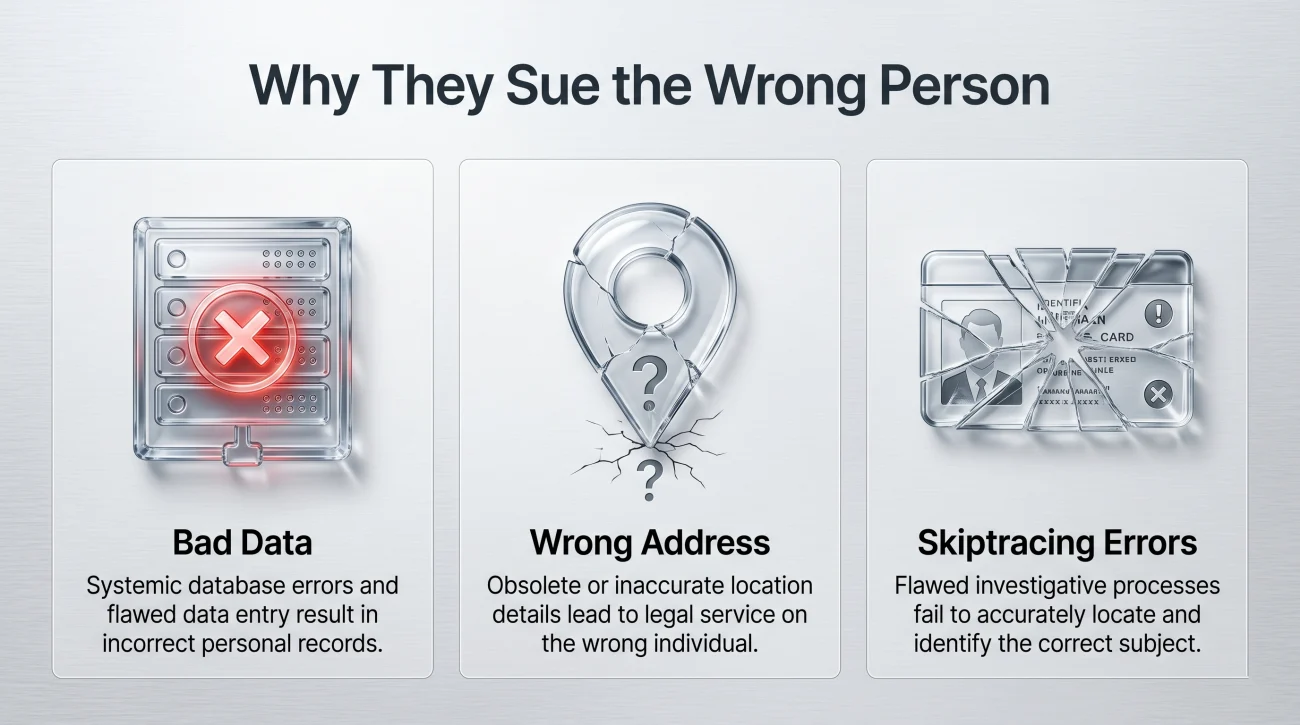
You might wonder how a sophisticated law firm could accidentally sue a completely unrelated person. The answer lies in the economics of the debt buying industry. When you are sued by a company like Midland Funding, Portfolio Recovery Associates, or LVNV Funding, you are dealing with a debt buyer, not an original creditor.
Debt buyers purchase portfolios of defaulted accounts for pennies on the dollar. When they buy these accounts, they do not receive neat folders filled with signed contracts and verified identification documents. They receive a massive spreadsheet containing thousands of rows of data: names, last known addresses, account numbers, and balances.
Field Note from the Collections Floor:
I watched automated skip-tracing software merge files incorrectly every single day. If a debt buyer purchased an account for “Michael Johnson” with an address from five years ago, their software would scrape public records, utility databases, and credit headers to find a current address to serve the lawsuit. The software often pulled a completely different Michael Johnson who happened to live in the same county. The collection law firm would then blindly print a summons and serve the wrong man. Because the plaintiff’s attorney relies on these automated spreadsheet guesses rather than original documents, forcing them to produce the actual contract breaks their entire machine.
Building Your Evidence File Before You Answer
Even though the burden of proof is on the collector, building your own evidence file immediately upon receiving the summons puts you in a much stronger position for trial or early settlement negotiations. You want to gather documents that actively contradict the claims in the complaint.
First, pull your credit reports from all three major bureaus (Equifax, Experian, TransUnion). If the account does not appear on any of your reports, take screenshots or save the PDFs. Second, review the address listed on the lawsuit’s attached billing statements. Find old utility bills, W-2 forms, or lease agreements matching the dates on the account statements in the complaint proving you lived somewhere entirely different. Having these documents ready makes it much easier to confidently deny their claims.
How to Raise the Mistaken Identity Defense in Your Answer
If you have been served with a summons, you have a strict deadline to file a formal written response with the court, known as an Answer. Calling the attorney to complain that they have the wrong person does not stop the clock. If you fail to file the Answer in time, the judge will enter a default judgment against you, legally declaring that you owe the money, regardless of the truth.
When drafting your Answer, a simple general denial is a good start, but you should also explicitly state your affirmative defense to ensure it is preserved for the court record.
In the section of your Answer designated for Affirmative Defenses, you can include language similar to this:
“Defendant denies that the alleged debt belongs to Defendant. Defendant asserts the affirmative defense of mistaken identity. Defendant did not open, authorize, or maintain the alleged account and did not make or authorize the charges claimed in the Plaintiff’s complaint. Plaintiff is pursuing the wrong individual.”
By placing this on the record, you are putting the collector’s attorney on notice that they have a severe evidentiary problem. You can explore a broader list of affirmative defenses that may apply to your case in our dedicated defense guide.
Using Discovery to Expose the Mistake
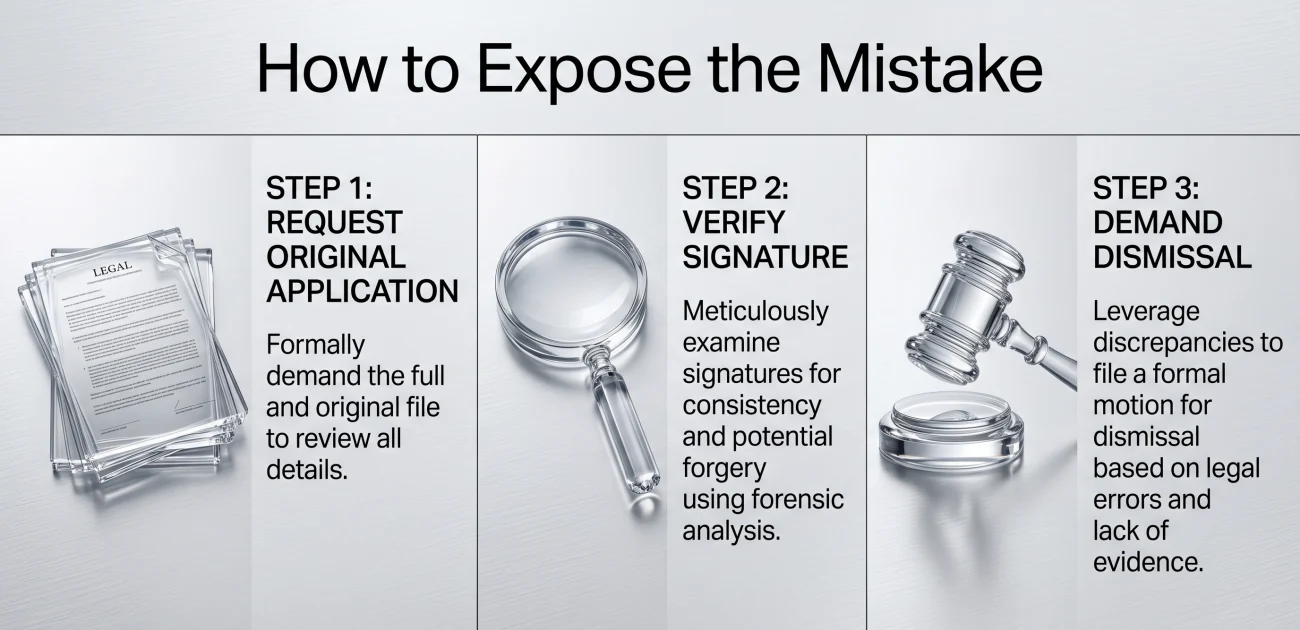
Filing your Answer stops the default judgment. The next phase of the lawsuit is called discovery, which is the formal process where both sides can request documents and evidence from each other. This is where you leverage the burden of proof inversion to win your case.
Since the plaintiff must prove you are the person who opened the account, you should send a formal Request for Production of Documents to their attorney. You want to request the specific pieces of evidence that will prove they have the wrong person.
- Request a copy of the original signed credit application showing the signature, social security number, and date of birth of the applicant.
- Request copies of historical account statements showing the physical address where the original bills were mailed.
- Request any photo ID, utility bill, or IP address log used to verify the identity of the person who opened the account.
- Request the complete chain of title documents showing exactly how the debt was transferred from the original creditor to the current plaintiff.
If none of these documents match your information, the case should be dismissed. This puts the debt buyer in an impossible position. If it is truly a case of mistaken identity, the original application they eventually request from the original creditor will show a different social security number and signature. Often, debt buyers cannot even obtain the original contract at all, which creates an entirely separate defense for you. Read our guide on why a debt buyer lacking the original contract is fatal to their case.
💡 Pro Tip on “Lack of Standing”: In debt defense, mistaken identity is often paired with a lack of standing defense. Because debt buyers purchase sloppy portfolios, they frequently lack the proper assignment documents connecting them to the original creditor. You can attack their legal right to sue alongside your mistaken identity claim. See our full breakdown of lack of standing as a debt collection lawsuit defense.
The Trap: Why You Must NEVER Settle for Someone Else’s Debt
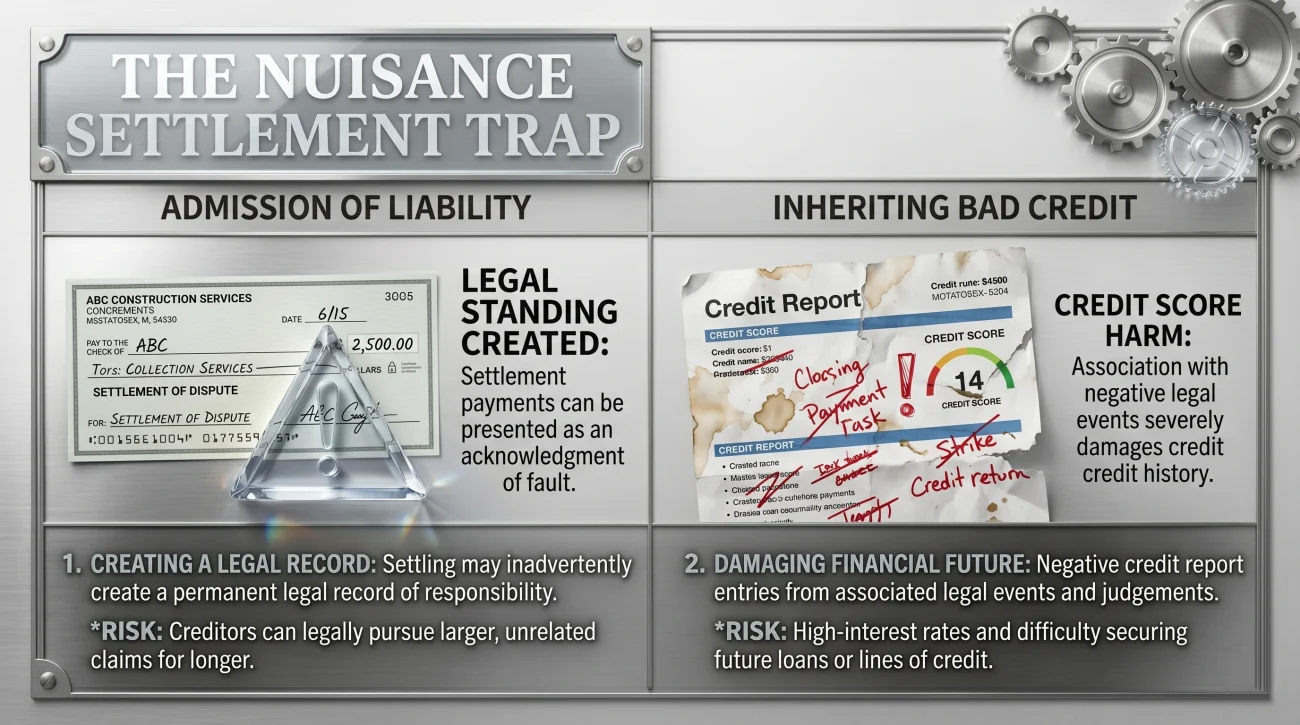
When consumers are sued for a small amount, say $800, and realize the cost of taking time off work to go to court is high, they sometimes consider calling the collector to negotiate a “nuisance” settlement. They think paying $300 to make the headache disappear is easier than fighting a mistaken identity case.
This is a catastrophic mistake. The California Consumer Law Center explicitly warns against this: never agree to a settlement or make a payment on a debt that is not yours.
Paying any amount toward a debt, or signing a settlement agreement, can be legally interpreted as an admission of liability. If you pay to settle a mistaken identity debt, that collection account can suddenly be validated and attached to your credit report for the next seven years. You are essentially volunteering to adopt someone else’s bad credit history.
If the debt is not yours, your only acceptable outcome is a dismissal of the lawsuit with prejudice. You must hold the line. Once the plaintiff’s attorney realizes they cannot produce the documents connecting you to the account, and that you are not going to fold, they often file a notice of voluntary dismissal to cut their losses. For a detailed look at how these dismissals work and how to push for them, review our guide on getting a debt collection lawsuit dismissed.
Signs the Mistaken Identity Defense Applies to Your Case
It is crucial to correctly identify if your situation fits the parameters of a mistaken identity defense before you build your strategy around it. If you simply forgot about an old account, claiming mistaken identity will backfire when they produce your signature.
However, if your situation matches the following signs, you likely have strong grounds to demand a dismissal based on mistaken identity:
- The name on the complaint has slight spelling differences, or is missing a suffix (like Jr. or Sr.) that differentiates you from a relative.
- The address listed on the account statements attached to the complaint is a place where you have never resided or worked.
- The account type (e.g., a specific retail store credit card) or the original creditor name is completely unrecognizable to you.
- The account does not appear anywhere on your current credit reports from Equifax, Experian, or TransUnion.
- Your signature does not appear on any of the documents the collector provided, or the signature looks blatantly different from yours.
If these signs are present, you have a highly defensible case. If you are dealing with a stubborn debt buyer law firm and need a professional to handle the discovery process and force the dismissal, consulting a consumer defense lawyer can shift the dynamic immediately. You can explore how professional debt lawsuit representation changes the leverage in your favor.
Final Thoughts: Hold Your Ground
Facing a lawsuit for a debt you did not create feels unjust, but the legal system provides the tools you need to dismantle it. The debt buyer’s entire business model relies on the assumption that you will be too intimidated to demand proof. The moment you file an Answer asserting mistaken identity and use the discovery process to demand the original application, you break their script.
Remember the golden rule: you do not have to prove you aren’t the debtor. Make them prove that you are. File your response on time, refuse to settle for someone else’s mistake, and force the collector to meet the strict legal requirements to win their case.
❓ FAQ
🤷♂️ Can I just call the collection attorney and tell them they have the wrong person?
You can, but a phone call does not stop the lawsuit clock. If you do not file a formal written Answer with the court before the deadline, the collector will secure a default judgment against you, even if you told them over the phone that the debt isn’t yours.
📄 Do I have to prove to the judge that the debt isn’t mine?
No. In civil litigation, the burden of proof is entirely on the plaintiff (the debt collector). They must provide evidence, like a signed application or verified identifying information, that proves you incurred the debt.
🔍 How do collectors end up suing the wrong person?
Debt buyers purchase large spreadsheets of defaulted accounts with minimal information. They use automated skip-tracing software to find current addresses for the names on those spreadsheets. If you share a name with the actual debtor, the software often mistakenly links your address to their file.
💳 What is the difference between mistaken identity and identity theft?
Mistaken identity means the collector is targeting the wrong person for a legitimate debt owed by someone else. Identity theft means a criminal used your social security number and personal details to fraudulently open an account in your name.
🤝 Should I just pay a small settlement to make the lawsuit go away?
Absolutely not. Never pay a settlement on a debt you do not owe. Making a payment can be viewed as an admission of liability, and it will likely result in the delinquent account being permanently attached to your credit report.
⚖️ What documents should I ask for in discovery to prove they have the wrong person?
You should request the original signed credit application, copies of account statements showing the original billing address, and any identification documents (like a driver’s license copy) used when the account was opened.
👨👦 What if I share a name with my father and the debt is his?
This is a classic mistaken identity scenario. You must file an Answer stating you are not the responsible party. During discovery, force the collector to produce the application containing the social security number and birth date, which will prove the account belongs to your father, not you.
📉 Will a mistaken identity lawsuit ruin my credit score?
The lawsuit itself does not impact your credit score directly. However, if the collector incorrectly reported the collection account to the credit bureaus under your profile, it will hurt your score. You must dispute the account directly with the credit bureaus to have it removed.
🛑 What happens if the collector realizes they sued the wrong person?
If you push back hard enough during discovery and they realize they cannot prove you are the debtor, the plaintiff’s attorney will usually file a notice of voluntary dismissal to close the case and cut their losses.
⏱️ What if a default judgment was already entered against me for someone else’s debt?
You must file a Motion to Vacate the default judgment. You will need to show the court that you have a meritorious defense (the debt is not yours) and explain why you did not respond to the original summons (e.g., you were never properly served).
What each stage of litigation requires and where your leverage sits.
- What the lawsuit process looks like from summons to judgment
- What to file, when to file it, and what happens if you do not
- The legal arguments that can defeat a debt collection lawsuit
- What a default judgment allows collectors to do and how to fight one
- How to negotiate a resolution once litigation has started
Once judgment is entered, collectors gain tools they did not have before.
- The FDCPA violations collectors commonly commit during the collection process
- How to respond to a debt lawsuit and what defenses are available to you
- How a judgment becomes a garnishment order on your paycheck
- When a collector uses a judgment to freeze your bank account instead
- How to settle before the judgment turns into something harder to stop
Disclosure: The content on this site reflects direct experience inside the debt collection industry and is grounded in federal law and regulation. It is informational in nature. Reading it does not constitute legal advice and does not create any professional relationship. If you are dealing with a lawsuit, a judgment, or a legal deadline, consult a licensed attorney in your state before acting.