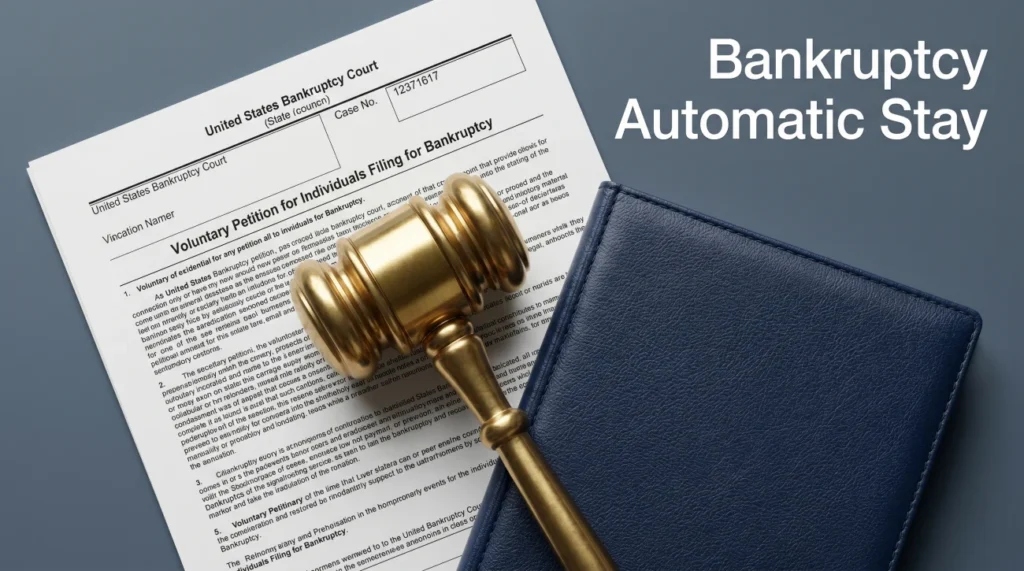
- Filing for bankruptcy triggers an automatic stay, a federal injunction that legally stops most wage garnishments the exact second your petition is filed.
- While the protection is immediate, your employer does not magically know about it. You or your attorney must actively notify your payroll department with your bankruptcy case number to stop the next deduction.
- The automatic stay stops garnishments for consumer debts, pauses federal student loan administrative garnishments, and halts IRS wage levies.
- Bankruptcy does not stop wage garnishment for child support or alimony. Domestic support obligations bypass the automatic stay entirely.
- If your bankruptcy case is dismissed before completion (for example, missing a fee or required class), the automatic stay lifts and the debt collector can instantly resume garnishing your paycheck.
The Immediate Power of the Automatic Stay
When a portion of your hard-earned paycheck suddenly vanishes to satisfy a debt collection judgment, the feeling of helplessness is overwhelming. You are trapped in a financial corner, unable to cover basic living expenses, while a debt buyer automatically extracts money from your employer every two weeks. Most people in this situation are desperately looking for a way to pull the emergency brake. Filing for bankruptcy is the ultimate emergency brake.
During my 12 years working inside third-party collection agencies and a national debt buyer, I watched thousands of wage garnishments execute. Once our law firm secured a default judgment and served the employer, we considered that account a steady revenue stream. There was very little the consumer could do to negotiate at that point because we already had guaranteed access to their income. However, there was exactly one event that forced our collection floor to stop everything instantly: a bankruptcy filing.
Understanding how bankruptcy interacts with wage garnishment requires separating the immediate block from the long-term resolution. Bankruptcy is a serious legal and financial decision, and it is not the right choice for everyone. But if you are trying to stop wage garnishment, you need to understand exactly how the federal bankruptcy code forcefully halts the collection machinery, what types of debts it works on, and where the protection falls short.
What the Automatic Stay Actually Is
The mechanism that stops a debt collector from touching your paycheck is called the “automatic stay.” Found in the federal bankruptcy code, the automatic stay is a powerful legal injunction that goes into effect the exact second your bankruptcy petition is filed with the court.
It is not a request. It is not a negotiation. It is a federal court order commanding all creditors to immediately cease all collection activities. This includes phone calls, collection letters, lawsuits, bank account levies, and active wage garnishments.
“From the collector’s side of the screen, the automatic stay is absolute. When an account in our system was flagged with a new bankruptcy case number, the software physically locked the file. We could not call, we could not send letters, and our legal department had to immediately notify the employer to release the garnishment. Federal bankruptcy judges do not tolerate violations of the stay, and agencies face massive financial sanctions if they take a single dime after the filing date.”
The automatic stay is “automatic” because it does not require a judge to review your case and approve it. The moment you pay the filing fee and submit the petition (or your attorney submits it electronically), the stay is active. It casts a protective shield over your income and assets while the bankruptcy court sorts out your financial situation.
The Notification Gap: How Fast Does It Actually Work?
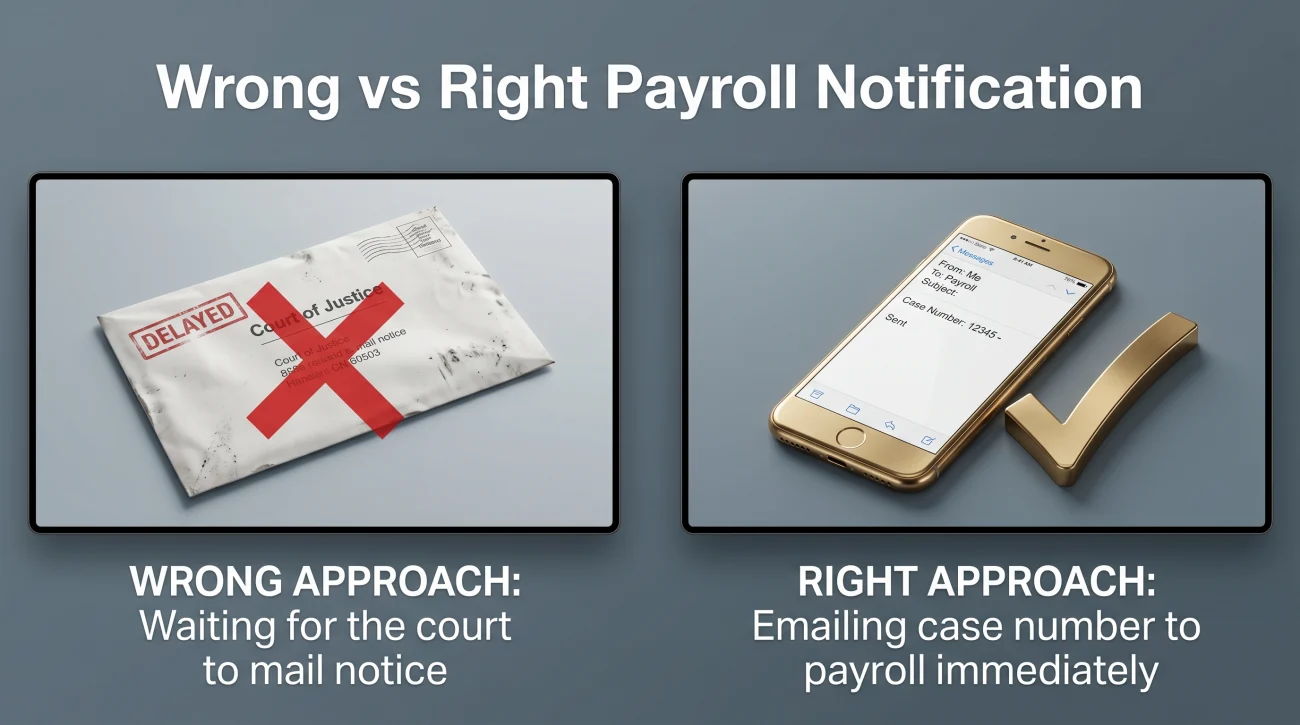
While the legal protection of the automatic stay begins instantaneously, the practical reality in payroll departments is different. This is where many consumers make a critical, costly mistake.
When you file for bankruptcy, the court eventually mails official notices to all the creditors listed in your schedules. But the court does not immediately call your employer’s human resources department. If your payroll is processed on a Tuesday and you file on a Monday, your employer will likely still deduct the garnished funds because they have no idea the federal injunction exists yet.
Assuming the court handles the employer notification immediately and waiting for your next full paycheck to arrive automatically.
Getting your official case number the moment you file and proactively emailing it to your employer’s payroll department that exact same day.
Script: Notifying Payroll of Your Bankruptcy Filing
To stop the deduction from your next paycheck, use this template to create a written paper trail. This gives your employer the legal cover they need to halt the garnishment immediately:
Subject: URGENT: Immediate Halt to Wage Garnishment – Bankruptcy Case #[Your Case Number]
Dear Payroll/HR Department,
I am writing to formally notify you that I filed for bankruptcy today, [Date of Filing]. My official bankruptcy case number is [Case Number], filed in the [Name of Bankruptcy Court, e.g., Northern District of Illinois].
Under federal bankruptcy law, the automatic stay went into effect the moment this petition was filed. This stay legally requires all wage garnishment deductions for consumer debts to cease immediately.
Please stop the active garnishment deduction for [Name of Creditor/Collection Agency] before the next payroll cycle is processed. I have attached a copy of my bankruptcy filing notice for your records.
Thank you for your prompt attention to this legal requirement.
Sincerely,
[Your Name]
[Your Employee ID]
By taking this step, you force the employer to acknowledge the federal injunction. If they continue to garnish your wages after receiving verifiable notice of the bankruptcy case number, they could be held liable for violating the automatic stay.
What the Automatic Stay Stops (and Pauses)
The automatic stay is broad, but it treats different types of debts in different ways. Understanding the origin of your garnishment is crucial for knowing how the bankruptcy will affect it.
| Garnishment Type | Effect of the Automatic Stay | Long-Term Result |
|---|---|---|
| Consumer Debt (Credit cards, medical, personal loans) | Stopped immediately. | Debt is permanently discharged in Chapter 7 or restructured in Chapter 13. |
| Federal Student Loans | Paused immediately. | Garnishment stops during the bankruptcy, but the debt usually survives and resumes later. |
| IRS Tax Levies | Paused immediately. | Collection stops during the case, but recent tax debts must usually be repaid. |
| Child Support & Alimony | Not stopped. | Garnishment continues without interruption. Debt is never discharged. |
Consumer Debt Judgments
For standard consumer debts like credit card balances, medical bills, auto loan deficiencies, and personal loans, the automatic stay is highly effective. If a debt buyer sued you, won a default judgment, and sent an earnings withholding order to your employer, bankruptcy halts it in its tracks. You will ultimately seek to have these unsecured debts completely wiped out in the bankruptcy process.
Federal Student Loans and IRS Levies
If you are facing an IRS wage levy or a federal student loan wage garnishment, the automatic stay still provides immediate relief. The government must halt the administrative garnishment process while you are under the protection of the bankruptcy court.
However, the relief here is a temporary shield, not a permanent cure. Federal student loans are notoriously difficult to discharge in bankruptcy, requiring a complex adversarial proceeding. Similarly, most recent tax debts survive the bankruptcy process. I have seen consumers file Chapter 7 expecting a clean slate, only to panic when the IRS levy hits their bank account again 100 days later as the case closes. For government debts, the automatic stay is best used to buy you a few months of breathing room to negotiate a federal payment plan or rehabilitation agreement without losing your current paycheck.
The Major Exception: What Bankruptcy Does Not Stop
There is a dangerous misconception that bankruptcy stops all money from leaving your paycheck. It does not. Federal law specifically carves out exceptions to the automatic stay for domestic support obligations.
If your wages are being garnished for child support or alimony, filing for bankruptcy will not help you. The automatic stay does not apply to the collection of domestic support, and your employer is legally required to continue withholding those funds and sending them to the state enforcement agency. Furthermore, child support arrears are strictly non-dischargeable in any form of bankruptcy. You cannot wipe them out, and you cannot use the automatic stay to pause them.
If you have multiple garnishments, this priority rule becomes very apparent. If you file bankruptcy to stop a credit card garnishment, that specific deduction will end. But if you have a simultaneous child support income withholding order, that deduction will continue unaffected.
What Happens to Wages Already Garnished?
A common question from consumers who just filed is, “When do I get the money back that they already took?” In the vast majority of cases, the answer is never.
The automatic stay is proactive, not retroactive. It applies to future paychecks starting from the moment you file your petition. Any wages that were legally deducted from your paycheck and remitted to the debt collector prior to your filing date belong to the collector.
There is a highly specific exception to this rule known as a “preference claim.” If a single unsecured creditor garnished more than $600 from your wages within the 90 days immediately preceding your bankruptcy filing, your bankruptcy trustee or attorney might be able to claw that money back into the bankruptcy estate. However, this is a complex legal maneuver. The recovered funds are often distributed among all your creditors, meaning you rarely get a check handed directly back to you. You should operate under the assumption that money already garnished is gone.
Chapter 7 vs. Chapter 13: What Happens After the Stay?
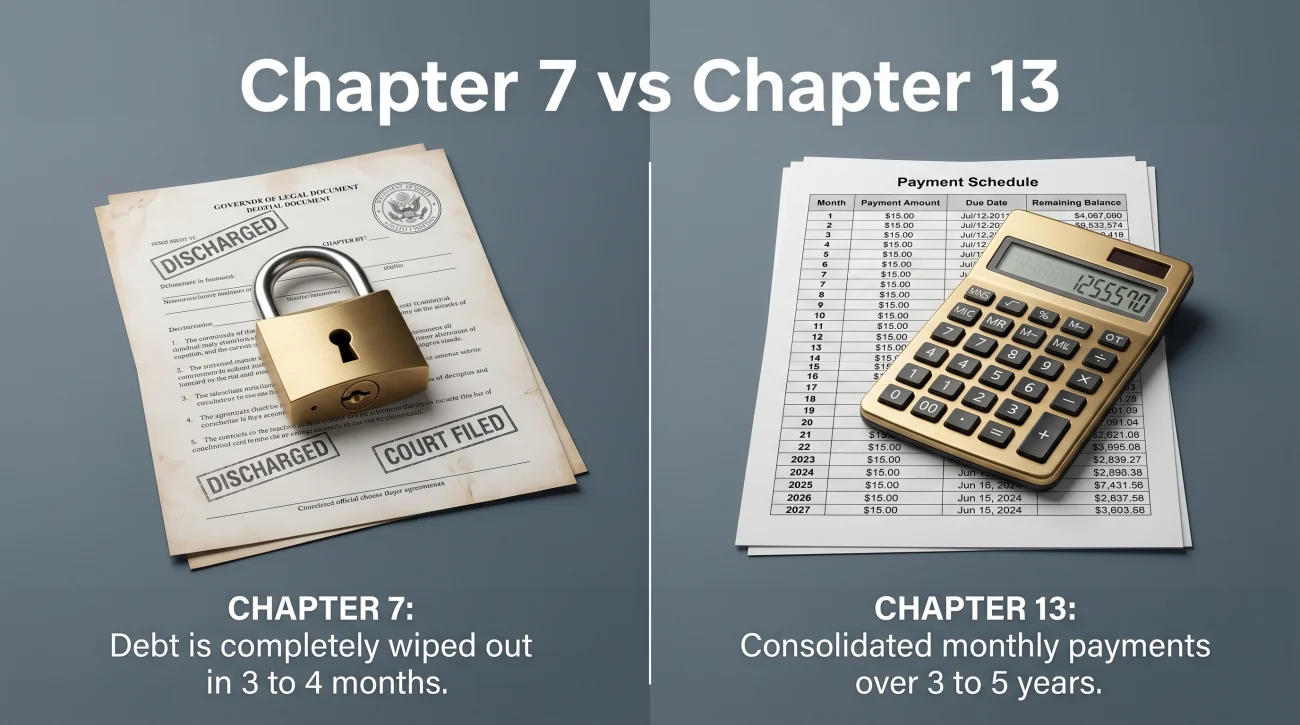
The automatic stay stops the bleeding, but you still have to cure the underlying wound. The long-term fate of the wage garnishment depends entirely on which type of bankruptcy you file.
Chapter 7 Bankruptcy (Liquidation): In a Chapter 7, the goal is to quickly discharge your unsecured debts. The process typically takes three to four months. The automatic stay prevents the garnishment during this time. At the end of the process, if the court grants your discharge, the underlying consumer debt is legally wiped out. Because the debt no longer exists, the judgment is voided, and the garnishment can never resume.
Chapter 13 Bankruptcy (Reorganization): If you have higher income or assets you need to protect, you may file Chapter 13. This involves a court-approved repayment plan lasting three to five years. The automatic stay stops the direct wage garnishment from the aggressive debt collector. Instead, you make one consolidated monthly payment to a bankruptcy trustee, who then distributes funds to your creditors according to the plan. At the end of the 3-5 year plan, any remaining eligible consumer debt is discharged. The collector never regains the ability to garnish your paycheck directly.
The Reinstatement Risk: The Dismissal Trap
Filing a bankruptcy petition solely as a tactical maneuver to delay a garnishment is highly risky due to the reinstatement rules. The automatic stay only protects you while your case is active and in good standing with the court.
I saw many cases where a consumer filed a bare-bones bankruptcy petition just to get the case number and stop a heavy garnishment. But bankruptcy requires strict compliance: you must pay filing fees, submit complex financial schedules, attend a mandatory meeting of creditors, and complete credit counseling courses.
⚠️ Warning: If you fail to complete the required steps, the bankruptcy judge will dismiss your case. The moment a case is dismissed, the automatic stay lifts. The debt collector is immediately legally authorized to contact your employer and reinstate the wage garnishment exactly where they left off.
Furthermore, the bankruptcy code punishes serial filers. If your case is dismissed and you try to file a second bankruptcy petition within one year, the automatic stay will only last for 30 days unless you prove to the judge that the new filing is in good faith. If you file a third time within a year, there is no automatic stay at all. Bankruptcy is a permanent resolution tool, not a pause button to be abused.
Signs Bankruptcy May Be the Right Move to Stop Garnishment
Once you understand how Chapter 7 and Chapter 13 treat your debt long-term, the remaining question is whether pulling this emergency brake makes sense for your specific situation. While negotiating a settlement is sometimes possible, bankruptcy becomes the most logical, mathematical choice when your overall debt burden, not just the active garnishment, is fundamentally unmanageable. You should seriously evaluate this path if any of the following apply:
- 📌 You have multiple garnishments waiting: If you have one active garnishment and two other lawsuits pending, stopping one will just allow the next collector to take your wages. Bankruptcy addresses all of them at once.
- 📌 Your income cannot survive the 25% hit: If losing up to 25% of your disposable income means you will face eviction or cannot buy food, you need the immediate, total halt that the automatic stay provides.
- 📌 Your overall unsecured debt is overwhelming: If the garnished debt is $5,000, but you also have $40,000 in other credit card and medical debt you cannot pay, settling the one active judgment does not fix the core problem.
- 📌 You lack lump-sum settlement leverage: Collectors rarely stop an active garnishment for a weak payment plan. If you do not have a lump sum of cash to negotiate a release, bankruptcy may be your only mechanism to stop the payroll deduction.
Because the automatic stay requires proper legal filing, and because choosing between Chapter 7 and Chapter 13 dictates your financial future for years, this is not a do-it-yourself project. You need to speak with a professional to understand whether you qualify for a complete discharge. Check your options with a wage garnishment attorney or a debt lawsuit attorney who can file the paperwork quickly and correctly to intercept your next paycheck.
Final Thoughts on the Automatic Stay
Wage garnishment relies on momentum. Debt collectors bank on the fact that once the court order reaches your employer, inertia takes over, and they are practically guaranteed a steady payout. Filing for bankruptcy breaks that momentum violently.
But the biggest lesson from the collection floor is this: bankruptcy is a permanent financial restructuring tool, not a tactical pause button. If you use it just to dodge one paycheck deduction and let the case get dismissed, the collector will be back in your HR department’s inbox the next day. Use the automatic stay only when you are fully committed to finishing the process and wiping out the underlying debt for good.
❓ FAQ
⏱️ Can my employer still garnish me if I filed bankruptcy today?
Legally, no. The automatic stay goes into effect the second you file. However, practically, if your employer does not know you filed, the automated payroll system will still deduct the money. You must immediately provide your bankruptcy case number to your HR or payroll department to physically stop the deduction.
💸 Do I get my garnished money back if I file Chapter 7?
Generally, no. The automatic stay stops future garnishments from the filing date onward. Money that was legally deducted before you filed belongs to the creditor. While there is a complex “preference claim” exception for large amounts taken in the 90 days prior to filing, you should not expect a refund check.
👨👧 Does bankruptcy stop child support garnishment?
No. Child support and alimony are domestic support obligations. Federal bankruptcy law specifically excludes them from the protection of the automatic stay. Your employer will continue to withhold child support exactly as before, regardless of your bankruptcy filing.
🏢 How does my employer know I filed for bankruptcy?
Eventually, the bankruptcy court mails a notice to the creditors involved, and the creditors must instruct the employer to stop. However, this mail process takes days or weeks. To stop an immediate garnishment, you or your attorney must directly email or fax your bankruptcy petition and case number to your employer’s payroll department.
📞 Will a debt collector stop calling after I file?
Yes. The automatic stay strictly prohibits any attempt to collect a debt. This means all phone calls, letters, and emails must stop immediately. If a collector continues to contact you after being notified of your bankruptcy case number, they can be sued for violating the stay.
🛑 Can I file bankruptcy just to stop a garnishment and then cancel it?
Filing a petition purely to trigger the stay with no intention of completing the bankruptcy is considered bad faith. If your case is dismissed, the stay lifts, the garnishment resumes immediately, and if you try to file again within a year, the court severely restricts your automatic stay protections.
🗓️ Does Chapter 13 stop wage garnishment?
Yes. Just like Chapter 7, filing for Chapter 13 triggers the immediate automatic stay. The hostile garnishment stops, and instead, you will make a single, organized monthly payment to a bankruptcy trustee based on an approved 3-to-5-year repayment plan.
⚖️ What is an automatic stay violation?
An automatic stay violation occurs when a creditor takes action to collect a debt after they know you have filed for bankruptcy. If a collector refuses to release a garnishment after receiving your case number, the bankruptcy judge can sanction them heavily and award you damages.
🏛️ Can the IRS still take my paycheck if I declare bankruptcy?
Filing for bankruptcy triggers the automatic stay, which pauses active IRS wage levies. However, this is usually a temporary pause. Many recent tax debts cannot be discharged in bankruptcy, meaning you will either need to pay them through a Chapter 13 plan or face collection again after a Chapter 7 concludes.
💍 Does my spouse’s wage garnishment stop if only I file?
It depends on the type of bankruptcy and state laws. In Chapter 13, there is a “co-debtor stay” that can protect a spouse from collection on joint consumer debts. In Chapter 7, if only you file, the creditor may still be able to garnish your spouse’s wages if they are jointly liable for the debt.
Garnishment sits at the end of a process that starts earlier. These cover the full picture.
- How courts allow collectors to reach your paycheck and your bank
- How Wage Garnishment Works: From Judgment to Paycheck Deduction
- IRS Wage Levy: Why It's Different and How the IRS Can Take Almost Everything
- How Much of Your Wages Can Be Garnished? The 25% Rule and When It Doesn't Apply
- Head of Household Exemption from Wage Garnishment: Florida's Strongest Wage Protection and the Waiver Trap
Garnishment is a symptom. These cover the options that address what caused it.
- The collector behavior that typically comes before the garnishment order
- How the lawsuit you may have missed is what created the garnishment
- How wage garnishment works and the options available to stop or limit it
- When a collector goes after your bank account instead of your wages
- How settling the underlying debt stops the garnishment permanently
Disclosure: The content on this site reflects direct experience inside the debt collection industry and is grounded in federal law and regulation. It is informational in nature. Reading it does not constitute legal advice and does not create any professional relationship. If you are dealing with a lawsuit, a judgment, or a legal deadline, consult a licensed attorney in your state before acting.