- Standing is the legal right to bring a lawsuit. If a debt buyer cannot prove they legally own your specific account, they lack standing to sue you.
- Debt buyers purchase accounts in massive portfolios, often receiving only a spreadsheet rather than complete documentation, creating severe standing vulnerabilities.
- To establish standing, the plaintiff must prove an unbroken chain of assignments from the original creditor directly to them, with your account explicitly identified.
- You must actively raise the lack of standing defense in your written Answer to preserve your right to challenge their documentation in court.
The Reality of a Stranger Suing You for Debt
You open a lawsuit summons and look at the name of the plaintiff. It is not the bank that issued your credit card. It is not the hospital that treated you. It is a company you have never heard of, with a name like Midland Funding, Portfolio Recovery Associates, or LVNV Funding. They claim you owe them thousands of dollars. Your first reaction is complete confusion, followed by panic. Who are these people, and how can they take you to court?
The company suing you is a third-party debt buyer. They are a company that paid pennies on the dollar for a massive portfolio of defaulted accounts, and yours happened to be included in the batch. But simply claiming they bought your debt is not enough to win in court. To successfully sue you, this stranger must prove they legally own your specific debt today. Many of them simply cannot.
During my 12 years working inside third-party collection agencies and a national debt buyer, I saw exactly how these bulk account transfers operate. When we purchased a portfolio of defaulted credit cards, we did not receive filing cabinets full of meticulously organized original contracts and signed agreements. We received an Excel spreadsheet. That spreadsheet contained names, addresses, account numbers, and balances. That was often the extent of our documentation on day one.
This is the greatest structural weakness in the debt buying industry. When you are sued by a debt collector who operates on this model, their biggest vulnerability is proving they actually have the legal right to stand in front of a judge and demand money from you. This concept is called “standing,” and challenging it is one of the most effective ways to defend yourself.
What Standing Actually Means in a Debt Lawsuit
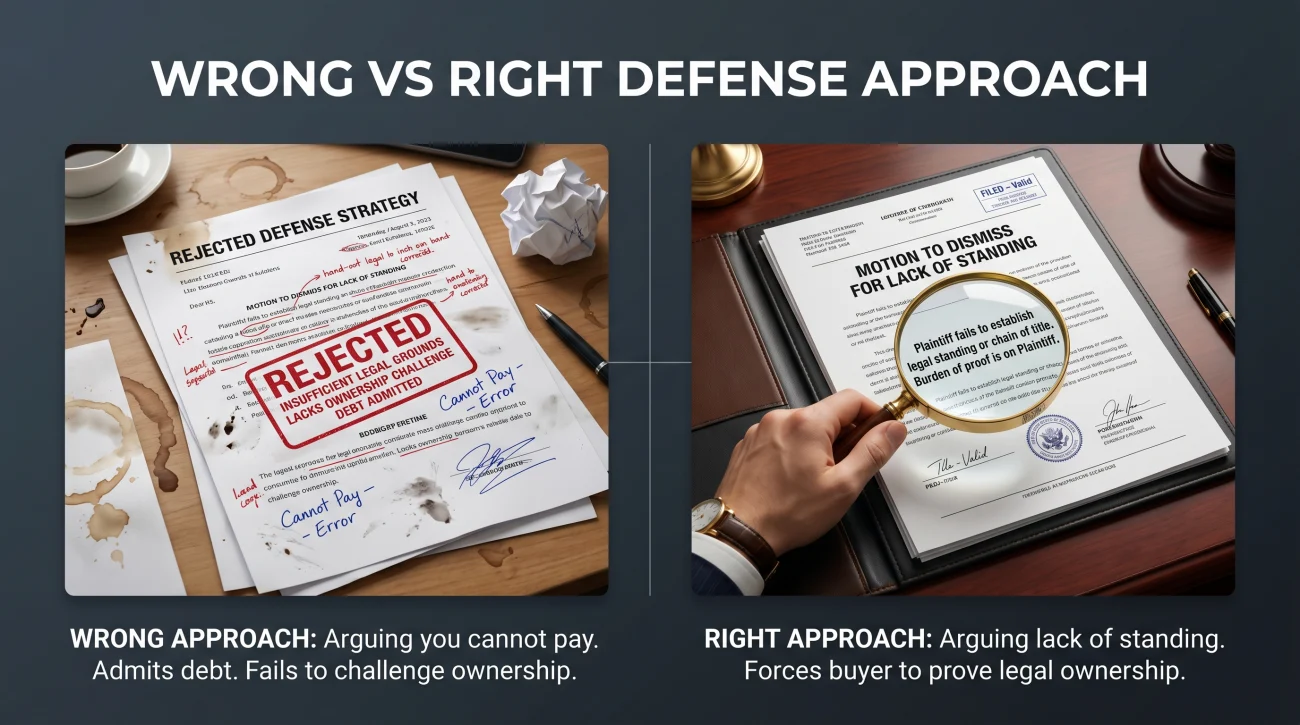
In legal terms, standing is the plaintiff’s right to bring the lawsuit in the first place. A court will only hear a case if the party filing the lawsuit has a direct, legally protectable interest in the outcome. In a debt collection lawsuit, standing means the plaintiff legally owns the debt they are trying to collect.
This is a critical distinction that many consumers misunderstand. Standing is not an argument about whether the debt existed at some point in the past. It is an argument about whether THIS specific company has the right to collect it from you right now.
Arguing “I do not owe this debt because I lost my job and could not pay.” This addresses why you defaulted, but it admits the debt is yours and does not challenge the debt buyer’s right to collect.
Arguing “The plaintiff has not proven they legally own this account and therefore lacks standing to bring this action.” This forces the debt buyer to produce legal documentation proving ownership.
Even if you know you owe the money to the original bank, if the debt buyer suing you cannot prove they legally acquired that specific account through a valid, unbroken chain of ownership, they lack standing. If they lack standing, the court must dismiss their case. You do not owe a debt buyer money simply because they say you do. They must prove their ownership with documentation.
Why Debt Buyers Have Standing Problems at Scale
To understand why lack of standing is such a common and powerful defense, you have to look at the economics of the debt buying industry. Debt buyers do not purchase accounts one by one. They buy them in bulk transactions containing thousands, sometimes tens of thousands, of defaulted accounts.
When a major bank sells off a block of bad debt, the purchasing company usually receives a generic “Bill of Sale.” This document typically says something broad like, “Seller hereby transfers the portfolio of accounts listed in the attached electronic file.” The debt buyer pays 3 to 10 cents on the dollar for this entire batch.
“From my side of the desk, standing was our most predictable vulnerability. We had strict internal metrics on smaller balances. If a defendant filed a proper Answer explicitly demanding the original chain of title for a $2,000 account, the directive was often to voluntarily dismiss the case. Paying our attorneys to hunt down redacted schedules and five-year-old bank records simply destroyed our profit margin on that specific file.”
Because the acquisition cost is so low, debt buyers expect a high default rate. They file thousands of lawsuits hoping that 70 to 90 percent of defendants will never respond to the summons. When a defendant defaults, the debt buyer wins a judgment automatically, without ever having to prove they had standing. But when a defendant files an Answer and demands proof of ownership, the debt buyer’s attorney suddenly has to dig up the actual paperwork.
Recent legal analyses of debt buyer litigation tactics highlight how these companies attempt to bypass this lack of original documentation. They often submit affidavits signed by their own employees, claiming to “authenticate” the original creditor’s records. However, in many states, only a qualified witness from the original creditor can legally authenticate those original business records. An employee of the debt buyer who just bought a bulk data file last week cannot testify to the accuracy of a bank’s record-keeping from five years ago.
What the Debt Buyer Must Prove to Establish Standing
When the debt buyer cannot rely on questionable employee affidavits, they are forced to produce the actual paper trail. To survive your standing challenge, the plaintiff must present a complete set of documents proving ownership, known as the chain of title.
To successfully establish standing in a contested case, a debt buyer generally must prove three things:
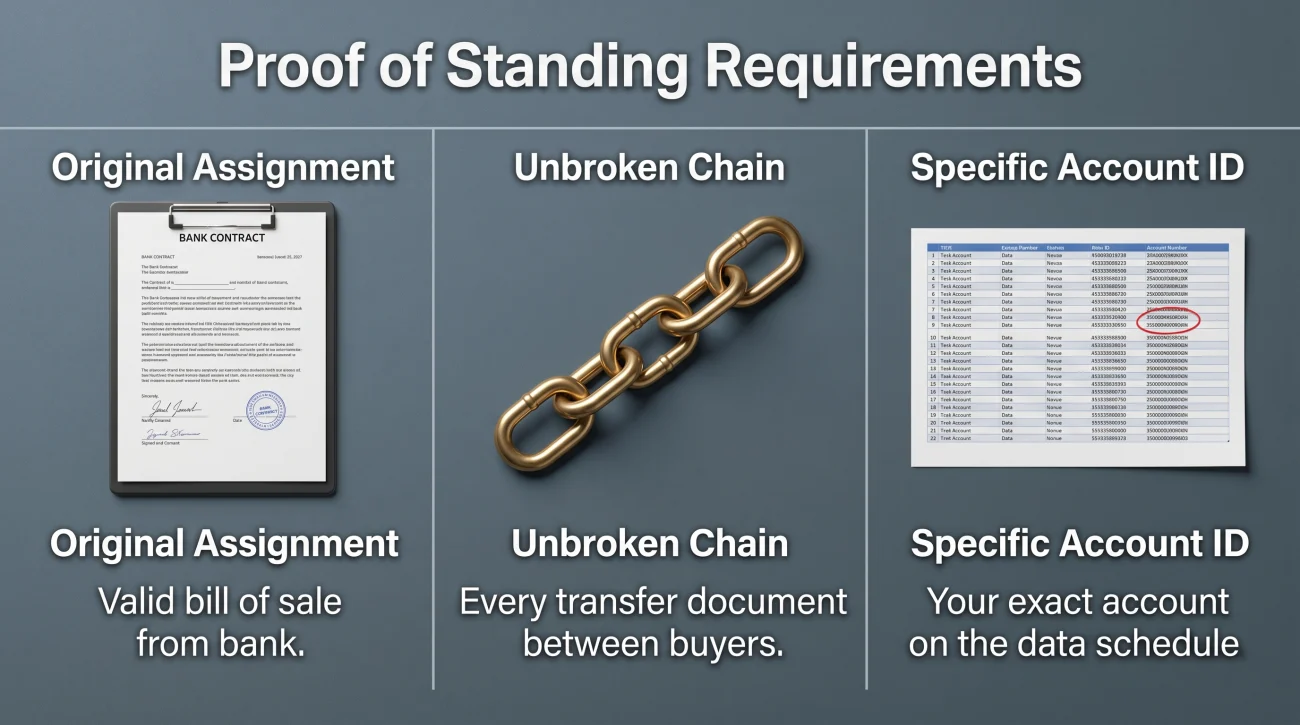
- The Original Assignment: They must produce a valid assignment or Bill of Sale transferring ownership from the original creditor (the bank or service provider) to the very first debt buyer.
- The Unbroken Chain: If the debt was sold multiple times, the current plaintiff must produce every single Bill of Sale for every transfer. Original Creditor to Buyer A. Buyer A to Buyer B. Buyer B to the Plaintiff. If there is a missing link anywhere in this chain, the plaintiff cannot prove they own the debt.
- Specific Account Identification: This is where most debt buyers fail. A generic Bill of Sale covering a massive portfolio is usually not enough. The plaintiff must produce the specific “Schedule of Accounts” or “Exhibit A” referenced in the Bill of Sale, and that exhibit must specifically list your name and your account number.
Courts and lawmakers are increasingly cracking down on sloppy documentation. Several states have enacted strict pleading requirements for debt buyer lawsuits. In these jurisdictions, debt buyers must show an unbroken chain of assignments, and your specific account must be explicitly identified in the transfer documents. A missing link equates to no standing. While rules vary heavily by state, the national trend is moving toward requiring concrete proof of ownership. Understanding the chain of title mechanics is essential for tearing apart their evidence.
How to Challenge Standing in Your Written Answer
The absolute most important rule regarding the standing defense is that you must actively raise it. The court will not automatically check the debt buyer’s paperwork for you. If you fail to respond to the lawsuit, or if you file an Answer but forget to challenge their ownership, you effectively waive your right to fight them on this issue later.
You preserve this defense by including it in the “Affirmative Defenses” section of your written Answer to the complaint.
Sample Affirmative Defense for Lack of Standing:
“Plaintiff lacks standing to bring this action because it has not demonstrated a complete and unbroken chain of title from the original creditor to Plaintiff establishing legal ownership of the alleged debt. Plaintiff has failed to attach documentation proving that Defendant’s specific account was legally assigned to Plaintiff.”
By placing this language in your Answer, you put the plaintiff on notice that their ownership is contested. You do not need to prove that they DO NOT own the debt at this stage. You are simply asserting that they have not proven that they DO own it, thereby shifting the burden of proof squarely onto their shoulders. For a complete list of other defenses you should consider asserting alongside this one, review our comprehensive guide on debt collection lawsuit defenses.
Using Discovery to Collapse Their Case
Filing the affirmative defense in your Answer is just the first step. The phase where cases are actually won or lost on the standing issue is called “discovery.” This is the formal process where both sides request documents and evidence from each other before a trial.
Because the debt buyer initiated the lawsuit, you have the right to demand they produce the documents proving their claims. To dismantle their standing, you must serve the plaintiff with a formal “Request for Production of Documents.”
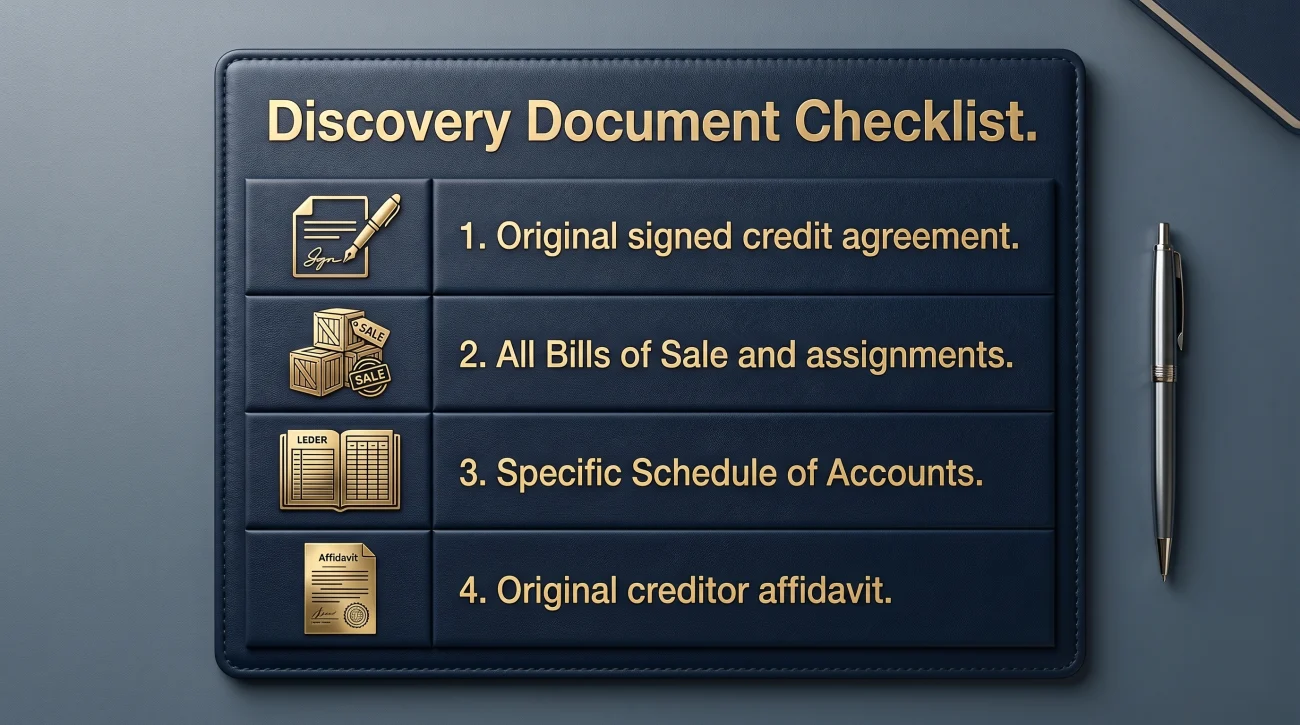
You should specifically demand the following items:
- The original credit agreement between you and the original creditor, bearing your signature. If they cannot produce this, you can invoke the debt buyer has no original contract defense.
- All Bills of Sale, assignments, or transfer agreements for every time the debt was sold, from the original creditor down to the current plaintiff.
- The specific Schedule of Accounts or Exhibit attached to each Bill of Sale that explicitly identifies your account number, name, and balance as being part of the transferred portfolio.
- Any affidavit from the original creditor authenticating the account records, not just an affidavit from a debt buyer employee.
💡 Pro Tip: This is where the debt buyer’s bulk-purchasing model actively works against them. Procuring a five-year-old original contract and a redacted schedule of accounts from a major bank takes significant time and legal expense. For a typical $2,500 collection lawsuit, it is often not economically viable for them to chase down the missing documents once you demand them.
When they cannot produce the documents requested in discovery, their standing defense collapses. At this point, the debt buyer may offer a highly favorable settlement, or more commonly, they may file a notice of voluntary dismissal to walk away from the case entirely.
Common Mistakes When Challenging Standing (And How to Fix Them)
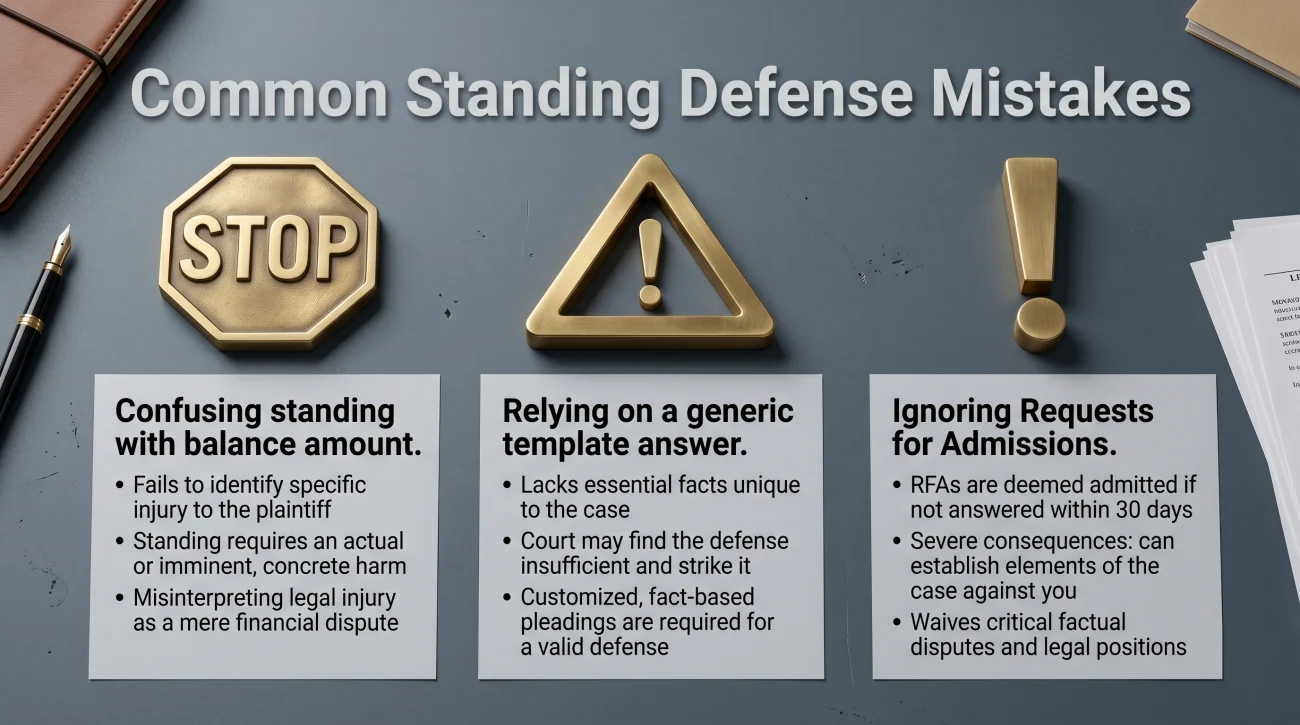
While challenging standing is highly effective, you can easily sabotage your own defense with procedural errors. Based on the patterns I watched play out in courtrooms for years, here is how to avoid or fix the most common traps.
Mistake 1: Confusing standing with the balance amount.
Do not stand before a judge and argue, “I already paid part of this,” while also trying to argue lack of standing. If you focus on the balance being wrong, you implicitly admit the plaintiff is the correct party to sue you. Keep your standing argument focused strictly on their lack of ownership documentation. If you must dispute the amount, separate the arguments clearly in your Answer.
Mistake 2: Relying on a generic template without the specific defense.
A simple “general denial” prevents an automatic default, but it does not always force the plaintiff to prove an unbroken chain of title. The Fix: If you already filed a basic Answer and forgot to include the standing defense, check your court’s rules for filing an “Amended Answer.” Many courts allow you to amend your response within a short window (often 20 days) of your original filing.
Mistake 3: Ignoring Requests for Admissions.
If the plaintiff’s attorney sends you a discovery packet asking you to “Admit that Plaintiff is the legal owner of the account,” ignoring it is fatal. Courts automatically treat ignored requests as admitted facts after the deadline (usually 30 days). The Fix: Respond in writing before the deadline. Simply write “Denied. Defendant lacks sufficient information to verify Plaintiff’s ownership” next to those claims, sign the document, and send it back to their attorney.
Signs the Plaintiff Likely Lacks Standing in Your Case
If you are evaluating how aggressive to be with your defense strategy, you need to recognize the red flags in the plaintiff’s lawsuit. Certain indicators strongly suggest the debt buyer will struggle to prove standing if pushed.
You have a high probability of successfully challenging standing if any of the following apply to your case:
- The plaintiff is a known third-party debt buyer (like those mentioned earlier) rather than the original bank or hospital.
- You do not recognize the name of the company suing you at all.
- The lawsuit complaint does not attach the original signed credit agreement.
- The complaint attaches a generic “Bill of Sale” but fails to attach a specific data schedule showing your individual account was part of that transaction.
- The debt is very old, or you know the account has been sold to multiple different collection agencies over the years before this lawsuit was filed.
If your case features several of these weaknesses, the debt buyer is likely relying entirely on you defaulting. Fighting back on the grounds of standing can drastically change the outcome. However, executing discovery requests and navigating court procedures requires precision. If you want to know exactly how to leverage their missing paperwork to force a dismissal, consulting a professional debt lawsuit attorney to fight the case is the safest way to ensure their lack of standing is fully exposed. An experienced attorney knows exactly how to compel the missing documents and push for a dismissal when the collector fails to produce them. You can read more about the procedural paths to getting the debt collection lawsuit dismissed once their evidence falls apart.
Final Thoughts on the Standing Defense
Getting sued for a debt is intimidating, but realizing that the company suing you might not even have the legal right to do so completely shifts the power dynamic. Debt buyers operate a volume-based business model that relies on cheap, incomplete documentation and the assumption that you will simply give up.
Challenging their standing is not about asking the court for a loophole. It is about demanding that the legal system hold debt collectors to its own standards. A plaintiff must prove they own the asset they are suing over. By raising the lack of standing defense and demanding the paper trail, you force them to do the work they hoped to avoid. Make them prove their case, and watch how often they choose to walk away.
❓ FAQ
⚖️ Can I use the lack of standing defense if the debt is actually mine?
Yes. Standing has nothing to do with whether you spent the money. It is entirely about whether the specific company suing you has the legal paperwork to prove they bought the right to collect it. You are legally permitted to force them to prove their ownership.
📈 Will getting the lawsuit dismissed for lack of standing fix my credit report?
Not automatically. A dismissal means they cannot collect the debt through the court system, but it does not erase the underlying delinquent account from your credit history. The original charge-off from the original creditor will typically remain on your report for seven years, even if the debt buyer’s lawsuit is thrown out.
📑 Can a debt buyer fix their lack of standing after I point it out?
Technically yes, by going back to the seller to retrieve the missing transfer documents. However, practically, this is often too expensive or impossible if the records are old or the original creditor has purged them. This is why many debt buyers prefer to drop the case instead.
🛑 What is the difference between dismissal with or without prejudice if I win?
If the case is dismissed “without prejudice,” the debt buyer could theoretically find the paperwork and sue you again later. If it is dismissed “with prejudice,” the case is permanently closed, and they are barred from ever suing you for that specific debt again.
🗣️ Can a debt buyer employee testify to prove standing?
Often, they try, but it can be challenged. Debt buyers frequently submit affidavits from their own employees to authenticate account records. In many jurisdictions, courts rule that only a qualified witness from the original creditor can legally authenticate the original business records.
🤝 Will challenging standing help me settle the debt?
Yes. If a debt buyer realizes they cannot produce the documents required to prove standing, the cost and risk of taking your case to trial skyrocket. They are often highly motivated to offer a deeply discounted settlement to salvage some profit rather than losing everything in court.
What each stage of litigation requires and where your leverage sits.
- What the lawsuit process looks like from summons to judgment
- What to file, when to file it, and what happens if you do not
- The legal arguments that can defeat a debt collection lawsuit
- What a default judgment allows collectors to do and how to fight one
- How to negotiate a resolution once litigation has started
Once judgment is entered, collectors gain tools they did not have before.
- The FDCPA violations collectors commonly commit during the collection process
- How to respond to a debt lawsuit and what defenses are available to you
- How a judgment becomes a garnishment order on your paycheck
- When a collector uses a judgment to freeze your bank account instead
- How to settle before the judgment turns into something harder to stop
Disclosure: The content on this site reflects direct experience inside the debt collection industry and is grounded in federal law and regulation. It is informational in nature. Reading it does not constitute legal advice and does not create any professional relationship. If you are dealing with a lawsuit, a judgment, or a legal deadline, consult a licensed attorney in your state before acting.