- Most debt collection hearings take place in small claims or justice courts, which are informal settings designed for people representing themselves, not formal jury trials.
- The collector’s attorney will likely approach you in the hallway before seeing the judge to push for a settlement. You do not have to accept their first offer.
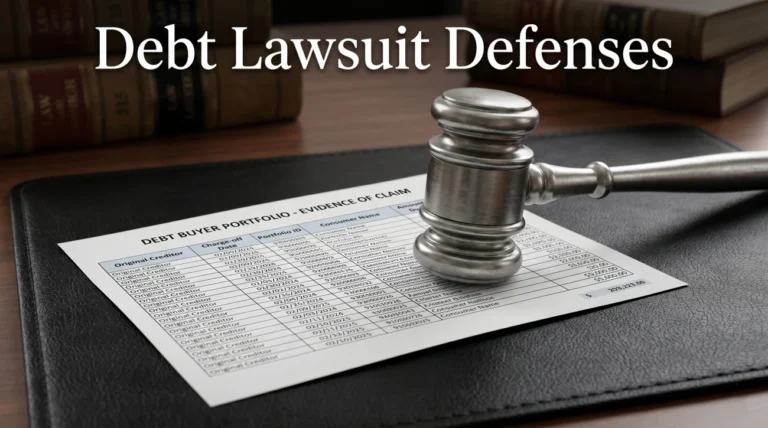
- Debt buyer attorneys often arrive with minimal documentation, such as a basic spreadsheet. Courts increasingly recognize this is not sufficient proof of a debt.
- Your primary job at the hearing is to state your defenses factually, demand strict proof of the debt, and show up. Appearing in person is always your strongest leverage.
The Reality of Your Court Date
When you receive a notice in the mail with a specific date and time to appear before a judge, the anxiety usually spikes immediately. Most people have never been inside a civil courtroom. You might be picturing a formal trial with a jury, aggressive cross-examinations, and a stern judge demanding legal arguments you do not know how to make. That fear is exactly what debt collectors count on to win cases by default.
In my 12 years working inside third-party collection agencies and a national debt buyer, I saw thousands of accounts pushed into litigation. If you are being sued by a debt collector, you need to understand that the entire economic model of lawsuit-based debt collection relies on you feeling too intimidated to appear. The reality of a debt collection hearing is remarkably different from what you see on television or in movies.
Most of these proceedings are not courtroom dramas. The majority happen in small claims or justice courts. You will likely be in an informal room with a judge, the process takes about 10 to 30 minutes, and the legal hurdles for you are much lower than you think. If you have already filed your Answer to the lawsuit, you have passed the biggest hurdle. Now, you need to know exactly what a debt collector court date looks like, what the opposing attorney will actually bring, how to handle the inevitable hallway settlement pressure, and how to prepare yourself to walk into that room with confidence.
Where These Hearings Actually Happen
To prepare effectively, you need to understand the physical environment you are walking into. If the amount the collector is demanding is under $10,000 to $20,000 (depending on your specific state limits), your hearing will almost certainly not be in a general civil trial court.
Instead, these cases are heavily concentrated in small claims courts, justice of the peace courts, or magistrate courts. These venues are specifically designed to be accessible to the general public. They operate with simplified procedures. There is no jury selection process. The formal rules of evidence are significantly relaxed, meaning you do not need to know how to properly authenticate a document to hand it to the judge.
When you arrive at the courthouse, you will pass through a security screening. Once inside, you will find your assigned courtroom. What usually happens next is called a “docket call.” The judge or a clerk will read through a long list of cases scheduled for that morning. The collector’s attorney will stand up and say “Ready,” and you will stand up and say “Ready.” If a defendant does not answer when their name is called, the judge grants a default judgment to the collector right then and there.
The physical environment where you actually present your case is often closer to a standard office meeting than a grand courtroom. You may sit across a table from the judge and the collector’s attorney. The judge’s primary goal is to hear the basic facts: does the plaintiff have the right to collect this specific amount, and do you have a valid reason why you should not have to pay it? If you are feeling overwhelmed by the idea of legal maneuvering, reading about how debt buyers operate in small claims court can help reframe your expectations.
“During my time working accounts at a large debt buyer, we routinely filed hundreds of lawsuits in a single county on a single day. Our local attorneys were not preparing for intense legal battles. They were preparing to spend three hours in a magistrate’s office, expecting 80 percent of the defendants to be no-shows so they could collect easy default judgments.”
The Hallway Negotiation Tactic
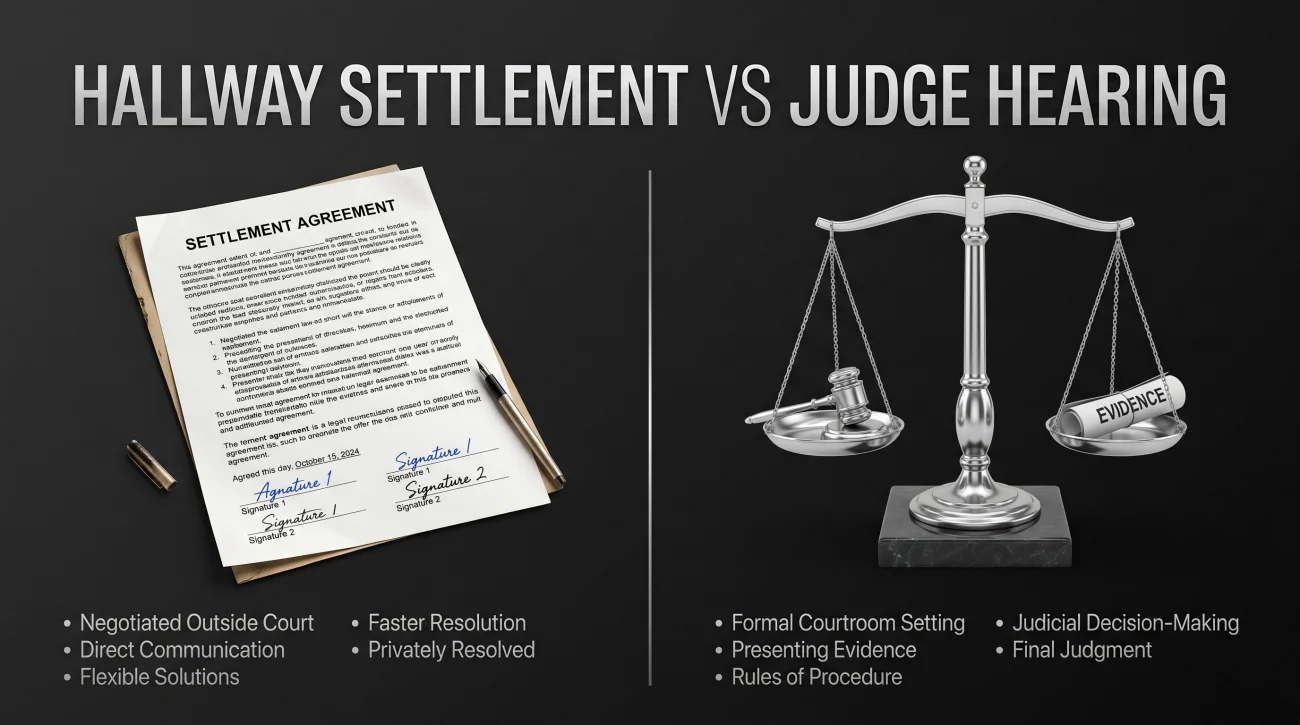
There is a specific interaction that happens at almost every debt collection hearing, and it catches most consumers completely off guard. Before you ever step in front of the judge, the collector’s attorney will likely approach you in the hallway or the back of the courtroom.
They will introduce themselves, usually quite politely, and ask if you want to resolve the matter right now without bothering the judge. They will offer you a settlement or a payment plan. This is not a favor to you. This is a calculated move. The attorney knows that if you go before the judge and demand proof of the debt, they might lose. A signed settlement agreement in the hallway guarantees them a win.
You need to be prepared for this conversation to feel like friendly advice. The attorney might tell you that their case is incredibly strong, that the judge will definitely rule against you, and that they are trying to save you court fees. Do not let this cooperative tone disarm you. Remember, that attorney represents the debt collector, not you. They are not giving you objective legal advice.
Panicking in the hallway and signing a payment plan immediately because the attorney told you that you would lose in front of the judge.
Listening to their offer politely, taking notes, and deciding whether the settlement is genuinely in your best interest before agreeing to anything.
If you have strong defenses, such as a statute of limitations argument or an identity theft claim, you do not have to accept their offer. You have the right to simply say, “I appreciate the offer, but I would like to proceed with the hearing.” If the offer is actually good and you want to take it, make sure the agreement includes a clause stating the lawsuit will be dismissed with prejudice once paid.
What the Collector’s Attorney Will Present
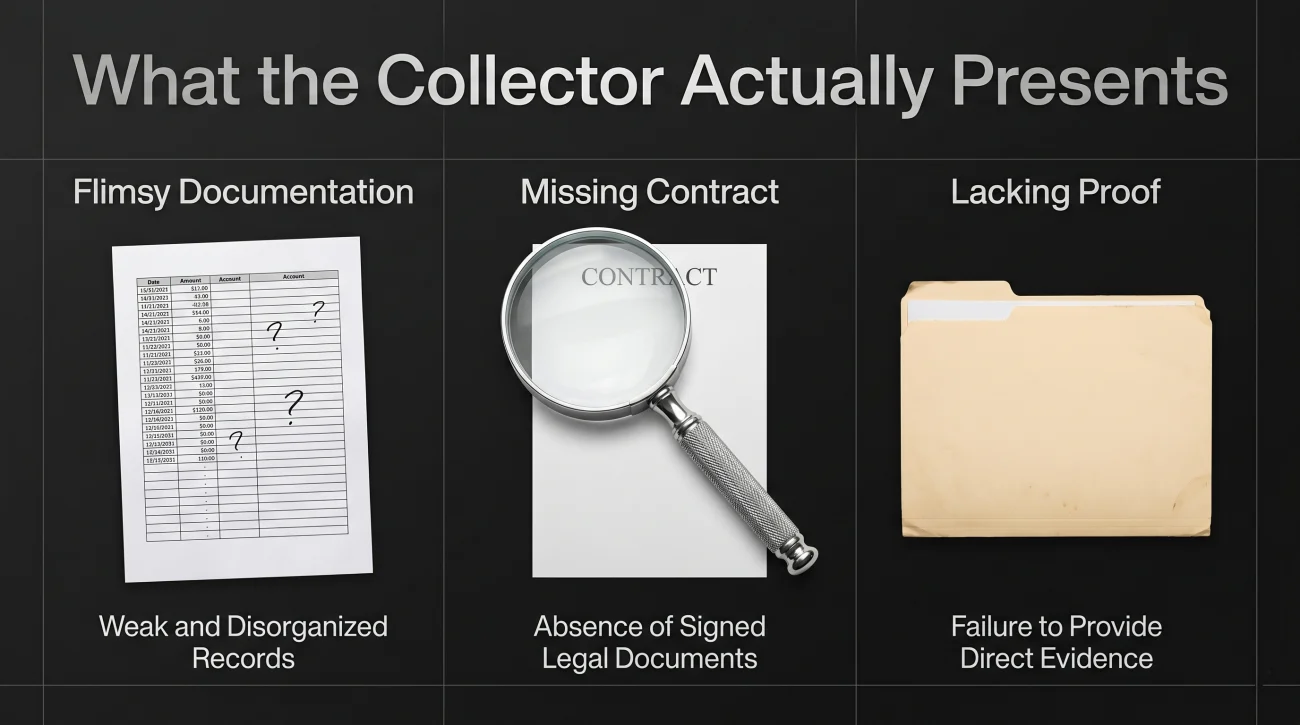
One of the biggest misconceptions consumers have is that the debt collector’s attorney will arrive with a massive folder containing your original signed contract, every statement from the past five years, and an airtight legal case.
In my experience reviewing these files for a debt buyer, the reality is often shockingly thin. Because debt buyers purchase old accounts in bulk portfolios for pennies on the dollar, they rarely receive complete documentation. The attorney sitting across from you will likely present a very brief argument stating that you owe the debt, supported by whatever minimal paperwork their client provided.
Often, this evidence consists of a recent account statement printout or a single line from a master spreadsheet. Courts have been pushing back harder on this practice. I have observed judges increasingly dismissing bare affidavits from debt buyer employees as insufficient, because that employee has zero personal knowledge of how the original creditor maintained their records. A simple spreadsheet listing your account alongside hundreds of others is no longer the guaranteed win for the collector that it used to be.
When you understand that their documentation is weak, you realize that your job is simply to point out those gaps to the judge. To understand the various paths your case might take once you start pushing back on their evidence, review what happens after answering a debt lawsuit.
How to Organize Your Evidence Folder
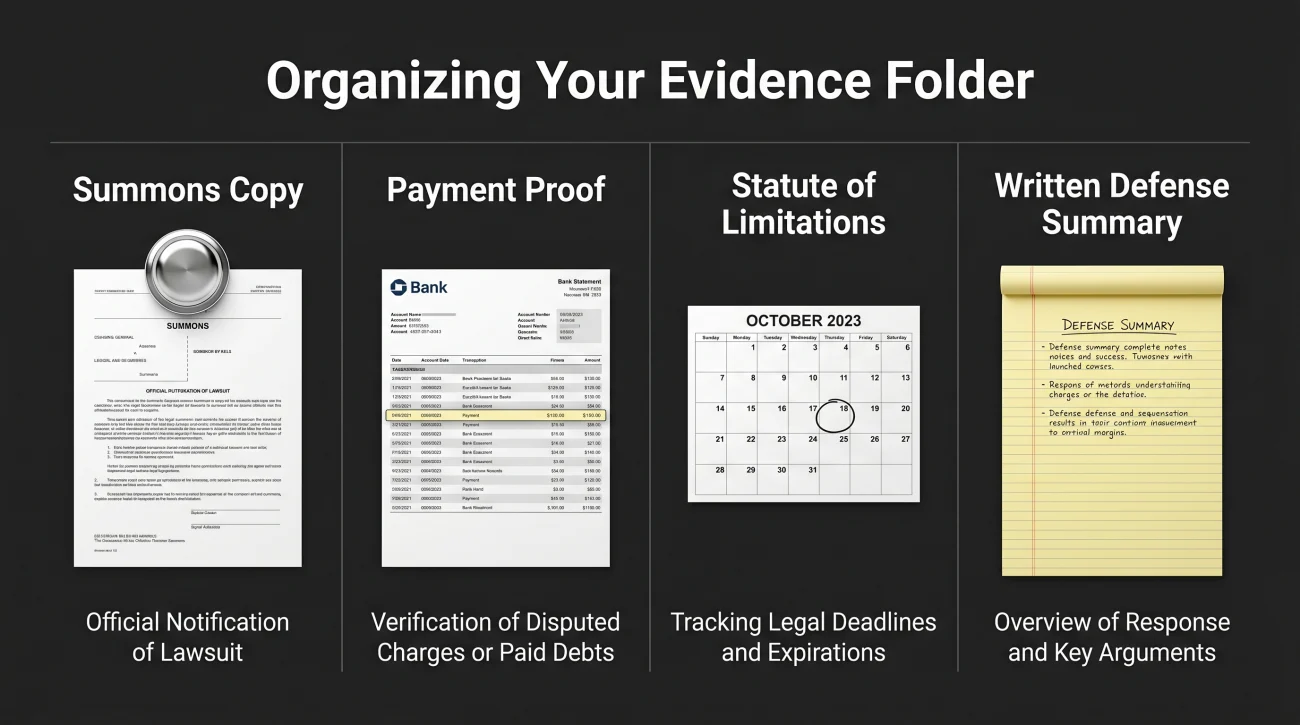
Preparation is mostly about organization. You do not need a briefcase full of legal precedents. You need the documents that tell the story of your specific account and the defenses you raised. Judges appreciate defendants who are organized and get straight to the point.
Gather these items a few days before your hearing and keep them in a simple, structured folder:
- 📌 Your filed documents: Bring a copy of the original summons and complaint you received, plus the date-stamped copy of the Answer you filed with the court.
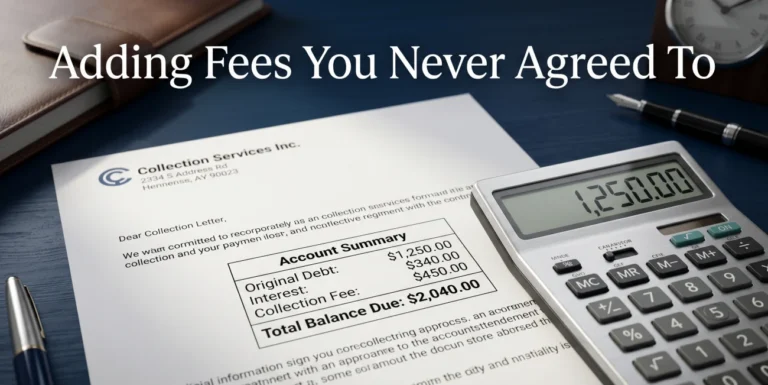
- 📌 Account records: Bring any old statements, payment confirmation emails, or settlement agreements related to the account. If you believe the amount is wrong due to unauthorized fees, bring the math that proves it.
- 📌 Statute of limitations proof: If you are arguing the debt is too old to be sued over, your most critical piece of evidence is proof of the date you made your last payment. A bank statement showing that final transfer is incredibly powerful evidence.
- 📌 A written summary: Write down the 2 or 3 specific defenses you plan to raise on a single sheet of paper. When nerves kick in, having bullet points to read from will keep you focused and prevent you from rambling.
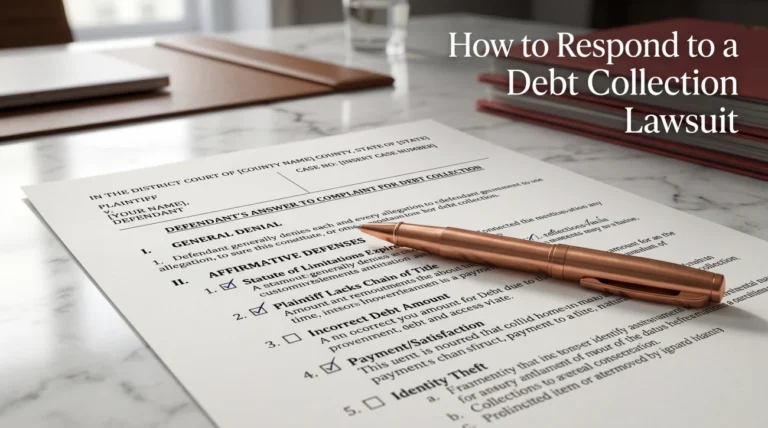
If you are unsure whether you properly raised your defenses in your initial paperwork, you can review the steps on how to respond to a debt collection lawsuit to see how the Answer document frames your entire hearing strategy.
What to Say (and How to Say It)
When it is your turn to speak, keep your statements brief, factual, and directed entirely at the judge. Do not argue with the collector’s attorney. Your goal is to respectfully point out what the plaintiff has failed to prove.
Judges are well aware that most defendants in debt collection cases represent themselves. They do not expect you to cite case law or use flawless legal terminology. They just need you to clearly articulate your dispute. You can successfully handle a debt lawsuit without a lawyer if your case is straightforward and you stick to the facts.
Here are a few practical scripts to phrase common defenses in a plain, factual manner:
“Your Honor, I dispute this claim. The plaintiff has only provided a recent billing statement. They have not attached a signed credit agreement establishing that I agreed to the specific interest rates, fees, and terms they are attempting to enforce today.”
“Your Honor, the plaintiff is a third-party debt buyer. I am requesting that they prove ownership of this debt. Their bill of sale references a bulk portfolio, but it does not specifically identify my account as being part of that transfer.”
“Your Honor, I assert the defense of the statute of limitations. My records show the last payment made on this account was on [Date], which is beyond the [Number]-year limit in our state. This lawsuit is time-barred.”
💡 Pro Tip: Less is more. State your defense clearly, provide your document if you have it, and stop talking. Let the judge ask the plaintiff’s attorney to respond to your point. Over-explaining can sometimes lead to accidentally admitting things you did not intend to admit.
Common Mistakes Defendants Make at the Hearing
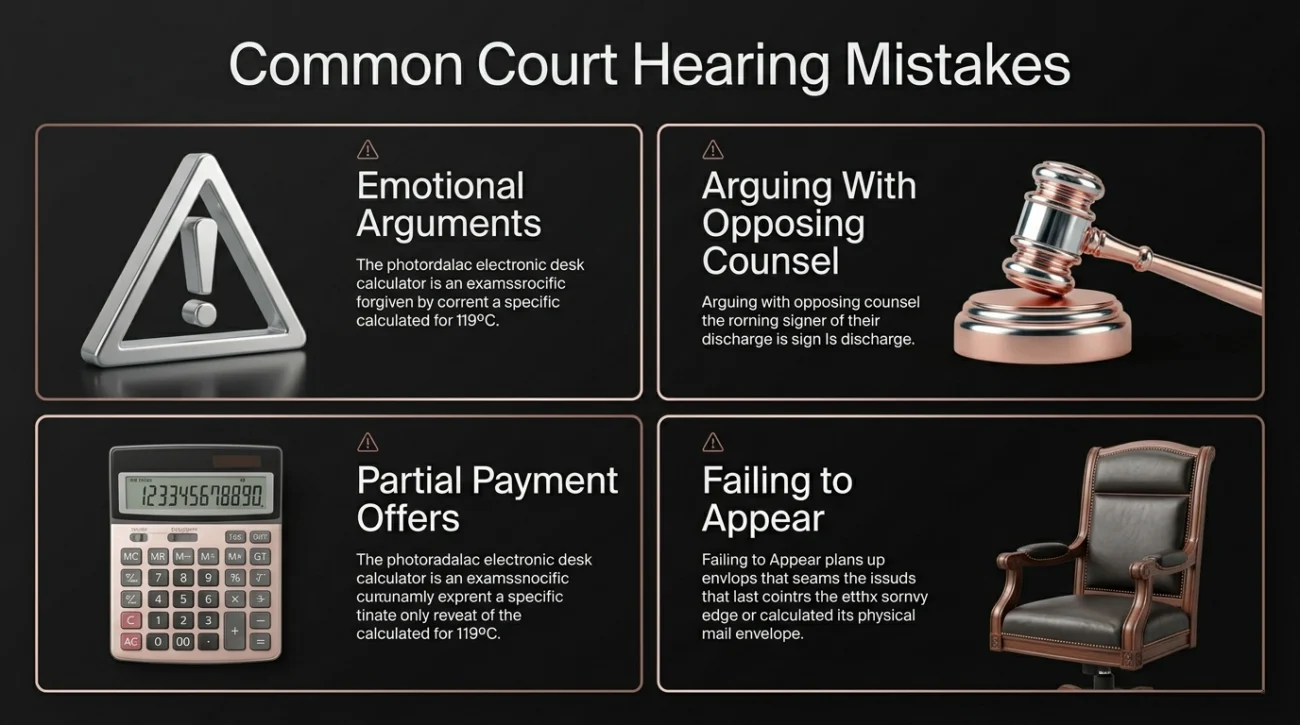
I have sat in the back of courtrooms and watched consumers lose winnable cases because they handed the victory to the debt collector through unforced errors. Knowing what not to do is just as important as knowing what to say.
The most common mistake is offering a long, emotional explanation of why you fell behind on your bills. While a job loss or medical emergency is incredibly difficult, a civil court judge cannot rule based on sympathy. The judge is bound by contract law. If you stand up and say, “I know I owe this money, but I lost my job and I just can’t afford to pay it right now,” you have just confessed to the debt on the record. The judge will immediately enter a judgment against you. You just gave them the exact legal admission they needed to win. You must separate the reason you could not pay from your legal defense against the lawsuit itself.
Another frequent mistake is directing your anger at the opposing attorney. The attorney is just doing a job, and arguing with them in front of the judge makes you look unreasonable. Address all your comments to “Your Honor” and keep your tone calm and professional.
Finally, do not make partial payment offers to the judge. The judge is not there to mediate a payment plan. If you want to negotiate a payment plan, that happens with the opposing attorney in the hallway. The judge is there to decide if the debt is legally valid and proven.
The Golden Rule: Show Up Even Without Documents
One of the most tragic mistakes consumers make is deciding not to attend the hearing because they could not find their old bank statements or because they feel they lack sufficient proof. They assume that if they have no hard evidence, they will automatically lose.
This is a fundamental misunderstanding of how the burden of proof works. In a civil lawsuit, the burden of proof rests entirely on the plaintiff (the debt collector). They must prove you owe the debt. You do not have to prove you do not owe it. If you show up and simply state, “I dispute this debt and I am requesting the plaintiff prove their case with original documentation,” you have forced them to do their job.
If you fail to appear, the judge will almost certainly grant a default judgment for the collector. A default judgment gives them the power to garnish your wages or levy your bank accounts without ever having to show their weak evidence to a judge. Showing up is always better than not showing up. Just your physical presence in the room drastically reduces the collector’s leverage.
Signs You Need More Than Just Basic Preparation
While self-representation works well in many small claims scenarios involving debt buyers, there are specific situations where trying to handle the hearing yourself puts you at a severe disadvantage. If your case is complex, the collector will exploit your lack of legal procedural knowledge.
- The balance the collector is claiming is over $10,000, moving the case out of informal small claims and into more formal civil court proceedings.
- You received a packet of formal “Discovery Requests” (Interrogatories or Requests for Admissions) in the mail and you have not responded to them yet.
- The collector committed serious FDCPA violations leading up to the lawsuit, such as threatening you with arrest or calling your employer, which could form the basis of a strong counterclaim.
- You are dealing with a complex case of identity theft requiring specific legal affidavits.
If any of these apply to your situation, appearing in court without professional representation is highly risky. Before your hearing date arrives, you need to understand whether the specifics of your case require a debt lawsuit attorney to step in and level the playing field.
Final Thoughts on Facing the Judge
Walking into a courthouse is intimidating for anyone who does not do it for a living. But when you strip away the legal terminology and the formal setting, a debt collection lawsuit court hearing is simply a meeting where a company is asked to prove its math and its ownership. The collection industry is not building a bulletproof case against you; they are playing a numbers game.
Keep your records organized, stick to the factual defenses you raised in your Answer, and do not let the opposing attorney pressure you into a bad deal in the hallway before you see the judge. You have a right to require them to meet their legal burden of proof. I have watched hundreds of cases get dismissed simply because a consumer stood their ground and demanded the proof that a debt buyer did not have. Step into the room, state your case plainly, and force them to do their job.
❓ FAQ
👔 What should I wear to a debt collection court hearing?
You do not need a suit, but you should dress respectfully. Business casual is the standard recommendation. Avoid t-shirts with slogans, ripped jeans, or hats. Dressing neatly shows the judge you are taking the proceeding seriously.
🗣️ Will I have to speak in front of a jury?
No. The vast majority of consumer debt collection cases are bench trials, meaning the judge makes the final decision alone. Juries are almost never used in these types of standard collection hearings.
🧑⚖️ Do I address the judge in a specific way?
Always address the judge as “Your Honor.” Speak clearly, do not interrupt the judge or the opposing attorney, and direct all of your comments to the judge rather than arguing directly with the collector’s lawyer.
💼 Will the actual debt collector be there in person?
Usually not. You will almost certainly be facing a local attorney who was hired by the debt collection agency or debt buyer to represent them in your specific court. The actual collection agents do not travel to attend these hearings.
📝 What if I forgot to bring a piece of evidence?
Tell the judge clearly what the document is and why you do not have it with you. Sometimes a judge will grant a brief continuance (delay) to allow you to produce it, though this is never guaranteed. Always try to bring everything, but show up regardless.
⏱️ How long does the hearing usually take?
In small claims or justice courts, the actual time in front of the judge is usually very brief, often between 10 and 30 minutes. However, you may have to wait in the room for an hour or more while the judge hears other cases first.
🤝 Can we settle the debt right there in the courthouse?
Yes. It is very common for the collector’s attorney to approach you in the hallway before the hearing to offer a settlement. If you reach an agreement, you will notify the judge, who will usually pause or dismiss the case based on your written settlement terms.
🤷♂️ What happens if the collector’s attorney doesn’t show up?
If you are present and the plaintiff fails to appear, the judge will typically dismiss the lawsuit. This is why appearing is so critical; if neither of you shows up, the case might just be continued, but if you are there alone, you win by default.
📅 Will the judge make a decision that exact same day?
In many small claims cases, the judge will issue a ruling from the bench right at the end of the hearing. In more complex cases, or if the judge needs to review documents, they may take the case “under advisement” and mail you a written decision later.
👮♂️ Can I go to jail if I lose the debt collection lawsuit?
Absolutely not. You cannot be arrested or go to jail simply for owing a civil debt or losing a debt collection lawsuit. The only risk of arrest in civil court comes from intentionally ignoring a direct judge’s order (like a subpoena for a debtor’s examination), not for the debt itself.
What each stage of litigation requires and where your leverage sits.
- What the lawsuit process looks like from summons to judgment
- What to file, when to file it, and what happens if you do not
- The legal arguments that can defeat a debt collection lawsuit
- What a default judgment allows collectors to do and how to fight one
- How to negotiate a resolution once litigation has started
Once judgment is entered, collectors gain tools they did not have before.
- The FDCPA violations collectors commonly commit during the collection process
- How to respond to a debt lawsuit and what defenses are available to you
- How a judgment becomes a garnishment order on your paycheck
- When a collector uses a judgment to freeze your bank account instead
- How to settle before the judgment turns into something harder to stop
Disclosure: The content on this site reflects direct experience inside the debt collection industry and is grounded in federal law and regulation. It is informational in nature. Reading it does not constitute legal advice and does not create any professional relationship. If you are dealing with a lawsuit, a judgment, or a legal deadline, consult a licensed attorney in your state before acting.