- Most defendants in debt collection cases represent themselves because they cannot afford an attorney. In standard debt buyer cases, this is a completely viable and effective path.
- Filing a basic written response prevents an automatic loss and forces the collector to prove their case with actual documentation.
- Self-representation works best in small claims courts, for lower balances, and when dealing with third party debt buyers who often lack original contracts.
- Filing your response often triggers a settlement offer. Collectors would rather negotiate a reduced lump sum than spend expensive attorney hours taking a self-represented defendant to trial.
- If a collector broke the law by harassing you, consumer protection attorneys frequently take these cases on contingency, meaning you might not have to pay out of pocket to fight back.
The Reality of Facing a Lawsuit When You Cannot Afford a Lawyer
Getting served with court papers is terrifying. The first instinct for anyone facing a legal problem is to look for a lawyer. The second instinct, which usually happens about five minutes later, is realizing that hiring a lawyer might cost as much as the debt itself. For someone already struggling with financial hardship, paying a retainer fee of two thousand dollars to fight a three thousand dollar credit card lawsuit is mathematically impossible.
This financial constraint leads many people to simply give up. They ignore the summons, throw the papers in a drawer, and allow the debt collector to win by default. This is exactly the outcome the debt collection industry relies on to stay profitable.
During my twelve years managing accounts inside third party collection agencies, I reviewed thousands of litigation files. We had a specific status code for accounts where the consumer filed their own response without an attorney. The legal term for this is acting “pro se” or self-representation. Many consumers assume that collectors love seeing a self-represented defendant because they are an easy target. That assumption is entirely false.
“When a consumer filed a basic written response on their own, the mood on the collection floor shifted immediately. A self-represented defendant who simply demands proof forces the debt buyer to do the exact same amount of expensive legal work as a high priced defense attorney would. In many cases, that single piece of paper caused us to pull the file from the active litigation queue and route it straight to the settlement desk.”
You can effectively respond to a debt collection lawsuit without an attorney in many situations. Because the legal burden rests entirely on the collector to prove you owe the specific amount to them, simply participating in the process is often enough to protect your rights. However, you must know exactly what you can handle yourself, what steps come after you file, and when you absolutely need professional help.
Know Your Opponent: Original Creditor vs. Debt Buyer
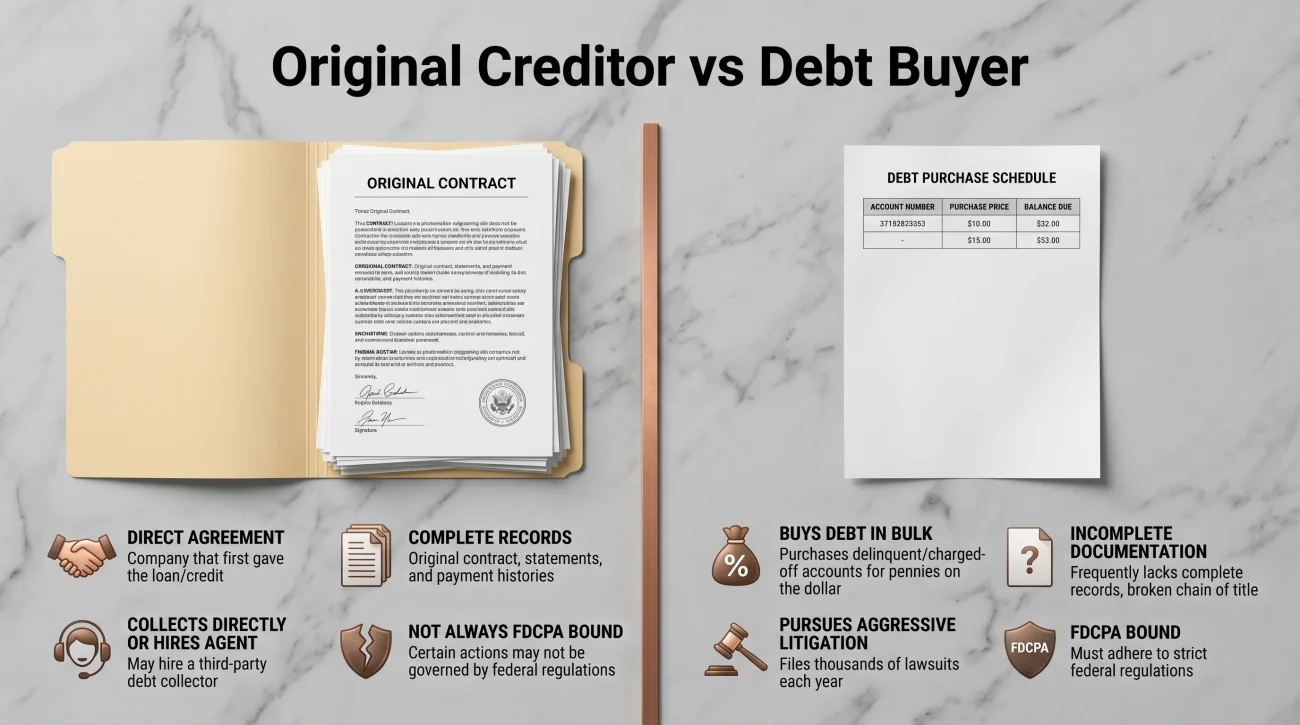
Before you decide to represent yourself, you must identify exactly who filed the lawsuit. The strategy, the risks, and the likelihood of success change dramatically based on the name of the plaintiff listed on your summons.
If the lawsuit was filed by the bank or company that initially issued your credit card, such as Chase, Discover, or Capital One, you are facing an original creditor. They still own the debt on their balance sheet. Because they issued the card, they typically possess perfect documentation. They have your signed application, every monthly statement, and a flawless record of your payments. Fighting an original creditor on your own is extremely difficult because their evidence is usually rock solid.
However, if the plaintiff is a company like Midland Funding, Portfolio Recovery Associates, or Jefferson Capital, you are facing a third party debt buyer. These companies bought your defaulted account in a massive bulk portfolio, often paying just pennies on the dollar. They receive basic electronic data, not filing cabinets full of original signed contracts. This documentation gap is their greatest weakness. Debt buyers rely heavily on consumers ignoring the lawsuit. When you show up and demand actual proof of the contract and the chain of ownership, their low cost business model frequently falls apart.
Where Self Representation Actually Works Well
Not all lawsuits require deep legal maneuvering. Some cases require nothing more than showing up and asking the plaintiff to prove their claims. Self representation is highly effective when you can leverage specific structural advantages or circumstances in your favor.
Small Claims and Justice Court Cases
If the amount you are being sued for is relatively low, the collector likely filed the case in small claims court or a justice of the peace court. These courts are explicitly designed for people without lawyers. The rules of evidence are relaxed. There is no jury. The judges are accustomed to speaking directly with consumers in plain English. If you want to understand the specific environment you are walking into, reviewing what to expect in small claims court proceedings will significantly reduce your anxiety.
Debts Past the Statute of Limitations
If the lawsuit is for a very old account, the specific identity of the debt buyer matters less than the timeline. Every state has a strict legal time limit for creditors to file a lawsuit, known as the statute of limitations. If the collector filed the paperwork after that window closed, you hold a definitive defense. Raising an expired statute of limitations as an affirmative defense in your Answer can force the judge to dismiss the case entirely, regardless of whether you actually owed the original balance.
Cases Requiring Only a General Denial
In many states, if a debt buyer sues you, you do not need to write a ten page legal brief explaining why you do not owe the money. You can use a tactic called a general denial. This is a highly simplified response where you formally deny all the allegations and demand the plaintiff prove them.
This works because civil litigation places the burden of proof entirely on the plaintiff. You are not committing perjury by refusing to admit to a debt. You are simply exercising your right to make the debt buyer produce the original signed contract and an unbroken chain of ownership documents. Because debt buyers purchase accounts in bulk, they frequently lack this specific paperwork. A one sentence general denial exploits this exact structural weakness, making it completely legally sufficient in numerous jurisdictions to prevent an automatic loss.
The Essential Steps You Can Execute Yourself
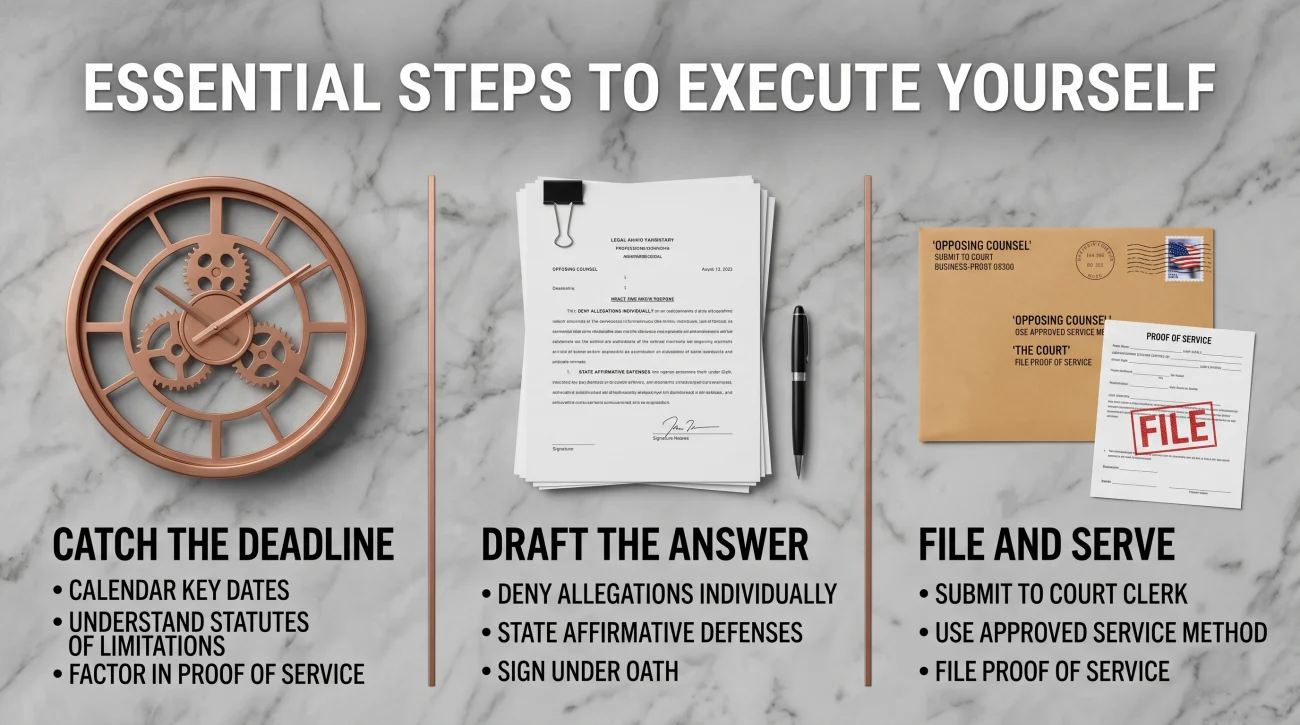
If you decide to handle the initial stages of the lawsuit yourself, there is a strict chronological process you must follow. None of these steps require a law degree, but they do require absolute attention to detail.
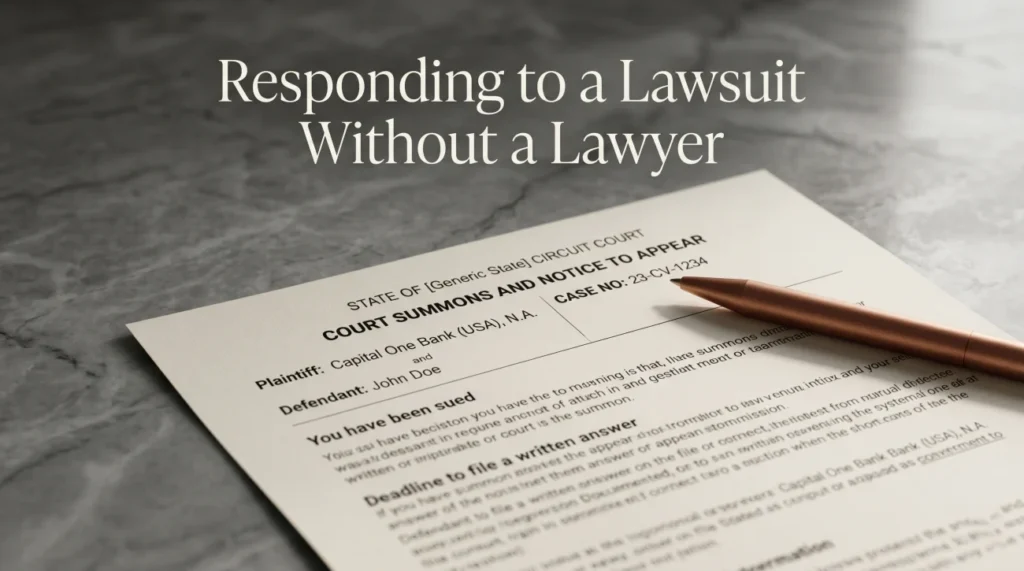
First, you must catch the deadline. Read the cover page of the court documents carefully to find your response window. This is typically between fourteen and thirty days from the exact date you were handed the papers or signed for the certified mail. Do not guess this date.
Second, you must draft your official response, which the court calls an Answer. This is the document where you admit or deny the collector’s claims and list your affirmative defenses like the statute of limitations or mistaken identity. You can learn exactly how to format your written response document to ensure it meets basic court standards.
Third, you must file and serve that document. You take your printed Answer to the court clerk and pay the filing fee. Crucially, you must then mail a stamped copy directly to the law firm representing the debt collector. Understanding how the entire debt collection lawsuit process works will help you see why serving the opposing attorney is the step that actually forces them to pause their automated litigation machine.
What Actually Happens After You File
A common misconception is that filing an Answer immediately results in a dramatic courtroom trial. In reality, filing the paperwork simply moves you to the next phase of the process, and that phase is often highly advantageous for a self-represented consumer.
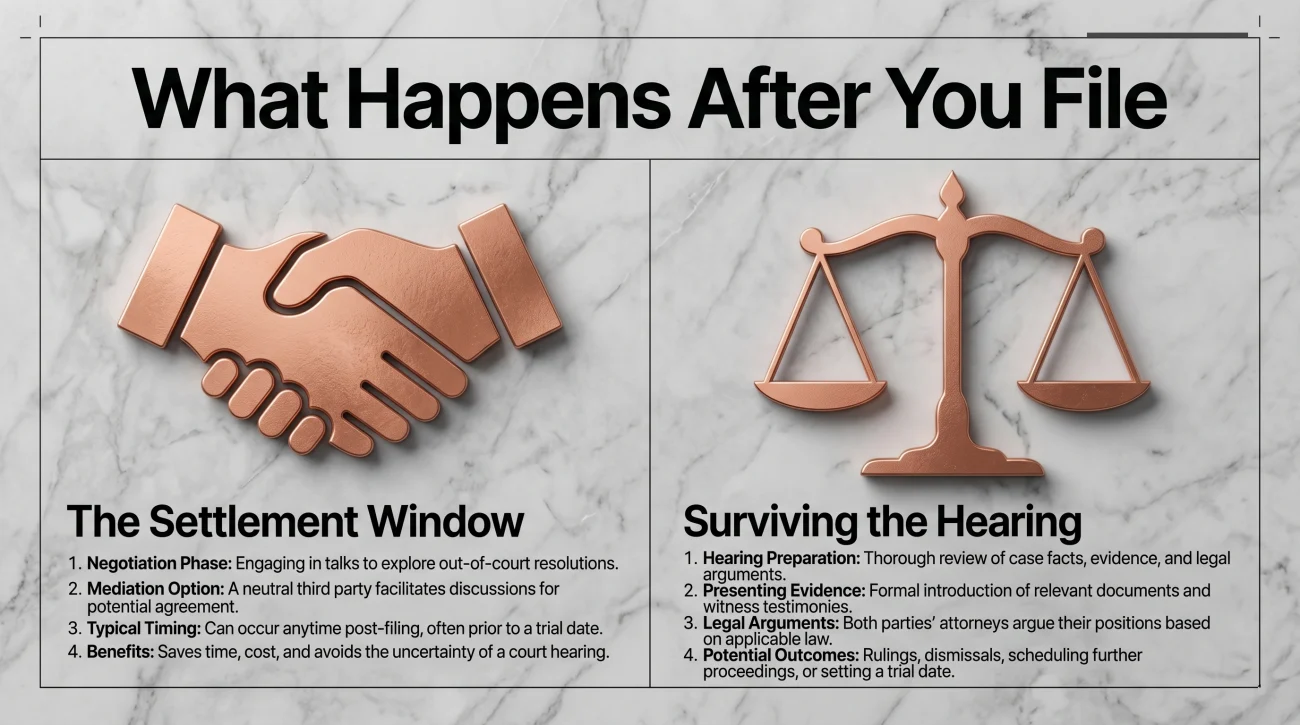
The Settlement Window
Once the collector receives your Answer, their cost calculation changes completely. They expected you to ignore the lawsuit so they could win for free. Now, they have to pay an attorney to review your defenses, gather evidence, and attend a hearing. Because of this, filing your response often triggers a settlement offer. Negotiating a settlement after filing your response gives you incredible leverage because the collector wants to avoid spending time and money on a trial.
If you want to negotiate, you can reach out directly to the plaintiff’s attorney. Debt buyers will often accept a lump sum payment of a fraction of the total balance because they bought the debt for pennies on the dollar. Original creditors are generally more rigid but will still negotiate payment plans. If you do reach a settlement, you must demand that the written agreement includes a “dismissal with prejudice.” This specific legal phrase ensures they cannot simply drop the lawsuit today and refile it against you next year. Never send a payment until that written agreement is signed.
Surviving the Court Hearing
If the case does not settle, the court will eventually schedule a hearing or pretrial conference. You must show up. Judges heavily penalize defendants who file paperwork but fail to appear in person.
When you stand before the judge, you do not need to act like a lawyer on television. Dress respectfully, bring three copies of your filed Answer, and have a notepad ready. Keep your statements brief and strictly factual. Do not overshare personal life stories, explain why you fell behind, or admit to the debt. Simply state to the judge that you dispute the amount and you are requesting the plaintiff to produce the original contract, a full statement of account, and the bill of sale proving ownership. If the debt buyer’s attorney shows up with nothing but a computer printout, many judges will refuse to grant them a judgment.
The Free Resources Designed for Your Situation
You do not have to figure out court formatting completely in the dark. Because so many consumer debt cases involve self representation, the legal system has built safety nets to guide you through the procedural maze.
Your first and best resource is the court clerk’s office. Every courthouse has clerks who manage the filing of documents. You just need to understand the strict boundary of what a clerk can and cannot do for you.
“The collector is lying about this balance. What defense should I write down to make the judge dismiss this case today?” Clerks are legally prohibited from answering this.
“I need to file an Answer to this civil summons. Does this specific court have a standardized fill in the blank form I can use, and how many copies do you require me to bring?”
Beyond the physical courthouse, almost every state maintains a robust online legal aid website (often ending in .org or .gov). If you search for “legal aid debt collection defense” along with your state name, you will typically find free, court approved templates that you can download, print, and fill out at your kitchen table.
💡 Pro Tip: If your income is below a certain threshold, ask the court clerk for a Fee Waiver Application (sometimes called an In Forma Pauperis petition). If approved, you will not have to pay the standard fee to file your Answer.
Where Self Representation Becomes Dangerous
While handling the initial response is highly manageable, certain situations escalate quickly. Pushing forward without help in these specific scenarios often leads to an expensive loss.
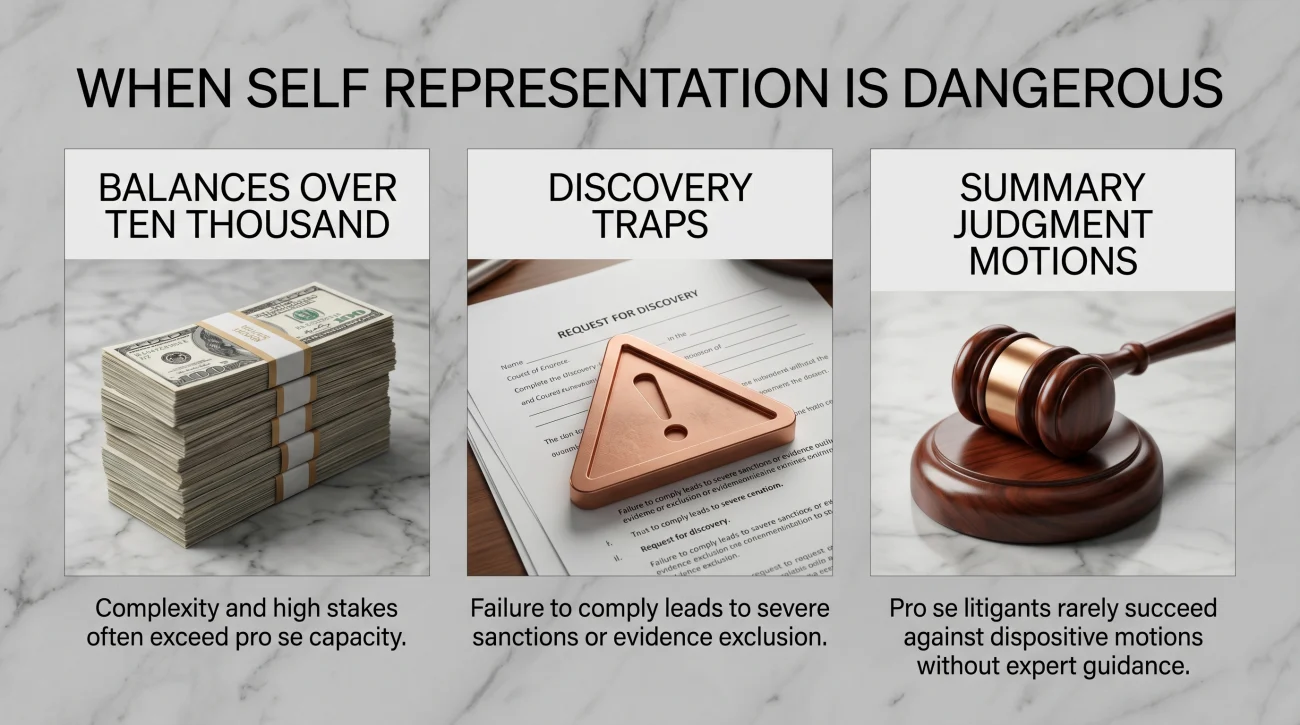
Balances Over Ten Thousand Dollars
If you are being sued for fifteen or twenty thousand dollars, the stakes are simply too high for trial and error. At these amounts, the collector’s law firm will dedicate senior attorney time to the case. They will fight hard because the potential recovery is massive. The cost of hiring your own lawyer is easily justified by the amount of financial exposure you are facing.
The Discovery Requests Trap
Sometimes, shortly after you file your Answer, the collector’s attorney will mail you a thick packet of documents called “Discovery.” The most dangerous document in this packet is titled Requests for Admissions. It is a list of statements like “Admit that you owe $5,000.”
If you ignore this document, the court automatically assumes you admitted to everything on the list. Debt buyers use this trap constantly to defeat self-represented consumers who think they are safe just because they filed an initial Answer. If you receive discovery paperwork, you are in deep water.
Motions for Summary Judgment
If you check your mail and find a “Motion for Summary Judgment,” the collector is asking the judge to end the case and declare them the winner without ever having a trial. Defeating this motion requires drafting a formal legal opposition, citing rules of civil procedure, and submitting sworn affidavits. This is extremely difficult for a layperson to execute correctly, meaning professional legal help becomes practically mandatory.
The Contingency Fee Reality: When Lawyers Are Free
Hitting one of those dangerous scenarios can feel completely defeating. When the legal maneuvering becomes complex, the standard advice is to hire an attorney, which brings you right back to your original problem: you cannot afford one.
However, before you give up, you need to review exactly how the collector treated you leading up to the lawsuit. If they used aggressive, deceptive, or illegal tactics to collect the debt, the legal landscape shifts in your favor. Federal law changes the economics of hiring an attorney in these specific situations.
The Fair Debt Collection Practices Act (FDCPA) dictates what collectors can and cannot do. If a debt collector broke this law, you have the right to hold them accountable. Crucially, the FDCPA includes a “fee shifting” provision. If you sue a collector for violating your rights and win, the debt collector is legally required to pay your attorney’s fees.
Because of this rule, consumer protection attorneys frequently take FDCPA cases on contingency. A contingency fee means the attorney gets paid a percentage of the damages they recover from the collector, charging you nothing out of pocket to start the case.
Examples of FDCPA Violations That Trigger Contingency Representation:
1. The collector called your workplace after you clearly told them your employer prohibits such calls.
2. The collector threatened to have you arrested, threatened criminal fraud charges, or claimed they would send the police to your home.
3. The collector continued to call you repeatedly after you sent them a written cease and desist letter.
4. The collector filed a lawsuit against you knowing the debt was past your state’s statute of limitations.
The Power of the Counterclaim
If a collector broke this law, you have the right to file a counterclaim. A counterclaim is essentially you suing them back within the exact same lawsuit. You typically file this document alongside your Answer. When a debt collector faces a valid FDCPA counterclaim, their entire leverage evaporates. They are no longer just trying to win your debt; they are defending their own wallets against damages and penalties. This creates immense pressure for them to drop their lawsuit and walk away.
Final Thoughts on Facing the Court Alone
The legal system looks incredibly intimidating from the outside, but consumer debt litigation at the lower dollar levels is largely a paperwork machine. Debt collectors rely on fear to secure default judgments. When you step into the process, file an Answer, and demand proof, you throw a wrench into that machine.
You do not need to be a legal scholar to protect your paycheck from a debt buyer who has no proof of their claims. Secure a blank Answer form from your local county court website, draft your general denial, list your basic defenses, and physically file the document before the countdown expires. Whether you take the case to a hearing, use your response to negotiate a favorable settlement, or pass the file to an attorney to pursue a counterclaim, your first step is identical. Do not ignore the summons. Force them to prove their case.
Red Flags: When Self-Representation Becomes Impossible
While taking action is critical, you must also recognize when to step back. If you try to represent yourself and fail, or if you simply ignore the lawsuit altogether, the court will issue a default judgment against you. With a judgment in hand, the collector can legally order your employer to garnish your wages or issue a bank account levy to freeze your checking account.
If you are reading this and realize your response deadline has already passed, your wages are currently being garnished, or you have received a formal Motion for Summary Judgment, self-representation is no longer your best path. The cost of a lost lawsuit far outweighs the cost of a consultation. In these scenarios, hope is not entirely lost, but you must prioritize having a professional evaluate your lawsuit options. An attorney can review your case for procedural errors to vacate the default judgment and reopen the fight. A default judgment is powerful, but it is not always permanent. Do not let a collector drain your paycheck without forcing them to defend their process.
❓ FAQ
⚖️ Does filing an Answer mean I have to go to a full trial?
Not usually. Filing an Answer simply prevents the collector from winning automatically. Once they realize you intend to fight, most debt buyers will reach out to offer a settlement long before a trial ever happens.
⏰ What happens if I already missed the deadline on my summons?
If you missed the deadline, the collector will ask the court for a default judgment. However, if the judgment hasn’t been officially signed yet, some courts will still accept a late Answer. If the judgment is finalized, you may need an attorney to help you file a motion to vacate it.
🏛️ Can I represent myself against an original creditor like Chase or Capital One?
Yes, but it is much harder than fighting a third party debt buyer. Original creditors usually have perfect documentation, original signed agreements, and exact account histories. If an original creditor is suing you for a large amount, self-representation is highly risky.
📅 How do I know if the statute of limitations has expired on my debt?
You need to check your state’s specific laws for debt collection time limits and compare it to the date of your very last payment on the account. If the collector filed the lawsuit after that time window closed, you have a complete defense.
📄 What should I do if I receive a packet called “Discovery” in the mail?
Do not ignore it. Discovery documents, especially “Requests for Admissions,” are designed to trap you. If you fail to respond to them within the strict deadline, the court assumes you admitted to everything the collector claimed, guaranteeing you will lose.
💰 What if I can’t afford the court filing fee for my Answer?
If you have low income, you can ask the court clerk for a Fee Waiver Application (In Forma Pauperis). If you prove financial hardship, the judge can waive the filing fee, allowing you to submit your response for free.
🗣️ Can a court clerk give me advice on how to fight my case?
No. Court clerks are strictly prohibited from giving legal advice. They can tell you which forms to use, how many copies you need, and where to file them, but they cannot tell you what legal defenses to write down.
🤝 Do I need a lawyer to negotiate a settlement?
You do not strictly need a lawyer to negotiate a settlement, but having one helps significantly if the balance is large. If you negotiate yourself, always make sure you get the final agreement in writing before sending any money.
What each stage of litigation requires and where your leverage sits.
- What the lawsuit process looks like from summons to judgment
- What to file, when to file it, and what happens if you do not
- The legal arguments that can defeat a debt collection lawsuit
- What a default judgment allows collectors to do and how to fight one
- How to negotiate a resolution once litigation has started
Once judgment is entered, collectors gain tools they did not have before.
- The FDCPA violations collectors commonly commit during the collection process
- How to respond to a debt lawsuit and what defenses are available to you
- How a judgment becomes a garnishment order on your paycheck
- When a collector uses a judgment to freeze your bank account instead
- How to settle before the judgment turns into something harder to stop
Disclosure: The content on this site reflects direct experience inside the debt collection industry and is grounded in federal law and regulation. It is informational in nature. Reading it does not constitute legal advice and does not create any professional relationship. If you are dealing with a lawsuit, a judgment, or a legal deadline, consult a licensed attorney in your state before acting.