- Discovery is the formal process where both sides exchange information after an Answer is filed. Receiving a thick packet of questions from the collector’s attorney is standard procedure.
- The most dangerous document in that packet is the “Request for Admissions.” If you do not respond to these statements by the deadline, courts automatically accept them as true.
- A general denial in your initial Answer does not cover Requests for Admissions. You must respond to the discovery packet separately.
- Debt buyers rely on defendants ignoring discovery to win easy summary judgments without ever going to trial.
- You have the right to send your own discovery requests demanding the original contract and chain of title.
The Stack of Papers That Can End Your Case Before Trial
You did exactly what you were supposed to do. You received a court summons, you figured out your deadline, and you successfully filed your Answer with the court. You probably felt a brief sense of relief, thinking the ball was now in the judge’s court. Then, a few weeks later, a thick envelope arrives in the mail from the debt collector’s attorney.
Inside is a dense packet of legal documents with intimidating titles: Interrogatories, Requests for Production of Documents, and Requests for Admissions. To someone who has never been involved in a civil lawsuit, this packet looks like a final exam you haven’t studied for. Many people set the envelope on the kitchen counter, planning to deal with it later.
That is exactly what the debt collector is counting on.
In my 12 years working inside third-party collection agencies and a national debt buyer, I saw exactly how collection law firms weaponize the legal process against consumers. Debt collection discovery requests are not just about gathering facts. In volume debt litigation, they operate as a trap. The law firm representing the debt buyer knows that if you ignore this specific packet of papers, they can win the lawsuit automatically, even if you have rock-solid defenses.
If you are navigating the phases detailed in our overview of being sued by a debt collector, receiving this packet means your case has entered active litigation. You are no longer just a name on a spreadsheet; you are in a procedural chess match. Understanding what these documents are, and specifically how to avoid the “admissions trap,” is the difference between keeping your case alive and having a judgment entered against you without a trial.
What Are Debt Collection Discovery Requests?
In civil litigation, neither side is supposed to be surprised at trial. “Discovery” is the formal legal process where both parties are required to exchange evidence, ask questions, and clarify the facts of the case before anyone steps in front of a judge.
When a debt buyer files a lawsuit, their initial complaint is often intentionally vague. After you file your Answer denying their claims and demanding proof, the discovery phase begins. This is where the collector’s attorney attempts to force you to admit to the debt in writing, or provide the financial documents they lack.
“From the inside perspective, sending a massive discovery packet is a standard attrition tactic. Debt buyer law firms mail these out automatically to anyone who files an Answer. They don’t expect you to fight through the paperwork. They expect you to miss the 30-day deadline, at which point their paralegals immediately file a motion to win the case based on your non-response.”
The timeline is strict. When you receive these documents, the clock starts ticking immediately. In most jurisdictions, you have 28 to 30 days to mail your formal, written responses back to the opposing attorney. If you do not know how your state calculates this window, reviewing the rules on what happens after answering a debt lawsuit is your next logical step.
The Discovery Cascade: A Typical Timeline
📌 Day 1: You receive the discovery packet in the mail.
📌 Day 30: Your deadline to serve written responses expires.
📌 Day 35-45: The collector’s attorney files a Motion for Summary Judgment based on your silence.
📌 Day 60+: The judge grants the motion. A default judgment is entered against you without a trial.
Improper and Tricky Tactics During Discovery
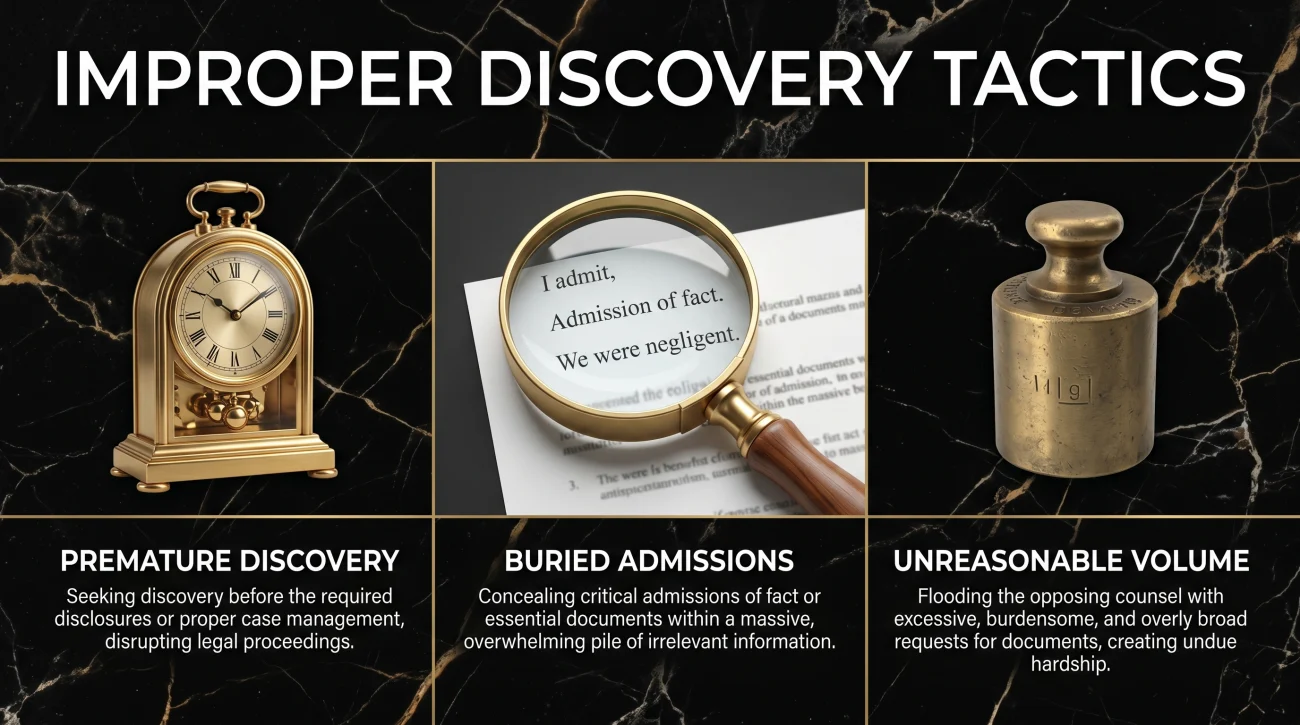
Because discovery is a highly procedural tool, debt collectors sometimes push into legal gray areas or use deceptive formatting, hoping you do not know your rights. You should be watching for these common tactics:
- Premature Discovery: In many jurisdictions, a plaintiff cannot serve discovery requests before they have properly served you with the lawsuit summons and complaint. If discovery arrives before you even know you are being sued, the timing is likely invalid.
- Buried Admissions: While not technically illegal, this is a highly deceptive maneuver. Collectors sometimes hide Requests for Admissions inside a long list of generic Interrogatories, hoping you will gloss over them. Read every heading carefully.
- Unreasonable Volume: State rules typically cap the number of questions a party can ask. If a debt buyer sends you an excessive number of questions for a simple credit card debt, you have the right to object to the requests as overly burdensome and harassing.
The Four Types of Discovery (And Which Ones to Watch For)
When you open the envelope from the plaintiff’s attorney, you will likely find a combination of different legal instruments. They usually arrive bundled together. You need to identify what you are looking at so you can respond correctly.
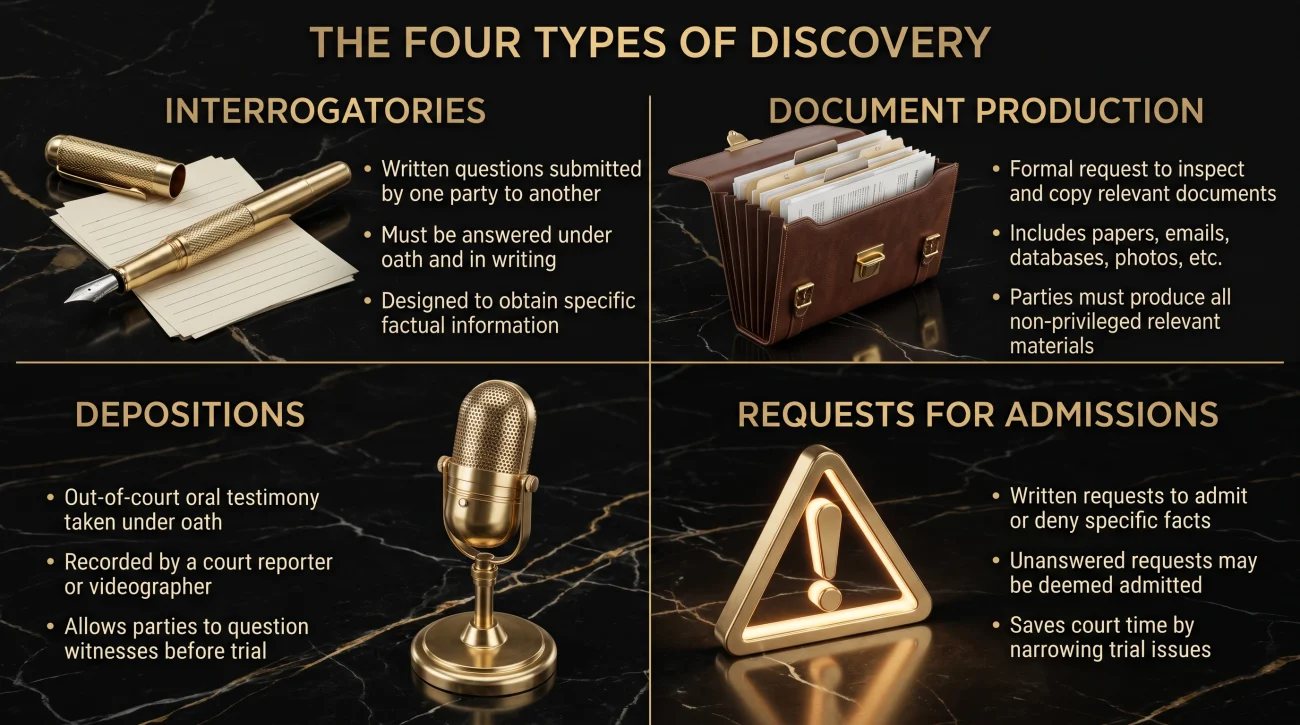
1. Interrogatories
Interrogatories are written questions that you must answer in writing, under oath. In a debt collection case, they are usually generic. The collector might ask you to state your full name, list past addresses, or explain the basis of any defenses you raised in your Answer.
The golden rule for interrogatories is to answer truthfully, but narrowly. Do not volunteer information that was not asked. Do not write a narrative explaining your financial hardship. Keep your answers brief and factual.
2. Requests for Production of Documents
This is a formal demand for you to provide physical copies of documents, such as bank statements or correspondence with the original creditor.
If you have documents that prove you paid the debt, you will identify them here. However, you are only required to produce documents currently in your possession or control. If the collector asks for original credit card statements from six years ago and you do not have them, a perfectly valid legal response is stating that after a diligent search, the requested documents are not in your possession.
3. Depositions
A deposition is face-to-face questioning under oath, usually recorded by a court reporter. In standard consumer debt collection cases, depositions are exceedingly rare because they are too expensive for a debt buyer to conduct over a low-balance account.
If you receive a notice of deposition, it signals that your case is highly unusual. Perhaps it involves a massive balance or complex fraud claims. You should immediately object to the cost and burden, and this is a clear indicator that you need to consult an attorney. Do not attend a deposition unrepresented.
4. Requests for Admissions
These are not open-ended questions. They are a list of declarative statements, and you are required to either “Admit” or “Deny” each one. Examples include:
- Admit that you opened an account with Citibank ending in 1234.
- Admit that you owe the Plaintiff the sum of $4,200.
While interrogatories and document requests are tedious, they are largely informational. The final document type requires immediate, specific attention.
The Request for Admissions Trap (The Most Dangerous Document)
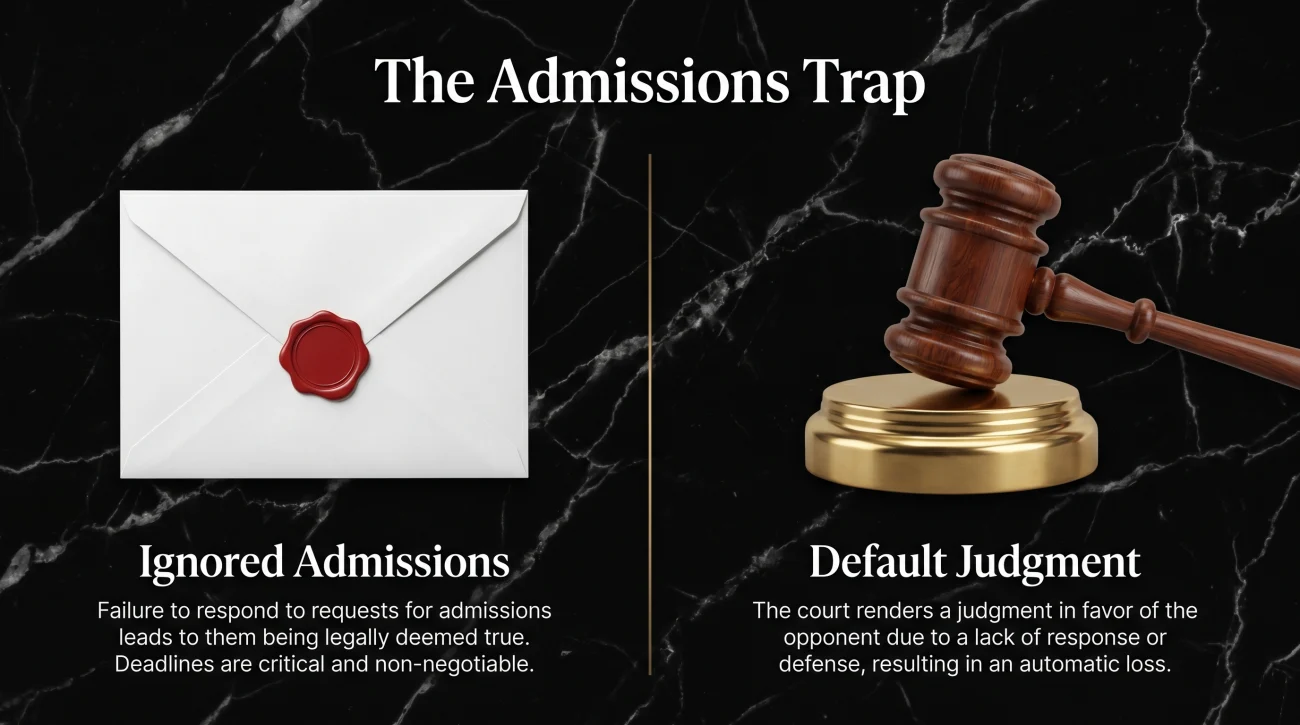
Requests for Admissions are designed as a trap for defendants representing themselves. Ignoring them is the fastest way to lose a case you otherwise could have won.
Under the rules of civil procedure in almost every state, if a party sends you a Request for Admissions and you do not respond to them in writing by the deadline, the court considers every statement in that document to be automatically admitted as true.
Think about the mechanics of that rule. The debt buyer’s attorney sends you a paper that says, “Admit you owe us $5,000.” You put it in a drawer. On day 31, because you did not explicitly deny it, the court legally accepts that you owe the $5,000. It is an automatic admission by silence.
Once those statements are admitted, the collector’s attorney immediately files a “Motion for Summary Judgment.” They tell the judge, “Your Honor, we don’t need a trial. The defendant failed to respond, which means they have legally admitted they owe the debt.” The judge will almost always grant it.
The Fatal Misunderstanding: The General Denial
When consumers read up on how to respond to a debt collection lawsuit, they often learn about filing a “general denial” in their Answer. This is a broad statement filed with the court denying the collector’s claims and forcing them to prove their case.
The fatal mistake occurs when the discovery packet arrives later. Consumers think, “I already filed my Answer with the court denying everything. I don’t need to fill out these papers.”
This is legally incorrect. Legal guides from multiple states explicitly clarify this scenario: A general denial in your initial Answer does not operate to deny Requests for Admissions. If the collector embedded Requests for Admissions inside the original complaint, or mailed them separately a week later, your initial Answer does not protect you. You must respond to the specific admissions document.
Understanding the trap is the first step. The second is knowing exactly how to dismantle it on paper.
How to Respond to Discovery in a Debt Lawsuit
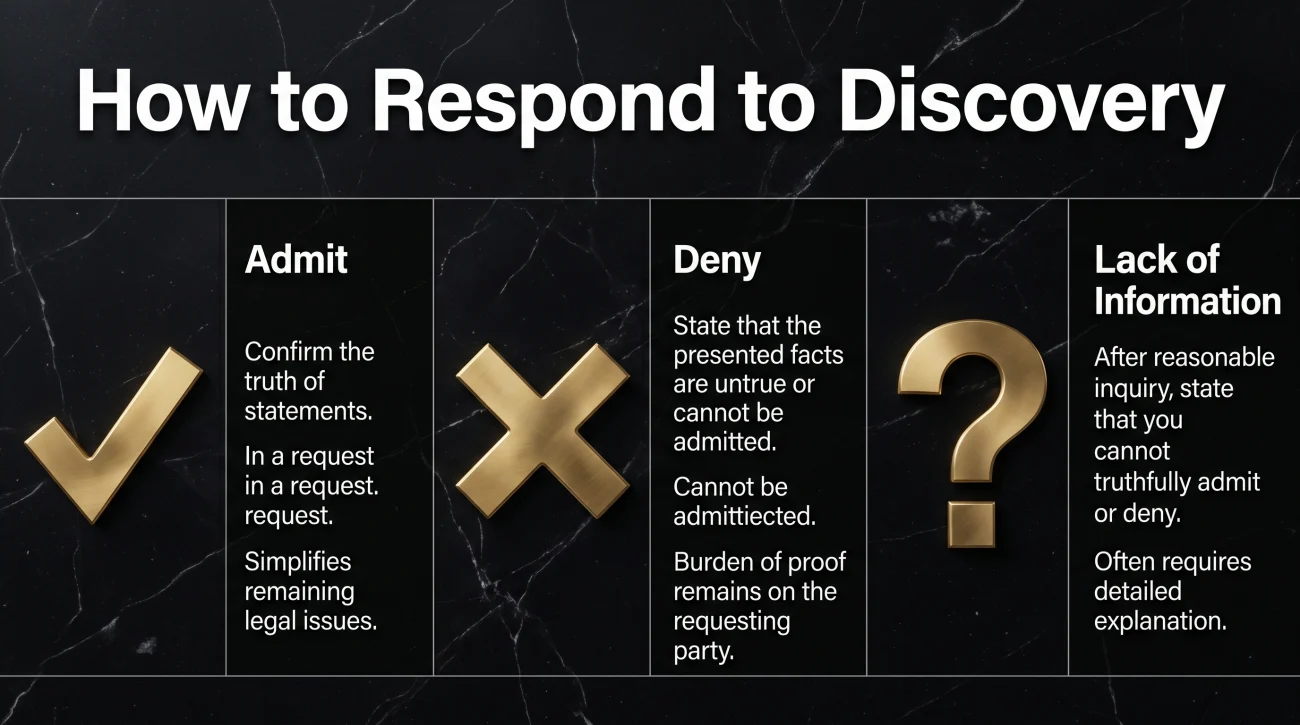
Responding to discovery does not require you to write like a lawyer, but it does require strict adherence to the format and the deadline. You must address every single numbered item in their packet.
When facing Requests for Admissions, you generally have three valid ways to respond to each numbered statement:
- Admit: You agree the statement is 100% factually true.
- Deny: You disagree with the statement, even partially.
- Lack of Information: You do not have enough information to either admit or deny the statement.
The “lack of information” response is vastly underutilized by consumers. In a debt buyer lawsuit, the plaintiff is a company you have never done business with (like Midland Funding or Portfolio Recovery). If they ask you to admit that a specific spreadsheet accurately reflects your balance from five years ago, you likely do not have the independent documentation to verify their math. You are not obligated to guess.
Sample response formatting for a Request for Admission:
Request No. 4: Admit that Defendant owes Plaintiff the principal sum of $3,450.22.
Response: Deny. Defendant lacks sufficient information or documentation to admit or deny the accuracy of the amount claimed by Plaintiff, and therefore denies the same.
You do not have to prove your denial during the discovery phase. You simply have to state your denial. The burden of proof remains entirely on the plaintiff. You are requiring them to prove the statement is true at the actual debt collection lawsuit hearing.
Once you have written out your responses, you must sign the document. In many states, discovery responses must be signed under oath or verified. Mail a copy to the collector’s attorney via certified mail so you have a tracking receipt proving you met the deadline. Keep a copy for your records.
<strong⚠️ Warning: Do not mail your discovery responses to the court unless your specific local rules require it. In most jurisdictions, discovery is exchanged privately between the parties. You only file it with the court if there is a dispute.
Turning the Tables: Sending Your Own Discovery Requests
Answering the collector’s questions is only half the battle. If you want to put pressure on a debt buyer, you must use the discovery process to your advantage. This is where you expose the weaknesses in their documentation.
Debt buyers rely on volume. They want to spend as little time as possible on each file. When you represent yourself, if you are reading guides on how to respond to a debt lawsuit without an attorney, you have the right to demand the exact same level of proof that a lawyer would demand.
You can draft and send your own “Defendant’s First Request for Production of Documents” to the collector’s attorney. Here is exactly how to word the two most critical requests:
Please produce the original, signed credit agreement or application bearing Defendant’s signature that created the alleged account, including all terms and conditions in effect at the time of default.Defendant’s Request for Production No. 2:
Please produce a complete, unbroken chain of assignment, including all bills of sale and specific schedules identifying Defendant’s account by name and account number, from the original creditor to Plaintiff.
Why do these two requests matter so much? The chain of title proves whether the plaintiff actually has the legal standing to sue you. The original contract proves whether the interest rates, fees, and right to sue were ever authorized. Because debt buyers purchase accounts in bulk portfolios, they rarely possess these specific documents.
When you force a debt buyer to produce these documents, they often hit a procedural wall. However, do not expect an immediate surrender. Dismissals take time. The collector’s attorney may attempt to stall, send generic spreadsheets instead of specific contracts, or suddenly offer you a lowball settlement to avoid producing the documents. What you have done is make their lawsuit significantly more expensive to pursue.
What Happens If You Already Missed the Deadline?
If you are reading this and realize your 30-day window has already closed, the situation is dangerous but not necessarily fatal. The admissions are technically deemed true by default, but courts strongly prefer deciding cases on actual facts rather than technicalities.
You must immediately ask the court for permission to file late responses. In legal terms, this is filing a Motion to Withdraw Deemed Admissions or a Motion to Extend Time. To win this motion, you generally have to show two things:
- Withdrawing the admissions will help the court reach a fair decision on the actual merits of the case.
- Allowing you to answer late will not give the debt collector a legitimate reason to argue that your late response put them at a disadvantage.
If the collector has not yet filed their Motion for Summary Judgment, your chances of getting the court to accept late answers are significantly higher. Act immediately.
Signs of Escalation: When to Get Professional Help
The discovery phase is highly procedural, and mistakes here are heavily penalized. If you find yourself in a compromised position, you need to execute a few basic triage steps before the legal machinery moves out of your control.
Signs your case has hit a critical procedural hazard:
- The deadline printed on the discovery documents has already passed, and you have not mailed anything.
- You mailed back some answers but completely skipped the “Requests for Admissions” section.
- You just received a “Motion for Summary Judgment” in the mail.
Immediate steps to take: First, log the exact date you received any new motions. Second, locate your original discovery packet and all envelopes to verify postmarks. Third, do not call the collector’s attorney to argue or beg for more time; anything you say can be used against you.
A Motion for Summary Judgment means they are asking the judge to end the case right now. However, an experienced consumer protection attorney knows how to file motions to withdraw deemed admissions or challenge the summary judgment to save the case. If you are out of time and out of your depth, review your options for professional representation immediately at our guide to debt lawsuit attorneys.
Final Thoughts on the Discovery Process
Discovery is the proving ground of a civil lawsuit. It is designed to strip away the bluffing. The debt collector is betting that the sheer volume and legal tone of their requests will intimidate you into silence.
Drafting your responses, denying the statements you cannot verify, and demanding that they produce their own documentation transforms your file from a guaranteed default judgment into a contested, expensive litigation problem. Stay organized, meet your deadlines, and require the collector to prove every single element of their claim.
❓ FAQ
⏰ How long do I have to answer debt collection discovery requests?
In most states, you have 28 to 30 days from the date you received the discovery requests to serve your written responses to the opposing attorney. Always check the documents or your local court rules, as the deadline is strict.
⚠️ What happens if I ignore the discovery packet entirely?
If you ignore it, any statements inside the packet are automatically accepted by the court. The collector will use these admissions to file a Motion for Summary Judgment and win the case without a trial.
📋 Do I file my discovery responses with the court clerk?
Usually, no. Discovery is typically exchanged privately between the parties. You mail your signed responses directly to the plaintiff’s attorney. You only file them with the court if a specific local rule requires it or if there is a legal dispute over the answers.
❌ Can I just answer “I don’t know” to their questions?
Yes, but you must use the proper phrasing. Stating that you “lack sufficient information or knowledge to admit or deny” the allegation is a legally valid response, which acts as a denial and forces the collector to prove their claim.
📞 Should I just call the collector’s attorney to answer the questions?
No. Discovery requests require formal, written responses that are signed and often verified under oath. A phone call does not satisfy your legal obligation and will not stop the deadline clock from expiring.
⚖️ Does a general denial in my Answer protect me from discovery?
No. This is a common trap. A general denial in your initial Answer to the lawsuit does not cover subsequent discovery requests. You must respond to the specific discovery packet separately.
What each stage of litigation requires and where your leverage sits.
- What the lawsuit process looks like from summons to judgment
- What to file, when to file it, and what happens if you do not
- The legal arguments that can defeat a debt collection lawsuit
- What a default judgment allows collectors to do and how to fight one
- How to negotiate a resolution once litigation has started
Once judgment is entered, collectors gain tools they did not have before.
- The FDCPA violations collectors commonly commit during the collection process
- How to respond to a debt lawsuit and what defenses are available to you
- How a judgment becomes a garnishment order on your paycheck
- When a collector uses a judgment to freeze your bank account instead
- How to settle before the judgment turns into something harder to stop
Disclosure: The content on this site reflects direct experience inside the debt collection industry and is grounded in federal law and regulation. It is informational in nature. Reading it does not constitute legal advice and does not create any professional relationship. If you are dealing with a lawsuit, a judgment, or a legal deadline, consult a licensed attorney in your state before acting.