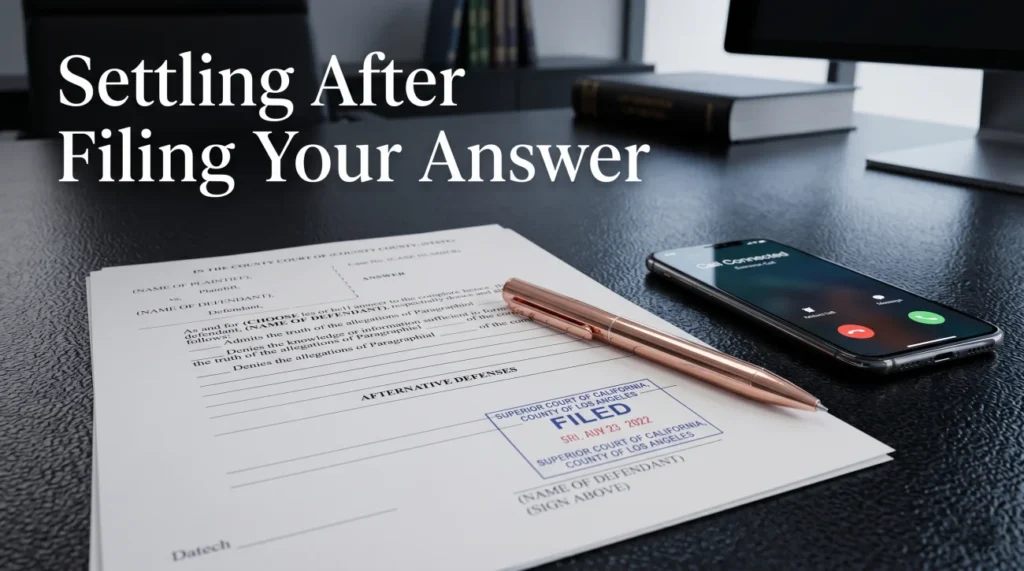
- Filing an Answer to a debt collection lawsuit does not lock you into going to trial. It actually puts you in the strongest possible position to negotiate a settlement.
- Never try to negotiate a settlement before filing your formal response with the court. Verbal negotiations do not stop the legal clock, and the collector can still win by default while you are talking.
- Settlement amounts typically increase after a lawsuit is filed. Offers under 60 percent of the balance are rarely accepted at this stage unless you have raised strong legal defenses.
You Filed Your Answer. Are You Locked Into Going to Trial?
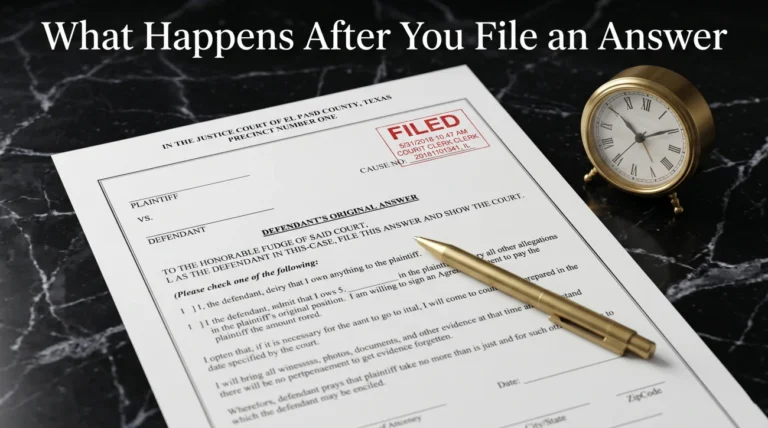
When a process server hands you a stack of legal documents, the immediate reaction is usually a mix of fear and urgency. You scramble to figure out the paperwork, you draft a response, and you file it with the court clerk just in time. But once that document is stamped and submitted, a new anxiety often sets in. Many people believe that by formally answering the lawsuit, they have crossed a point of no return. They assume they are now locked into a formal trial, standing in front of a judge, arguing over old credit card statements.
That is not how the debt collection legal machine actually works. Filing your formal response does not lock you into a courtroom battle. In fact, it does the exact opposite. It creates the leverage you need to settle the account on your own terms without ever seeing the inside of a courtroom.
During my twelve years working inside third-party collection agencies and a national debt buyer, I watched the litigation process play out thousands of times. The vast majority of debt collection lawsuits never go to trial. They are resolved through negotiated settlements. However, the timing of that negotiation dictates everything about the outcome. If you try to negotiate at the wrong moment, you risk losing your case entirely. This guide explains why your leverage dramatically improves after you submit your court paperwork, what numbers you can realistically expect to negotiate, and the exact steps to initiate a settlement discussion safely.
The Correct Sequence: Secure Your Legal Shield Before You Talk
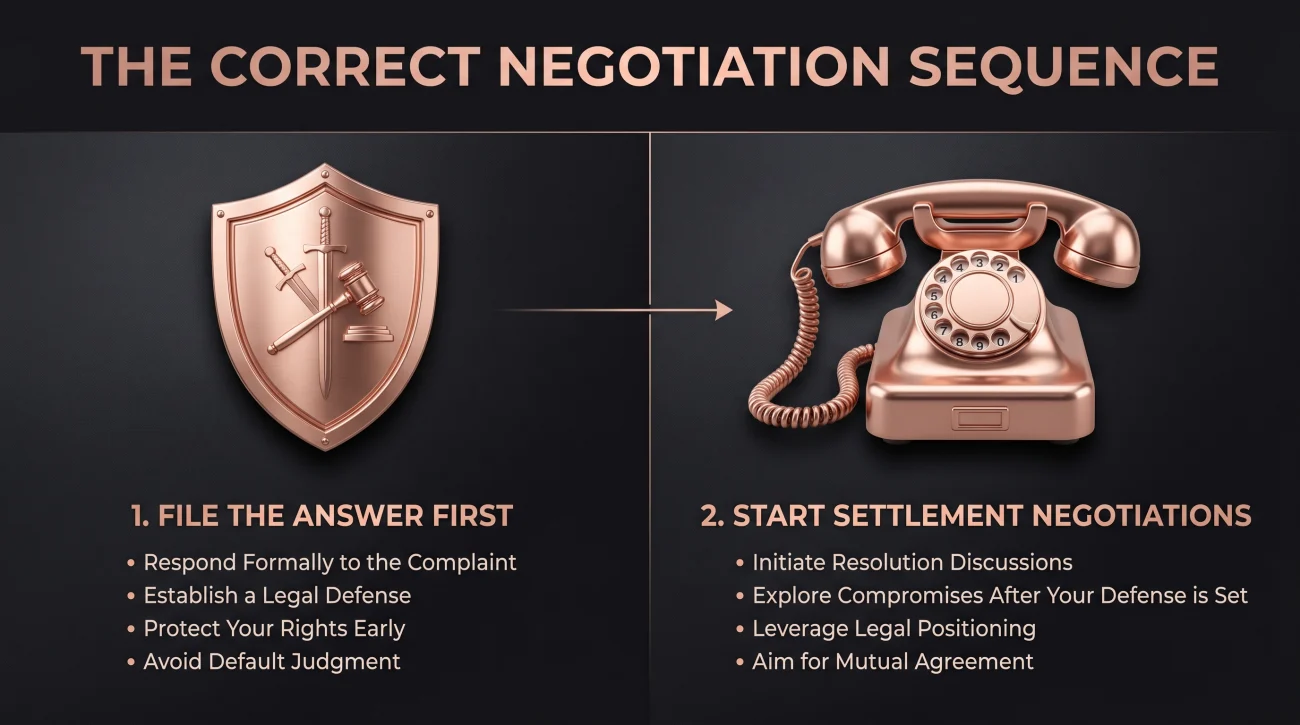
Before we discuss numbers, we have to address the biggest mistake consumers make. When served with a lawsuit, the immediate instinct is often to pick up the phone, call the collection agency, and try to work out a payment plan to make the case go away.
This is a catastrophic procedural error. Calling the collector to negotiate does not stop the legal clock from ticking down on your court deadline. Collection law firms represent their clients, not you. A verbal promise from a phone representative that they will “put a hold on the legal action” while you gather funds is not legally binding.
The Sacramento Public Law Library explicitly warns: “Your negotiations do not automatically stop the lawsuit. The other party can proceed with a default judgment against you unless you file a response with the court.”
Calling the collector on day 15 of a 20-day deadline, reaching a verbal agreement to pay $100 a month, and assuming the lawsuit is canceled. You miss the court deadline, and the collector quietly files for a default judgment behind your back.
Filing your written response with the court to legally freeze the default clock, then contacting the plaintiff’s attorney to negotiate a settlement from a protected position.
If informal phone calls cannot stop the lawsuit, what does? To protect yourself, you must separate the legal process from the financial negotiation. Your first obligation is to draft the formal document that contests the plaintiff’s claims and file it with the court clerk before your deadline expires. That document is your legal shield. Once it is stamped, the collector can no longer win by default. They are now legally required to prove their case with admissible evidence. Only after this shield is in place should you begin talking about money. This ensures that if negotiations break down, your case remains active and defended.
Why Your Leverage Dramatically Improves After Filing
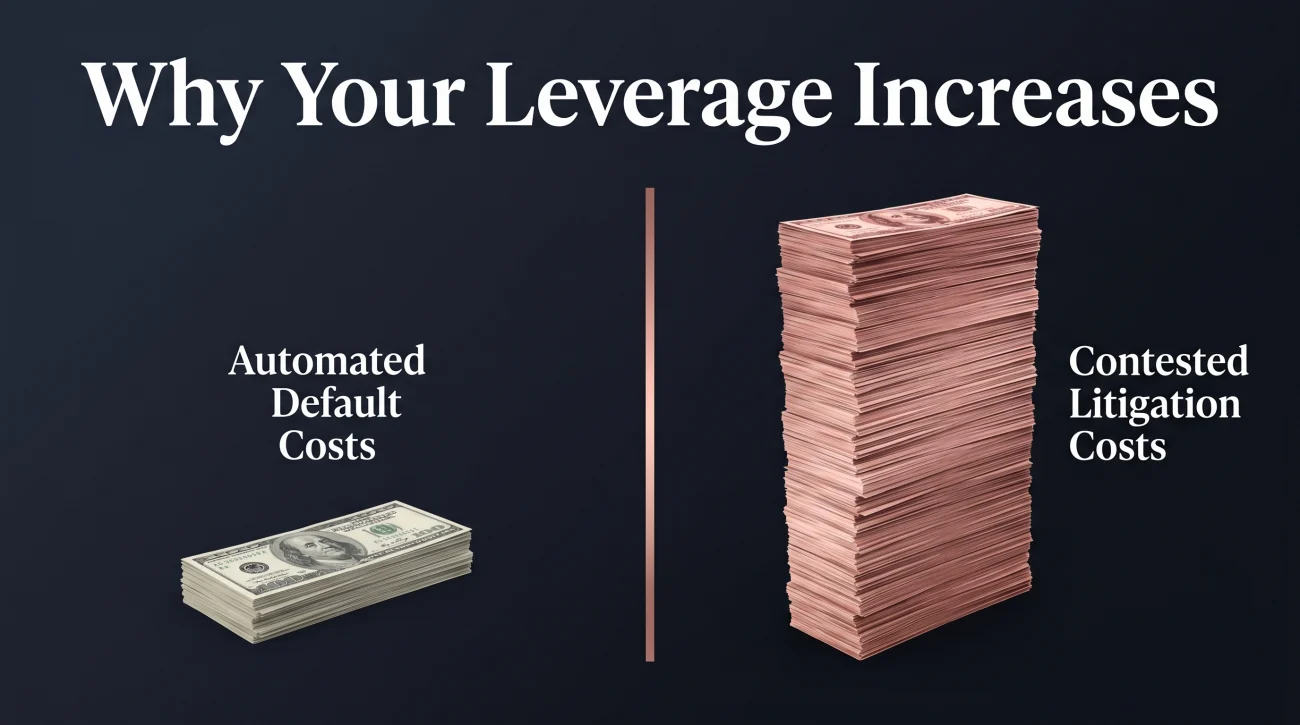
Many consumers fear that fighting back will make the collector angry and result in a harsher stance during settlement talks. But collectors are not in the business of holding grudges. Every decision they make runs through a single filter: will this cost more than it returns?
Debt buyer law firms are volume businesses. They file hundreds of lawsuits every week, operating on the statistical certainty that 70 to 90 percent of defendants will ignore the paperwork. For those uncontested cases, the law firm spends practically nothing on attorney time. The process is highly automated, allowing them to secure profitable judgments with minimal effort.
“When a defendant actually filed an Answer, that file was immediately pulled from the automated judgment track. It was flagged as a contested case. The attorney suddenly had to review the file, check if we actually possessed the original credit agreement, and calculate the cost of attending hearings. A file that was supposed to cost us $50 to process was suddenly going to cost $500 in billable time. That is the exact moment the settlement department was instructed to reach out and make a deal.”
Filing your paperwork changes the collector’s cost calculation. You have proven that you will not be an easy, automated victory. Litigation is expensive. Taking a single case to trial requires discovery, witness preparation, and hours of attorney time. If the debt they are suing you for is only $3,000, spending $1,500 in attorney time to fight you at trial is a terrible business decision for the law firm.
This is why legal experts at SoloSuit note that the period after you respond to the lawsuit but before a trial is scheduled is “where you have the most leverage to negotiate.” The collector now faces the very real cost of litigation, making them highly motivated to find a compromise.
Realistic Settlement Numbers: The 60 Percent Rule
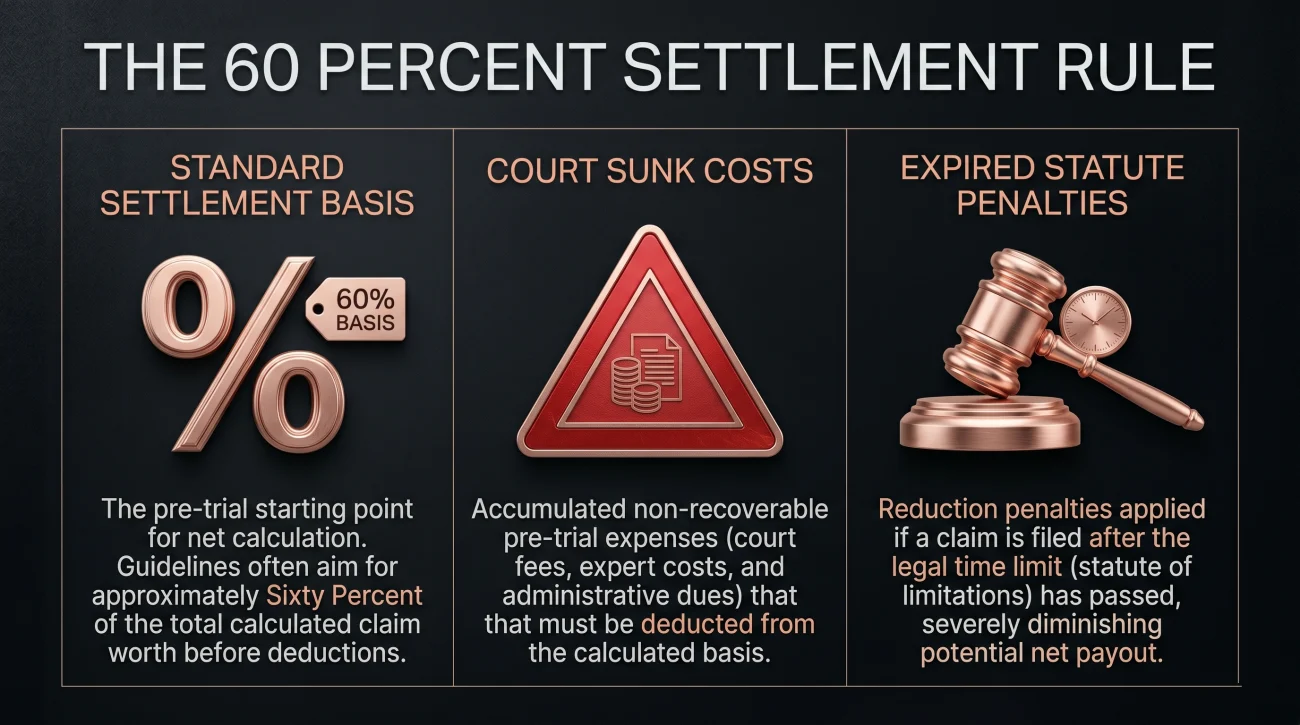
While your leverage is better after filing, you must adjust your financial expectations. The settlement offers you might have received a year ago before the lawsuit was filed are generally no longer available.
Before a lawsuit, debt buyers will often settle accounts for 30 to 40 percent of the total balance. However, once they decide to involve the court system, their costs increase. They have paid court filing fees, process server fees, and initial attorney costs. They want to recoup those sunk costs.
According to data from SoloSuit, once a lawsuit is filed, lowball offers under 60 percent of the total balance are rarely accepted. If a collector is suing you for $5,000, offering to settle for $1,000 will almost certainly be rejected at this stage. A more realistic starting point for a post-lawsuit settlement is between 60 and 70 percent of the claimed balance.
How Defenses Change the Math
There is a major exception to the 60 percent rule. If you filed a strong response that highlighted critical flaws in the collector’s case, the settlement number can drop significantly.
For example, if your response points out that the statute of limitations has likely expired, or that the debt buyer failed to attach a proper chain of title proving they own the account, the collector’s attorney knows they are at risk of losing the case entirely. For a volume litigation firm, a contested case with a real chance of losing is a toxic asset. They would much rather close the file for 20 or 30 cents on the dollar today than risk having a judge dismiss the case completely next month.
If you have multiple debts in litigation or need to orchestrate complex resolutions across several creditors, relying on professional debt negotiation programs to evaluate your overall financial picture can sometimes yield better percentage reductions than negotiating a single lawsuit in isolation.
Step-by-Step: How to Initiate the Settlement Discussion
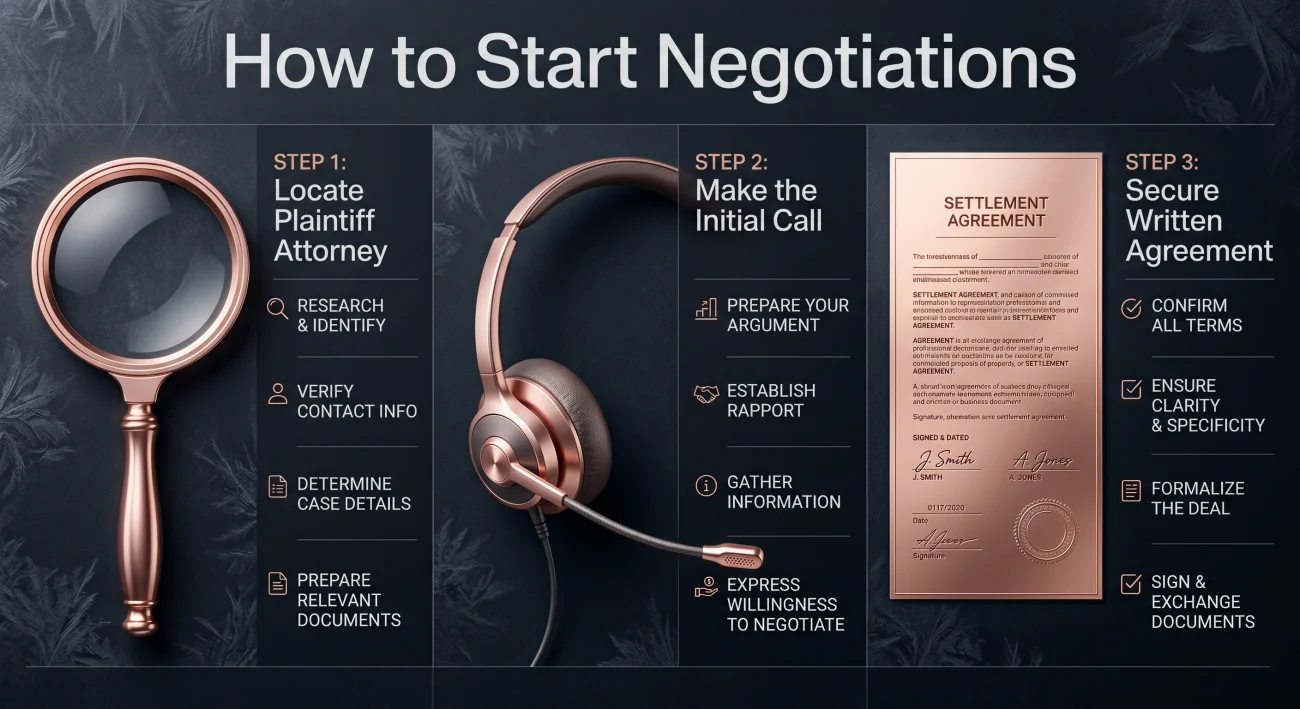
Once your court response is officially filed, you are ready to open negotiations. In an active lawsuit, you must follow specific rules of engagement. You cannot call the original creditor (like your credit card bank) or the customer service line of the debt buyer. Once a lawsuit is active, all communication must go through the attorney representing the plaintiff.
Step 1: Locate the Attorney’s Information
Look at the very first page of the complaint or summons you received. You will find a section listing the name, law firm, phone number, and address of the attorney representing the debt collector. This is your point of contact, and this is the only office you need to communicate with going forward.
Step 2: Make the Initial Call
When you call the law firm, you will likely speak to a paralegal or a settlement negotiator rather than the lead attorney. Be polite, direct, and strictly factual. Do not admit that you owe the full amount, and do not offer details about where you work or where you bank.
“Hello, I am calling regarding case number [Insert Case Number]. My name is [Your Name]. I want to confirm that you have received a copy of the Answer I filed with the court on [Date]. I am calling today to see if your client is interested in resolving this matter voluntarily before we proceed further into litigation. I am prepared to offer a one-time lump sum payment of [Dollar Amount] to settle this account in full today.”
Once you put your offer on the table, stay quiet and let them respond.
Step 3: Negotiate the Terms
The negotiator will likely counter your initial offer. Remember that a lump-sum cash offer is always more attractive to a collector than a multi-year payment plan. If you agree on a number, your final condition must be that they put the entire agreement in writing with a clause to formally dismiss the lawsuit.
If you are struggling to communicate effectively or feel outmatched by the opposing counsel, it is crucial to understand the limits of representing yourself in a legal proceeding and when bringing in your own counsel is necessary.
Signs This Is the Right Moment to Negotiate
Timing your settlement offer correctly maximizes your leverage. If you can check most of the boxes in the following scenario, you are in an optimal position to initiate a settlement discussion:
- 📌 You have already filed your Answer, stopping the default judgment clock, and raised strong affirmative defenses.
- 📌 The collector’s attorney has received your response but has not yet filed any heavy discovery requests.
- 📌 You have a court hearing or pretrial conference approaching, creating a deadline that pressures both sides to resolve the matter.
- 📌 You have secured access to a lump sum of cash that allows you to make an immediate, final payment.
If you are facing an aggressive law firm that refuses to negotiate reasonably, or if the balance is too large to handle on your own, having a consumer defense attorney take over the negotiations frequently forces the collector to offer terms they would never present to an unrepresented defendant.
The Final Step Before You Pay
Filing your formal response to a debt collection lawsuit is the single most empowering action you can take. It strips the collector of their easiest victory and forces them to face the economic reality of litigation. When you use that leverage to negotiate a settlement, you take control of the outcome.
However, reaching an agreement on a dollar amount is only half the battle. Before you transfer a single cent, you must ensure you are legally protected. A proper settlement agreement must explicitly state that the payment is in “full and final satisfaction” of the debt and that the collector will file a “dismissal with prejudice.” Without that specific language, the collector could legally take your money and still pursue the rest of the balance later. To learn exactly how to review your paperwork and ensure the case is permanently closed, review the complete guide to closing out a debt collection lawsuit safely.
❓ FAQ
📞 Can I settle a lawsuit over the phone without going to court?
Yes. The vast majority of debt collection settlements are negotiated over the phone with the plaintiff’s attorney. If you reach an agreement and sign the proper paperwork, the attorney will file a dismissal, and you will not have to attend any court hearings.
🛑 Will a verbal agreement to settle stop a default judgment?
No. A verbal agreement on the phone does not legally stop the court process. If your deadline to respond passes while you are waiting for settlement paperwork, the collector can still ask the court for a default judgment against you.
💰 Do collectors accept lower percentages for lump-sum payments?
Yes, almost always. Collectors prefer cash in hand today over a payment plan that could fail next month. A collector who demands 75 percent for a two-year payment plan might accept 60 percent for a lump-sum payment made within ten days.
⚖️ Who do I actually contact to negotiate the settlement?
You must contact the law firm representing the plaintiff. Their contact information will be listed on the first page of the summons and complaint you received. Do not try to call the original credit card company or the collection agency directly.
📄 Do I have to admit I owe the money to settle?
No. Settlement agreements routinely include language stating that the payment is a compromise of a disputed claim and does not constitute an admission of liability. You are simply paying to make the lawsuit go away.
🕒 Can I settle on the actual day of my court hearing?
Yes. It is very common for defendants and plaintiff’s attorneys to negotiate in the hallway right outside the courtroom before the judge calls the case. However, it is much less stressful to negotiate weeks in advance.
📉 Why are settlement offers worse after a lawsuit is filed?
Once a lawsuit is filed, the collector has spent money on court filing fees, process servers, and attorney drafting time. They factor these sunk costs into their minimum acceptable settlement amount, which usually pushes the percentage higher.
✍️ What happens if the collector refuses to put the settlement in writing?
If they refuse to provide a signed written agreement detailing the settlement amount and promising to dismiss the lawsuit, do not pay them. A legitimate law firm will always provide a written settlement stipulation.
🏦 Will settling a lawsuit clear the debt from my credit report?
Settling the lawsuit resolves the legal danger, but the underlying account will likely be updated on your credit report to show “Settled for Less Than Full Balance.” This mark remains for seven years from the original delinquency date.
👨⚖️ What if I already have a court date scheduled?
If you have a court date, you must attend it unless you have a fully signed settlement agreement in hand AND you have verified with the court clerk that the plaintiff’s attorney has officially filed a dismissal.
What each stage of litigation requires and where your leverage sits.
- What the lawsuit process looks like from summons to judgment
- What to file, when to file it, and what happens if you do not
- The legal arguments that can defeat a debt collection lawsuit
- What a default judgment allows collectors to do and how to fight one
- How to negotiate a resolution once litigation has started
Once judgment is entered, collectors gain tools they did not have before.
- The FDCPA violations collectors commonly commit during the collection process
- How to respond to a debt lawsuit and what defenses are available to you
- How a judgment becomes a garnishment order on your paycheck
- When a collector uses a judgment to freeze your bank account instead
- How to settle before the judgment turns into something harder to stop
Disclosure: The content on this site reflects direct experience inside the debt collection industry and is grounded in federal law and regulation. It is informational in nature. Reading it does not constitute legal advice and does not create any professional relationship. If you are dealing with a lawsuit, a judgment, or a legal deadline, consult a licensed attorney in your state before acting.