- The paper trail is mandatory: A debt buyer must prove they legally own your specific account through an unbroken chain of documents from the original creditor to them.
- Generic documents are not enough: A bill of sale that mentions a “portfolio of accounts” is insufficient unless it includes an attachment that specifically lists your name and account number.
- Missing links win cases: If you force the collector to produce the chain of title in discovery and they cannot connect every single transfer, their lawsuit can be dismissed.
The Paper Trail That Can Make or Break a Debt Buyer Lawsuit
When you are sued by a company you have never heard of, your first reaction is usually confusion. You never signed a contract with them, you never borrowed money from them, and yet they are taking you to court. In order to win a chain of title debt buyer lawsuit, that company cannot simply show up and say you owe them money. They must prove exactly how they acquired your specific account.
During my 12 years inside third-party collection agencies and a national debt buyer, I saw exactly how these accounts change hands. They are not sold individually. They are sold in massive portfolios containing tens of thousands of accounts, usually represented by nothing more than a spreadsheet. The documentation transferred between the bank and the debt buyer is often minimal.
This creates a massive vulnerability for the collector when they decide to file a lawsuit. The paper trail showing how your debt moved from the original creditor to the current plaintiff is called the chain of title. Every single link in that chain must be fully documented. If one link is missing, the entire lawsuit falls apart. In this guide, I will walk you through what a valid chain of title looks like, the specific document gaps collectors try to hide, and how to demand the proof that often forces them to walk away.
What Chain of Title Means in Concrete Terms
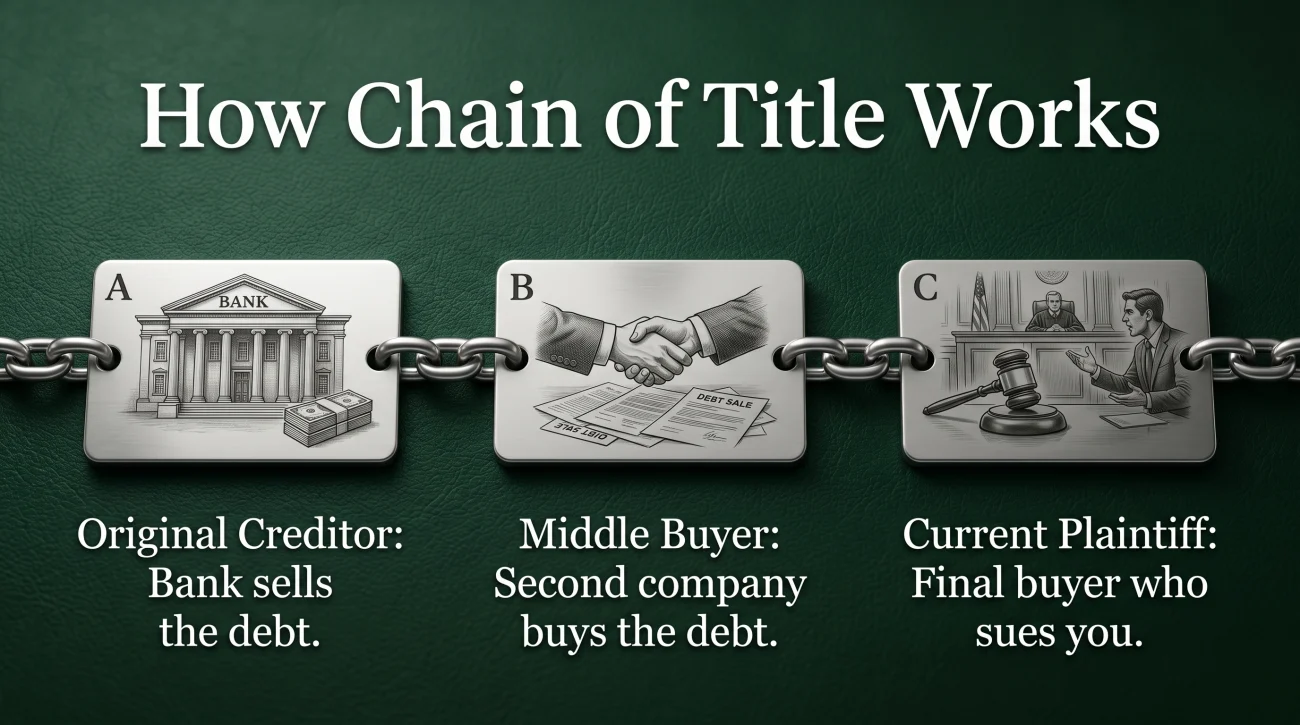
To understand how to fight back, you first need to understand the mechanics of a chain of title debt lawsuit. Chain of title is a property law concept applied to debt. It is the documented history of ownership. Just as you need a clear title to sell a car or a house, a debt buyer needs a clear chain of title to enforce a debt in court.
Think of it as a series of stepping stones. If the original creditor is Stone A, and the company suing you is Stone C, there must be a solid, documented step from A to B, and from B to C.
Here is what that looks like in practice:
- Document 1 (The Origin): A bill of sale showing the original creditor (for example, Citibank) sold your specific account to Buyer A.
- Document 2 (The Middle): A bill of sale showing Buyer A sold your specific account to Buyer B.
- Document 3 (The End): A bill of sale showing Buyer B sold your specific account to the current plaintiff filing the lawsuit.
Each of these transfers is a legal assignment. The chain of assignment debt collection rules require that every single transfer is proven. If the plaintiff can show that Citibank sold the debt to Buyer A, and they can show that Buyer B sold the debt to them, but they cannot produce the document showing how the debt got from Buyer A to Buyer B, the chain is broken.
When the chain is broken, the plaintiff suffers from a fatal legal flaw. They cannot prove they have the right to sue you. You can learn more about the broader legal concept behind this in our guide on lack of standing in a debt collection lawsuit. Standing is the legal theory; the chain of title is the actual paperwork required to prove it.
What Every Link in the Chain Must Actually Show
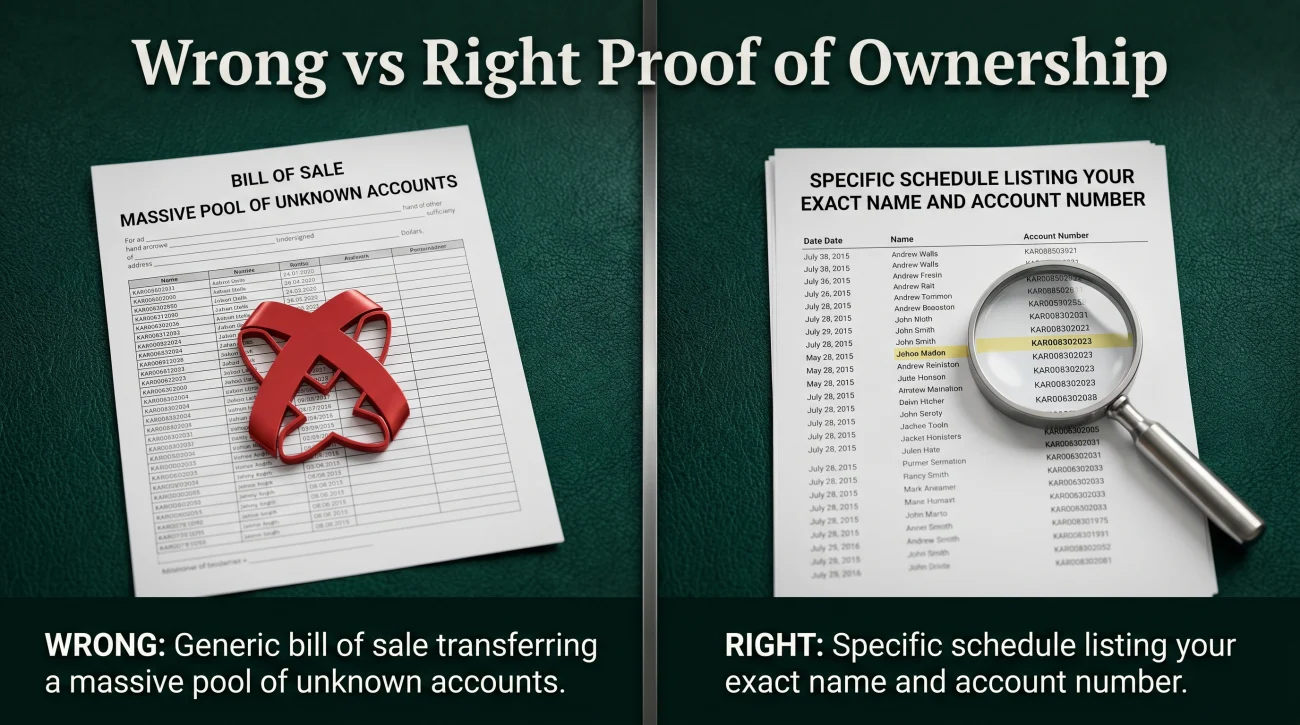
It is not enough for a debt buyer to simply produce a generic piece of paper that says “we bought debts.” Courts have become increasingly strict about what these documents must contain to be considered valid evidence.
To successfully prove chain of title debt buyer documentation must be specific to you. For every link in the chain, the transfer documents must meet fundamental requirements:
- The exact names of the seller and the buyer.
- The specific date the transfer took place.
- Your specific account number, your name, and the balance at the time of the sale.
The requirement for specificity is not just a technicality. It is a consumer protection standard. For example, under the New York Consumer Credit Fairness Act (effective 2022) and common law precedents in many other states, a transfer document is legally insufficient to prove ownership unless your account is demonstrably part of that exact transaction.
The collector provides a Bill of Sale that states, “Seller transfers all rights to the pool of charged-off accounts described in the Forward Flow Agreement.” Your name does not appear anywhere on this document or its attachments.
The collector provides the Bill of Sale, accompanied by a redacted schedule that specifically lists your name, your account number, and your exact balance, proving your account was part of that specific sale.
The Three Most Common Chain of Title Gaps
Now that you know what the law requires, it is important to understand how debt buyers consistently fail to meet that standard, and why. Major debt buyers, such as Midland Funding, Portfolio Recovery Associates (PRA), LVNV Funding, and Jefferson Capital, buy accounts for pennies on the dollar. Because they purchase in such massive bulk, the documentation they receive from the banks is often incomplete.
When consumers actually challenge them to produce the chain of ownership debt lawsuit documentation, three specific weaknesses appear over and over again.
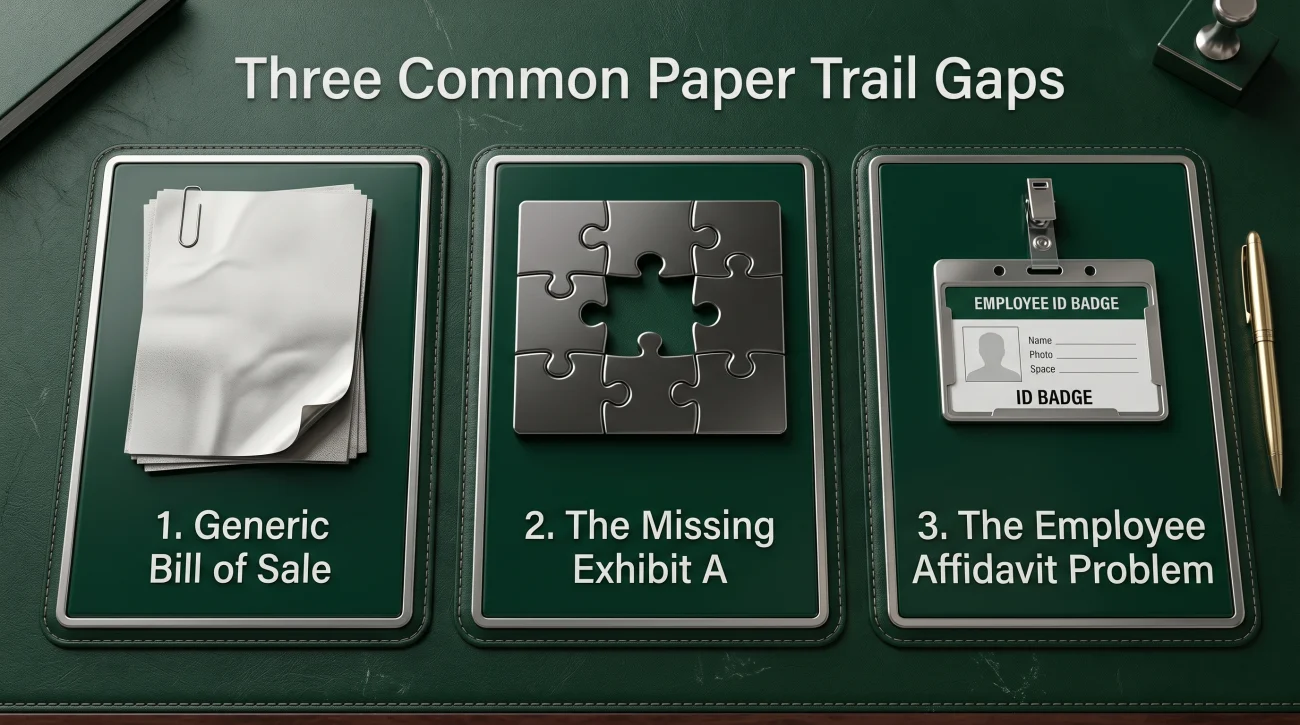
Gap 1: The Generic Bill of Sale and the Economics of Bulk Debt
The most common flaw is the generic bill of sale, and it happens for purely economic reasons. When a debt buyer purchases 50,000 defaulted credit card accounts, obtaining individual, notarized bills of sale for every single account is administratively impossible and too expensive. Instead, they use one generic piece of paper covering the entire portfolio.
They will attach this official-looking document to your lawsuit complaint, complete with corporate logos and bank signatures. The problem is that your account is not mentioned on it. As consumer defense attorneys frequently point out, a generic spreadsheet of accounts is not enough; the collector needs specific proof that your individual account was part of the sale. A bill of sale that transfers 10,000 unnamed accounts does not prove that yours was one of them.
Gap 2: The Missing “Exhibit A”
To solve the generic bill of sale problem, the official contract usually contains a line that says something like: “Seller transfers the accounts specifically listed on the attached Exhibit A.”
This is where you must look closely at the documents they provide. Very often, the bill of sale references an exhibit, but that exhibit is completely missing from the lawsuit packet. If the bill of sale points to a “See Exhibit A” but that exhibit is nowhere to be found, you have identified a major structural flaw in their case.
Why do they omit it? Because the real Exhibit A is a massive digital spreadsheet containing the personal data of thousands of other consumers. The debt buyer either cannot isolate your single line of data cleanly, or they simply do not want to go through the administrative hassle of producing a redacted version for a small claims lawsuit.
Gap 3: The Employee Affidavit Problem
When collectors know they cannot produce the actual transfer documents, they try a workaround. They submit an affidavit (a sworn written statement) from one of their own employees. The employee swears under oath that the debt buyer chain of title missing documents are accurate and that the debt was properly purchased.
This is a massive legal vulnerability. A debt buyer’s employee did not work at the original bank. They did not create the bank statements, nor did they oversee the bank’s record-keeping. Courts often reject this as hearsay because the debt buyer’s employee lacks personal knowledge of how the original creditor maintained its files.
How to fight this: In your written response or at your hearing, object to the affidavit. State clearly: “The plaintiff’s affidavit is inadmissible hearsay. The affiant is an employee of the debt buyer and lacks personal knowledge of the original creditor’s record-keeping practices.”
When I reviewed account files for litigation on the collection floor, a large percentage of our older accounts had missing links. We had the bill of sale from the bank to the first buyer, but we were the third buyer, and we had no paperwork showing how the second buyer got it. The strategy was simple: file the suit anyway. If the consumer files an Answer and demands the chain of title, we drop the case. It was cheaper to dismiss the case than to try and hunt down documents from a company that went out of business three years ago.
How to Request Chain of Title Documents in Discovery
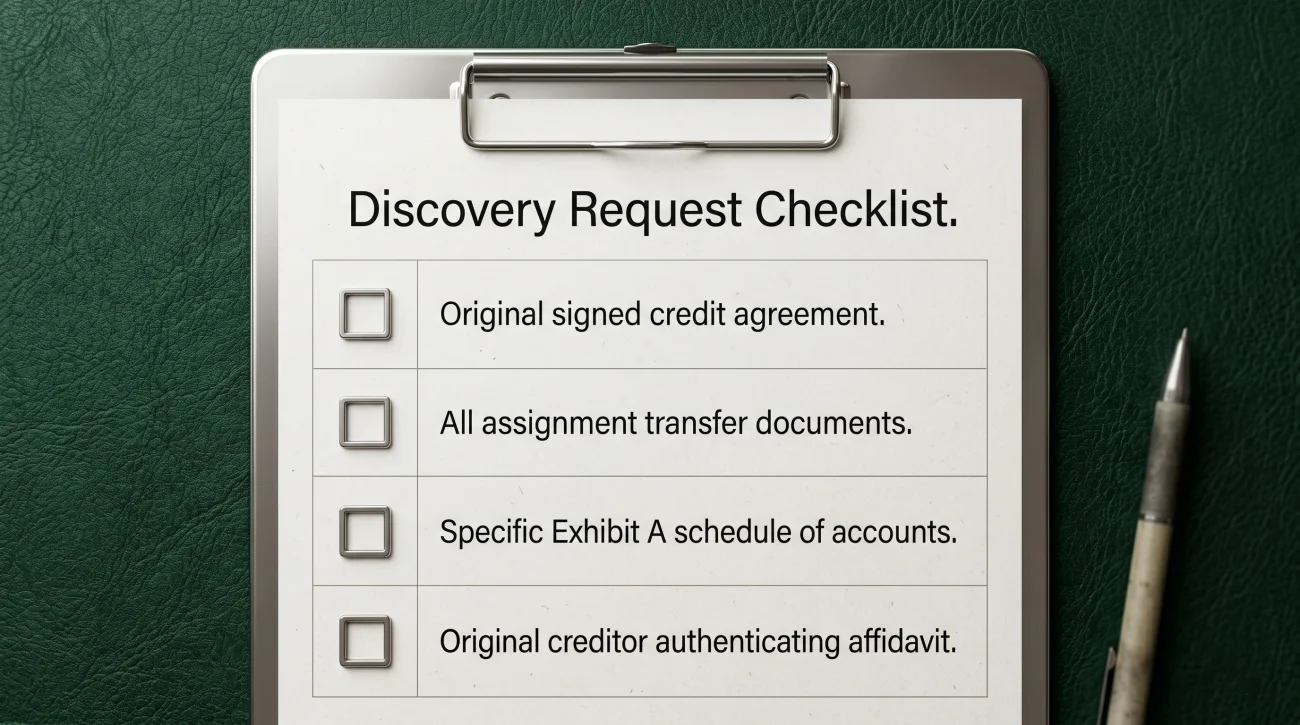
If you have filed your Answer to the lawsuit, the next phase is discovery. This is the period where both sides can request evidence from each other. This is your opportunity to demand the debt assignment documents lawsuit evidence that the collector likely does not have.
You can serve the plaintiff’s attorney with a formal “Request for Production of Documents.” You must force them to produce the specific, unbroken chain. It is not enough for them to send you old credit card statements. As we cover in our guide on the debt buyer no original contract defense, billing statements show a balance, but they do not prove ownership or transfer rights.
Here is the exact type of language you should use when requesting these documents:
Sample Discovery Request Language:
Please produce the following documents:
1. A copy of the original signed credit agreement between Defendant and the original creditor.
2. All contracts of sale, bills of sale, or assignment documents transferring the alleged debt from the original creditor to the Plaintiff, including any intermediate transfers to third parties.
3. Any Schedule of Accounts, Exhibit A, or data file referenced in the bills of sale that specifically identifies the Defendant’s name, account number, and balance as being part of the transferred portfolio.
4. Any affidavit from an authorized representative of the original creditor (not the Plaintiff) authenticating the account records and the transfer of the specific account.
Always set a strict deadline for their response, typically 28 to 30 days depending on your state’s rules of civil procedure. This deadline is critical. If you force the timeline and they fail to produce the documents, their case is severely weakened and primed for dismissal.
What to Argue When the Chain is Incomplete
If the collector responds to your discovery requests and provides a generic bill of sale, or fails to provide the intervening transfer documents, you now have the leverage to use the chain of title defense debt lawsuit strategy.
You do not need to use complex legal jargon. Your argument to the judge, or in a motion to dismiss, should be factual and direct. You are simply pointing out that the plaintiff has not met their burden of proof.
Key Point: You are not arguing that the debt doesn’t exist. You are arguing that this specific plaintiff has not proven they own it. If they don’t own it, they have no right to collect it or sue you for it.
If you are standing before a judge in small claims court, or writing a motion, your argument should follow this structure:
“Your Honor, the plaintiff is a third-party debt buyer, not the original creditor. I requested the complete chain of title in discovery. The plaintiff provided a generic bill of sale that references a portfolio of accounts, but they did not attach any Schedule or Exhibit specifically identifying my account as being included in that sale. Furthermore, there is a missing transfer document between [Buyer A] and the current plaintiff. Because the plaintiff has failed to establish an unbroken chain of title, they lack standing to bring this action, and I respectfully request the case be dismissed.”
What Typically Happens Next
After you raise this defense and demand the documents, one of two things usually happens. The collector’s attorney may realize the missing documents cannot be found and file a voluntary dismissal within a few weeks. Alternatively, they may reach out to you with a drastically reduced settlement offer to salvage some profit before the judge throws the case out. For a complete breakdown of how this leads to the end of a case, read our overview on how to get a debt collection lawsuit dismissed.
How to Spot a Deficient Chain of Title in Your Papers
Debt buyers rely on intimidation, hoping the stack of legal papers will overwhelm you before you realize how thin their evidence actually is. If you want to know whether you have a strong defensive hand, look for these specific red flags in the lawsuit complaint or the discovery documents they send you:
- You see a single billing statement, but zero transfer documents connecting the bank to the plaintiff.
- The bill of sale mentions a “purchase agreement” or “pool of accounts,” but your name is nowhere on it.
- A document clearly references an attached schedule or “Exhibit A,” but the pages simply stop there.
- The debt has clearly been sold multiple times, but they only provided paperwork for the very last transfer.
- The only “proof” of ownership is an affidavit signed by someone who works for the debt buyer, not the original bank.
If you spot these signs, you have a highly defensible case based on a broken paper trail. If the balance is significant, this is the exact moment where having an experienced attorney compel them to produce the chain of title can force the collector into a corner, often leading to a dismissal or a highly favorable settlement.
Final Thoughts on Broken Paper Trails
The debt collection industry operates on speed and volume. When I reviewed account files for litigation on the collection floor, the accounts with broken chains were the ones we hoped consumers would simply ignore. The moment someone demanded the paper trail, the math changed entirely.
Demanding the chain of title is not a trick or a loophole. It is your right under the law to require a plaintiff to prove they actually own the property they are suing you over. By scrutinizing the bills of sale, demanding the missing exhibits, and refusing to accept a debt buyer’s hearsay affidavit, you level the playing field. To see how this defense fits into the broader picture of your lawsuit, review the full defensive framework in our main guide on being sued by a debt collector.
❓ FAQ
📄 What exactly is a chain of title in a debt lawsuit?
It is the documented paper trail showing how your specific debt account was transferred from the original creditor (like a bank) through every buyer, ending with the current company suing you.
🔗 Why does a broken chain of assignment matter?
If the debt buyer cannot prove they legally own your specific account with an unbroken chain of transfer documents, they lack legal standing. Without standing, they have no right to sue you, and the court can dismiss the case.
🕵️♂️ How do I prove the debt buyer is missing the chain of title?
You do not have to prove it is missing. The burden is on them to prove it exists. You simply file your Answer denying their claims and send a Request for Production of Documents demanding they produce the complete, specific transfer history.
📑 Is a generic bill of sale enough to prove ownership?
Usually, no. A bill of sale that only mentions a “portfolio of accounts” without an attached schedule or exhibit specifically identifying your name and account number is generally insufficient to prove ownership of your specific debt.
📎 What should I do if the collector’s bill of sale references an Exhibit A that is missing?
Point out the omission in your legal response or to the judge. Argue that without the referenced Exhibit A detailing your specific account, the bill of sale is incomplete and fails to prove chain of title.
🗣️ Can a debt buyer employee’s affidavit substitute for transfer documents?
No. In most jurisdictions, an employee of a debt buying company cannot legally swear to the accuracy of the original bank’s records or substitute their testimony for the actual, specific bills of sale.
⚖️ How do I raise this defense in my Answer?
Include an affirmative defense stating that the Plaintiff lacks standing because they have failed to demonstrate a complete and unbroken chain of title from the original creditor specifically identifying your account.
🛑 Will a missing link automatically get my case dismissed?
Not automatically. You must actively raise the lack of standing defense in your Answer, demand the documents in discovery, and file a motion to dismiss or present the argument at your hearing to win on this ground.
🏦 Does the original creditor need to prove chain of title?
No. If the original creditor (the bank you actually borrowed from) is suing you directly and they never sold the account, there is no chain of title to prove. This defense is primarily used against third-party debt buyers.
📉 Do debt buyers ever drop lawsuits if you ask for the chain of title?
Yes, frequently. If a debt buyer knows they cannot produce the required specific transfer documents, they often voluntarily dismiss the lawsuit rather than spend money fighting a case they are likely to lose.
What each stage of litigation requires and where your leverage sits.
- What the lawsuit process looks like from summons to judgment
- What to file, when to file it, and what happens if you do not
- The legal arguments that can defeat a debt collection lawsuit
- What a default judgment allows collectors to do and how to fight one
- How to negotiate a resolution once litigation has started
Once judgment is entered, collectors gain tools they did not have before.
- The FDCPA violations collectors commonly commit during the collection process
- How to respond to a debt lawsuit and what defenses are available to you
- How a judgment becomes a garnishment order on your paycheck
- When a collector uses a judgment to freeze your bank account instead
- How to settle before the judgment turns into something harder to stop
Disclosure: The content on this site reflects direct experience inside the debt collection industry and is grounded in federal law and regulation. It is informational in nature. Reading it does not constitute legal advice and does not create any professional relationship. If you are dealing with a lawsuit, a judgment, or a legal deadline, consult a licensed attorney in your state before acting.