- Federal law prohibits debt collectors from calling you before 8:00 a.m. or after 9:00 p.m. in your local time zone.
- A call placed outside of these hours is not a minor oversight. It is a documentable violation of the Fair Debt Collection Practices Act.
- Missed calls and voicemails left during restricted hours still count as legal violations, even if you never speak to an agent.
- You should immediately document the exact date and time of the call with a screenshot of your phone’s call log before taking any further action.
The Reality of After-Hours Collection Calls
In my 12 years working inside third-party collection agencies, I reviewed countless call logs. When I saw an agent dialing a consumer at 9:15 p.m. or 7:45 a.m., I knew it was not a coincidence. It was either a failure of the agency’s compliance software to scrub for time zones, or it was a deliberate pressure tactic used by an aggressive collector hoping to catch someone off guard.
Either way, it is illegal.
If you just received a call from a debt collector late at night or early in the morning, you likely feel a mix of anxiety and frustration. You know intuitively that something about the situation feels wrong. You are correct. Federal law draws very clear boundaries around when a debt collector can intrude on your life. Understanding these exact time limits is your first step in regaining control of the situation.
The Time Zone Rule: What the Law Actually Says
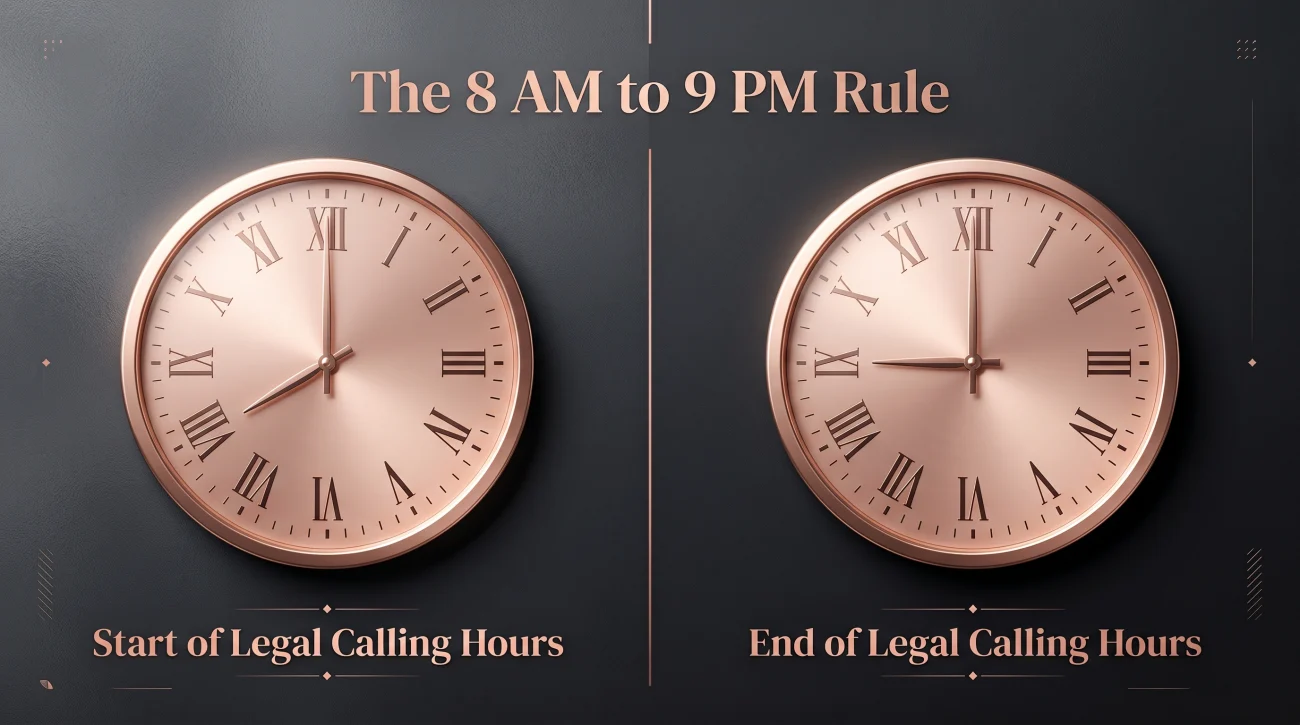
The rules governing when an agency can contact you are strict and unambiguous. The Fair Debt Collection Practices Act dictates exactly what times are considered convenient for consumers.
A debt collector cannot call you before 8:00 a.m. or after 9:00 p.m. in your local time zone. This restriction applies every single day of the week, including weekends and holidays. For a comprehensive look at the overall framework of these protections, you can review our full guide on federal debt collection laws.
Your Time Zone Is What Matters
The most common excuse agencies use when caught violating this rule involves location differences. It is entirely irrelevant what time it is where the collector is sitting. The only clock that matters is the one where you are located.
Collectors cannot claim ignorance if they have your current address or a phone number with an area code tied to your state. It is their legal responsibility to verify the time zone before their dialing system initiates the call.
What Actually Counts as a “Call”
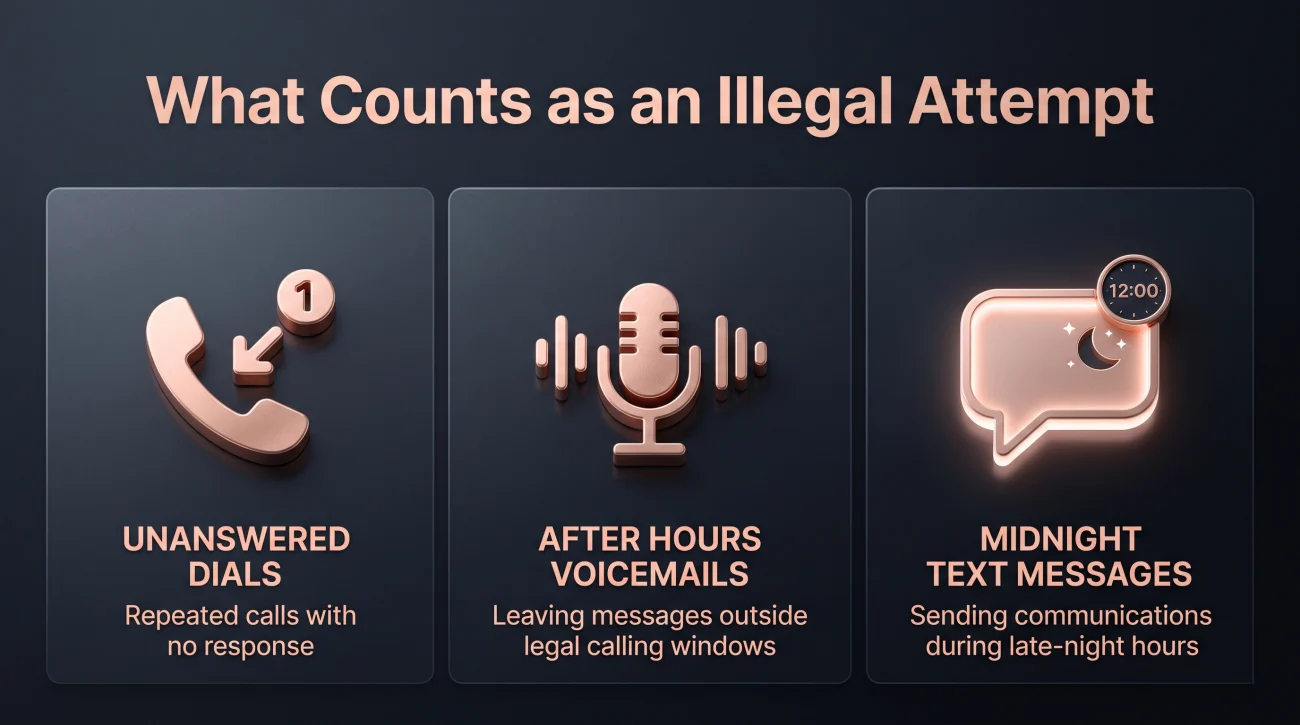
Many consumers mistakenly believe that a violation only occurs if they actually pick up the phone and speak to an agent. This is absolutely false. The law regulates the attempt to communicate, not just successful conversations.
- Missed calls: If your phone rings at 10:00 p.m. and you do not answer, the collector has still violated the law. The intrusion happened the moment they dialed.
- Voicemails: A recorded message left outside of permitted hours counts as a communication attempt. Furthermore, the content of that message is highly regulated. You can read more about what collectors are legally allowed to leave in a voicemail to check if they broke additional rules.
- Text messages and emails: The Consumer Financial Protection Bureau updated regulations in 2021 to apply these same timing presumptions to electronic communications. A text message sent at midnight is treated with the same legal scrutiny as a midnight phone call.
On the agency floor, we used automated predictive dialers. Sometimes, a poorly managed dialer system would fail to recognize a consumer’s area code shift after they moved across the country. The system would launch calls at 6:00 a.m. local time. Whether it was a machine error or human error, our compliance department treated it as a massive liability because the courts do not care why the call was made early, only that it happened.
How to Document Outside-Hours Calls
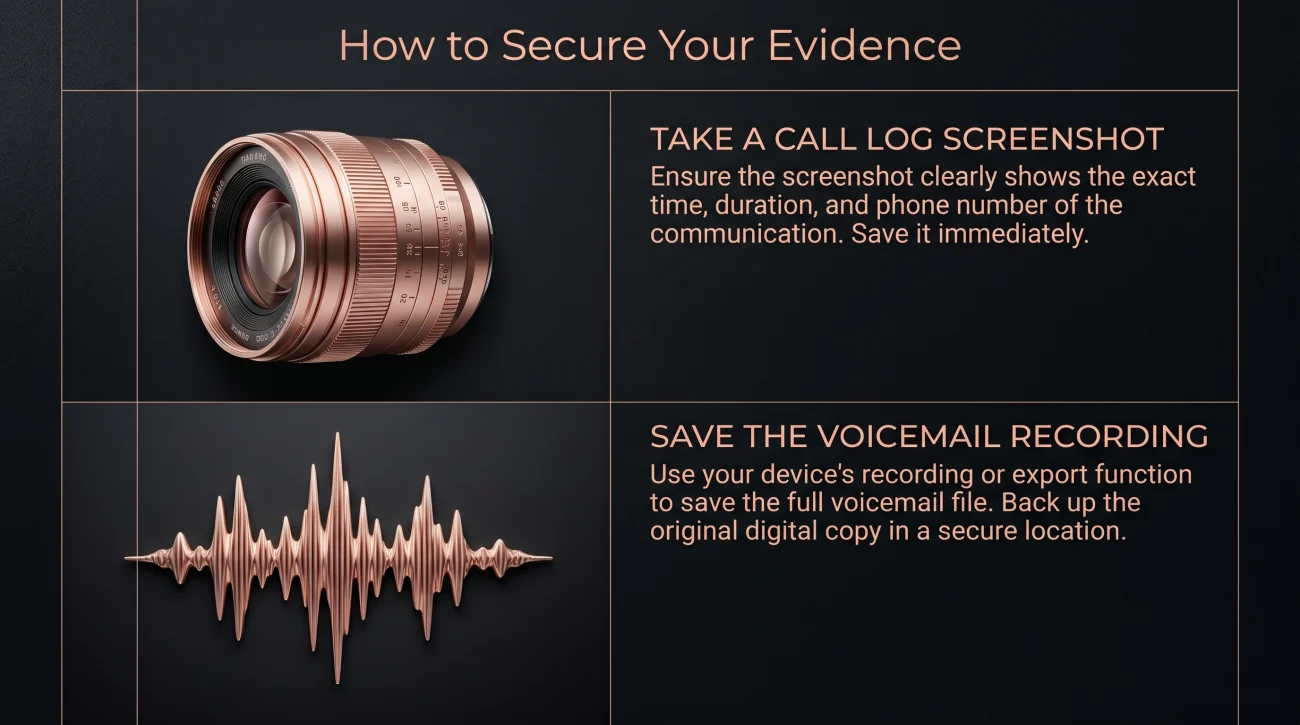
If you receive an early morning or late night call, your immediate priority should be securing evidence. Do not call the agency back to argue. A verbal debate does not help you. Documentation is the only thing that holds up if you need to escalate the issue.
I have seen cases immediately dismissed by compliance departments because the consumer only complained verbally that they were “called all the time.” Conversely, a simple, clear record forces the agency to take you seriously. Here is exactly what you need to capture:
- The call log screenshot: Capture the phone number, the date, and the exact time the call came in.
- The voicemail file: If they left a message, do not just leave it in your carrier’s voicemail box where it might automatically delete after 30 days. Forward the audio file to your email, or screen-record your phone while playing the message out loud.
This specific record is exactly what a regulatory agency or an attorney will ask for first.
What an After-Hours Violation is Worth
Under the FDCPA, you do not have to prove the collector intended to harass you by calling late. The law is black and white: if they dial outside the permitted window, they break the rule.
Each call made outside of allowed hours represents a separate violation. Consumers can be awarded statutory damages of up to $1,000 per lawsuit, in addition to actual damages and attorney fees. I have watched agency management scramble to settle accounts quietly the moment a consumer provided hard proof of a midnight call, simply to avoid paying the consumer’s attorney fees in court.
Because the law forces the collection agency to pay your legal costs if you win, many consumer protection attorneys will review these cases without charging you any upfront fees.
Immediate Next Steps: One Call vs. a Pattern
How you respond depends on whether this was an isolated incident or part of an ongoing campaign of aggressive contact. Knowing the boundaries of debt collector contact rules helps you determine your next move.
If It Happened Once
If this is the first time the collector has called outside of the legal window, document it immediately. You can choose to send a written request demanding they cease all communication. Sending a formal letter removes their ability to contact you legally by phone at any time of day. You can learn exactly how to format a cease and desist letter to ensure it is legally binding.
If It Is a Pattern
If you are receiving multiple calls early in the morning or late at night, the situation has escalated beyond a simple compliance mistake. If you are also dealing with excessive daytime contact, you should check our breakdown of how the seven call limit actually works.
A documented pattern of outside-hours calls gives you strong grounds to escalate. You can learn how this process works in our guide on how to properly report a debt collector.
Signs Your Situation is Ready for Legal Evaluation
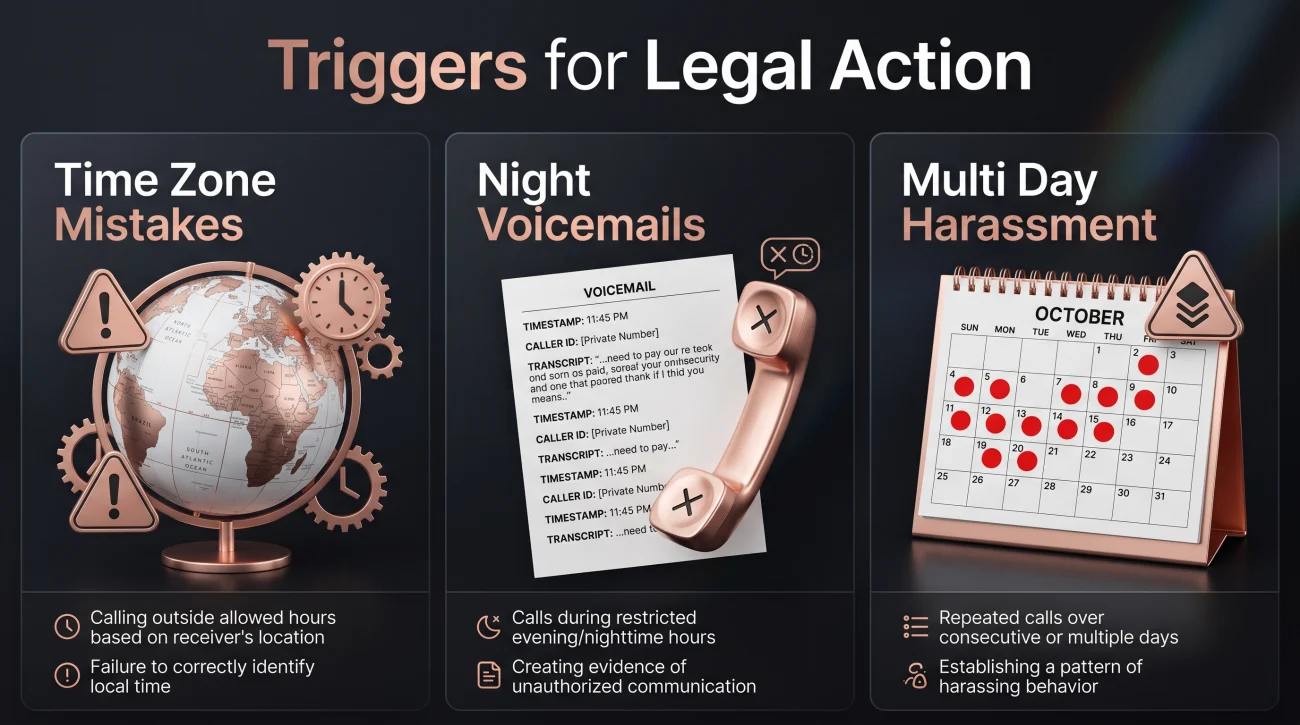
An illegal call is only useful if you can prove it happened. You likely have a strong, documentable violation ready for professional review if your situation matches any of these specific scenarios.
- 📌 The Area Code Trap: You moved across the country but kept your old cell phone number, and the collector is dialing based on the wrong time zone despite having your current mailing address.
- 📌 The Timestamped Voicemail: The collector left a voicemail at 10:15 p.m. where they identified themselves as a debt collector, giving you a perfectly documented, undeniable timeline.
- 📌 The Multi-Day Campaign: You have screenshots of your call log showing the exact same agency number dialing at 6:30 a.m. for three consecutive days.
If you have this level of proof, the next step is not just blocking the number. The next step is evaluating your legal leverage to hold the agency accountable.
Final Thoughts: Flipping the Leverage
A debt collector calling you outside of legal hours is attempting to exploit your exhaustion to force a payment. However, the moment that call hits your phone, they have unknowingly handed you a federal violation. By capturing the evidence and understanding your rights under the FDCPA, you instantly flip the leverage. You are no longer just a consumer being harassed; you are a consumer holding proof of illegal collection activity.
❓ FAQ
📝 What if I accidentally told them they could call me late?
If you explicitly gave the collector verbal or written permission to contact you after 9:00 p.m. (perhaps because of your work schedule), they are allowed to do so. However, you can revoke this consent at any time by simply telling them to stop calling outside standard hours.
✈️ What if I am traveling to a different time zone?
Collectors generally rely on your phone’s area code or your last known address to determine your time zone. If you are traveling or have moved but kept your old number, you must explicitly inform the collector of your current location to enforce the 8:00 a.m. to 9:00 p.m. rule for where you actually are.
📵 What happens if I send a cease and desist letter?
Once a collector receives your written cease and desist letter, they must stop calling you entirely. The law only allows them one final contact to confirm they are ending communication or to notify you of a specific legal action, such as a lawsuit.
🕵️♂️ What if they call from an unknown or blocked number at night?
It is very common for collectors to rotate caller IDs. If an unknown number calls late, let it go to voicemail. If they leave a message identifying themselves, you now have the timestamped proof you need. If they don’t leave a message, keep a log of the exact time the blocked calls occur to show a pattern of harassment.
👨👩👧 Can they call my family members early in the morning?
No. The 8:00 a.m. to 9:00 p.m. time restriction applies to any person a debt collector contacts regarding your debt, including family members they call attempting to locate you.
📑 Does a late call mean I don’t have to pay the debt?
No. An FDCPA violation gives you the right to sue the collection agency for their illegal behavior, but it does not erase the underlying debt you owe. The debt and the collector’s behavior are treated as two separate legal issues.
The full FDCPA framework and the four areas where it matters most.
- Your legal rights when collectors call, write, or threaten to sue
- When they can call, what they cannot say, and how to make it stop
- How to identify FDCPA violations and what you can do with them
- Why the age of a debt determines what a collector can legally do
- Your right to demand proof before paying or acknowledging anything
Harassment is one thing. Lawsuits, garnishments, and frozen accounts are another.
- When collector behavior crosses the line the FDCPA was written to prevent
- What to do if a collector files suit after their calls have not worked
- What collectors can do to your wages once a judgment is entered
- How a bank levy works and which funds the law protects from seizure
- How to resolve the debt that collectors have been calling about
Disclosure: The content on this site reflects direct experience inside the debt collection industry and is grounded in federal law and regulation. It is informational in nature. Reading it does not constitute legal advice and does not create any professional relationship. If you are dealing with a lawsuit, a judgment, or a legal deadline, consult a licensed attorney in your state before acting.