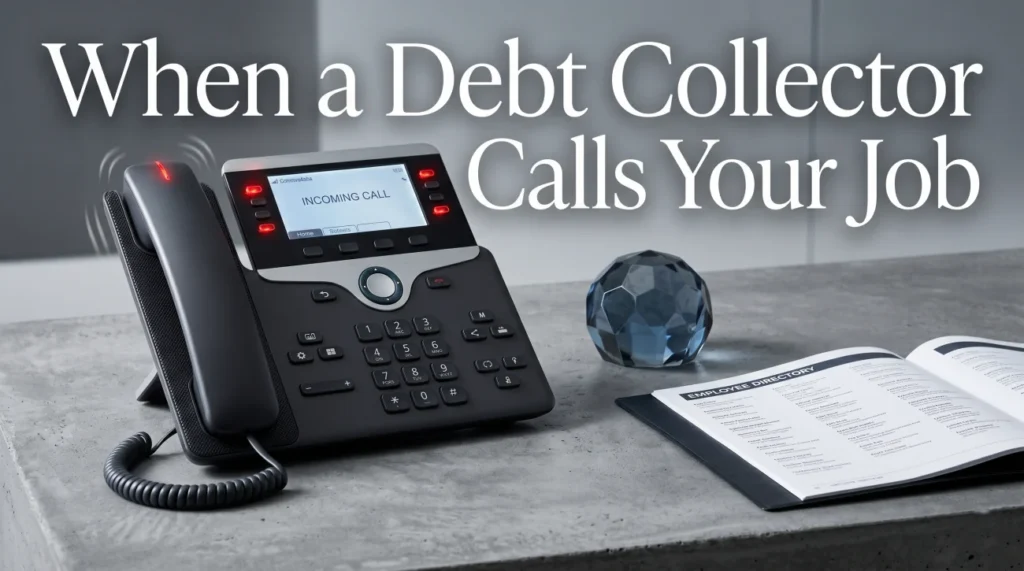
- Debt collectors do not call your employer just to pass along a message or find your cell phone number.
- Agencies use these calls under the guise of “location verification” to confirm you have an active paycheck worth garnishing.
- A confirmed employer updates the account’s priority status and often moves the file closer to a litigation review.
- You can stop these calls immediately by notifying the agency in writing that your employer prohibits personal calls during work hours.
The Queue Code: Why a Debt Collector Called My Employer
On the collection floor, not all data was treated equally. A disconnected phone number was an annoyance. A missing home address was a hurdle. But confirmed, active employer information? That changed the entire trajectory of an account. If a debt collector called my employer today, it usually isn’t because they lost my cell number; it is because they are moving toward the final phase of collection.
When a file had a confirmed employer attached to it, the system automatically assigned it a different queue code. It moved out of the standard call rotation and was placed on a faster track toward litigation review. Calling someone’s job was rarely a courtesy step to see if they were available to chat. For us, it was the final box to check before flagging a file as a prime judgment candidate.
Forty-Five Seconds With Human Resources
I was working a file for a woman in her mid-thirties. She had a $2,800 credit card balance and was roughly eleven months delinquent. A credit pull from three months prior listed a regional healthcare provider as her employer. I needed to know if she was still there.
I did not dial her direct extension. I dialed the main corporate number and asked the operator for Human Resources. When the HR representative picked up, I kept my tone professional, polite, and slightly urgent. I stated my name, mentioned I was trying to reach her regarding a personal business matter, and simply asked if she was still employed at that location.
The HR representative did not ask any questions. They checked their directory, confirmed she was an active employee, and offered to transfer me to her department.
I politely thanked them, declined the transfer, and hung up the phone.
I never spoke to the woman who owed the debt. I did not need to. In that 45-second call, I got exactly what I was looking for. I confirmed she was still working, which meant she was still bringing in a steady, predictable income. I opened her file, updated her employment status, and logged the interaction.
Officially, the system recorded the call as “location verification.” In practice, what I had just completed was asset confirmation. That distinction matters because it shapes exactly what comes next for the person on the other side of the account.
Understanding “What Happens When a Debt Collector Called My Employer”
Many people assume that a collector calls their boss because the agency somehow lost their cell phone number. That is almost never the case. We usually had your number. We called your job because we needed to know if suing you would actually result in a payout. If an agency already has your cell phone number and they are still dialing your employer’s HR department, they are not looking for you. They are confirming whether you have a paycheck worth garnishing.
There is a distinct difference between a file being worked by a regular floor collector hoping to squeeze out a quick voluntary payment, and a file being actively prepared for legal review. The employer call is often the bridge between the two. Once we verified active employment, the agency knew that if they decided to file a lawsuit and won a default judgment, there was a clear, documented path to seize a portion of those wages.
Final Thoughts: Shutting Down Workplace Calls
Under the Fair Debt Collection Practices Act, collectors are generally allowed to contact a third party, including your employer, exactly once for the strict purpose of verifying your location or employment status. They are strictly forbidden from disclosing that you owe a debt. If a collector tells your HR department why they are calling, or if they call your workplace multiple times, you need to know how to identify clear FDCPA violations.
You can stop these calls immediately without ever explaining your financial situation to your boss. You simply need to notify the collection agency in writing that your employer prohibits you from receiving personal communication during work hours. Once they receive that notice, continuing to call your job becomes illegal. If they ignore your written demand, you have strong grounds to hold the agency accountable for workplace harassment and file a formal complaint with the CFPB.
❓ FAQ
🏢 Can a debt collector legally call my employer?
Yes, but under very strict limits. Under federal law, a debt collector can usually only contact your employer once, and only to confirm your employment status or location. They cannot call repeatedly to harass you at work.
🗣️ Are they allowed to tell my boss about my debt?
No. It is a violation of the Fair Debt Collection Practices Act (FDCPA) for a debt collector to disclose to your employer, HR department, or coworkers that you owe a debt.
🚫 How do I stop a debt collector from calling my job?
You must notify the debt collector that your employer prohibits personal calls during work hours. It is best to do this in writing via certified mail. Once they know your employer does not allow these calls, they are legally required to stop.
🔁 Can they call my work more than once?
Generally, no. A collector can only call a third party once for location information unless you explicitly give them permission to call again, or if they have reasonable belief that the previous information they received was false.
☎️ What if they leave a voicemail on my work phone?
If a collector leaves a voicemail on a shared work phone or a system your employer can access, they cannot mention the debt. They can only leave their name and a callback number.
🕵️ How did the debt collector find out where I work?
Collectors use a variety of tools, including pulling your credit report, checking original loan applications, searching public records, and using advanced skip-tracing databases that aggregate your employment history.
⚖️ Can I be fired because a debt collector called my job?
While an employer cannot legally fire you for a single wage garnishment, having collectors repeatedly call your workplace can strain your relationship with your boss. This is why stopping the calls quickly is essential.
📝 What do I say if my HR department asks about the call?
Keep it brief and professional. You do not need to over-explain. Simply state that it is a private personal matter that you are actively handling, and request that HR not forward any future calls from that number.
💸 Does an employer call mean they are going to sue me?
Not necessarily, but it is a strong warning sign. Agencies often call to verify employment specifically to see if you have a steady paycheck that could be garnished if they decide to take you to court.
🛑 What if the collector keeps calling my work after I told them to stop?
If you have documented that your workplace prohibits these calls and the collector continues to dial your employer, they are violating federal law. You should log the calls and file a complaint with the Consumer Financial Protection Bureau (CFPB).
Four areas of the collection process. Start wherever your situation applies.
Some situations have deadlines attached. These pages are written for those situations.
- When collector behavior crosses the line the FDCPA was written to prevent
- What to do if a collector files suit after their calls have not worked
- What collectors can do to your wages once a judgment is entered
- How a bank levy works and which funds the law protects from seizure
- How to resolve the debt that collectors have been calling about
Disclosure: The content on this site reflects direct experience inside the debt collection industry and is grounded in federal law and regulation. It is informational in nature. Reading it does not constitute legal advice and does not create any professional relationship. If you are dealing with a lawsuit, a judgment, or a legal deadline, consult a licensed attorney in your state before acting.