- Most collectors are not villains; they are hourly workers motivated by leaders, metrics, and commissions. I started as a top-performer before the moral complexity became impossible to ignore.
- The industry relies on “information asymmetry,” a gap where we knew your full financial footprint while you were often unaware of your own legal leverage.
- Three factors changed my perspective: the realization that debt is bought for pennies, the “good faith” trap that resets legal clocks, and the fact that mass lawsuits are a revenue strategy, not a quest for justice.
- The decision to leave was an accumulation of specifics: seeing the math of the balance sheet collide with the reality of prescriptions being skipped to pay a collection agency.
- TheDebtFile.com exists to hand you the exact insider playbook I once used to collect from you, leveling the playing field once and for all.
I Did Not Fall Into Debt Collection: I Chose It
I remember the phone call that started it all. I was twenty-three, working in customer service for a regional bank, frustrated by the low pay and the repetitive nature of answering questions about overdraft fees. A recruiter called about a “consumer financial services” position. The pay was 40% higher than what I was making. The benefits were better. The job description talked about “account resolution” and “consumer outreach.”
I didn’t realize until my first day of training that I had walked onto a debt collection floor. But at the time, that didn’t bother me. Account resolution is exactly what we did, at least in the official sense. We were taught that we were helping people “clean up their past” and “regain their financial future.” It was a persuasive narrative, and for someone young and hungry for professional success, it was easy to believe.
I spent seven years inside that world. I worked for three different agencies, ranging from a massive national participant to a ten-person “bucket shop” where compliance was a binder on a shelf that only came out for license renewals. I didn’t leave because I was bad at the job. In fact, I made Collector of the Month three times in eighteen months. I left because I eventually learned things that I couldn’t unlearn.
“The first year felt satisfying. There is a specific dopamine hit in finding someone who has been avoiding a debt and getting them to commit to a payment. The leaderboard, the commissions, the high-fives from managers: they create a motivational environment that can make you forget there is a human being on the other end of the line.”
If you are receiving calls right now, you aren’t just dealing with a person. You are dealing with an entire psychological and economic machine. To understand how to win, you have to understand why I eventually decided to stop pulling the levers of that machine.
The Quiet Tension of the “Hardship Checkbox”
Most consumers assume the collector on the phone is angry or malicious. In reality, most collectors are just tired. They are following specifically designed call scripts and industry contact metrics designed to pivot around every objection you raise. Over time, you develop a protective layer of cynicism.
I used to spend eight hours a day in a high-intensity environment where the “enemy” was a consumer who was usually broke, scared, and confused. The real danger of the industry isn’t overt cruelty; it’s the fact that it turns human empathy into a checkbox. When someone told me they couldn’t pay because their child was sick or they had lost their job, my training didn’t teach me to feel bad. It taught me to validate, then pivot.
“I understand that is difficult,” I would say, checking the ‘hardship’ box on my screen. “But we need to see what we can do to resolve this today so it doesn’t move to the next level.” I would document the call for follow-up in thirty days and move to the next dial. I wasn’t hearing the person; I was managing a workflow. But as I moved higher into the management and litigation side of the business, I started seeing the raw economics behind those checkboxes, and the cynicism began to crack.
Unlearnable Fact #1: The Arbitrage of Fear
The first thing that broke the narrative for me was learning what debt buyers actually paid for the accounts I was working. We were trained to talk about “collecting what is owed,” which sounds very principled until you see the actual balance sheets of a debt buyer.
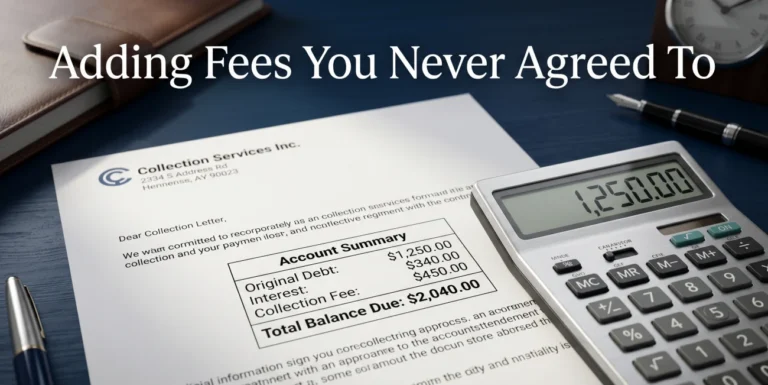
In many of the portfolios I worked, the accounts were purchased for as little as four cents on the dollar. That means for every $1,000 of debt, the buyer paid roughly $40. If I could get a consumer to pay even 10% of their balance, the company had already more than doubled its investment. The rest was pure profit. Knowing that a debt buyer paid $90 for an $1,800 account fundamentally changed what “collecting what’s owed” meant to me.
* Original Balance: $2,500
* Debt Buyer Purchase Price (4%): $100
* Collector’s Goal: Settlement for $1,250 (50%)
* Result: $1,150 profit on a $100 investment
When I realized that industry data reflects massive profits built on these tiny purchase prices, the “moral obligation” I was selling on the phone felt like a lie. It wasn’t about the original contract; it was a commercial transaction where the collector has a massive profit margin to play with, while the consumer is struggling to buy groceries.
Unlearnable Fact #2: The “Good Faith” Legal Trap
The second thing I couldn’t unlearn was the mechanism behind the “good faith payment.” This is one of the most effective tools in a collector’s arsenal, and I used it for two years before I truly understood the legal weight of it. In training, we were taught to ask for a small payment, even $20, if the consumer couldn’t pay the full amount.
We called it a “good faith gesture” to show cooperation. It sounds reasonable, but in most states, that tiny payment is a legal reset button. It restarts the statute of limitations. I saw accounts that were five years old, nearing the point where they would be legally uncollectible, suddenly get “refreshed” for another six years because the consumer made a $10 payment to “stop the calls.”
I realized I was using language that sounded like helpful advice but was actually a legal trap. I wasn’t helping them “cooperate”; I was resetting their vulnerability clock. Once I understood how this interplayed with federal credit reporting rules, I couldn’t keep using that script with a clean conscience. This is the exact trap I described in the story of Margaret.
But restarting the legal clock on an old account wasn’t just about keeping the file active on my desk; it was about prepping the file for the most aggressive phase of the business: the mass-filing litigation machine.
Unlearnable Fact #3: Litigation as an Arithmetic Problem
When I moved into a role reviewing accounts for litigation, I saw the most cold-blooded part of the business. We didn’t evaluate cases based on who was “right.” We evaluated them based on a scoring model that prioritized “judgment candidates.”
A “judgment candidate” was anyone who had a stable job (documented via credit pulls) or owned a home. These were the high-value targets because they had assets we could seize or wages we could garnish. Conversely, we ignored the “judgment proof”: the elderly on Social Security or the chronically unemployed, because there was no point in spending the filing fee. We weren’t seeking justice; we were seeking a clear path to a bank account.
Mass-filing firms rely on the fact that 70% to 80% of consumers never show up in court. Filing a hundred cases and expecting eighty defaults is not a legal strategy; it is a revenue strategy. The court system was being used as an automated billing machine. When you understand that federal and state laws and federal compliance rules are only effective if you show up to use them, you see why the industry thrives on consumer silence.
The Call That Ended My Career
The “parking lot moment” for me wasn’t a vague feeling of sadness; it was a specific call on a rainy Tuesday evening. The file was a “high-priority” medical debt. Her name was Mrs. Miller, a 64-year-old widow who owed $3,400 for a hospital stay following a mild heart attack. She wasn’t avoiding the debt. She was trying to pay it $10 at a time.
She told me that her grandson was living with her and that she had started cutting her own blood pressure medication in half to afford the $10 “good faith payments” I had been requesting. I looked at her account history. Every single $10 payment she made was being swallowed by interest and fees. Her balance was actually increasing every month. My “helpful” advice was literally making her sicker while doing nothing to resolve the debt.
The thought of that young boy watching his grandmother skip her heart medication because of a ten dollar payment I was assigned to squeeze was what finally broke my professional shell. I didn’t argue with her. I didn’t pivot. I sat in silence for a long time, then told her something my supervisor would have fired me for: “Mrs. Miller, do not send us another ten dollars. Instead, I want you to write a letter asking us to verify this debt and to only contact you in writing.”
That night, I sat in the parking lot of a Walgreens for thirty minutes, staring at the store where she probably bought those medications. I realized I was spending my life building a leaderboard of other people’s failures. I wasn’t “resolving accounts.” I was extracting capital from the most vulnerable using a machine I no longer believed in. I stayed for a while longer to help a few more “Mrs. Millers” before walking out for good.
Final Thoughts: Reversing the Information Flow
The imbalance of power in debt collection is entirely by design. The collector on the other end of the line has a screen full of your data, your employer’s address, and a script designed to manipulate your sense of duty. You have an incoming call you were not prepared for and a stomach full of knots.
The reason I founded TheDebtFile.com is to reverse that flow of information. I want you to have the same “field notes” that I had. I want you to know the purchase price of the debt and the reality of the court docket. I am not a lawyer, and I am not writing this to condemn every individual in the industry. But I know how the floor works, and that knowledge belongs on the consumer side.
You do not have to be a legal expert to defend yourself. You just have to be willing to demand documentation, show up when required, and refuse to make decisions based on artificial urgency. The leverage is there; you just have to know how to reach for it. Nothing here is legal advice, but it is the truth from the other side of the desk.
❓ FAQ
💼 Are all debt collectors as manipulative as the ones described?
No. There is a wide range of professionalism. Larger agencies often have strict compliance monitoring. Smaller “bucket shops,” however, operate with much less oversight, which often leads to the more aggressive and ethically questionable tactics I witnessed.
📉 Do collectors really buy debt for pennies?
Yes. Bulk portfolios of older debt are commonly sold for 4 to 10 cents on the dollar. This is why settlements of 30-50% are so common: the buyer still makes a massive profit even after cutting the balance in half.
🛑 Can I really just tell a collector to only contact me in writing?
Yes. Under federal law, if you notify a collector in writing that you want them to stop calling you or only communicate via mail, they must comply. This ends the psychological pressure of the phone call and puts everything on a paper trail.
🤐 Should I tell the collector why I can’t pay?
Generally, no. Collectors are trained to use your hardship details as a “map” to find other payment sources. If you mention medical bills, they may ask about your tax refund or assets. Keep the conversation focused strictly on the documentation and the debt’s validity.
⏰ Does the “good faith payment” really restart the legal clock?
In many states, yes. Making any payment, no matter how small, can be viewed as an “acknowledgment of the debt,” which resets the statute of limitations and gives the collector a brand-new window to sue you.
🏢 Do collectors check my social media?
They don’t usually scroll for fun, but commercial skip tracing tools like LexisNexis index public social media data. If your profile publicly lists your employer, it is flagged in the collector’s database as a potential garnishment target.
⚖️ What happens if I show up to the court hearing?
You change the math. Debt buyer law firms rely on default judgments. If you show up and demand proof of the “chain of title,” they often have to evaluate whether it’s worth the cost of litigation. Many cases are dismissed just because the consumer appeared.
😱 Why do collectors call my family members?
They use skip tracing tools to find “relatives and associates.” While they cannot discuss the debt with them, they can call to ask for your location. It is a tactic designed to use social pressure to get you to call them back.
💸 Can a collector see my bank account balance?
No. They cannot see your live balance without a court order or judgment. However, if you have ever paid them via check, they have your routing and account number on file, which they will use immediately if they get a garnishment order.
🚪 Is it true that debt collectors can come to my house?
For standard consumer debt, this is extremely rare and usually not cost-effective. If someone shows up at your door, they are likely a process server delivering legal papers for a lawsuit, not a collector asking for cash.
References
Four areas of the collection process. Start wherever your situation applies.
Some situations have deadlines attached. These pages are written for those situations.
- When collector behavior crosses the line the FDCPA was written to prevent
- What to do if a collector files suit after their calls have not worked
- What collectors can do to your wages once a judgment is entered
- How a bank levy works and which funds the law protects from seizure
- How to resolve the debt that collectors have been calling about
Disclosure: The content on this site reflects direct experience inside the debt collection industry and is grounded in federal law and regulation. It is informational in nature. Reading it does not constitute legal advice and does not create any professional relationship. If you are dealing with a lawsuit, a judgment, or a legal deadline, consult a licensed attorney in your state before acting.